

synagogue Synagogue
Synagogue in the village Stupava in the Bratislava region is an orthodox church from 1803. These are one of two well-preserved examples of the nine archeological type of synagogues in Slovakia.
The Jewish religious community in Stupava was founded in the 17th century when the Jews settled on the lands of the Hungarian noble family Pálffy. The existence of the community is evidenced by a tombstone at the local cemetery of 1642. In 1800 the village organized a collection for the construction of the synagogue. Part of the community contributed to the construction by physical work. In 1828 the community was 819 members, representing about a quarter of the 3 374 inhabitants of the village. The Jewish community in Stupava administered a school that was also attended by children from Christian families.
The building is made in the style of classicism. Its architecture is based on the designs of 17th century Polish synagogues, namely the Livov suburban synagogue. The 17 x 23.5 m building has massive walls, small Baroque windows, a gable roof and a shield with oval holes for ventilation. Prayer hall is divided into twelve parts by four columns, which support a nine - vaulted ceiling. These columns bordered the centrally placed bimu for reading from sacred books. In front of the building there is a glazed altar. Paints in cobalt and dark red are preserved on walls and vaults.
After prosperity in the 19th century, the number of members of the community declined due to the departure of young people to Bratislava and Vienna. In 1940, the village had 191 members, most of whom died during the Holocaust. Currently, the Jewish religious community in Stupava is no longer active. In the period of socialism, tiles were sanded in the building, leaving red marks on the stones.
Synagogue is registered The landmark office of the Slovak Republic under number ÚZPF 10004. The exterior renovation and static security were completed in 2008 thanks to the initiative of Jewrope. Reconstruction works are ongoing in the interior. The cracks, unscathed places and damaged paintings were left. The building will serve as a central archive and book depository of the Slovak Jewish community. A permanent exhibition of Judaics and Archivals is planned at the women's gallery.
The building is located in the center of the village opposite the Palffy mansion. Visit to the synagogue and Jewish cemetery on the street At Bornik, he documents the history of this community in Stupava.
Tehdy a dnes
Drag the slider and compare how the monument might have looked when it was built with the view today.
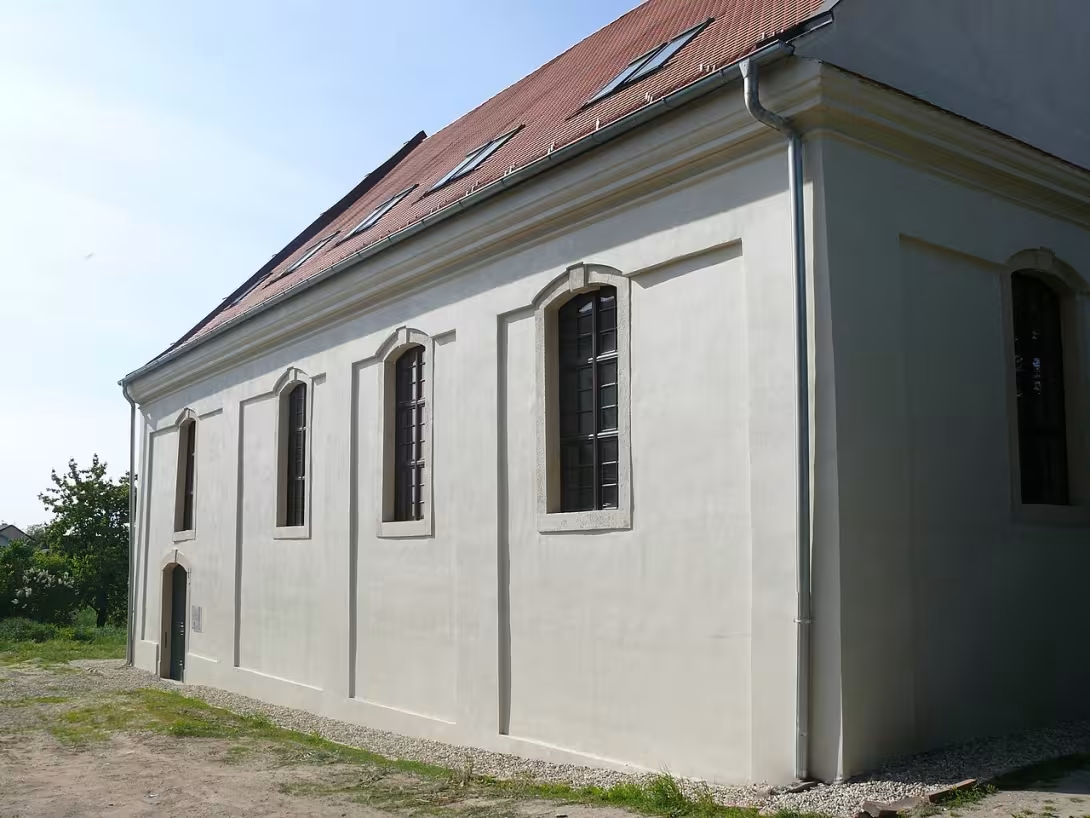
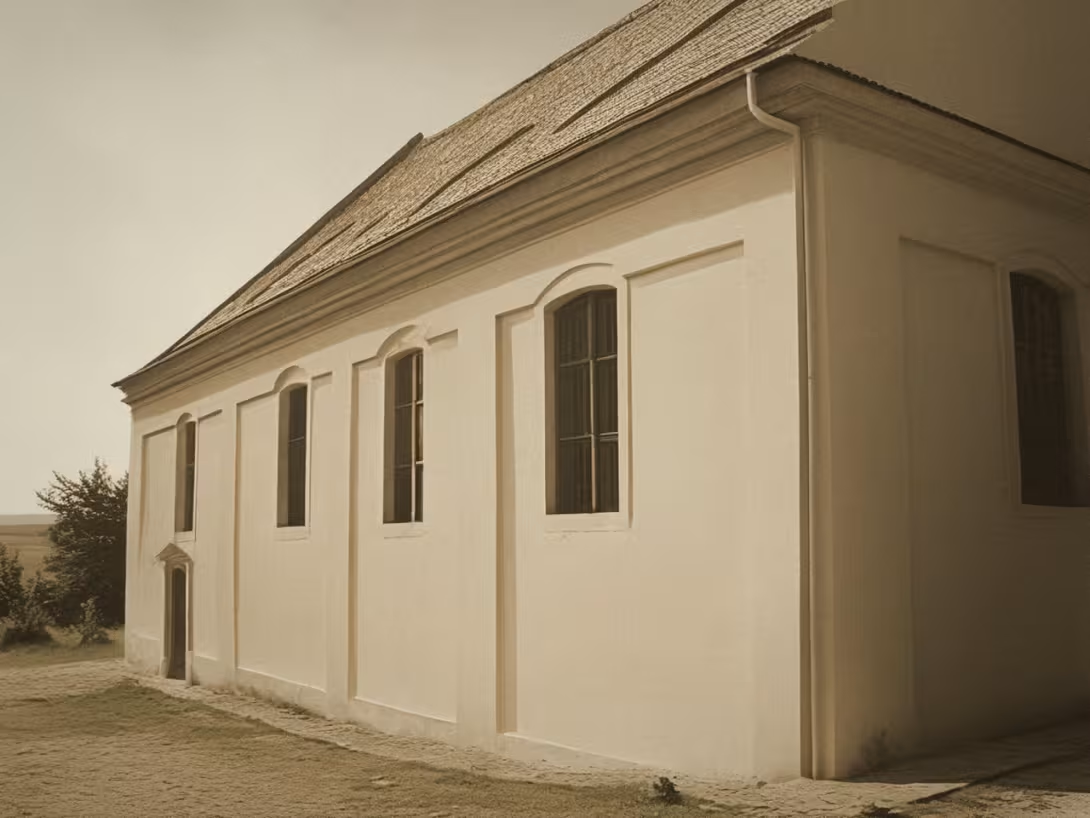
The historical view on the left is a visualisation generated by artificial intelligence and serves as inspiration.
Historical Milestones
- 1800
- organizing a collection for the construction of the synagogue by the jewish community
- 1803
- construction of the synagogue
- 2008
- completion of the restoration of the exterior and the static security of the object
Interesting facts
- It is an Orthodox church from 1803 and one of two well-preserved examples of nine archeological types of synagogues in Slovakia. - The architecture of the building in the style of classicism is based on the designs of Polish synagogues from the 17th century, namely the Livov suburban synagogue. - The prayer hall is divided into twelve parts by four columns and on the walls and vaults are preserved paintings in cobalt and dark red. - In the period of socialism, tiles were sanded in the building, leaving red marks on the stones. - The building will serve as a central archive and repository
Guide
Show guide text
The text was prepared by artificial intelligence and has not been editorially reviewed. It may contain inaccuracies.
We welcome you to Stupava, a city rich in history, where you will come to one of the most important sights of this village today. You are standing right in front of the Synagogue building, an object that bears in itself traces of faith, community and architectural heritage that has survived over two centuries. Now, when you look at the building in front of you, see its peaceful atmosphere and majesty, which is still coming out of its walls, although time and history have left its mark on it. Now let's rush into the past to understand how this temple was built. Everything began at the turn of the century, namely in the year thousand eight hundred, when the Jewish community in Stupava decided to build its own place for prayer and spiritual life. At that time, a collection began to be organised because the construction of such an important object required not only financial resources but also deep solidarity from the whole community. This joint effort brought fruit very quickly, and already in a thousand eight hundred and three the construction of the synagogue was successfully completed. A building was thus created to serve as a center for the religious and social life of Jewish inhabitants in the area. Now that you are right in front of the object, pay attention to its overall appearance. Although we do not know exactly who the architects who designed the project, it is clear that they were oriented in the style of classicism. Note the cleanliness of the lines and the balance of the overall operation of the building. Classicism then sought inspiration in the antiquity and looked to harmony and simplicity, which is visible even when looking at the facade in front of you. However, if we look deeper at the origin of this architecture, we will come across a very interesting detail. The building is not only a local product, but it is based on models that were widely distributed at that time. In particular, it is an inspiration from the Polish synagogues of the seventeenth century. If you were to travel deep into Eastern Europe, you would find that this type of construction resembles mostly the Livov suburban synagogue. It is fascinating to imagine how architectural ideas have moved across the borders of countries and states to shape the form of buildings in small Slovak towns. Now let's move our attention to what's behind the walls. Although we are now focusing on the exterior, it is important to know that it is an Orthodox temple. One of the most precious elements of this building is its interior construction. Synagogue in Stupava represents one of only two well-preserved examples of the nine archeological type of synagogues throughout Slovakia. Imagine this spatial piece and the complexity that this type of building offers. Another important detail is the prayer hall, which is divided into twelve parts. This precise division of space testifies to the ritual and functional need of the inside of the temple, where each part had its designated place and meaning. If we look for the specific names of the personalities associated with this place, history does not tell us in this case, but the building itself witnesss the stories of thousands of nameless people. They were merchants, craftsmen, and families who sought comfort, pray, and maintain their traditions in these rooms. Each stone of this building thus bears a silent story about the perseverance and identity of the community that worked in Stupava. You may now wonder what state the building is in, and why it looks what it looks like. The synagogue has undergone an important process of renewal in recent years. In the year two thousand eight was completed monument restoration exterior. In the framework of these works, the appearance of the building from outside was not only adjusted, but mainly carried out static security of the building. This was essential for this precious monument to be preserved for future generations and to prevent its further decay. It is thanks to these interventions that we can certainly stand in front of a building that is stable and still represents its original size. It is truly fascinating when we realize that there is a building in front of us that is so unique throughout Slovakia. The fact that only two examples of the nine - vaulted type have been preserved makes this synagogue a jewel of our cultural landscape. It is a place where Polish architectural tradition meets the local context and where classicalism creates a framework for the spiritual center of the Orthodox community. Now that you have looked at the main features of this monument and you have learned about its origin and architectural rareness, we recommend that you spend a little more time on your own observation. Go around the building, see its proportions, and think about how many generations of people have passed through her door. The synagogue in Stupava is not only a building from bricks and mortar, but it is a symbol of the plurality and history of our region. Thank you for taking this short tour with us. We hope that this information has enriched you and helped you to better understand the meaning of this place. Now we're going to lead you to another look at the beauty of Stupava and its surroundings. May the way continue with peace and new knowledge. Make yourself happy and maybe we'll meet again here.
Tips for visitors
The construction is recommended to visit in spring or autumn, when temperatures allow detailed observation of the exterior.
We recommend comfortable shoes and water. Since it is a sacral building, dress appropriately.
Details of the facade and architecture are interesting for photographers. The best light for exterior shots is during the golden hour of the sun shortly before the sun flood, when the building takes a warm tone.
Families with children can connect the visit with a walk around the village.
Frequently asked questions
Can the monument be visited?
Religious buildings are usually open mainly during services; at other times a visit is normally arranged with the parish or the operator. We have not verified specific times.
Where is the monument?
Location: Nám. M. R. Štefánika 1614/8, Stupava, Bratislavský kraj. The map on this page shows the exact spot.
Why is the monument protected?
It is listed in the Central List of the Monuments Fund of the Slovak Republic as a national cultural monument (ÚZPF no. 106-10004).
For children
Close your eyes for a while and imagine you're moving on with time. Can you feel the wind? It's 1803. It's 223 years ago! There are no cars, no smartphones or asphalt roads around you. We're in Stupava, where the air smells like smoke from fireplaces and hears only the weight of horses and the noise of local sweats. There's something special coming up right now.
Nearby
🏰 Historic sites (440)
- Milan Rastislav Štefánik 0.1 km
- sv. Ján Nepomucký 0.1 km
- Padlým hrdinom v 1. svetovej vojne 0.1 km
- Trojičný stĺp 0.2 km web
- Ohradenie kostola 0.2 km
- Pieta 0.2 km
- Kaštieľ Stupava 0.2 km Hlavná 380/13 web
- Ignác Juračka 0.2 km
- Ignác Gond 0.2 km
- sv. Florián 0.3 km
- Múzeum Ferdiša Kostku 0.5 km
- Rímsky vojenský tábor 0.6 km
- Ježiš Kristus 0.8 km
- sv. Jozef 0.9 km
- Panna Mária 0.9 km
- sv. Anna a Panna Mária 0.9 km web
- Hrdinom 1. svetovej vojny 0.9 km
- Trojičný stĺp 0.9 km
- Mariánsky stĺp 1.7 km
- sv. Ján Nepomucký 1.7 km
🍽️ Restaurants and dining (824)
- Haki Kebap 0.1 km +421 911 707 739 web
- Dartagnan - Srdiečko 0.1 km
- Milica 0.2 km
- Pizzeria U Samira 0.2 km web
- Zmrzlina Dubrovnik 0.2 km
- U Melónka 0.2 km +421 903 249 636
- U holuba 0.2 km
- Cukráreň 0.3 km
- Inga's Cookies 0.3 km
- Kaviareň Kultúrka 0.3 km web
- Cukráreň Maj-Pet 0.4 km
- Arkady Hof Restaurant 0.5 km web
- Restauracia Skala 0.5 km web
- ilGaleone 0.5 km +421 2 4444 2029 web
- Stupavská krčma 0.5 km Ferdiša Kostku 67/2
- Brioška 0.6 km
- Ristorante Pizzeria Da Mario e Nicola 0.6 km +421 948 735 705 web
- Pohostinstvo Maroš 0.7 km
- Šenk Mlyn 0.7 km
- Makovice 0.8 km Park 1987/3
🏨 Accommodation (110)
- Hotel Eminent 0.2 km Hlavná 575/19 +421 915 884 415 web
- Penzión u Maxa 0.2 km
- Arkady Hof Hotel 0.4 km web
- Ubytovňa Stupava 0.8 km +421 903 446 446
- Penzión Privát 1.3 km web
- Inter Sport Hotel 1.3 km web
- Park Hotel Intenzíva 1.5 km Nová 1555/66
- Pútnický mlyn 3.6 km Námestie 4. apríla 61/1
- Villa Ivica 3.6 km +421 902 22 33 22 web
- Hotel Carpatia 3.9 km +421 904 206 666 web
- Chata pod Vrchom 4.4 km web
- Thorin 5.7 km +421 2 64 776 515 web
- Boutique Hotel Pri Mlyne 6.4 km +421 252 623 593 web
- Karpatský dvor 6.6 km +421 2 659 68 124 web
- FÉNIX Lozorno 6.9 km Gozovská 1223/42A +421 910 898 333 web
- WX Hotel 7.2 km Opletalova 6314/1A +421 948 946 835 web
- Chata Cementárka 7.4 km +421 911 444 563 web
- Domček vo výške – Kačín 7.5 km web
- Domček na dube – Kačín 7.5 km web
- Optimum Devínska 8.1 km Vápenka 7514/24 +421 940 626 096 web
🚲 Rentals and sport (187)
- Koliesko 0.1 km +421 903 743 881 web
- Športová hala 0.7 km Školská 3024/2B
- Bajkservis 1.5 km +421 903 760 537 web
- Paintball Záhorská 3.6 km Československých tankistov 1B web
- Fitness Club Lochness 3.8 km
- Medené Hamre 6.5 km
- Kellys Factory Store 6.8 km web
- Movement institute 6.8 km web
- Cube Store 7.3 km
- Endorphin Republic 7.5 km
- Decathlon 7.5 km web
- Intersport 7.5 km
- Sport Vision 7.6 km
- Club Penati 8.0 km +421 2 6920 3611 web
- Ekocentrum a Turistická informačná kancelária 8.2 km +421 2 64 77 02 60 web
- cshop.sk 8.2 km web
- Bike King 8.4 km
- Plavecká akadémia 8.4 km web
- Športová hala Lamač 8.4 km
- nextbike Marchegg Bahnhof 8.8 km web
🥾 Hiking and nature (472)
- Kaštieľsky park 0.3 km
- Šibeničný vŕšok 0.7 km
- Park pri Mlyne 0.7 km
- Vrchná hora 1.9 km
- Kamenný vŕšok 2.9 km
- Farský park 3.6 km
- Ľudový dom 3.6 km Námestie sv. Floriána 7112 web
- Salaš Príroda 3.6 km web
- Park na Bratislavskej ulici 3.9 km
- Kráľovská studnička 3.9 km
- Zákopy z 2. svetovej vojny 4.0 km
- Svätá studňa 4.0 km
- Artézska studňa 4.1 km
- Dúbrava 4.4 km
- Mangánová studnička 4.5 km
- Bazgovič 4.6 km
- Záhoračka 4.6 km
- Vápenný prameň 4.6 km
- Ohek 4.8 km
- Kozlisko 4.8 km
Thematic route
The proposed thematic route in the area of the memorial:
1. Synagogue - tour of architecture and interior of the building. 2. Exposition - an overview of the history and culture of the local Jewish community. 3. Courtyard - outdoor space near the building for rest.
Seasonal recommendations
In spring, the surroundings of the synagogue of St. Pleasant temperatures and spring light are suitable for photography the exterior of this historic building. It is recommended to wear comfortable shoes and choose the morning time.
Summer season brings intense sunlight, which highlights the details of the architecture and color of the facade. Thanks to long days, you can also visit the parrot late in the evening. It is advisable to avoid the midday glow, wear lightweight clothing and use sun protection.
Autumn in the Bratislava region is characterized by golden tones of leaves. During this period, the synagogue operates mainly in fog or October light. It is practical to choose layered clothes and visit the site in earlier hours.
Winter construction surrounds silence. If snow falls, the building gets a look that contrasts with the surrounding environment. When visiting you need to dress in warm layers and tight shoes. A good time is before the holidays, when there is less rush around.
Visualisations and artistic views


The visualisations are generated by artificial intelligence and serve as inspiration.
Photographs from the area
Real photos taken near the monument

Source and licence are given for each image.
Visitor Tips
No tips yet. Be the first!
Log in and add your tip.
Location on Map


Visitor photos
No photos yet. Be the first to add a photo from your visit!
Log in and add your photo or leave a rating.
You get more points for a visit verified in the app — we can tell from the GPS that you are there.
Reviews and comments