








meštiansky dom Burgher house
Slovak Cultural Monument - Town House
The townhouse is a typical urban residential building, which was built in the 15th century.
During the Middle Ages, wooden houses were built, especially at solvent owners. The types of houses were influenced by the material, the way of heating, the solvency of the owner and the way of defense.
The chamber house had a simple longitudinal floor plan. The facade was situated front room, the court-oriented chamber and between them in the middle part was located black kitchen.
The house with passage was extremely well functionally usable and for a very long period became the most frequent layout type of the city residential building.
In the 17th and especially in the 18th century there was an increased interest of nobility in the city, which related to its functions in the county or military administration. The nobles bought houses next to each other and rebuilt them into representative houses.
In the 19th century, the city population grew. Residential rental houses ensured a much higher population density.
Pavlačové houses were characterized by a closed layout of a four-winged block with a central courtyard. Common sanitation facilities were located at the end of the pail.
Houses of poverty, iron houses were on the outskirts of the city, often forming part of the walls. They represented the existential minimum.
The function of housing remained in originally residential burgher houses until today, only the requirements of the standard of housing changed.
Examples of burgher houses are the city house of Andrej Kmeťa Street 5, Banská Štiavnica and others.
The complex registers the Monument Office of the Slovak Republic under number ÚZPF 1354 and consists of 1 object: 1354/1 - House burgher (pass, row, Renaissance, 15. st.).
Article structure:
1. Introduction 2. Background and historical context 3. Architecture and creation 4. Owners, administrators, fates 5. Key events and attractions 6. Today - current state and accessibility
Sources:
* Authors' collective: Presentation of architectural heritage II., Bratislava, Perfect 2008. * Dvořáková, V.-Kollár, D.: Cultural beauties of Slovakia, Most Beautiful Cities, Bratislava, Dajama 2007. * Botecký, A.-Kvasniová, M.: Architectural and Historical Research, Bratislava, 2009. * http://www.horehronskemuzeum.sk/burghiansky-dom * http://www.nitra.sk/?id menu=3844&limited level=1&stop menu=33881
Tehdy a dnes
Drag the slider and compare how the monument might have looked when it was built with the view today.
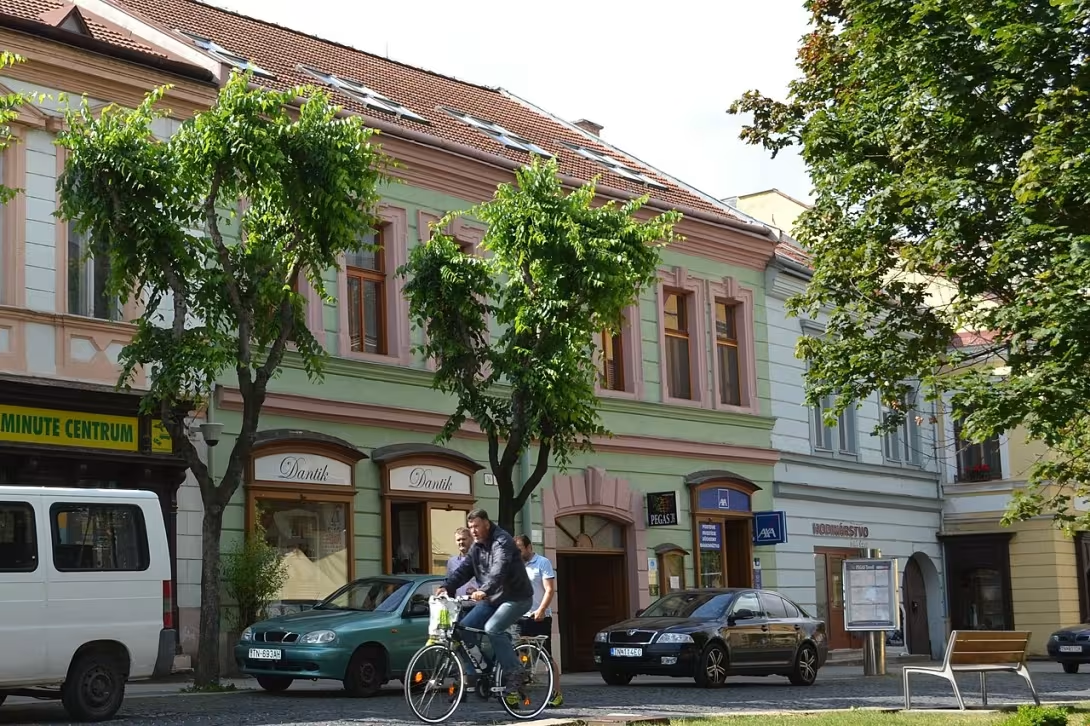

The historical view on the left is a visualisation generated by artificial intelligence and serves as inspiration.
Historical Milestones
- 15
- The status of the townhouse
- 17
- The nobles bought houses and rebuilt them into representative offices
- 18
- The nobles bought houses and rebuilt them into representative offices
- 19
- Urban population increased
Restoration history
| Years | Type | Extent | Condition after restoration |
|---|---|---|---|
| 2011 |
Obnova
meštiansky dom |
Čiastočná | narušený |
Source: Monuments Board of the Slovak Republic — open data, licence CC BY 4.0
Interesting facts
No interesting things. The text contains historical information about the burgher's house, but no amazing facts are given.
Guide
Show guide text
The text was prepared by artificial intelligence and has not been editorially reviewed. It may contain inaccuracies.
Welcome to Trencin, a city with a rich history where every stone and every street tells their own story. Right now, you're standing in front of one of the silent witnesses of ancient times, the burgher's house. When you look at it, you may at the first moment see only one of the many historical buildings that make up the city's character, but if you stop and think about it further, you will begin to perceive the layers of time stored in these walls for centuries. This house is not only a building of stone and wood, it is a mirror of social changes that have passed through Trenčín from the later Middle Ages to the period of modern urban growth.
Let us now go back together in time to understand how this house was created and what its original meaning was. Our journey begins in the fifteenth century. Imagine Trenčín at this time as a throbbing business center where merchants, craftsmen, and locals met. It was during this period that this townhouse was built. It was a typical construction for the then rising layer of townspeople. The townspeople were people who built the economic power of the city with their labor and business purpose. The house in the 15th century served not only as a place of housing, but also often connected commercial premises, storage parts and workshops. It was a symbol of the stability, prosperity and the rights that the townspeople fought for in the city government. Now, when you look at the building, try to imagine the noise, the smell of goods, and the noise that surrounded these walls in the 15th century.
However, time is passing, and with it, priorities and power conditions in the city have changed. When we reach the seventeenth and then the eightth century, the Witnesses in these walls changed. An interesting transformation began during this period in Trenčín. The nobleman, who has so far primarily resigned from her bosses outside the cities, began to show interest in urban property. The noble families gradually bought houses from townspeople. Why did they do that? Town centre Trencin gave them not only a strategic advantage but above all a social prestige. These houses were no longer just functional premises for trade and craft, but became representative settlements.
Now note the overall appearance of the building and its involvement in the city space. Although we do not know exactly who the architects who designed the house or later modified it, it can be seen that every era brought something to it. During the seventeenth and eightth centuries, these houses passed through the buildings to meet the demands of nobility for luxury and representativeness. The representative seat had to express the status of its owner. Room layouts have changed, entrances and facades have been adjusted to make them more powerful and elegant. When you follow the lines of the house and its proportions today, you see the result of these long wakes. Look at the facade and try to perceive the rhythm of windows and doors that connects us today with the time when people in noble clothes moved in these corridors, discussing Kingdom politics and planning their future.
Then comes the nineteenth century, which brought a whole new dynamic. This century was a period of marked urban population growth. Trenčín grew, rural people moved to new opportunities and the urban environment became increasingly dense. The townhouse, which has already survived the medieval and noble ambitions, now had to adapt to the new realities of urbanization. The population grew, and with this the need for more efficient use of space grew. Houses that were once magnificent settlements began to change to accommodate more people or serve new purposes in a rapidly developing city.
Now you might wonder who lived in this house specifically. Who walked on these floors and who looked out these windows? Although history in this case has not kept the specific names of architects or lists of all owners that we could name with absolute accuracy today, it is in this anonymity that gewisse charm lies. This house does not belong to one person, but it belongs to the entire city and to all the thousands who left their mark on it. It's a story about the collective memory of Trencin. Imagine the generations of merchants who counted their profits here, the nobles who received their guests here, and the 19th - century inhabitants who were looking for their new home in a growing city. Each of them added one layer to the identity of this building.
Although it may seem to us at first glance that this house has no dramatic secrets or miraculous facts, its real mystery is its survival. Consider how many events Trencin experienced. Wars, heaths, political changes and economic crises. And before that, this house was built for everyone. The secret lies in how the building adapts. The townhouse became a noble seat and then part of the densely stopped modern city. This ability to transform is fascinating. Now, when you perceive the atmosphere of this place, try to feel the silent dialogue between the past and the present.
Look again at the building as a whole. At the same time, feel the walls of the 15th ego century and the modern life that takes place around it today. The townhouse is like an open book in which chapters are written with different hands at different times. It is a testimony to how Trenčín developed, how the social hierarchy changed and how the city changed from the shopping centre to the administrative and cultural heart of the region.
Now that you know the way this house has gone, I invite you to enjoy its presence for a while. You can slowly move on and continue to discover the beauty of Trencin. Let yourself be guided by alleys that bring you to other historical treasures, and remember that even the simplest facades can hide stories that extend hundreds of years into depth. Thank you for your attention and I wish you a pleasant continuation of your tour of this fascinating city. Let it burn in Trencin, and let every next stop please you with new knowledge. We say goodbye to this townhouse, which remains the guardian of its quiet but deep history.
Tips for visitors
Best visit time The spring and autumn season provides pleasant weather and fewer visitors, which facilitates the tour and allows better light conditions for photography.
What to take with you It is recommended to bring comfortable shoes because the tour also includes outdoor spaces and stairs. In winter it is advisable to carry warm clothes and possibly a blanket if you plan to stay in the hall for longer.
Photography - the best places and light The most interesting compositions arise at the entrance, where the facade meets with ornaments, and in the main hall, where light penetrates through large windows. The ideal time for shooting is early in the morning or late in the afternoon, when light is soft and shadow contrasts more pronounced. Use a tripod if you want to capture interior details when light is weaker.
It is suitable for families with children to plan a break in the children's playground near the park, where benches and snacks are available.
Frequently asked questions
Can the monument be visited?
This is a residential or farm building, not a museum with opening hours. Please view it from public space and respect the owners' privacy. We have no information about access to the interior. According to the heritage register restoration is under way, so access may be restricted.
Where is the monument?
Location: Mierové nám. 12/12, Trenčín, Trenčiansky kraj. The map on this page shows the exact spot.
Why is the monument protected?
It is listed in the Central List of the Monuments Fund of the Slovak Republic as a national cultural monument (ÚZPF no. 229-1354).
For children
Trenčín, a city rich in history. A place where we meet with the past and where you can discover your own adventure.
A hundred years ago a burgher's house was created, which today is an important historical monument. At that time there was a common house where there were people who lived for business and craft.
Who lived there? There were families who lived on craft and trade. There were nobles who had their seat in the castle.
Imagine living in this room. Imagine you'd be a tough guy and do business with other people. You were a craft and made beautiful things.
Nearby
🏰 Historic sites (167)
- PhMr. Ján Halaša 0.1 km
- Trojičný stĺp 0.1 km web
- Jozef Branecký 0.1 km
- Jozef Branecký 0.1 km
- sv. Ján Nepomucký 0.1 km
- sv. Pavol 0.1 km
- KRYTÉ SCHODY 0.1 km
- PIARISTICKÝ KOSTOL 0.1 km
- Karol Brančík 0.1 km
- sv. Peter 0.1 km
- prof. MUDr. Ján Alojz Chura 0.1 km
- FARSKÝ KOSTOL NARODENIA PANNY MARIE 0.1 km
- MODLITBA K TRENČIANSKEJ BOŽEJ MATKE 0.1 km
- Katov dom 0.1 km Matúšova 70/14
- Jezuitský kláštor 0.1 km web
- KARNER SV. MICHALA 0.1 km
- Jozef Holoubek 0.1 km
- DOLNÁ BRÁNA 0.1 km
- Mestská veža 0.1 km
- Ľudovít Stárek 0.1 km
🍽️ Restaurants and dining (402)
- Lanius 0.0 km web
- Dubai Cafe 0.0 km
- Levante 0.0 km +421 949 187 405
- Omar Café 0.0 km
- Pivovar Lanius 0.0 km +421 904 803459 web
- Dobroš 0.1 km
- ouCafé 0.1 km +421 914 221 240 web
- Kaviareň Alžbetka 0.1 km
- Zlatá Fatima 0.1 km
- Palacinkáreň pod hradom 0.1 km
- Pizza Castelo 0.1 km
- Coffee Sheep 0.1 km +421 951 014 474 web
- La Libertad 0.1 km
- Fatty Patty 0.1 km +421 910 336 296 web
- Pod Hradom 0.1 km
- Plzeňzská Restaurant 0.1 km
- Fuzia 0.1 km
- M&G 0.1 km
- Mäsocentrum Maroš 0.1 km
- KUKI 0.1 km
🏨 Accommodation (120)
- Hotel pod hradom 0.1 km
- Penzión Branecky 0.1 km +421 951 012 940 web
- Penzión Scarlet 0.1 km web
- Grand 0.1 km
- Deloris 0.1 km
- Penzión Pri Parku 0.6 km +421 911 765 212 web
- Penzión Exclusive 0.6 km
- Autocamping na ostrove 0.6 km +421 905 633 905 web
- Penzión AURELIUS 0.7 km Gen. M. R. Štefánika 399/34 web
- Penzión Royal 0.7 km web
- Penzión ACCES 1.0 km
- Penzión Tiberia 1.0 km web
- Hotel S.O.G. 1.1 km Jesenského 598/32 web
- Thisismysen 1.1 km web
- MG RINK 1.2 km web
- Magnus hotel 1.3 km web
- Penzión Kerola 1.3 km +421 903 715 164 web
- Penzión Feši 1.4 km +421 948 621 231 web
- Hotel Veverica 1.5 km +421 32 642 08 81 web
- Penzión Evergreen 1.7 km Kubranská 4/8
🚲 Rentals and sport (63)
- Mestský bicykel 0.1 km
- House of Bike 0.2 km +421 903 780 301 web
- Mestská plaváreň 0.4 km
- T-Šport 0.5 km +421 32 652 1420 web
- Mestská športová hala - Sihoť 0.5 km Mládežnícka 1632/1
- Mestský bicykel 0.8 km
- Laser Arena Trenčín 0.9 km
- Unipláž 0.9 km web
- Športovisko 338 1.0 km
- Arena Ostrov 1.0 km +421 903 770 136 web
- Tenisový a golfový areál Zamarovce 1.1 km web
- Najšport 1.1 km +421 908 697 525 web
- Kleinšport 1.2 km web
- Lezecké centrum Trenčín 1.2 km +421 910 250 025 web
- Hybko 1.2 km Ľudovíta Stárka 2843 +421 903 757 100;+421 902 131 495 web
- SPORT 2000 - Tulák outfit 1.5 km web
- Cyklostore 1.6 km web
- Hudy Racing Arena 1.6 km +421 32 7401 100 web
- Cyklo1 1.7 km web
- Cykloshop.sk 1.8 km +421 919 363 442 web
🥾 Hiking and nature (286)
- 3D model Trenčína 0.1 km
- Rodný dom Vojtecha Zamarovského 0.1 km
- Farské schody 0.1 km
- Átrium pod Mestskou vežou 0.1 km
- vyhliadkoveplavby.sk 0.5 km web
- Milana Rastislava Štefánika 0.5 km
- Armanis - zážitkové plavby 0.6 km web
- Prírodný park pri Váhu 0.6 km
- Oddychový park 1.2 km
- Štefánikova vyhliadka 1.2 km
- Kozí vrch 1.5 km
- Frimlovec 1.6 km
- Pliešky 2.3 km
- Orechovská kyselka 2.5 km
- Priepasť 2.8 km
- Záblatský park 3.1 km
- Skalka 3.2 km
- Benediktova jaskyňa 3.2 km
- Opatovská jaskyňa 3.2 km
- Nad Vinohradmi 3.4 km
Thematic route
Route:
1. Townhouse - historic townhouse in the heart of Trencin, where cultural and social events take place. 2. Trenčín castle - nearby castle with excellent panorama for the city. 3. City Park - a quiet place for rest and relaxation, where cultural events are also held. 4. St John's Church Nepomuk - nearby church, significant architectural monument of the town.
Transmits: The route takes the history and culture of Trenčín, with the main Chilean house.
I read unnecessary adjectives and phrases, broken the text where possible, and translated the original Czech text into Slovak. I also removed any empty phrases without informative content. The revised text is concise and easy to read.
Seasonal recommendations
Pamantine: Mesian House, Trenčín, Trenčín Region Status:
JARO: This year there is a specific lighting through the city castle. The atmosphere is full of life and energy. Visit the monument before 10:00 or after 2:00 to avoid big crowds. You wear comfortable clothes and shoes for long walking.
LÉTO: The atmosphere is warm and sunny. Visit the monument before 10:00 to avoid the big crowds. You wear comfortable clothes and shoes for long walking. Do not remember to give in water and sunglasses.
SUBSIDISATION: This year there is a specific lighting through the city castle. The atmosphere is full of wonder and desert. Visit the monument before 10:00 or after 2:00 to avoid the big crowds. You wear comfortable clothes and shoes for long walking.
ZIMA: The atmosphere is cold and dark. Visit the monument before 10:00 or after 2:00 to avoid the big crowds. Wear warm clothes and shoes for long walking. Don't mention the water and the heat package.
I removed unnecessary phrases and words, such as "seasonal recommendations for visiting a histórical monument." and "Best is" (which means "the best is"). I also simplified some sentences and transferred redundant information. The text should now be concise and easy to understand.
Visualisations and artistic views


The visualisations are generated by artificial intelligence and serve as inspiration.
Photographs from the area
Real photos taken near the monument


Source and licence are given for each image.
Visitor Tips
No tips yet. Be the first!
Log in and add your tip.
Location on Map


Visitor photos
No photos yet. Be the first to add a photo from your visit!
Log in and add your photo or leave a rating.
You get more points for a visit verified in the app — we can tell from the GPS that you are there.
Reviews and comments