








meštiansky dom Burgher house
The town house in Trenčín is a historic building from the 15th century, registered by the Monument Office of the Slovak Republic under the number ÚZPF 1371. The building is located in Trenčín region and is conceptually a cross-country terraced house of Renaissance origin.
Medieval buildings of urban houses depended on building materials, heating, financial opportunities of the owner and defense. In the Middle Ages, houses were primarily wooden, while brick buildings were built by solvent owners. The layouts were applied towers forming a defense system, chamber houses with longitudinal floor plan and hall houses. The house with a passage became a long-time busy type of urban residential building.
Architectural development of burgher houses went through several styles. In the 17th and especially in the 18th century there was an interest of nobility in the town's stay in connection with its administration. The nobles then bought the neighboring plots and changed them to the city palaces with front courtyards and staircases to the social spaces upstairs. In the 19th century, the population grew, resulting in rental and pavilion houses with a four - winged block and a central courtyard. On the outskirts of the city walls were created houses of poverty and iron houses.
This object in Trenčín is characterized by a pass-by type and inclusion in terraced buildings. Original burgher houses have undergone modernization of the ground floor and maintained commercial functions, which later focused on advertising. Housing in originally residential burgher houses persisted to the present time when changing the requirements of the standard.
The monument fund of the Slovak Republic records an object for its historical and architectural importance associated with the development of urban housing.
Tehdy a dnes
Drag the slider and compare how the monument might have looked when it was built with the view today.
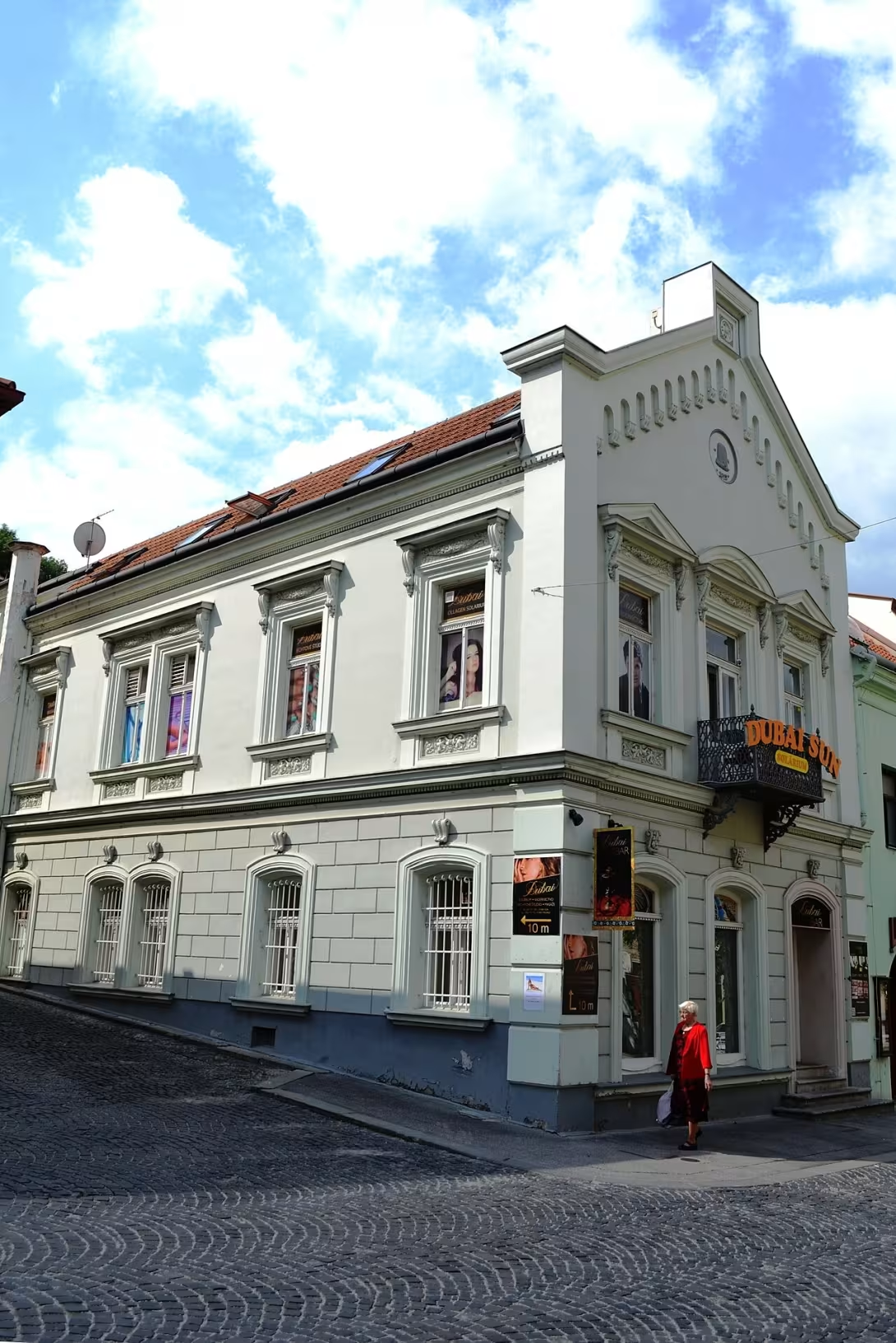

The historical view on the left is a visualisation generated by artificial intelligence and serves as inspiration.
Historical Milestones
- 1450
- The origin of the original medieval buildings in Trenčín.
- 1500
- Construction of a Renaissance crossing burgher house.
- 1750
- Adjustments during the Baroque period associated with the interest of the nobility of the city.
- 1900
- Upgrade the ground floor and preserve business functions.
- 2000
- Registration of the object by the Monument Office of the Slovak Republic.
Heritage surveys
-
2016/04 — Architektonicky-historícký výskum
Čiastkový pamiatkový výskum
Interesting facts
- Townhouse in Trenčín is a historic building dating back to the 15th century, which is conceptually designed as a cross-country terraced house of Renaissance origin. - The monument office of the Slovak Republic records this object under the number ÚZPF 1371 due to its historical and architectural importance associated with the development of urban housing. - The building is characterized by a pass-by type and inclusion in terraced buildings, and housing in originally residential burgher houses lasted to the present time when changing the requirements of the standard.
Guide
Show guide text
The text was prepared by artificial intelligence and has not been editorially reviewed. It may contain inaccuracies.
Welcome to Trencin, a city that tells stories from many centuries with its atmosphere and architecture. Right now, you are facing one of the fascinating witnesses to local history, the historic townhouse. When you look at it, you may at the first moment see only one of the many buildings in the city centre, but if you stop and listen, this house will begin to reveal its long and layered history. See his presence and see how the fates of the inhabitants of Trencin from different ages are entangled in his walls. To understand what we have in front of us, we must return to our minds very far. The foundations of this site date back to the mid-15th century. Just around the year a thousand four hundred fifty was established in Trencin original medieval buildings. At that time the city was an important strategic point and its centre was gradually filled with houses that served not only as dwellings but also as places of crafts and trade. This house grew from this medieval tradition, in which each building was closely connected with its neighbors, creating a dense fabric of urban life. A key turning point in the likeness of this building, however, came around the year a thousand five hundred, when elements of the Renaissance were introduced into the architecture. It was during this period that the house was built as a so - called pass-through terraced house. You may wonder exactly what this term means. The crossing house was a very practical solution in its time. It made it possible for carriages, horses and goods to pass directly through the building, making efficient use of space in narrow city streets while ensuring access to backyards or warehouses. Now, when you visualize this house in its Renaissance form, try to imagine the warfare's sound of chariot wheels and horse drag that went right under the roof of this building. It was an architecture of functionality that also represented the status of its owner. However, time did not stand and the city changed. When we reached the middle of the eighteenth century, namely around the year one thousand seven hundred and fifty, Trencin experienced a new wave of change. In the Baroque period there was an increased interest of nobility in urban housing. The noble families, who had previously preferred their sovereign settlements in the countryside, began to look for prestige and comfort in the city centre. This has led to different modifications of existing buildings to meet new aesthetic demands and higher comfort. This townhouse also went through some changes during this period, which gave it a Baroque touch and reflected the social shifts of the time. The building thus became a bridge between pragmatic Renaissance commerce and representative Baroque style. Let us now take a step further, until the end of the nineteenth and the beginning of the twentieth century. About a thousand and nineteen hundred in Trencin, like many European cities, began to show the need for modernisation. At this time, adjustments were made to the ground floor of the house. The aim was to adapt the premises to new business features that required greater interpretations and easier access for customers. The ground floor thus became a dynamic centre of trade, while the upper floors maintained their restistential characteristics. This contrast between modernized business space below and the historical substance above is a typical sign of the development of many Trencin houses. Although we do not know the names of the specific architects who designed this house or the names of all the personalities who lived there, the building itself is a living monument. Imagine generations of townspeople, merchants, and craftsmen who lived here working and shaping the face of Trencin. Every detail you see on the facade today is the result of hundreds of years of adaptation. Note how the building naturally fits into a series of other houses, creating a uniform historical picture that takes us back to the time when the rhythm of the day determined the church bell and the opening of shops. Now I would like to invite you to focus on one interesting thing that gives this house official importance. In the year of two thousand this object was officially registered by the Monument Office of the Slovak Republic. If you looked into the expert lists, you'd find him under the number of the USPF a thousand three hundred seventy-one. This may seem to be just a dry number, but it actually means that the state has acknowledged its irreplaceable historical and architectural significance. This house is not only a piece of old buildings, but is a key element for understanding how the urban environment in Trenčín developed. It is proof of how the medieval foundation turned into a Renaissance crossing house, then into a baroque residence and finally into a modern business area. Now that you've taken the whole building again, try to imagine all the layers of time in it. From the medieval roots of the year thousand four hundred fifty to today's protection as monuments. It's a fascinating story about survival, adaptation and durability. This house survived wars, burns, regime changes and economic crises, and before you put these headphones on, it stood quietly here and watched thousands of people crossing these streets. Before I say goodbye and leave you in a quiet observation of this beautiful building, I recommend you walk around the house and perceive its proportions in relation to the surroundings. Look at how row houses lean on one another, creating a sense of security and a community that was so characteristic of old cities. Thank you for your attention and for devoting time to this silent witness to Trenčín history. I now invite you to continue your investigation of the city. Let yourself be guided by the attractions that Trenčín hides in each of its alleys, and discover other gems that tell about our ancestors and their dream of a beautiful and functional city. I wish you a pleasant and inspiring walk around Trencin.
Tips for visitors
Trenčín and its historical centre are suitable to visit in the morning when the streets are quieter. It is recommended to walk to the center and the burgher houses. Due to the paved streets we recommend to wear comfortable shoes. The camera is suitable for photography the details of buildings. Exteriors can be photographed early in the morning or during the golden hour before sunset. Walking through the center is easy for families with children; the region is famous for legends.
Frequently asked questions
Can the monument be visited?
This is a residential or farm building, not a museum with opening hours. Please view it from public space and respect the owners' privacy. We have no information about access to the interior.
Where is the monument?
Location: Mierové nám. 39/40, Trenčín, Trenčiansky kraj. The map on this page shows the exact spot.
Why is the monument protected?
It is listed in the Central List of the Monuments Fund of the Slovak Republic as a national cultural monument (ÚZPF no. 229-1371).
For children
Imagine you're standing in the middle of town, and suddenly everything changes around you. No cars, no phones, just the sound of footsteps and the remote horse clicking. That's how you'd feel if you'd come back in a few centuries' time. Exactly 526 years ago, this beautiful burgher house was created in Trencin. It was not just an ordinary house at the time, but a symbol of strength and wealth.
Nearby
🏰 Historic sites (167)
- Trenčianske múzeum 0.0 km
- Bývalý župný dom 0.0 km
- Jozef Holoubek 0.1 km
- prof. MUDr. Ján Alojz Chura 0.1 km
- Karol Pádivý 0.1 km
- Rímsky nápis 0.1 km
- Galéria Miloša Alexandra Bazovského 0.1 km +421 327 436 858 web
- Maršovského palác 0.1 km Palackého 100/27 web
- Trojičný stĺp 0.1 km web
- Ján Jiskra z Brandejsa na hradnej skale 0.1 km
- Katov dom 0.1 km Matúšova 70/14
- Trenčínský hrad 0.2 km web
- Škoda Classic Cars 0.2 km +421 32 6400 056 web
- Matúšova veža 0.2 km
- PhMr. Ján Halaša 0.2 km
- Jozef Branecký 0.2 km
- Ľudovít Vladimír Rizner 0.2 km
- Jozef Branecký 0.2 km
- KRYTÉ SCHODY 0.2 km
- FARSKÝ KOSTOL NARODENIA PANNY MARIE 0.2 km
🍽️ Restaurants and dining (403)
- Dubai bar 0.0 km
- Coffee Sheep 0.0 km +421 949 816 296 web
- Sládkovič café 0.0 km +421 948 138 038 web
- Oyshi 0.0 km +421 911 051 999 web
- KUKI 0.1 km
- Fuzia 0.1 km
- Mäsocentrum Maroš 0.1 km
- Maxim pizza 0.1 km web
- M&G 0.1 km
- ouCafé 0.1 km +421 914 221 240 web
- Restaurant Elizabeth 0.1 km
- Coffee Sheep 0.1 km +421 951 014 474 web
- Zlatá Fatima 0.1 km
- Fatty Patty 0.1 km +421 910 336 296 web
- Pivovar Lanius 0.1 km +421 904 803459 web
- Pod Hradom 0.1 km
- Plzeňzská Restaurant 0.1 km
- Lanius 0.1 km web
- La Libertad 0.1 km
- Dobroš 0.2 km
🏨 Accommodation (120)
- Penzión Scarlet 0.1 km web
- Grand 0.1 km
- Hotel pod hradom 0.1 km
- Deloris 0.2 km
- Penzión Branecky 0.2 km +421 951 012 940 web
- Penzión Pri Parku 0.4 km +421 911 765 212 web
- Autocamping na ostrove 0.5 km +421 905 633 905 web
- Penzión AURELIUS 0.6 km Gen. M. R. Štefánika 399/34 web
- Penzión Exclusive 0.7 km
- Penzión Royal 0.8 km web
- Penzión ACCES 0.8 km
- Penzión Tiberia 0.9 km web
- Thisismysen 1.0 km web
- MG RINK 1.1 km web
- Magnus hotel 1.1 km web
- Penzión Feši 1.2 km +421 948 621 231 web
- Hotel S.O.G. 1.3 km Jesenského 598/32 web
- Penzión Kerola 1.4 km +421 903 715 164 web
- Hotel Veverica 1.5 km +421 32 642 08 81 web
- Penzión Evergreen 1.5 km Kubranská 4/8
🚲 Rentals and sport (63)
- House of Bike 0.1 km +421 903 780 301 web
- Mestský bicykel 0.1 km
- Mestská plaváreň 0.3 km
- Mestská športová hala - Sihoť 0.4 km Mládežnícka 1632/1
- Mestský bicykel 0.7 km
- T-Šport 0.7 km +421 32 652 1420 web
- Laser Arena Trenčín 0.7 km
- Unipláž 0.8 km web
- Športovisko 338 0.8 km
- Arena Ostrov 0.8 km +421 903 770 136 web
- Tenisový a golfový areál Zamarovce 0.9 km web
- Najšport 1.2 km +421 908 697 525 web
- Kleinšport 1.3 km web
- Lezecké centrum Trenčín 1.3 km +421 910 250 025 web
- Hybko 1.3 km Ľudovíta Stárka 2843 +421 903 757 100;+421 902 131 495 web
- Cyklostore 1.4 km web
- Hudy Racing Arena 1.5 km +421 32 7401 100 web
- SPORT 2000 - Tulák outfit 1.6 km web
- Cyklo1 1.6 km web
- Cykloshop.sk 1.9 km +421 919 363 442 web
🥾 Hiking and nature (289)
- Rodný dom Vojtecha Zamarovského 0.2 km
- Farské schody 0.2 km
- 3D model Trenčína 0.2 km
- Átrium pod Mestskou vežou 0.3 km
- Milana Rastislava Štefánika 0.3 km
- vyhliadkoveplavby.sk 0.4 km web
- Armanis - zážitkové plavby 0.6 km web
- Prírodný park pri Váhu 0.6 km
- Oddychový park 1.1 km
- Štefánikova vyhliadka 1.2 km
- Frimlovec 1.4 km
- Kozí vrch 1.4 km
- Pliešky 2.1 km
- Orechovská kyselka 2.4 km
- Priepasť 2.7 km
- Skalka 3.0 km
- Benediktova jaskyňa 3.0 km
- Opatovská jaskyňa 3.1 km
- Záblatský park 3.3 km
- Hrabovka 3.4 km
Thematic route
Draft thematic route for a cultural and historical trip in Trenčín. As the list does not contain other external points, the route focuses on the main objective and its area.
1. House bourgeois - Type: Historical monument / Architecture - Why it is worth visiting: Represents the city's Renaissance and Baroque architecture.
2. Courtyard of the townhouse - Type: Monument area - Why it is worth visiting: Space with original construction details and historical layout of the exterior.
3. Exposition of burgher housing - Type: Internal exposure - Why is it worth visiting: Interiors with period equipment.
Seasonal recommendations
Spring in Trenčín brings awakening nature. The townhouse in the historical centre operates freshly during this period. Sun rays fall at a low angle on the facade, creating a game of shadows and light suitable for photographing details. Greenery on the castle hill sprout. There are fewer tourists in the city, so you can take a tour at a quiet pace. We recommend layered clothing and light wind, because the weather is variable. A good time to visit is the morning when the streets are almost empty.
Summer is the main tourist season and the burgher house is reviving the city's bustle. Sunlights illuminate the memory almost all day long. The surrounding area is complemented by lush vegetation and flowering gardens. Temperatures can be high, so we recommend coming right after opening to avoid afternoon heat and crowds of visitors. Choose light clothes, comfortable shoes for historical tiles, sunglasses and don't forget the drinking mode.
Autumn brings shades of red and yellow to Trencin. The sun falls at a low angle, highlighting the structure of the walls, while morning fog changes the appearance of the historical centre. Tourists are declining, which allows for a quieter tour. Since temperatures are falling, especially in the evening, do not forget the warm coat, scarf, and sturdy shoes. Good time to visit is afternoon.
Winter covers the roofs and streets of the townhouse with snow. The days are shorter and the sun sets early. In cold months it is shorter opening time and in historical interiors it is colder. Dress warmly for the tour - choose a winter jacket, a cap, gloves, and non-skid shoes because of the frozen pavement. A good time to visit is around noon, when temperatures are highest and there is plenty of daylight.
Visualisations and artistic views


The visualisations are generated by artificial intelligence and serve as inspiration.
Photographs from the area
Real photos taken near the monument


Source and licence are given for each image.
Visitor Tips
No tips yet. Be the first!
Log in and add your tip.
Location on Map


Visitor photos
No photos yet. Be the first to add a photo from your visit!
Log in and add your photo or leave a rating.
You get more points for a visit verified in the app — we can tell from the GPS that you are there.
Reviews and comments