








burgher's house Burgher house
Townhouse in Banská Štiavnica in Banská Bystrica region is a corner baroque building from the beginning of the 18th century, registered in the Central List of Monument Fund under number ÚZPF 10782. The monument represents the urban architecture of the late Renaissance and Baroque and retained the overall expression and ground plan and space composition.
The origin and historical context of the building are related to the development of burgher houses in Banská Štiavnica. Townhouses in the city included the construction of an older unorganized building and left narrow streets between the buildings. Banská Štiavnica houses are situated in a rough terrain, where the St. Trinity Square is three- to four-storey, while the last floor is also the ground floor in the back alley. Later, through modifications, the expansion of houses and the construction of neighboring streets, a series of buildings were created. During the Baroque period, the nobility bought side by side standing houses and rebuilt them into representative residences.
The architecture and artistic design of the house show signs of late Renaissance and Baroque. The building fixes the older urban situation in connection with the original communication route and side communication. It is situated in a micron square as an end corner object. The architectural concept of the facade is partially modified by modification of the parter and the material expression interferes with the removal of part of the volume of the side wing. The cellars of this type of houses are dug into the rock subsoil and in some houses they move to the galleries, which were the remains of previous activity.
Owners, administrators and particular fates of the house are not in available architectural and monument documents specifically evidenced. Historical development of this type of buildings has undergone conversions from medieval wooden or brick buildings through tower, chamber, hall houses and houses with passage to baroque reconstructions to city palaces for nobility in county or military administration.
Key events and specific historical moments directly related to the house are not specified in the documents. The general development of burgher houses in the 19th century brought about an increase in population and the creation of residential rental houses, pavlač houses, houses of poverty and iron houses on the outskirts of the city near the walls. In the 19th and 20th centuries the objects were modernized mainly in the parter and many maintained functional use for trade, while the way of sales was more oriented towards advertising.
Originally residential burgher houses maintained the function of housing and only requirements for standard housing changed.
Tehdy a dnes
Drag the slider and compare how the monument might have looked when it was built with the view today.
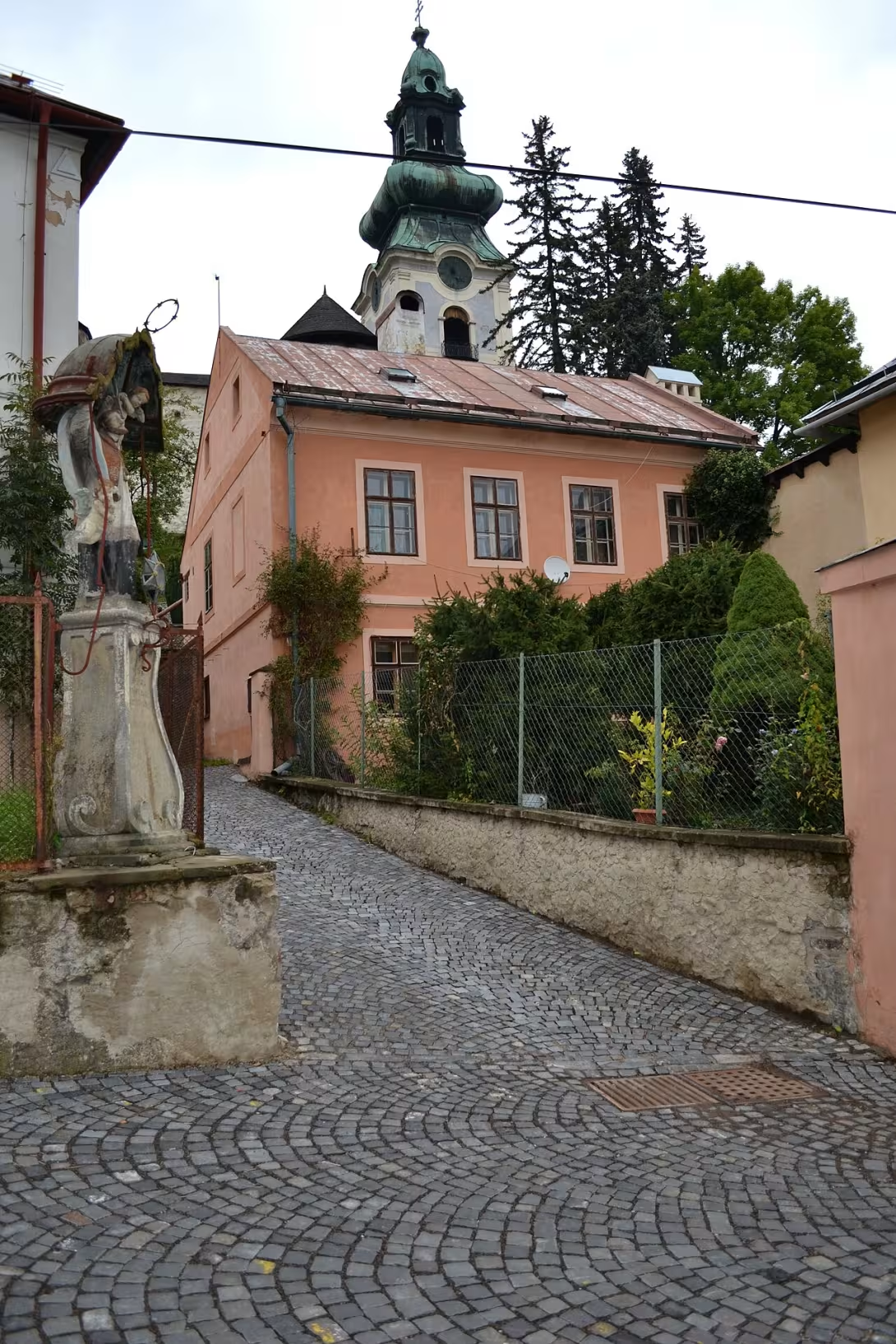
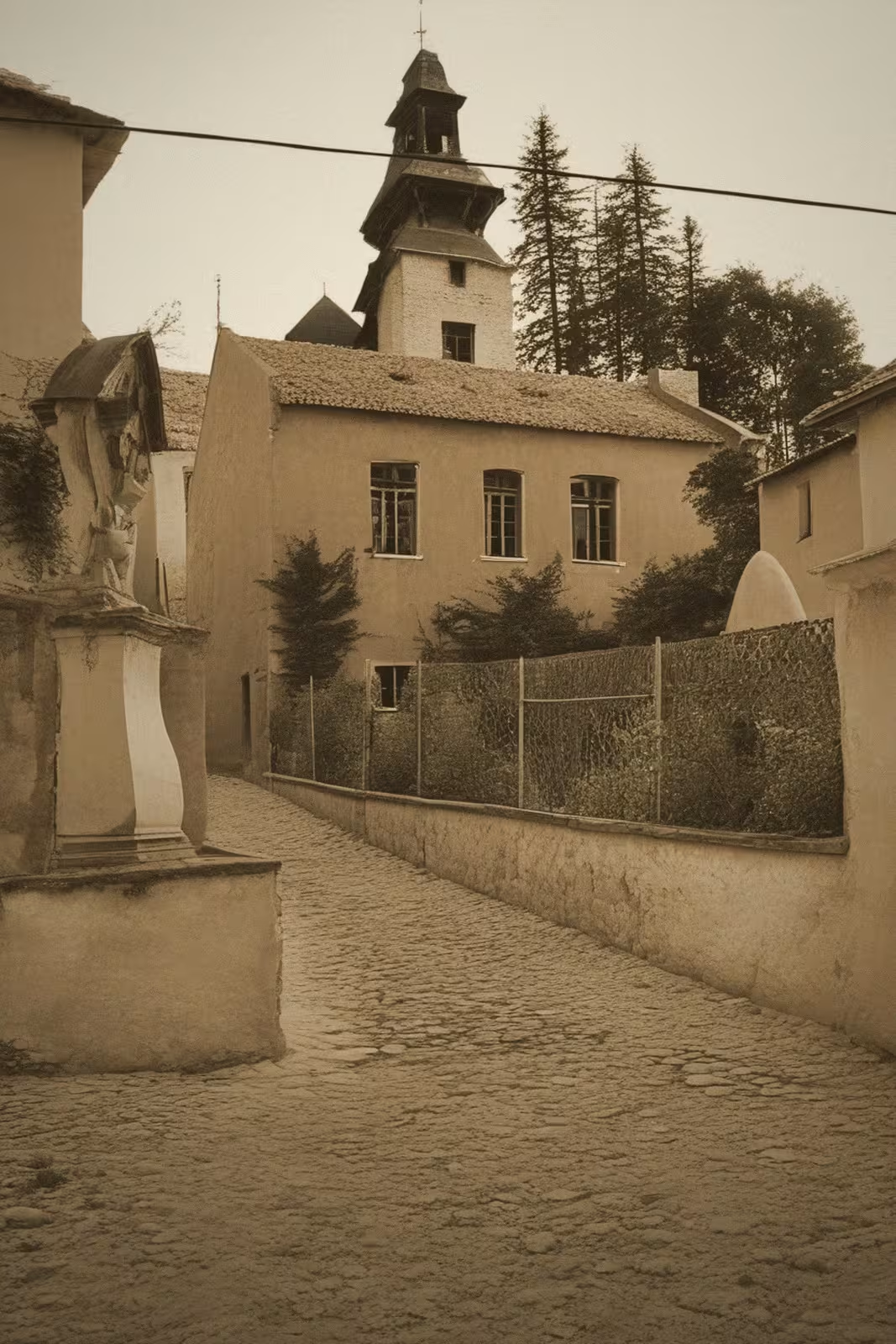
The historical view on the left is a visualisation generated by artificial intelligence and serves as inspiration.
Historical Milestones
- round 1300
- Medieval creation of the first wooden or brick buildings in the region.
- round 1550
- Development of late-renaissance urban architecture in Banská Štiavnica.
- round 1700
- Construction of corner Baroque building and reconstruction of the city palaces.
- round 1850
- Modernization of objects, creation of rental houses and modification of partners.
- round 1950
- Monument protection and registration of the object in the list of monuments.
Interesting facts
- Townhouse in Banská Štiavnica is a corner baroque building from the beginning of the 18th century. - The monument represents the urban architecture of the late Renaissance and Baroque and preserved the overall expression and ground plan and space composition. - Architecture and visual design of the house show signs of late Renaissance and Baroque. - The building fixes the older urban situation in connection with the original communication route and side communication. - The cellars of this type of houses are dug into the rock subsoil and in some houses they move to the galleries, which we
Guide
Show guide text
The text was prepared by artificial intelligence and has not been editorially reviewed. It may contain inaccuracies.
Welcome to Banska Stiavnica. You are now standing in a place where history breathes in every stone and a chapter is opened in front of your eyes behind a chapter from the rich past of this extraordinary mining city. When you look up and look in front of you, you see a majestic burgher's house, which forms a characteristic and unnoticed part of this picturesque space. You stand in front of a corner baroque object which, by its presence, completes the unmistakable atmosphere of the entire site. Let's take a moment to follow the sound of my voice recording, and let's get together to clarify the story behind these ancient walls.
The view of this building brings us deep into the past, where the first chronicles of this region are written. Already around the year a thousand three hundred began to write the history of medieval creation of the first wooden or brick buildings. The place where you are now has undergone a long development over the centuries, reflecting the transformations of the whole society. Around the year about a thousand five hundred fifty experiences Banská Štiavnica significant development of late-renaissance urban architecture. At that time, space was formed, which gradually became more generous and more durable. A turning point that has determined today's visual form comes about the year seventeen hundred. It is this corner baroque building that grows here, and there are extensive reconstructions on the city palaces that should represent the influence and position of their then owners. The city grew, changed, and with it the houses themselves. About eight hundred and fifty start the next stage, during which the modernization of buildings takes place, rental houses are created and parties are modified to meet new urban and commercial needs. This constant construction development was closed or rather stabilized around the year one thousand nine hundred fifty, when a new era of conservation and registration of the object in the list of monuments began, so we can admire this beauty to this day.
He doesn't want to take a closer look at what you see in front of you. Although the names of the original architects remain in the shadow of history and chronicles have not left us their identity, the building itself speaks clearly. Support your view by seeing the overall expression and ground plan-space composition that has been preserved until today. The townhouse in Banská Štiavnica represents the urban architecture of the late Renaissance and Baroque. When you look at the facade, note that the architecture and visual design of the house show significant signs of late renaissance, which harmoniously connect with the Baroque reconstructions of the later period. Stop for a moment and see the proportions of this corner object, its matter and the way it complements the surrounding urbanism of the city. It is a testimony to the craft skills of builders whose names zwar took time, but their work lasted for generations.
When we think about who walked all these tiles and who breathed life in this house, we will come across an interesting historical plane. Although historical personalities connected directly to this particular house remain unknown and archives have not revealed the names of particular nobles or townsmen who lived here, the whole place is linked to the fate of miners, craftsmen and merchants. All of Banska Štiavnica was a crossroads of culture, finance and science. Imagine the hustle that prevailed in the times when silver and gold were mined around. The inhabitants of this house witnessed the famous time of mining, when educated experts from all over Europe met here. Perhaps it was from behind these windows that they watched the processions, markets, and the city's bustle, which was among the most important in Hungary.
And what is the greatest attraction or some kind of silent mystery of this place? It is fascinating that despite all the centuries full of fires, wars, economic crises and building modifications, this burgher house has preserved its overall expression and ground plan-space composition. Many other objects in other cities have lost their face because of insensitive demolitions or modernizations, but here, at this corner in Banská Štiavnica, as if time had stopped. When you look at Baroque and late-renaissance elements, you look at an authentic fragment of history that has not succumbed to destruction. It's like a living textbook of architecture, where old verses live in perfect harmony under one shrub.
I believe this look has brought you a new look at where you are standing. Banská Štiavnica has countless other stories, corners and historical monuments. I invite you to further explore this unique city, go down the aisles further, let yourself lead by your curiosity and discover other secrets that this mining jewelryry offers you. Thank you for your attention and I wish you a wonderful experience from the next tour. Goodbye.
Tips for visitors
The best time to visit Banská Štiavnica is during the early morning or late afternoon, when the sun rays picturesquely illuminate the historical facade of burgher houses and create ideal conditions for photographing architectural details. You can easily reach the city by car and regular public transport connections, while you best check the exact timetables in the online search engine before travel. Be sure to take comfortable tight shoes with you, as the historic centre and the surrounding streets are characterized by their pavement and steep terrain. The exterior of the house and adjacent slopes offer great perspectives for photographers, especially in the side light, which highlights the structure of the building. We recommend a walk through the picturesque streets of this historic mining town and discover its atmosphere.
Frequently asked questions
Can the monument be visited?
This is a residential or farm building, not a museum with opening hours. Please view it from public space and respect the owners' privacy. We have no information about access to the interior.
Where is the monument?
Location: Radničné námestie 47/6, Banská Štiavnica, Banskobystrický kraj. The map on this page shows the exact spot.
Why is the monument protected?
It is listed in the Central List of the Monuments Fund of the Slovak Republic as a national cultural monument (ÚZPF no. 322-10782). It is part of a UNESCO World Heritage Site.
For children
Let's go back to 1700 for a while! In Banská Štiavnica, where everything was pierced by the miracles of Rudnice and the eager noise of new ideas. And this is where one of the most interesting homemakers stands - the Town Hall, as if the real sorcerer was all the sight. This Baroque treasure is like a stone from which the secrets of the years are carved.
Nearby
🏰 Historic sites (231)
- sv. Ján Nepomucký 0.0 km
- SNP 0.0 km
- Mariánsky stĺp 0.1 km
- Starý zámok 0.1 km web
- Galéria Schemnitz 0.1 km
- Cesta v čase 0.1 km web
- Morový stĺp 0.1 km
- Dom Maríny 0.1 km
- Vzbura baníkov v roku 1852 0.1 km
- Galéria Jozefa Kollára 0.2 km +421 918 990 449 web
- Židovská synagóga 0.2 km
- Sándor Petőfi 0.2 km
- Kalmán Mikszáth 0.2 km
- Andrej Sládkovič 0.2 km
- Emil Grillusz 0.2 km
- Lajos Fekete 0.2 km
- Hugo Heincz 0.2 km
- Július Farbaky 0.2 km
- Samuel Porubszky 0.2 km
- Anton Kerpely 0.2 km
🍽️ Restaurants and dining (160)
- Lemberg 0.1 km Radničné námestie 10 +421 911 220 126 web
- Coburg coffee & burger 0.1 km
- U Jašteríc 0.1 km
- Archanjel Cafe Bar 0.1 km web
- Bansky Dom 0.1 km
- Reštaurácia Monarchia 0.1 km web
- RUINbar 0.1 km web
- OPERA Prosecco Bar 0.1 km
- Pasta per-te v opere 0.1 km +421 907 841 794
- Pizzeria Black M 0.1 km +421 45 692 0202 web
- Čajovňa Klopačka 0.1 km +421 905 980 499 web
- Reštaurácia Gallery 0.1 km +421 45 692 12 52
- Svätá Barborka 0.1 km
- Barcadam 0.1 km
- Pivovar ERB 0.2 km +421456921147 web
- Gavalier 0.2 km +421 903 802 226 web
- Eleuzína 0.2 km web
- Stará škola 0.2 km
- Na Trojici 0.2 km
- Penzión Príjemný oddych 0.2 km web
🏨 Accommodation (107)
- Skautský dom 0.0 km Antona Pécha 69/2 +421905382885 web
- Skautský dom 0.1 km web
- Boutique Hotel ERB 0.1 km +421 456 789 555 web
- BARCADAM 0.1 km Námestie sv. Trojice 17/13 +421 908 965 202 web
- Gavalier Design Rooms 0.2 km +421 903 222 309 web
- Penzión Resla 0.2 km
- Penzión Rozália 0.2 km +421 948 221 213 web
- Penzión Na trojici 0.2 km Námestie sv. Trojice 21/17
- Bristol 0.2 km Andreja Kmeťa 123/11
- Subyt 0.2 km
- Apartmán Zlatý dvor 0.2 km
- Black M 0.3 km Kutnohorská 603/1 +421 910 947 187 web
- Penzión Cosmopolitan II 0.3 km web
- Penzión Matej 0.4 km
- Hotel Grand Matej 0.4 km
- Penzion Nostalgia 0.4 km Ing. Štefana Višňovského 208/3
- Penzión Tomino 0.4 km
- Salamander 0.5 km
- Villa Botanica 0.5 km web
- Ubytovanie Tatiana 0.6 km
🚲 Rentals and sport (18)
- Diana poľovnícke potreby 0.8 km
- Ortler sport 0.8 km
- BS-Rent 1.0 km +421 948 908 737 web
- Pontónová plaváreň na Klingeri 1.0 km
- MK bike service 1.2 km +421 904 494 573
- Tanad sport 1.4 km
- Bikepro - Hotel Salamandra 2.8 km web
- ŠK Lesy Banská Belá 4.3 km
- Požičovňa vodných bicyklov 6.5 km
- Sedací bazén 7.8 km
- Detský bazén 7.8 km
- Rekreačný bazén 7.8 km
- Jaskynný parný kúpeľ 7.9 km
- OFK Štart Prenčov 11.0 km
- Lodenica Hliník nad Hronom 12.6 km
- Cyklosport 3000 13.1 km Májová 280/3
- Bazén Ďuricov majer 14.2 km
- Plážové kúpalisko Žiar nad Hronom 14.3 km
🥾 Hiking and nature (590)
- História mesta (reliéf) 0.1 km
- Banskoštiavnicky betlehem 0.1 km web
- Banka lásky 0.1 km web
- Michal štôlňa 0.1 km
- Kaufhaus šachta 0.1 km
- Na centrum 0.2 km
- Z Lichardovej 0.2 km
- Od Červeného kríža 0.3 km
- Z Hornej ružovej 0.3 km
- Z Dolnej ružovej 0.3 km
- Z Vodárenskej 0.3 km
- Cherubín dedičná štôlňa 0.3 km
- Z Katovej 0.4 km
- Na kalváriu 0.5 km
- Z Vodárenskej 0.5 km
- Nad Reslou 0.5 km
- Glanzenberg dedičná štôlňa 0.6 km web
- Park SNP 0.6 km
- Žigmund šachta 0.7 km Na Zigmund šachtu 1647/15
- Nad Šmintorínom 0.7 km
Thematic route
Thematic tour of the corners and architecture of the historical object:
1. Historical facade of burgher house Type: Architectural exterior In front of the house you can look at the preserved architectural elements and the division of the facade, which are typical for the rich mining town building. The facade reveals the social status of the original owners.
2. Entrance mazhaus and crossing Type: Historical interior Massive vaults and original stone details in this space on the ground floor testify to its past purpose as the main communication hub of the house, where guests met and shops closed.
3. Interior courtyard Type: Courtyard Atrium protected from street noise reveals court wings and picturesque pavlače, which are characteristic of past housing. The space offers a view of the daily life of the town family.
4. Residential rooms upstairs Type: Interior exposure The premises of the upper floor show residential background and a culture of living stiavnica burgher. Maintained beam ceilings, historical floors and restored details document contemporary comfort.
5. Stone underground cellars Type: Underground spaces The tour ends in the underground with vaulted stone cellars deep into the rock subsoil, which served to store the stocks and wine. These areas are closely linked to the mining nature of the settlement.
Seasonal recommendations
Spring brings nature awakening to Banská Štiavnica, when the slopes of the surrounding hills after the snow melt into fresh greenery and the historical facade of burgher houses will start in the morning sharpening sunlight pleasantly warm up. During this transitional period there is a quiet atmosphere in the streets, sometimes interrupted only by the singing of birds and the noise of the spring wind. The town's wanderings are worth putting on layered clothing and tight shoes, because the original tiles can be slippery after rain and the morning temperatures are low. The best time to admire architectural details of exteriors is morning, when soft side light ideally highlights historical portals and stucco decorations.
Summer will cover Banská Štiavnica in warm sunlight and the atmosphere of the city is lively, accompanied by the buzzing of insects in blooming pre-gardens and shadows, which throw narrow streets on stone walls. The surrounding nature in full bloom creates a picturesque scenery for photography burgher houses from the exterior. The best choice for walks is the early morning clock or late evening, when the air is pleasantly cooler and the setting sun gives ancient buildings a golden touch.
Autumn turns the landscape into a varied range of shades from yellow to brown and morning mist rolling from the valleys, Banská Štiavnica melancholy, almost romantic times, in which burgher houses are particularly mysterious. The light is muffled and creates ideal conditions for capturing the nostalgic atmosphere of old mining architecture during cloudy days. During this period, windproof and warm clothing is essential, since the mountain climate can change quickly and temperatures plummet sharply as the sun reaches the horizon. The best time for outdoor shows is noon, when daylight is the most intense and can penetrate even deeper, narrow parts of the historical centre.
Winter brings silence and peace to Banská Štiavnica, often under a layer of fresh snow, which picturesquely covers the roofs and ledges of burgher houses and creates contrast with the dark stone facade. The atmosphere in the city is at this time chamber and fabulous, amplified by the leaping shadows of instructive lighting in the early evening. Winter footwear with non-slip soles and warm layered clothing, including hats and gloves, are essential because the movement to the freezing air requires protection. The best time for an outdoor tour is the afternoon when the sun low above the horizon creates long shadows and unique lighting effects suitable for creating photos.
Visualisations and artistic views


The visualisations are generated by artificial intelligence and serve as inspiration.
Photographs from the area
Real photos taken near the monument


Source and licence are given for each image.
Visitor Tips
No tips yet. Be the first!
Log in and add your tip.
Location on Map
More monuments – Banská Štiavnica
Show all in the town


Visitor photos
No photos yet. Be the first to add a photo from your visit!
Log in and add your photo or leave a rating.
You get more points for a visit verified in the app — we can tell from the GPS that you are there.
Reviews and comments