

evangelical church Church
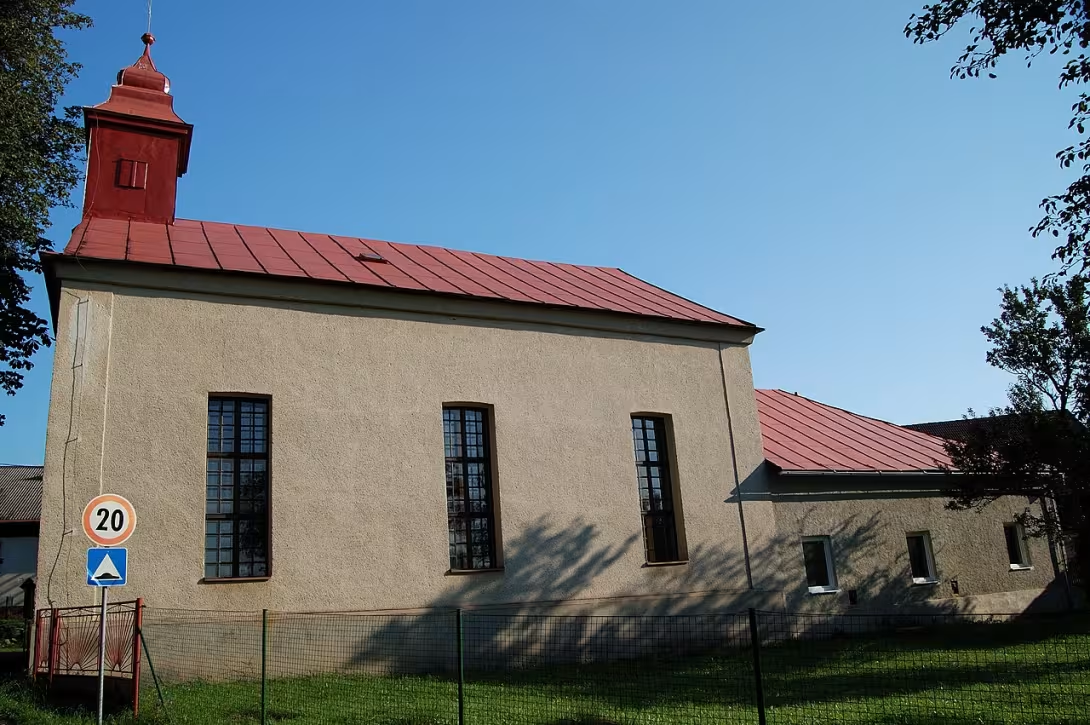
Evangelical church in the village Štôla in Prešov region is a newly classicistic building from 1870. The building has historical links to the local community and architecture typical for the second half of the 19th century.
The need for their own church space in Štôl led to the fact that the faithful had previously met in private houses, the last time before the consecration of the church they did so at Jurča-Krokoš. The building started on April 5, 1869, under the direction of priest Andrej Dianišk, whose headquarters was in Batizovce, and the Evangelical inspector David Husz from Poprad. Construction took place quickly and the consecration took place on September 11, 1870. The total cost of the church and school was 4550 gold; the largest support was provided by the German Adolf Society.
The church has a neoclassicist style, rectangular floor plan of the hall space and Prussian vaults. The facade is divided by lysenes and finished with a brick shield with a built-up wooden bell tower. Above the entrance is a wooden empora. The brick altar with classicistic pillar architecture contains the image of Christ on the Olive Mountain, painted by P. Bohúň in 1869.
In 1875 the church purchased agricultural land in the cadastral area of Štôl for 1200 gold and Batizovce for 255 gold. On March 30, 1883, she received a gift of 100 gold from the then ruler to buy bells. She ordered two bells at Fridrich Seltenhofer in Soproni for 256 gold and 76 grajciárs. In July and August 1883 for 140 gold tower was built for bells; their consecration took place on August 5, 1883. In 1878 the Spišský German association contributed 48 gold to the bell purchase and in 1884 Count Albert Mariássy donated 50 gold.
The area is registered by the Monument Office of the Slovak Republic under number ÚZPF 986. The current state of the church is good and the building fulfills its original purpose.
The church in Štôle is an example of the newly-classicist sacral architecture and documents the assistance of German associations in the construction.
Tehdy a dnes
Drag the slider and compare how the monument might have looked when it was built with the view today.
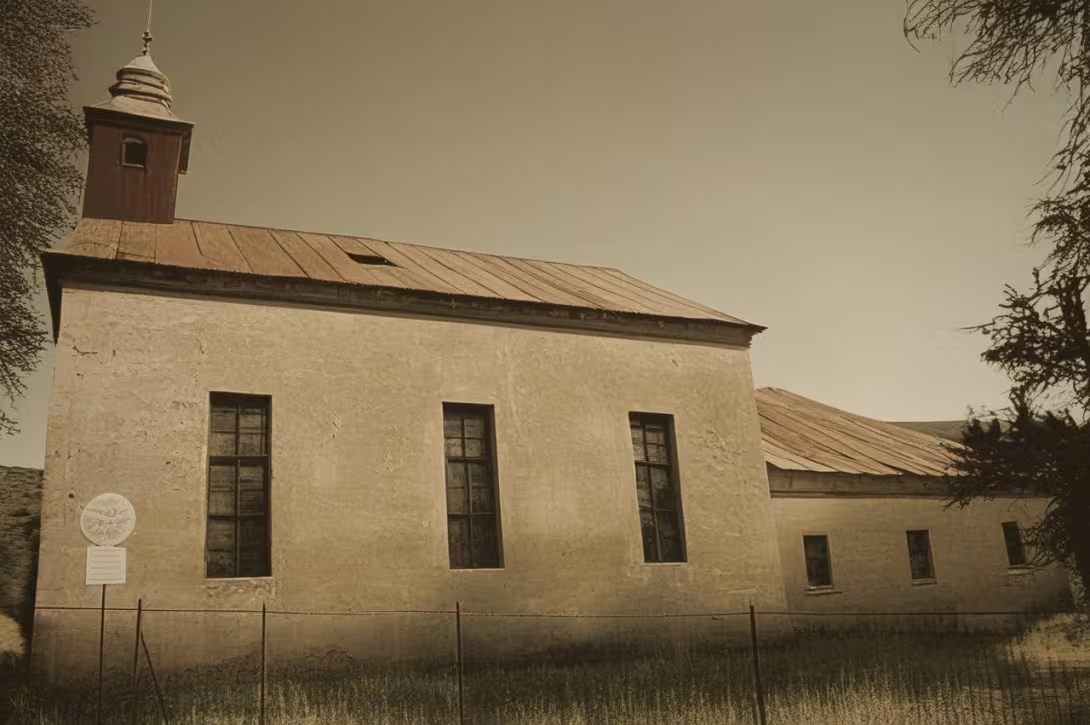
The historical view on the left is a visualisation generated by artificial intelligence and serves as inspiration.
Historical Milestones
- 5. 4. 1869 - began the construction of the church for priest Andrej Dianišek and ev. inspector David Husz
- 11. 9. 1870 - the patronage of the church
- 1875 - church bought agricultural land in the cadastral area of Štôla and Batizovce
- 30. 3. 1883 - the church received a gift from a ruler of 100 gold to buy bells
- 5. 8. 1883 - wall of bells and completion of tower for bells
Interesting facts
- It is a new-classicist building from the year 1870, whose construction took place quickly under the direction of priest Andrej Dianišek and inspector David Husz. - Before building the church, believers met in private houses, last time at Jurča-Krokoš. - The German Adolf Society provided the most financial support in building the church and school. - The brick altar contains an image of Christ on the Mount of Olives, painted by P. Bohúň in 1869. - To buy bells, the church received a gift of 100 gold from the then ruler.
Guide
Show guide text
The text was prepared by artificial intelligence and has not been editorially reviewed. It may contain inaccuracies.
Welcome to the village of Štôla, in the heart of Prešov region, where time seems to run slower and where each building tells its own, inconspicuous, but deep story. You are standing just in front of the evangelical church, which is a silent witness to the faith, perseverance, and community of local inhabitants. Look at the building in front of you. The first impression that you are likely to think of is a feeling of peace and moderation. This temple is designed not to stagger its size or its overly rich decorativeness, but rather to express inner harmony and spiritual purity. Feel the atmosphere of this place and try to imagine how generations of people prayed here, for whom this house was the center of their social and spiritual life.
To understand why this church is so important to locals, we need to go back almost a century. The building you are facing now dates back to 1870. At the time, building such a significant object was not a simple task. This required not only funding, but above all strong will and organisation of the whole community. The construction took place surprisingly quickly, indicating how much desire the believers in Stylish had for their own space for prayer. The whole process of construction took place under the guidance of two key figures, which at that time moved spiritual life in the area. He was priest Andrej Dianišk and inspector David Husz. It was their coordination and tireless work that allowed this project to become a reality in such a short time.
Now that you notice the exterior of the building, consider its architectural style. It's a New Classicist building. New classicism, which dominated many parts of Europe in the nineteenth century, was marked by a return to the principles of antiquity, emphasis on symmetry, simplicity and clear lines. Look at the overall appearance of the facade. Note how architecture avoids unnecessary details and instead bets on balance and proportions. It is this moderation that is typical of the evangelical temples of the time, where the main objective was not the visual representation of power, but the creation of an environment that would not interfere with the concentration on the word of God and prayer. Look carefully at the number of lines and the overall rhythm of the construction, which is stable and timeless.
But behind this neoclassicistic appearance lies a story that is much more emotional than the architecture itself could suggest. Imagine the period before 1870. At the time, this church did not exist. Believers in Stylish had nowhere to go to pray together in sanctified space. However, this did not mean that their faith was weaker. Rather, their devotion was so great that they met in private homes. Imagine those small rooms where families gathered quietly to read the Bible together and sing psalms. It was a period of secret or semi-secret meetings where the community was confirmed in common values and mutual assistance. Last time the believers met at the house of Jurchu-Krokosh. It was this house that served as a temporary refuge for their spiritual needs until they succeeded in building their own temple. The transition from the living room of the private house to this newly-classicistic building must have been an extremely moving moment for the then residents. It was a symbol of recognition of their faith, and at the same time proof that their community had been given its official and permanent place in the country.
The key personalities that made this process possible have already been mentioned by priest Andrej Dianišk and inspector David Husz. Their role was not just administrative. They had to motivate people, search for resources and see to it that the building was in line with the then standards, while expressing the identity of the evangelical community. Dianišk was a spiritual leader for the people, who gave them strength when they prayed in private homes, and Inspector Husz provided the necessary professional supervision and organization. Together they created a tandem that was able to transform the desire of the community into a concrete building made of stone and wood.
The interesting thing that gives this place a special dimension is this speed of construction. In the 19th century, modern construction machines and modern logistics were not available. Everything was done by hand, with the help of local craftsmen and often volunteers from the village. The fact that the church originated so quickly speaks of the immense mobilisation of the inhabitants of Stôla. It was a collective work in which they put their jobs, time and savings. Although the building is now taken for granted to the country, it was a miracle built on their own efforts for the people of 1870.
Now that you're standing in front of this church, try to imagine the contrast. On the one hand the silence of the private house of Jurču-Krokosha, where people whispered and prayed in a narrow circle, and on the other hand this open, bright neoclassicist space, which opened the door to all believers in the village. This church is not just an architectural element, it is a memorial of endurance. It is a reminder that the community can overcome obstacles if it has a common goal.
Look again at the building as a whole. See its simplicity, which carries great depth. New classicism in this case is not only a fashion trend from the last century, but an expression of balance and humility. In the country of Prešov region there are many magnificent cathedrals and rich decorated temples, but it is these smaller, moderate churches in villages like Štôla that tell us the most about the real, everyday faith of ordinary people.
Let's end up with a little silence. Look at the surroundings of the church, see the silence of the village and think of all the people who walked before us. You may have noticed that the building is very harmonious with its environment. It is the secret of New Classicism - not to control the country, but to complete it.
This ended our short tour before the Evangelical Church in Štôle. We hope that you have felt the spirit of this place and that you are impressed by the story of the passage from private homes to this beautiful temple. Now we invite you to go around the building in peace, to see its details, and perhaps to find your own inspiration in this moderate beauty. Thank you for sharing this moment of history with us. We wish you a pleasant continuation in your journey and a peaceful discovery of the beauties of the Prešov region. We say goodbye to you and wish you a good trip.
Tips for visitors
The best time to visit is the spring or autumn, when the nature surrounding the village Štôla best complements the aesthetic of the Evangelical Church and the country of Prešov region stands out with its colors.
We recommend shoes suitable for terrain and in case of unpredictable weather preparation umbrella so that you can see the exterior of the building in peace and dry conditions.
For the best photos use natural daylight, especially during the morning or evening hours, when the architecture of the church stands out in the best light and the details of the facade are most visible.
The visit is also suitable for families with children who can observe the details of historical construction in a quiet environment and learn about local cultural heritage.
During the walk, focus on the harmonious involvement of the church in the surroundings of the village and observe the external structure, which shows the quality of the construction of this sacral building.
Frequently asked questions
Can the monument be visited?
Religious buildings are usually open mainly during services; at other times a visit is normally arranged with the parish or the operator. We have not verified specific times.
Where is the monument?
Location: č. 6, Štôla, Prešovský kraj. The map on this page shows the exact spot.
Why is the monument protected?
It is listed in the Central List of the Monuments Fund of the Slovak Republic as a national cultural monument (ÚZPF no. 416-986).
Nearby
🏰 Historic sites (119)
- Galéria Tatry 3.4 km web
- Pomník Obetiam 1. a 2. svetovej vojny 3.7 km
- Ondrej Šimek 3.7 km web
- pamätník 75. výročia deportácie Židov 3.7 km
- Kaštieľ Mariássyovcov 3.8 km Družstevná 25/3
- Kaštieľ Lučivná 4.3 km Hlavná 269/23 web
- Kurhotel Tivoli 4.7 km
- Jiří Wolker 4.7 km
- Poliankovo 5.0 km web
- Kostol Svätého kríža 5.0 km
- Múzeum Baťa pod Tatrami 5.3 km web
- MS 1970 FIS 5.5 km
- Pamätník Anny Svitanovej 5.5 km
- Padlým hrdinom odboja a SNP 5.5 km
- Tomáš Baťa 5.7 km
- Pamätník Tomáša Baťu 5.9 km
- Štrbská drevenica 6.0 km web
- SNP 6.1 km
- Ľudovít Markušovský 6.1 km
- Padlým Štrbanom v 1. a 2. svetovej vojne 6.1 km
🍽️ Restaurants and dining (371)
- Penzion Horal 0.5 km web
- Gašperov mlyn 2.9 km web
- XXL 3.4 km
- Piváreň a vináreň Habeš 3.5 km
- Motorest Bôrik 3.8 km
- Pohostinstvo GUĽA 3.8 km Osloboditeľov 231
- Reštaurácia Guľa 3.9 km web
- Bistro moment 4.4 km +421 52 285 1681 web
- Kolkáreň 4.4 km +421 944 505 455
- Café Adriana 4.5 km Hlavná 4 +421 950 668 396 web
- U Tinkera 4.5 km
- Koliba pri vleku 4.7 km
- Koliba u Miška 4.9 km
- Poliankovo 5.0 km web
- Koliba Žerucha 5.1 km web
- Cukráreň LYNX 5.5 km +421 950 506 591 web
- Pod topoľom 5.6 km
- Reštaurácia Kino 5.6 km
- TatraMoto café 5.6 km
- Pizzeria Sorriso 5.7 km web
🏨 Accommodation (278)
- Valek 0.2 km +421 905 962 152
- Hotel Avalanche 0.3 km
- Villa Tatry Stola 0.7 km +421 337742918
- Penzion Rogalo 1.8 km web
- Penzion u Pejtrika 1.8 km web
- Jasmín 2.0 km
- Gašperov mlyn 2.9 km +421 905 033 462 web
- Gerlach 3.2 km
- Ubytovňa 3.4 km
- Hotel Granit Nová Polianka 3.4 km +421 52 784 1111 web
- Obytný dom Plesnivec 3.7 km
- Villa Danielov dom 3.8 km web
- Hotel Guľa 3.9 km web
- Hotel Lučivná 4.2 km +421 907950464 web
- Kamélia 4.3 km
- Kaštieľ Lučivná 4.3 km +421 918 323 333 web
- Moment penzion 4.4 km +421 52 285 1681 web
- Vila Horec 4.5 km
- Zrub Lilian 4.6 km +421 948 913 880 web
- Hotel Hubert 4.6 km +421 52 478 08 11 web
🚲 Rentals and sport (65)
- Lekno 3.0 km
- Swixstore 4.8 km
- Ondrej Glajza bicykle a železiarstvo 5.0 km
- Strelnica Svit 5.3 km
- Požičovňa ebajkov ABL.sk Tatranská Štrba 5.4 km +421911576667;+421915813552 web
- Motokáry tatry 5.4 km
- Zajo 6.4 km web
- INTERSPORT Rent 6.4 km
- odloshop 6.4 km web
- Sport JS 6.4 km
- Krytá plaváreň vo Svite 6.5 km web
- Outlet spyder 6.5 km K vodopádom 4081/2
- Veveričí park 6.5 km web
- Poniklec shop 6.8 km
- Požičovňa ebajkov ABL.sk Štrbské Pleso 7.2 km +421911576667;+421915813552 web
- INTERSPORT Rent 7.2 km
- Mostíky 7.4 km
- PS Sport 8.0 km
- CMP sport 8.0 km web
- INTERSPORT Galfy 8.0 km +421 52 789 79 91 web
🥾 Hiking and nature (490)
- Výhľad na Vysoké Tatry, Mengusovce, Štôlu a Poprad 1.4 km
- Humbierk 2.3 km
- Bôrik 3.1 km
- Tatry na dlani 3.2 km
- Pod Vtáčnikom 3.3 km
- Kaštieľsky park 3.8 km
- Pivnica 4.3 km
- Spálený vrch 4.3 km
- Park pri kaštieli 4.3 km
- Kolombiarok 4.8 km
- Valtierov vrch 5.0 km
- Štrbský rybník 5.1 km
- Hora 5.3 km
- Vyhliadka na vlaky 5.6 km
- Psotkov 5.8 km
- Sviniarka 5.9 km
- Smolník 5.9 km
- Veľký Krížny kopec 5.9 km
- Malý Smolník 6.1 km
- Rozhľadňa Monte Móry 6.2 km
Thematic route
As there are no other locations in the area, I propose a thematic route within the area itself:
1. Evangelic Church - The main monument where you can see the architecture and interior furnishings of this spiritual centre. 2. Courtyard church - Space around the building, which provides a peaceful atmosphere and allows you to admire the exterior of the building from different angles. 3. Surrounding area - Walking in the immediate surroundings of the church, which helps to perceive the involvement of monuments in the surroundings of the village Štôla.
Seasonal recommendations
In spring the surroundings of the Evangelical church in the village of Štôla will wake up to life. The first green grass and flowering trees complement the form of this sacral structure. It is recommended to dress with layers because spring weather in Prešov region is unstable. The morning hours with light are a good time to visit.
Summer season brings bright sunlight that highlights the details of architecture. Nature is in full bloom. Due to high temperatures it is advisable to choose light, breathable clothing and head covering. Visiting is best planned for the early morning or later evening to avoid the strong sun.
Autumn in Štôle is characterized by a color palette of leaves and frequent morning fog. The atmosphere is quieter and calmer. It is practical to put on waterproof shoes and take a warmer sweater. The so-called golden hour before sunset is suitable for photography the building.
In the winter months evangelical church is in contrast with white snow. The surroundings are in winter sleep. It is necessary to dress in warm thermal layers and to wear gloves and a cap. For short days, it is advisable to come at dawn to use daylight.
Visualisations and artistic views


The visualisations are generated by artificial intelligence and serve as inspiration.
Photographs from the area
Real photos taken near the monument

Source and licence are given for each image.
Visitor Tips
No tips yet. Be the first!
Log in and add your tip.
Location on Map
Visitor photos
No photos yet. Be the first to add a photo from your visit!
Log in and add your photo or leave a rating.
You get more points for a visit verified in the app — we can tell from the GPS that you are there.
Reviews and comments