

grave-cross file Crosses group
The collection of grave crosses in Detva village in Banská Bystrica region includes approximately 30 wooden crosses from the second half of the 19th century. This national cultural monument (ÚZPF number 1829) documents folk art craft Podpoľanie.
The exhibition was founded in 1990 by the District Office in Detva. After the restoration of the crosses from the memorial ensemble, the original crosses from the cemetery have been added since 2000.
Crosses are made mainly of oak. They have dark basic color and white, yellow, green or red ornaments. Decoration consists of carved geometric and plant motifs such as three leaf, flower, leaves, vines with bunches of grapes, heart and snails, complemented by Christian symbolism. Some pieces are free of decoration or fine carving. Typical are triangular or round roofs with decorative elements. Each cross contains the name of the deceased and the years of his birth and death.
Objects were made by masters from Podpoľanie. From the middle of the 20th century are known their names, among them Jozef Fekiač-Shuný, Ján Fekiač-Poštár, Štefan Melich-Klimo and Mikuláš Sekereš from Detva.
Tehdy a dnes
Drag the slider and compare how the monument might have looked when it was built with the view today.
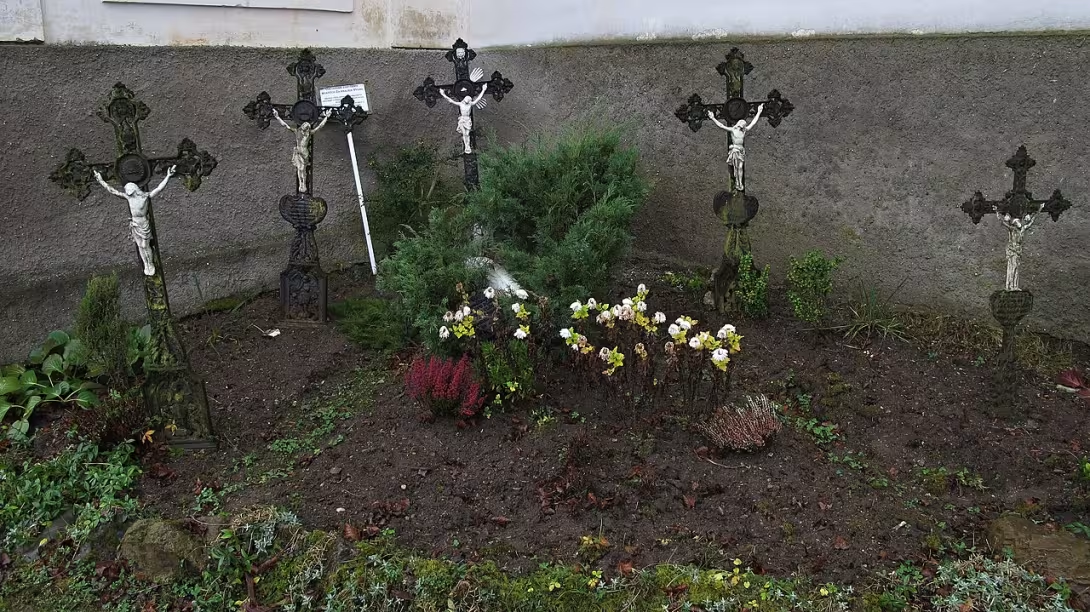

The historical view on the left is a visualisation generated by artificial intelligence and serves as inspiration.
Historical Milestones
- the second half of the 19th century
- About 30 wooden crosses formed
- 1990
- Establishment of the exposure District Office in Detva
- 2000
- Add original crosses from cemetery to file
- the middle of the 20th century
- Start registration of name of masters from Podpoľanie
Interesting facts
- The ensemble includes approximately 30 wooden crosses from the second half of the 19th century and documents folk art craft Podpoľanie. - Crosses are made mostly of oak in dark colors with color ornaments and carved geometric or plant motifs. - Typical are triangular or round roofs with decorative elements and details of the name and data of the deceased. - The exhibition was founded in 1990 by the District Office in Detva, and since 2000 the original crosses of the cemetery have been added. - Authors of the cross were masters from Podpoľanie, such as Jozef Fekiach-Shamný, Ján Fekiač-Pošt
Guide
The guide was voiced by a synthetic voice created by artificial intelligence.
Show guide text
The text was prepared by artificial intelligence and has not been editorially reviewed. It may contain inaccuracies.
Welcome to Detva. You are facing an extraordinary set that is not just a mere exhibition of objects, but a real gateway to the past of this region. Before your eyes, there is a collection of tombstones that form both a fascinating and deeply emotional picture of human life, faith and art. Feel this atmosphere of peace and respect that prevails. When you look around, you will see works that speak of the people who lived, loved, and believed here, and whose traces of these wooden monuments have survived for many generations. It is a view of beauty that came from simple materials and a deep need to express what is immortal.
Now that you're starting to look at these crosses, perhaps you couldn't imagine how long they've come so they can present themselves here today. Most of these pieces come from the second half of the 19th century. At that time, in the era, when life in the Podpoľanie was governed by the rhythm of nature and traditions, about thirty of these wooden crosses arose. Each of them was then a symbol of memory and respect. This whole exhibition, which you now perceive, has its own fascinating history of creation. In 1990 it was founded by the District Office in Detva in order to preserve this rare folk craft, which could otherwise perish forever in the shadow of time. However, to make the collection an even more authentic and deeper reflection of reality, in 2000 the original crosses were added directly from the cemetery. This step became a living document that connects artists from the past with us, visitors of the present.
Now I'm asking you to take a closer look at the pieces. Note their material and texture. Most of the crosses are made of oak. The oak is known for its strength and durability, which is particularly important in the case of tombstones. Feel the dark colors that dominate the entire file. This color palette gives cross seriousness and depth, underlining their sacred character. But although the wood is dark, it is not just monotonous matter. Look at those beautiful ornaments. Watch how the color elements that revitalize the entire work come out on a dark background.
Note those carved details that are the result of immense skill. Here you will find geometric motifs - lines, shapes, and patterns that act precisely and orderly. At the same time, you will find fine plant motifs in these crosses. Watch those carved leaves, flowers, or other creatures of nature that fit into the wood structure. It shows the deep relationship of the people of Sublanden to their surroundings, to the forests and fields in which they lived. Look at the silhouettes of the cross. Some have a typical triangular end that is directed towards the sky, while others have round, fine lines that act calmer and more balanced. Every detail, every notch in oak wood is proof that even in a simple object, great artistic value can be hidden.
You may feel that these works are anonymous, but they are actually linked to specific people. Although the exact names of the authors of these particular crosses from the nineteenth century are not known in our records, they are not works without soul. Since the mid-20th century, very important registration of the name of masters from Podpoľanie began. This tells us that this craft was not just a workplace but a real art that the creators respected. These masters, who have become the bearers of tradition, have put not only technical skills but also their identity into their work. When you look at those precisely cut patterns, you actually look at the work of specific people who tried to preserve beauty in every millimeter of wood.
However, there is also one interesting thing that can really surprise you. Think about how these pieces of wood were preserved. These crosses are not just objects in the museum; they are survivors. Imagine them in their original environment, in a cemetery where they faced wind, rain, and changes in temperatures. The fact that we see such detail of ornaments today and the preservation of shapes is a marvel of human care and also evidence of the quality of the work of these ancient masters. Is there the same mystery - how, under this constant influence of time, has such richness of color and precision of lines been preserved? It is a call for us to appreciate what has been left to us by previous generations.
Now I'm asking you to continue your next review of this file. Take time to go through each cross with your eyes, see the game of light on the dark oak wood, and look for your own stories in these patterns. Perhaps in some plant motivation or geometric line you will find something that will appeal to you in a personal way. Feel the atmosphere of this place and get carried away by the history of Podpoľanie. Thank you for being here with us and for exploring this precious piece of our culture. We wish you a pleasant sequel to the next part of your journey.
Tips for visitors
We recommend a visit in the early morning hours or later in the afternoon when light is softer. When shooting, we recommend looking for angles that capture the details of crosses against the sky; the best light is during the golden hour before sunset. For families with children, the visit is an opportunity to talk about local history and traditions in Detva. In the surroundings you can explore the center of the village and its public spaces.
Frequently asked questions
Can the monument be visited?
This is a structure in a public space that can usually be seen from outside free of charge. We have not verified that this particular one is freely accessible.
Where is the monument?
Location: Detva, Banskobystrický kraj. The map on this page shows the exact spot.
Why is the monument protected?
It is listed in the Central List of the Monuments Fund of the Slovak Republic as a national cultural monument (ÚZPF no. 324-1829).
For children
Imagine coming back exactly 126 years in time. It's not a spaceship, it's your own fantasy! It's 1900 and the world around you looks completely different than today.
At that time, life went at a completely different pace. People grew up here, worked in the fields, and made up things to last for a century. It was during this time that this collection of tombstones arose, which you can visit today.
Nearby
🏰 Historic sites (44)
- Pamätník 0.1 km
- Padlým v 1., a 2. svetovej vojne a SNP 0.6 km
- Július Juraj Thurzo 0.6 km
- Július Juraj Thurzo 0.6 km
- Podpolianske múzeum 0.6 km Námestie SNP 466/1
- Karol Anton Medvecký 0.7 km
- Anton Prokop 0.7 km
- sv. Ján Nepomucký 0.8 km
- Prehliadka partizánskych a povstaleckých jednotiek 1.0 km
- Havarované lietadlo LI-2 6.3 km
- Pamätník hrdinom SNP 7.3 km
- Teplotný rekord -41°C 7.9 km
- SNP 8.0 km
- SNP 9.1 km
- Zámok Vígľaš 9.3 km web
- RČS 9.5 km
- SNP 10.1 km
- Ján Berky-Mrenica 10.8 km
- Letecké nešťastie 7. 10. 1944 10.8 km
- Matej Bel Funtík 10.8 km
🍽️ Restaurants and dining (50)
- Kaviareň Rudhan 0.8 km
- Pivnica pri studni 0.8 km web
- U Kelta 0.9 km Partizánska 476/48
- Margerita 2.4 km
- Skala 2.4 km
- Kamzík 2.6 km
- Noodles & Rice Vietnamské Bistro 2.6 km +421 902 666 866
- Doner Kebab 2.6 km
- Pizza Seki 2.6 km +421 907 353 655 web
- Barock 2.9 km
- Zapekanka 2.9 km
- Reštaurácia Siroň 3.0 km web
- Ponorka 3.0 km
- KING KEBAB 3.0 km
- Coffe house 3.0 km
- Pizzeria Talia 3.1 km M. R. Štefánika 3175/2C
- Fresh Corner 3.3 km
- Salaš Detvan 3.5 km
- Na slepej koľaji 4.3 km
- Motorest u Gáboríkov 4.3 km
🏨 Accommodation (24)
- Penzión SIROŇ 3.0 km +421 915 064 500 web
- Hotel Detva 3.1 km Záhradná 1400/22 +421 45545 6480 web
- Motorest Detvan 3.3 km web
- Penzión Victoria 3.7 km
- Farma pod Melichovou skalou 3.8 km +421 907 449 941 web
- Motel Duvoks 4.6 km
- Poľana 7.2 km web
- Penzión ANKA 7.5 km Školská 2960/4
- Ubytovanie Pstruša 8.0 km
- Penzión Masarykov dvor 8.0 km +421 45 5244600
- Chata Košútka 8.0 km web
- Skautské táborisko 8.3 km web
- Chaty Antónia 8.3 km +421904110329 web
- The Grand Vígľaš 9.2 km +421 45 5245795 web
- Chata Dudáš 9.9 km
- Chata na samote DOBROČ 10.8 km
- Kubová 10.9 km web
- Gazdovský dvor Koristekovci 11.5 km web
- Ubytovanie na farme - Salaš Juraj 11.6 km +421 907 830 162
- Ranč Pod Bukmi 11.7 km
🚲 Rentals and sport (6)
- Kúpalisko Detva 0.4 km
- 1 Stopa 1.4 km web
- Sportisimo 3.0 km
- Športová hala 3.1 km
- Lanový Park Stožok 6.7 km +421 950 736 510 web
- Letné kúpalisko Hriňová 7.5 km
🥾 Hiking and nature (232)
- Detvianske kríže 0.0 km
- Kalvária 0.0 km
- Jánošík 0.4 km
- Detvianska maľovaná brána 0.6 km
- Detvianska brána 0.8 km
- Hlinisko 1.3 km
- Breziny 1.4 km
- Kochlačka 1.9 km
- Chochuľa 2.2 km
- Korytársky vrch 2.2 km
- Kolárov vrch 2.5 km
- Medvedí vŕšok 2.5 km
- Zadná Kochlačka 2.6 km
- Ježová 2.6 km
- Pôjdik 2.8 km
- Nad priekopou 2.9 km
- Voliarky 2.9 km
- Studňa Pôjdy 3.4 km
- Holý vrch 3.4 km
- Kopec 3.5 km
Thematic route
As there are no other objects listed in the area of the area of the main objective, I propose a thematic route:
1. Tombs-file (main object) - place is characterized by concentration of historical tombstones that document local traditions and artistic processing. 2. The immediate area of the ensemble - a walk around the cross allows you to perceive the atmosphere of the place and to explore the distribution of individual monuments in detail. 3. The screens and information boards (in case of their presence in the area) serve to further understand the historical context and meaning of individual gravestones.
Seasonal recommendations
In the spring, the surroundings of the tombstones in Detva will awaken to life and the landscape will be covered with light green shades. The blooming nature creates a contrast to the historical stoneness of monuments. It is recommended to visit a place in the morning when the air is fresh. Footwear should be waterproof, because the terrain in this part of the Banská Bystrica region can be wet after rains.
Summer brings intense lighting and full colors of surrounding vegetation, which highlight the details of carved crosses. Thanks to the length of the day is the ideal time to visit the early morning or late evening, when the sun is not too strong and there is a calmer atmosphere.
Autumn is a time when the colors of leaves turn into golden and brown tones. At this time the light is softer and creates deeper shadow areas, which is favorable for photographing details. When planning the visit it is necessary to expect colder wind and humidity, so it is advisable to put on layers and choose stable shoes suitable for autumn terrain.
Winter brings different dynamics to Detva, as snow often covers the lower parts of the cross and creates a minimalist, quiet scene. Visitors need to wear warm winter clothes and tight, insulated footwear with anti-slip soles to avoid falling on the frozen surface within public space.
Visualisations and artistic views


The visualisations are generated by artificial intelligence and serve as inspiration.
Photographs from the area
Real photos taken near the monument


Source and licence are given for each image.
Visitor Tips
No tips yet. Be the first!
Log in and add your tip.
Location on Map
Visitor photos
No photos yet. Be the first to add a photo from your visit!
Log in and add your photo or leave a rating.
You get more points for a visit verified in the app — we can tell from the GPS that you are there.
Reviews and comments