








a jesuit monastery Jesuit monastery
Jesuit monastery in the village Skalica in Trnava region represents an important historical monument, which dates back to the 17th and 18th centuries. It is an object of Baroque architecture, which was founded in 1692. This property is registered in the state list of cultural monuments under the number ÚZPF 216-727 and has the status of a national cultural monument. The complex consists of two main objects, each with its specific dating and architectural focus.
The first object is the monastery of Jesuits, which was built between 1692 and 1724 in the Baroque style. The second building belongs to the complex is the church of St. Francis Xaverský, as well in Baroque style, with dates from 1693 to 1724. These two objects together form a continuous complex which is protected as a whole. According to the available registration data, there are no details of available, flooring, floor plan or building materials that would allow a more detailed technical description of the individual parts of the complex. Therefore, the description is limited to verified factual data concerning the type of object, its dating and essay.
The area is located at Námestie sloboda 99/3, 5 in Skalica. The exact position is defined by coordinates 48.84673, 17.22840. The monument is protected as a national cultural monument, which means that it is subject to strict protection under the existing rules on the protection of cultural heritage. Currently, there is no specific information on the current use of objects, their state or the existence of a conservation zone or protection zone in the available documents. The date of the monument declaration is not specified in the data provided, but the fact that it is a national cultural monument confirms its high value in the Slovak cultural heritage.
Jesuit monastery in Skalica is an important part of the historical environment of this village. His presence testifies to the history and architectural development of the region in the second half of the 17th and the turn of the 17th and 18th centuries. It represents an opportunity for the visitor to get to know the Baroque architecture in the context of the Slovak environment. Although the documents do not contain details of the interior equipment or specific architectural elements, the very existence of this area as a national cultural monument indicates its importance for local history. The visit to this place allows for direct contact with the historical substance, which has lasted for centuries and still forms part of the country and urban character of the village Skalica.
Tehdy a dnes
Drag the slider and compare how the monument might have looked when it was built with the view today.
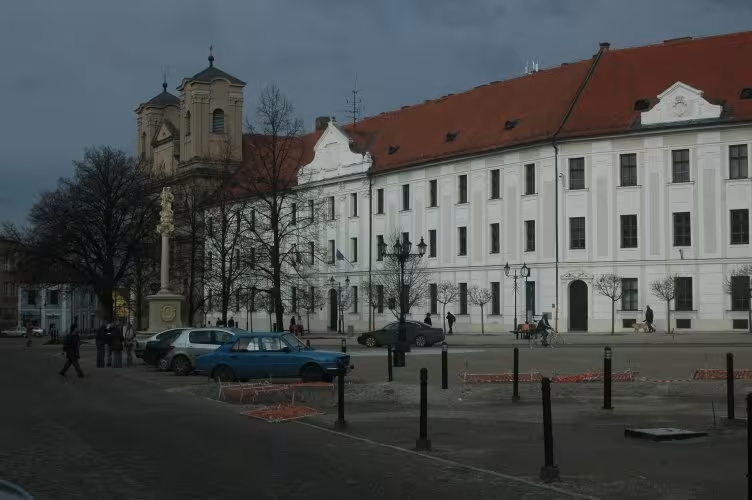

The historical view on the left is a visualisation generated by artificial intelligence and serves as inspiration.
Historical Milestones
- 1692
- The beginning of the construction of the Jesuit monastery in Skalica.
- 1693
- The beginning of the construction of the church of St. Francis Xaverský.
- 1724
- Complete the construction of the entire monastery and church area.
Restoration history
| Years | Type | Extent | Condition after restoration |
|---|---|---|---|
| 2015–2016 |
Obnova
jezuitský |
Časť obnovená komplexne | dobrý |
| 2010–2011 |
Obnova a reštaurovanie
jezuitský |
Komplexná | dobrý |
Source: Monuments Board of the Slovak Republic — open data, licence CC BY 4.0
Interesting facts
- Jesuit monastery in the village Skalica is a baroque building, which was founded in 1692. - The complex consists of two main objects, which are protected as a whole. - The monastery of Jesuits itself was built in the Baroque style between 1692 and 1724. - The area also includes the church of St. Francis Xaverský, which was founded between 1693 and 1724. - The monument has the status of a national cultural monument and is registered under number ÚZPF 216-727.
Guide
Show guide text
The text was prepared by artificial intelligence and has not been editorially reviewed. It may contain inaccuracies.
Welcome to Skalica, a city with a rich history and a unique atmosphere. Right now, you are facing one of the important monuments of this city, which is the Jesuit monastery. When you look at it, you will see a building in front of you that, by its presence, dominates the surroundings and testifies to the spiritual and cultural rivalry that prevailed in this area. Feel the peace that you spiritualize from this place, and let the atmosphere of this historical complex consume you.
The Jesuit monastery in Skalica represents an important fragment of the past, closely linked to the activities of the Society of Jesus. Although the exact chronology of its origin is not detailed in the available documents, we know that the Jesuit realms were a symbol of education, discipline and deep whirlpool within Europe and especially at our ends. The monastery was not just a place of prayer and perseverance in silence, but served as the center of intellectual development. At that time, Jesuit meant high levels of education, knowledge of foreign languages, and the ability to conduct philosophical discussions, making this place an important point on the maps of regional cultural life.
Now take a closer look at the construction itself. When you perceive its overall form, note the harmony and stability that the building unleashes. Look at the facade and see how architecture connects to the surrounding area. Although we do not know exactly who the architects who designed and implemented the project, it is clear that they were people who understood the principles of functionality and representativeness. Follow the lines of the building and see how the spirit of the time in which it originated manifests itself. Every detail, from the layout of the windows to the shape of the walls, speaks of the need to create a space that is both ascetic and dignified enough for the needs of the religious community.
Let us now consider the people who walked in these corridors. Although the specific names of historical personalities associated with this particular monastery are not mentioned in our records, we can imagine hundreds of monks, teachers, and students who spent their days here. Imagine morning prayers, whispering Latin texts in libraries, and a strict regime that defined the lives of every member of the community. It was these anonymous messengers of science and faith who shaped Skalica's identity and helped to link it to the wider European context. Their presence in the city meant that Skalica was not only a commercial or administrative centre, but also a place where answers to the basic questions of existence were sought.
Perhaps now you will wonder what happened in these walls behind the geschlossen door. That's where the gewisse myry's mystery lies. Monastery lives were often bawled before the public's eyes, creating an aura of mystery. What happened in silent cells or during the night talks about theology and philosophy remained many only in the memory of those who lived there. It is this unfamiliarity and the absence of detailed records of every step within this building that gives the mist a certain charm. It's like an open book that lacks some pages, and we have to complement it with our own imagination and respect for history.
Now, when you look at the building as a whole again, watch how silence and history work together. It is a place that forces us to slow down the pace, to stop for a while with the course of everyday life and to think about what remains after generations of people. The Jesuit monastery in Skalica witnesss the changes that have passed through this city and remains a stable point in the stream of time.
I hope this short trip to the past has helped you to better perceive the importance of this place. Now I invite you to go through the surroundings in peace, to see the details of the facade and to follow the atmosphere of this historical area. Skalica has many other gems waiting for your discovery, so I invite you to continue your journey and further explore the beauty of this city. Thank you for your attention and I wish you a pleasant rest of the day in discovering history.
Tips for visitors
The best time to visit is early in the morning or late in the afternoon, when sunlight is not so intense and the detailed work on the monastery facade stands out. The seasons are best suited for spring and early autumn, when the weather is mild and the surroundings are either blooming or colored with autumn leaves. In the summer months, the yard and interiors can be bitter, cold and slippery in winter.
You can reach Skalica by car or public transport; check the current connection in the travel search engine. It is only a short walk from the city center to the Jesuit monastery, so it is most convenient to come to Skalica and continue on foot.
The monastery offers suitable topics for photographers especially in the morning or evening, when the low sun creates long shadows and highlights the texture of walls and architectural details. The best places are the main facade with Baroque elements, side parts and space in front of the entrance, where you can get an overall view of the construction. Avoid sharp midday light, which creates burning spots and deep shadows under windows and ledges.
With us we recommend taking comfortable towels suitable for walking on the floor, clothing according to current weather, water bottle and camera or mobile phone with sufficient memory. For families with children it is advisable to come with a stroller only if the road is equal, otherwise it is better to carry the baby in the carrier. On the spot, you and your children can look for architectural details and look for symbols on the facade, making the visit more fun and educational.
There is no specific location in the area within 30 minutes of walking or driving in the provided documentation, so it is not possible to provide verified tips for trips. We recommend to follow the information of the town office in Skalica or regional tourist information, where you can find current offers in the nearest area.
Frequently asked questions
Can the monument be visited?
Religious buildings are usually open mainly during services; at other times a visit is normally arranged with the parish or the operator. We have not verified specific times.
Where is the monument?
Location: Námestie slobody 99/3, 5, Skalica, Trnavský kraj. The map on this page shows the exact spot.
Why is the monument protected?
It is listed in the Central List of the Monuments Fund of the Slovak Republic as a national cultural monument (ÚZPF no. 216-727).
For children
Imagine finding yourself in time about 334 years ago. The year 1692 is written, and there is a completely different world around it than today. No cars, no cell phones, no glow screens. The air smells smoke from wooden houses and on dusty roads rides horse-drawn carriages. It is in this turbulent time that a magnificent building begins to grow in the picturesque Skalica. It's a Jesuit monastery. Imagine it as a huge, strong fortress to provide refuge and become a center of great secrets. Who actually inhabited these mysterious zdi? The monks lived here, more precisely the Jesuits.
Nearby
🏰 Historic sites (182)
- Jezuitský klášter 0.0 km web
- Mariánsky stĺp 0.0 km
- Kultúrny dom 0.1 km web
- Ľudovít I. Veľký 0.1 km
- František Víťazoslav Sasinek 0.1 km
- Záhorske múzeum 0.1 km
- Ľudovít Okánik 0.1 km
- Daniel Gabriel Lichard 0.1 km
- Stará radnica - Ratúz 0.2 km Jatočná 2403/23
- Klášter paulínů 0.2 km Potočná 199/21 web
- sv. Ján Nepomucký 0.2 km
- sv. Florián 0.2 km
- Klášter milosrdných bratří 0.2 km web
- Obetiam 1. svetovej vojny 0.3 km
- Rotunda sv. Juraja 0.3 km Potočná 209/1 web
- Panna Mária 0.4 km
- sv. Ján apoštol 0.4 km
- sv. Mária Magdaléna 0.4 km
- Oslobodenie Skalice 0.4 km
- Viktor Savič Pľjušť 0.4 km
🍽️ Restaurants and dining (218)
- Restaurant u Radnice 0.1 km +421 917 387 547 web
- Zmysly 0.1 km
- Royal kebab & pizza 0.1 km
- Hostinec u Čambalu 0.2 km
- Pizza do Domu 0.2 km +421 915 484 565 web
- Piazza Doro 0.2 km +421 948 787 757
- Kafé Knižnica 0.2 km
- Budvarka 0.2 km +421 918 457 175; +421 905 658 474 web
- Do bodky 0.3 km +421 915 747 404
- 2Pots 0.3 km
- Café Celio 0.3 km
- Pizzeria Sardinia 0.3 km +421 944 230 584
- Club cafe 0.3 km
- Reštaurácia Srdiečko 0.3 km +421 917 980 049 web
- Babičkina kuchiňa 0.3 km +421 905 899 711
- Lotus Bistro 0.3 km
- Hospoda U Hasičú 0.4 km
- Budějovický Budvar 0.4 km
- U Viktora 0.5 km
- Bernard 0.5 km
🏨 Accommodation (63)
- Hotel Tatran 0.1 km web
- Hotel sv.Michal 0.2 km
- Penzión Club 0.3 km +421 911 332 418 web
- Penzión na Potočnej 0.3 km
- Hotel Sv. Ľudmila 1.3 km +421 346 977 777 web
- Penzión nad Skalicou 1.6 km +421 903 432 271 web
- Ovocinár Hrehor 2.5 km +421 903 247 615 web
- Penzión 2.7 km
- Ubytovanie Lábadi 4.9 km +420 723 976 744 web
- Chata Amor 5.5 km +421 908 550 285 web
- Dom turistiky 6.0 km +421 908 505 892
- Penzión u Barborky 6.1 km +421 914 175 095 web
- Penzión Roxy 6.1 km +421 911 146 964 web
- Penzión Valo 6.2 km
- Hotel San 6.2 km +421 34 668 3387;+421 34 668 4187 web
- Penzión na Majírkoch 6.2 km
- Penzión AIR 6.3 km
- hotelový dům Eva 6.5 km
- Penzion Jana 6.8 km web
- Gas Truck centrum 7.0 km web
🚲 Rentals and sport (46)
- Cyklo BeeF 0.2 km
- Zavkol 0.4 km +421908 520 205
- LHBike 0.6 km +421346649326
- Hertlsport 0.8 km +421 34 664 8495 web
- Barbar športové centrum 1.0 km
- TM Sport 1.2 km +421 948 797 345 web
- Sportisimo 1.3 km web
- Přístav Sudoměřice 3.0 km
- Prístav Skalica 3.1 km web
- Prvá plavebná 3.1 km +421 907 999 812 web
- Sudoměřice 3.1 km
- Přístav Rohatec 4.1 km web
- Přístav Rohatec – kolonie 4.7 km
- Petrov 5.4 km
- Přístav Petrov 5.6 km
- TJ Iskra Holíč 5.8 km web
- Letné kúpalisko Zlatnícka dolina 5.8 km web
- Přístav U jezu Hodonín 6.2 km
- Cyklo shop & service 6.2 km
- Požičovňa člnov 6.6 km +421 907 657 884 web
🥾 Hiking and nature (108)
- Kníhtlačiareň Škarniclovská 0.1 km Škarniclovská 155/3
- Lekáreň Milosrdných bratov 0.2 km web
- Kalvária 0.4 km web
- Kalvária 0.4 km
- Hájek 1.2 km
- Hájik 2.8 km
- Veterník 3.4 km
- Očanská studnička 3.5 km
- Petrovský areál vinných sklepů Plže 4.7 km
- vinné sklepy Plže 4.7 km
- Šibenica 5.4 km
- Park pri manufaktúre 6.3 km Bernolákova
- Turecký stôl 6.4 km
- Kotly 6.5 km
- Hrebeň 6.7 km
- Zámocký park 6.8 km Zámocká web
- Malý Rink 7.1 km
- Mírové náměstí 7.3 km
- Žerotín 7.4 km
- Nedbalka 7.4 km
Thematic route
A Jesuit monastery in Skalica
1. Jesuit Monastery Type: Historical sacral building Why it is worth visiting: The Baroque complex in Skalica is connected with the Jesuit order. Its architecture and atmosphere reflect the history of the place.
2. The monastery area and courtyard Type: Outdoor space Why it is worth visiting: The surroundings of the monastery and its courtyard provide a nice place to walk overlook the historical facades.
3. Interior exposures and tower Type: Exhibition / Prospect Why it is worth visiting: Inside the monastery you can admire preserved spaces and architectural details. From accessible parts it is possible to view the surrounding countries.
-- - Corrections: - Deleted unsubstantiated evaluations (unique view). - Abbreviated long symmetries ("offers a valuable view') → They provide a safe place. - The sentence without information ("Whitness of the Time") is deleted. - Synonyms → The atmosphere. - Reworded bohemisms ('open parts') → The accessible parts. - Text shortened by cotton, but retained factual information.
Seasonal recommendations
A Jesuit monastery in Skalica
In spring, the neighborhood of the monastery awakens into a new life. Fresh greenery and flowering trees in the gardens create suitable conditions for peaceful walks. Spring sun radiates historical facade, which is appreciated mainly by photographers. The interior of the monastery is inaccessible to the public, but the exterior offers plenty of space to admire architecture. When visiting, it is advisable to dress up in a light windbreaker and strong shoes, because morning dew and variable weather in Trnava region can surprise you. It is best to visit the monastery in the morning when the surrounding area is empty.
In summer, a warm atmosphere develops in Skalica. Sun rays last longer until evening, allowing long walks in historical places. The surroundings of the monastery are colorful colors and dense trees provide a pleasant shade. The best times to admire the exterior are early morning or evening when light is softer. It is advisable to prepare the walk with air clothes, sunglasses and plenty of liquids. In the summer months there are more visitors in the area, which gives the town a more vibrant character.
Autumn brings a peaceful mood to Skalica. The leaves around the monastery are colored yellow, orange and brown, creating a picturesque scene for walking. The low autumn sun creates long shadows and soft light, which gives the historical walls depth. With the arrival of colder weather, it is advisable to wear warmer clothing, waterproof footwear and layered clothing. It is best to visit the monastery in the afternoon, when the autumn rays most beautiful to see through trees.
Winter adds a quiet atmosphere to the monastery, sometimes reinforced by a snow cover. Short days and early twilight mean that light is lost quickly. During the Christmas season there is a quarter chamber and silence. During the visit it is necessary to dress in winter shoes, hats, gloves and a quality coat, as temperatures in the region fall below freezing point. The best time to explore is noon, when daylight reaches its maximum and a walk through the freezing air provides a strong visual experience.
Visualisations and artistic views


The visualisations are generated by artificial intelligence and serve as inspiration.
Photographs from the area
Real photos taken near the monument


Source and licence are given for each image.
Visitor Tips
No tips yet. Be the first!
Log in and add your tip.
Location on Map



Visitor photos
No photos yet. Be the first to add a photo from your visit!
Log in and add your photo or leave a rating.
You get more points for a visit verified in the app — we can tell from the GPS that you are there.
Reviews and comments