








Rotunda St. Juray Church
St. George's Rotunda in the village of Skalica in Trnava region is an early Romanesque church apparently from the 11th century. It is a central circular structure with horseshoe apsid and baroque dome.
The building was created in early-morning style as a church on the castle. It served as an ownership church and had a small area for burial. Originally the building was lower and had a flat roof.
Architecturally it is a central circular structure with horseshoe apsida and horse, which have preserved the original romance form. On the outside of the apsid are visible traces of two Romanesque windows. Masonry is built of small sandstone blocks. Later, the building was rebuilt in Gothic and Baroque style.
The development of the object is related to the historical status of the city. After 1372, when Ľudovít I. promoted Skalica to the royal city with the right walls, the rotunda was built above the wall level. The extension uses smaller stones. In 1650 a dome was built with lateral and a crypt was created in the middle of the rotunda.
Inside are wall paintings from the end of the 15th century. The frescoes illustrate two scenes from the legend of St. George fighting the dragon and complementing their coats of arms. Paintings were restored in 1996.
During the fighting in 1945 the building was damaged. The repair took place in 1949, when the outer plasters were removed. In 1970 the monument was declared a national cultural monument, followed by archaeological, restoration and artistic historical research.
The rotunda is currently in the Záhorie Museum in Skalica. Since 2002 there has been a permanent exhibition focused on the presentation of monuments and its historical development.
The construction is accompanied by early-romantic elements and later Baroque additions.
Tehdy a dnes
Drag the slider and compare how the monument might have looked when it was built with the view today.
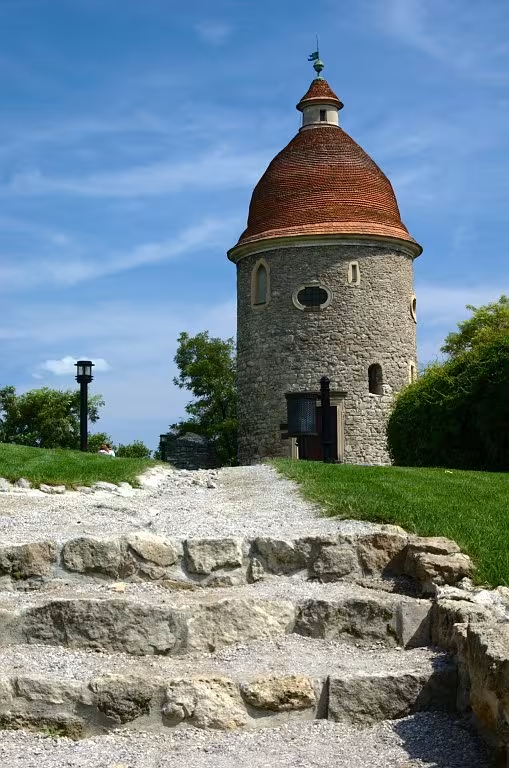

The historical view on the left is a visualisation generated by artificial intelligence and serves as inspiration.
Historical Milestones
- 1372
- putting the rotunda above the wall level after the rise of Skalica to the royal city
- 1650
- construction of a dome with lateral and crypt construction in the middle of the rotunda
- 1949
- repair after damage from 1945 and removal of external plasters
- 1970
- declaration as a national cultural monument and carrying out comprehensive research
- 1996
- restoration of wall frescoes
- 2002
- installation of permanent exhibition of the Záhorie Museum in Skalica
Restoration history
| Years | Type | Extent | Condition after restoration |
|---|---|---|---|
| 2017 |
Obnova
Rotunda sv.Juraja |
Čiastočná | dobrý |
Source: Monuments Board of the Slovak Republic — open data, licence CC BY 4.0
Interesting facts
- The church is probably from the 11th century, which originated as a church on the castle. - The building is a central circular building with horseshoe apsidou, while the masonry is built of small sandstone blocks. - After 1372 the rotunda was built above the wall level and in 1650 a dome with lateral and crypt was built. - In the interior there are restored wall paintings from the end of the 15th century, which illustrate the legend about St.
Guide
Show guide text
The text was prepared by artificial intelligence and has not been editorially reviewed. It may contain inaccuracies.
Welcome to Skalica, a city with a rich history and a unique atmosphere. Right now you are facing one of the most valuable monuments of the entire Trnava region. In front of you is the Rotunda of St. George, a building that immediately binds attention to its appearance and simplicity. When you look at it, you may be impressed by its unusual shape and compact dimension, which bears stories from many centuries. It is a place where spirituality meets architecture and every stone bears witness to ancient times.
Let's go now together and dive into a deeper context and find out how this building originated. Saint George's Rotunda is not just an ordinary church, it is a Ranomanic building that probably dates back to the eleventh century. At that time it was formed as a small church on the castle, making it a strategic and spiritual point within the then settlement. Imagine this place almost a thousand years ago, when the rotunda was part of a fortified area and served as a place for prayer and attack to the locals.
Now that you are closer to changing the architecture of this building, note its basic form. It is a central circular structure, which is typical of the Early Romanesque rotundas. If you look at the back, you'll see a horseshoe apsid that completes this circular plan. Now pay attention to the material itself from which the building is built. If you approach the masonry, you will notice that it is built of small sandstone blocks. It is this detail that tells us about the craft skills of early medieval builders who used local raw materials to create a structure that has survived such a long time.
However, the history of this rotunda is dynamic and has undergone some fundamental changes that you can see today. One of the key moments occurred in 1372. During this period, Skalica was promoted to the royal city, which brought not only prestige but also the need to modify the city and its defence system. It was then that the rotunda was erected above the wall to be more visible and accessible.
Let us go further in time, until the middle of the seventeenth century. In 1650 the building went through another major transformation. At that time a dome was built with a lateral one, which now crowns the entire building and adds its characteristic silhouette. At the same time, a crypt was created in the middle of the rotunda, which added a new layer of mystery and meaning to the construction. These additions from 1650 are clear evidence of how the function and aesthetic of the church developed along with the needs of the times.
Although the specific names of architects or personalities that helped to build are now unknown, the building itself speaks for itself. He's a Witness of all the changes that Skalica has gone through. However, there are sadder moments in the history of this building. In 1945, the rotunda suffered damage, which was not removed until 1949. As part of this repair, external plasters have been removed, which allows us today to see the natural beauty of sandstone blocks that we discussed earlier.
Nyni, change your attention to a detail that may not be visible at first sight, but is key to this object. In 1970, Saint George's Rotunda was declared a national cultural monument. A comprehensive research has also been carried out during this period, which has helped professionals to better understand its origin and development. Another important step was the restoration of wall frescoes in 1996, thus preserving precious artistic details from inside the building.
You are now interested in one interesting thing that connects architecture with the museum mission. Since 2002, the rotunda has served as a space for permanent exposition of the Záhorie Museum in Skalica. It is a fascinating fact that the building, which began as an early Romanesque church on the castle, today serves as a place where the history of the entire region is preserved and presented. So it is the bridge between the spiritual past and the educational present.
The exact moment of its creation and identity of the first builders remains a mystery. Who exactly laid the foundation stones of this rotunda in the eleventh century? Why was this site chosen on the castle? These questions add charm to the construction work and make us think about the people who lived here thousands of years ago.
You stand before a building that has survived centuries, wars and regime changes. From a small church on the castle, through the superstructure at the time of the royal town, to today's museum exposition. It's all encoded in these sandstone walls and in the shape of a horseshoe apsy.
We're telling you now to go around the building in peace, see its atmosphere, and perhaps try to imagine what Skalica looked like when the rotunda was a new building in the city. Let your curiosity and details guide you. Thank you for sharing this short trip with us into the depths of history. We wish you a pleasant further stay in Skalica and pleasant discovering other beauties of this city.
Tips for visitors
We recommend St. George's Rotunda to visit in spring and summer, when the surroundings of the flower and the building are illuminated by natural light. Since it is a sacral building, visit it at a time suitable for quiet contemplation.
We recommend shoes suitable for walking around the historical centre and clothing corresponding to the character of the church.
For photography are suitable surrounding streets, which allow to capture the shape of the rotunda. The best light for exterior images is during morning or late afternoon hours when shadows are softer.
Families with children can connect the visit with a walk around the city. During it you can explain to them the meaning of stone buildings and show them the differences between the shape of the rotunda and ordinary churches.
Frequently asked questions
Can the monument be visited?
Religious buildings are usually open mainly during services; at other times a visit is normally arranged with the parish or the operator. We have not verified specific times.
Where is the monument?
Location: Potočná 209/1, Skalica, Trnavský kraj. The map on this page shows the exact spot.
Why is the monument protected?
It is listed in the Central List of the Monuments Fund of the Slovak Republic as a national cultural monument (ÚZPF no. 216-718).
For children
Close your eyes and imagine you're passing through time. You travel deep into the past, exactly 826 years back. The air is clean, there are no cars running anywhere, and instead of asphalt roads there are just mud trails and dense forests. You just landed in the town of Skalica, when things were going to last thousands of years. Where you stand now, there used to be a castle. Imagine it as such a safe base surrounded by walls where people felt protected. Right here, in the middle of this fortified place, a small, but very strange, building came out.
Nearby
🏰 Historic sites (182)
- Rotunda sv. Juraja 0.0 km Potočná 209/1 web
- Panna Mária 0.1 km
- sv. Ján apoštol 0.1 km
- sv. Mária Magdaléna 0.1 km
- Obetiam 1. svetovej vojny 0.1 km
- Daniel Gabriel Lichard 0.2 km
- Klášter paulínů 0.2 km Potočná 199/21 web
- sv. Ján Nepomucký 0.3 km
- Jezuitský klášter 0.3 km web
- Mariánsky stĺp 0.3 km
- sv. Florián 0.3 km
- Kultúrny dom 0.4 km web
- Ľudovít I. Veľký 0.4 km
- František Víťazoslav Sasinek 0.4 km
- Stará radnica - Ratúz 0.4 km Jatočná 2403/23
- Záhorske múzeum 0.4 km
- Ľudovít Okánik 0.4 km
- Oslobodenie Skalice 0.5 km
- Klášter milosrdných bratří 0.5 km web
- Viktor Savič Pľjušť 0.5 km
🍽️ Restaurants and dining (218)
- Café Celio 0.1 km
- Hostinec u Čambalu 0.1 km
- 2Pots 0.1 km
- Do bodky 0.2 km +421 915 747 404
- Pizzeria Sardinia 0.2 km +421 944 230 584
- Piazza Doro 0.3 km +421 948 787 757
- Babičkina kuchiňa 0.3 km +421 905 899 711
- Reštaurácia Srdiečko 0.3 km +421 917 980 049 web
- Royal kebab & pizza 0.3 km
- Pizza do Domu 0.3 km +421 915 484 565 web
- Club cafe 0.3 km
- Restaurant u Radnice 0.3 km +421 917 387 547 web
- Lotus Bistro 0.4 km
- Zmysly 0.4 km
- Kafé Knižnica 0.4 km
- Budvarka 0.4 km +421 918 457 175; +421 905 658 474 web
- Hospoda U Hasičú 0.6 km
- Budějovický Budvar 0.7 km
- U Viktora 0.8 km
- Bernard 0.8 km
🏨 Accommodation (62)
- Hotel sv.Michal 0.3 km
- Penzión Club 0.3 km +421 911 332 418 web
- Hotel Tatran 0.4 km web
- Penzión na Potočnej 0.6 km
- Hotel Sv. Ľudmila 1.5 km +421 346 977 777 web
- Penzión nad Skalicou 1.8 km +421 903 432 271 web
- Ovocinár Hrehor 2.8 km +421 903 247 615 web
- Penzión 2.9 km
- Ubytovanie Lábadi 4.6 km +420 723 976 744 web
- Chata Amor 5.8 km +421 908 550 285 web
- Dom turistiky 5.9 km +421 908 505 892
- Penzión u Barborky 6.0 km +421 914 175 095 web
- Penzión Roxy 6.1 km +421 911 146 964 web
- Penzión Valo 6.1 km
- Hotel San 6.2 km +421 34 668 3387;+421 34 668 4187 web
- Penzión na Majírkoch 6.2 km
- Penzión AIR 6.3 km
- hotelový dům Eva 6.3 km
- Gas Truck centrum 6.8 km web
- Penzion Budvarka Hodonín 6.9 km Měšťanská 1174/10 +420602727523
🚲 Rentals and sport (46)
- Cyklo BeeF 0.2 km
- LHBike 0.6 km +421346649326
- Zavkol 0.7 km +421908 520 205
- Hertlsport 1.1 km +421 34 664 8495 web
- TM Sport 1.2 km +421 948 797 345 web
- Barbar športové centrum 1.3 km
- Sportisimo 1.3 km web
- Prvá plavebná 2.8 km +421 907 999 812 web
- Prístav Skalica 2.8 km web
- Přístav Sudoměřice 2.9 km
- Sudoměřice 3.0 km
- Přístav Rohatec 3.8 km web
- Přístav Rohatec – kolonie 4.5 km
- Petrov 5.4 km
- Přístav Petrov 5.6 km
- TJ Iskra Holíč 5.7 km web
- Přístav U jezu Hodonín 6.0 km
- Letné kúpalisko Zlatnícka dolina 6.1 km web
- Cyklo shop & service 6.2 km
- Požičovňa člnov 6.6 km +421 907 657 884 web
🥾 Hiking and nature (107)
- Kalvária 0.1 km web
- Kalvária 0.1 km
- Kníhtlačiareň Škarniclovská 0.2 km Škarniclovská 155/3
- Lekáreň Milosrdných bratov 0.5 km web
- Hájek 1.4 km
- Hájik 3.1 km
- Veterník 3.6 km
- Očanská studnička 3.7 km
- Petrovský areál vinných sklepů Plže 4.7 km
- vinné sklepy Plže 4.7 km
- Šibenica 5.3 km
- Park pri manufaktúre 6.3 km Bernolákova
- Kotly 6.7 km
- Turecký stôl 6.7 km
- Hrebeň 6.8 km
- Zámocký park 6.8 km Zámocká web
- Mírové náměstí 7.1 km
- Nedbalka 7.2 km
- Malý Rink 7.3 km
- Park Sadová 7.3 km
Thematic route
As the list of surroundings is not completed, I propose a thematic route within the main monument area:
1. Rotunda St. George - Main monument and one of the oldest churches in Slovakia. It is a necessary stop because of its unique Roman architecture and historical value.
2. Interior rotunda - Indoor space with religious objects and altar. Visitors can experience the atmosphere of medieval sacral space.
3. The immediate area and courtyard - Outdoor surroundings of the church, which provides space for yearning and observation of the exterior of the building. The ideal place to shoot the entire building from different angles.
Seasonal recommendations
In spring, St. George's Rotunda in Skalica is surrounded by fresh greenery. The sun provides natural lighting during this period, which highlights the details of historical walling. It is recommended to visit the place in additional hours and wear layered clothes suitable for variable spring temperatures.
Summer months bring intense light and rich colors of nature, creating conditions to photograph the exterior of the building. Due to high temperatures, it is a good time early in the morning or later in the evening when it is quieter in the city. It is practical to choose light, breathable clothing and sun protection.
In the autumn, the colour of the leaves in the surrounding area contrasts with the stone structure of the rotunda. The low sun creates long shadows that add depth to construction. It is advisable to wear waterproof clothes and a warm sweater, especially in later hours of the day.
Zimą acts Rotunda St. George ascetically and peacefully, while snowmaking changes the appearance of the entire area. The atmosphere is quiet in advent time. Due to frost and humidity it is necessary to dress very warm and waterproof clothing and shoes with good grip to avoid slipping on frozen origin.
Visualisations and artistic views


The visualisations are generated by artificial intelligence and serve as inspiration.
Photographs from the area
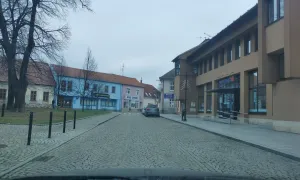
Real photos taken near the monument


Source and licence are given for each image.
Visitor Tips
No tips yet. Be the first!
Log in and add your tip.
Zdroje a literatura
The factual basis for this text was the article na Wikipedii, whose authors are Wikipedia contributors. The article is available under the licence CC BY-SA 4.0.
Location on Map
More monuments – Skalica
Show all in the town


Visitor photos
No photos yet. Be the first to add a photo from your visit!
Log in and add your photo or leave a rating.
You get more points for a visit verified in the app — we can tell from the GPS that you are there.
Reviews and comments