








ľudový dom Vernacular house
In the village Veľké Leváre, Bratislava region, there is a folk house, declared a national cultural monument. The building comes from the 18th century and represents an example of folk architecture.
The area of the Monument Office of the Slovak Republic with number ÚZPF 2202 consists of one building, namely the folk house with catalog number 2202/1. The building has brick construction.
The monument is located at No. 79 in the village Veľké Leváre, coordinates 48.50169, 16.99411. The object is protected within the list of national cultural monuments.
A visit to this object allows you to get acquainted with historical architecture in a given location and is part of the cultural heritage of Veľké Leváre.
Tehdy a dnes
Drag the slider and compare how the monument might have looked when it was built with the view today.
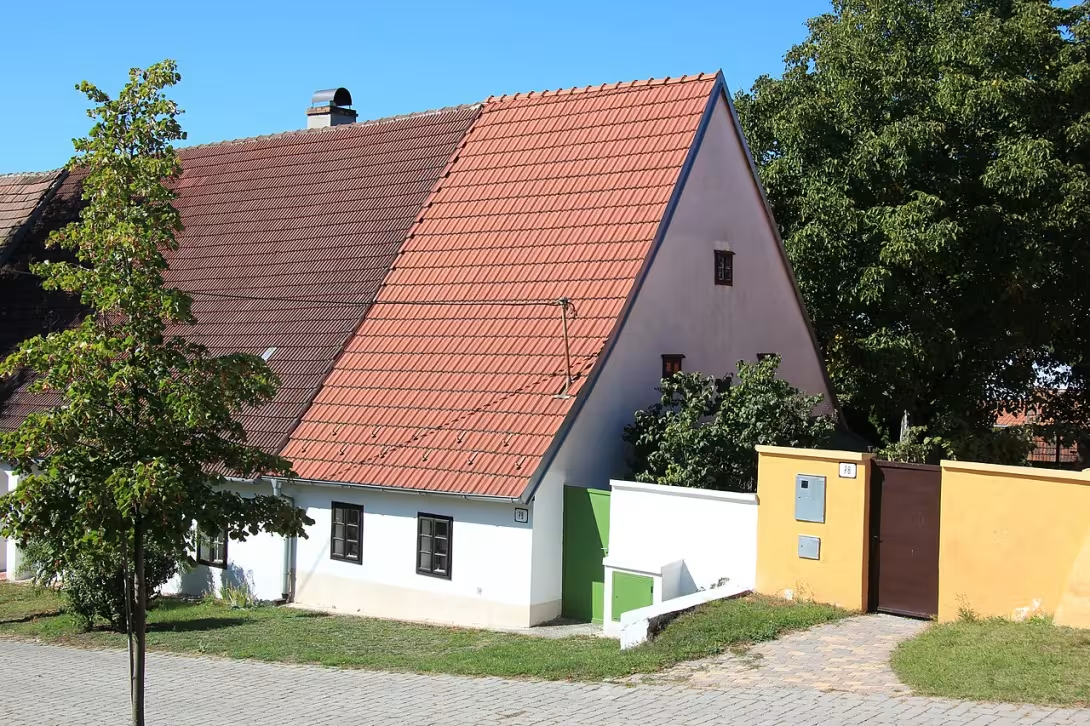

The historical view on the left is a visualisation generated by artificial intelligence and serves as inspiration.
Historical Milestones
- 18th century
- Creation of a brick folk house.
- 20th century
- Declaration of the object as a national cultural monument.
Guide
Show guide text
The text was prepared by artificial intelligence and has not been editorially reviewed. It may contain inaccuracies.
Welcome to the Great Lions. Right now you are standing in front of a place that carries the silent memory of generations. Before you lies a folk house, which is much more than a building of materials and wood. It is a relationship with our common past, a sympathetic witness to the everyday life of ordinary people whose names may have disappeared from memory, but their footprint in the country has been preserved in such buildings. When you look at this house, try turning off the noise of the present for a moment and imagine what this place looked like tens of years ago, perhaps hundreds of years ago. Feel the atmosphere of this environment, the silence of the surroundings and the feeling of peace that comes naturally from such traditional architecture.
Although the exact date of construction of this house is not known today, its very presence tells us much about the historical context of the region. This house was created at a time when architecture was not a question of great plans of well-known builders, but a result of the need, tradition and deep knowledge of nature. At the time, it was not built according to catalogs, but according to what dictated the terrain, available raw materials and the needs of the family that lived in the house. In Bratislava region, and specifically in this part, folk construction developed in accordance with the rhythm of nature and the requirements of the economy. The house was not just a place of rest, it was a center of work, a warehouse of crops and a shelter from winter. Every detail, every edge and every corner had their practical meaning.
Now, please look at the overall form of the building. Note its simplicity, which is also its greatest strength. In folk architecture, it was not about preaching, but about functionality and harmony with the surroundings. Look at the facade and see how the house fits into the country of the Great Levary. Notice the proportions of the building, the way it is settled on the plot, and note the details that may seem unimportant at first glance. It is in these tiny elements that the genius of anonymous builders hides, who withoutH academic education, but with great experience from practice, created a home that resisted time testing.
When you look into the details, think about who built this house. The architects of this work remained anonymous, but that is where the fascination of the folk house lies. It was not the signature of one person, but the result of the collective knowledge of the whole community. Building such a house was often a joint event involving neighbors, family, and friends. It was a work based on mutual assistance and trust. Each piece of material was selected with care, each joint was made to last generations. Now that you're following the lines of the house, you see basically the grip of the people who lived in this region long before us.
Although we do not know the names of the specific personalities that lived in this house, we can imagine the stories that took place here. Imagine the morning rising up at sunrise, the smell of baked bread, the discussions at the evening light of the lamp, and the children's laughter in the chambers. This house saw the joy of harvest, the worry of crop failure, the birth of new family members, and the departure of the elders. It's a silent archive of human destinies. Every wall, every floor and every threshold absorbed the emotions and daily cares of the people who found their harbor here. It is this unknownness of particular names that gives the place a special, almost mystical dimension. This house no longer belongs to one family, but it becomes a symbol of all the people who have built their lives in similar homes.
Perhaps you will now wonder what is most interesting about this house. The mystery is this quiet anonymity. In an era where every building today tries to be unique and every architect wants to be known, this folk house is a reminder of the time when the community was more important than the individual. The mystery remains the exact moment when the door closed behind the last original inhabitants in this house and when the living space became a memorial object. It is fascinating that the building, which was meant to serve only the basic necessities of life, survived many modern buildings and today forces us to stop and think about our values.
Look around you again. See how this house communicates with the surrounding area. In folk architecture there was no sharp difference between interior and exterior; life naturally flowed from house to court, from court to field and from field to forest. Everything was connected. This house is like an anchor that keeps us connected to the soil and the earth. In today's fast world, where we change everything every few years, the stability of this house is a refreshing contrast.
Before you crack this place, take the time to go around the house from all sides. Notice how his silhouette changes depending on the angle of view. Try to imagine how the voices of people in this house sounded in different seasons - from the spring awakening of nature to the deep wintering, when all piled up in the warmest part of the house.
The folk house in the Great Levary is not just a museum object. It is living proof that simplicity is often the highest form of sophistication. It is a reminder that home is not just a set of walls, but a place where memories are formed. We hope that this short trip to the past has helped you to better perceive the beauty and importance of traditional construction in our region.
Thank you for spending this time with us. Now we invite you to continue exploring the surroundings and look for further traces of history that secretly carries the country around you. Let yourself be guided by your curiosity and feel the silence that more than a thousand words tell you. We wish you a pleasant further journey and a peaceful meltdown in the atmosphere of this beautiful region. Goodbye.
Tips for visitors
The best time to visit the folk house is autumn, when the surrounding area is without leaves and the whole building can be seen. In summer, the surroundings are often overgrown, preventing a clear view of architectural details.
The distance from the main roads is a short pedestrian section, so there is no need to look for more distant garages.
Take strong shoes with you because the paths can be uneven or soily. In case of rainy weather, we also recommend a waterproof jacket, as not all parts of the area are covered.
In the morning and late afternoon, when the light is soft and does not create sharp shadows on wooden facades. The best angles to capture the whole house are from where the path leading to the entrance ends.
Local museums or historical centers of the villages are located in the vicinity half an hour distance. For families with children is a short walk along the sidewalks, where it is less busy and local greenery can be observed.
Frequently asked questions
Can the monument be visited?
This is a residential or farm building, not a museum with opening hours. Please view it from public space and respect the owners' privacy. We have no information about access to the interior.
Where is the monument?
Location: č. 79, Veľké Leváre, Bratislavský kraj. The map on this page shows the exact spot.
Why is the monument protected?
It is listed in the Central List of the Monuments Fund of the Slovak Republic as a national cultural monument (ÚZPF no. 106-2202).
For children
Imagine finding yourself in a completely different world at one point. No tablets, no videos on the Internet and no lights you turn on with one click. Just the silence, the smell of old wood and the fine dust dancing in the rays of sunlight.
This house is not just a building. It's a time machine that takes you to a time when people lived close to nature. The most important thing happened in the past in these walls and under the roof. There were whole families who shared every joy and every difficult moment.
Nearby
🏰 Historic sites (93)
- Habánske múzeum 0.0 km +421 918 504 919 web
- Zosnulým poľovníkom 0.3 km
- Zosnulým hasičom 0.3 km
- sv. Florián 0.3 km
- Ladislav Slovák 0.4 km
- Františka Lechnerová 0.5 km
- Najsvätejšie Srdce Ježišovo 0.6 km
- Trojičný stĺp 0.6 km
- Panna Mária 0.6 km
- Pamätník padlých v 1. svetovej vojne 0.6 km
- Obetiam 2. svetovej vojny 0.6 km
- sv. Ján Nepomucký 0.7 km
- Posol Božského srdca Ježišovho 0.7 km
- sv. Vendelín 0.8 km
- Oslobodenie obce a SNP 0.8 km
- Kaštieľ Veľké Leváre 0.8 km
- Anton Štefánek 1.0 km
- sv. Florián 1.6 km
- sv. Vendelín 1.6 km
- sv. Anton Paduánsky 1.7 km
🍽️ Restaurants and dining (156)
- Šenk u Habánú 0.1 km
- Pálenica Kafe Bar 0.5 km +421948 526 948 web
- Verde 0.7 km +421 908 155 773
- Fajn shop café 0.8 km
- Hostinec U Gazdu 1.7 km
- MASH 1.9 km
- Kotva 2.9 km
- Bufet Vokle 3.0 km
- Bufet u Komára 3.1 km +421903430813
- Motel M 5.2 km +421347724384 web
- Dante 5.3 km +421 34 77 99 080 web
- Cukráreň za Vodú 5.6 km +421 948 427 302 web
- Pod Kostolom 6.1 km +421 918 693 577 web
- Matelko 6.2 km
- Felix Pizza 6.2 km +421 944 202 803
- Na hrišti 6.2 km
- Čermák 6.3 km
- Ajka 6.3 km
- Žaba 6.3 km +421 903 262 515 web
- Fontána 6.4 km
🏨 Accommodation (25)
- Autokemp Rudava 3.1 km Rekreačná oblasť Rudava +421 902 165 427 web
- Motel M 5.2 km +421347724385 web
- Dante 5.3 km +421 34 77 99 080 web
- Záhoran 6.0 km
- Špek 6.3 km
- Hotel Tatra 7.3 km Záhorácka 1895/5 +421 949 816 049 web
- Hotel Atrium 7.4 km Zámocká 65/1 +421 34 772 31 61
- Šport aréna Malacky 7.6 km +421 904 672 352 web
- WWW agrostav 7.9 km +421 910 314 615
- Fine restaurant & apartments 8.1 km +421 917 917 916 web
- TAM Autohof 8.7 km +421903260364 web
- 3 Duby 8.8 km +421 908 746 049
- Banarka penzón 9.7 km
- Penzión Zuzana 9.8 km +421347726788 web
- Banarka 9.8 km
- Banarka 9.8 km
- Ubytovňa 9.9 km Továrenská 6116/39 +421905445542
- Per Tutti 10.0 km +421 902 488 537 web
- Penzión u Tonky 10.7 km +421918614003 web
- Ubytovňa 11.0 km
🚲 Rentals and sport (16)
- Telocvičňa 6.3 km Skuteckého 1271/55A
- Kolo Sport 7.0 km 1. mája 12 +421 948 015 159 web
- Lezecká stena 7.3 km +421 911 392 666 web
- Malina 7.3 km Sasinkova 901/2 +421 911 392 666 web
- Krytá plaváreň 7.3 km +421 911 392 666 web
- Šport aréna Malacky 7.6 km Na píle 1 +421 904 672 352 web
- Cyclo 7.7 km Radlinského 2432/20 +421343811959 web
- Augustín Král - Cyklošport 7.8 km +421 905 507 788;+421 944 139 979
- Mestské kúpalisko Malacky 7.9 km web
- Sportisimo 8.1 km Javorová 1 +421 914 323 177 web
- Jericho Bike 8.1 km Brezová 2 +421 950 431 016 web
- Tenisový klub Moravský Svätý Ján 9.8 km +421 908 565 950 web
- Prístavisko Gajary 10.3 km
- Sport Röhm 13.2 km
- Sport Böhm 13.4 km Hauptstraße 11a +43 2535 3219
- Boxerňa Rohožník 13.9 km
🥾 Hiking and nature (57)
- Moravný vŕšok 3.1 km
- Malá hôrka 4.4 km
- Vŕšok 4.8 km
- Park športu, kultúry a oddychu 5.3 km
- Centrálny park 5.5 km
- Gašparov vŕšok 5.6 km
- Bahience 6.0 km
- Vŕšok 6.0 km
- Vahadlová studňa Krajní 6.2 km
- Pamätná izba Martina Benku 6.2 km web
- Teplica 6.3 km
- Simperlberg 6.3 km
- Rodný dom Martina Benku 6.3 km Hlavná 198/59 web
- Šuterňa 6.5 km
- Železná opona 7.9 km
- Tančibok 8.0 km
- Weinpresse 8.3 km
- Jazerské vŕšky 8.5 km
- Orlovské vŕšky 8.8 km
- Goldberg 8.8 km
Thematic route
Route of folk house in Great Levary
1. Folk House - the destination of the route where cultural and social events take place. 2. St. Martin's church - neo-baroque church from the 18th century in front of the folk house. 3. Castle - ruins from the 17th century near the folk house, available on foot.
The route is suitable for visitors who want to know the history and culture of the Great Levers.
Seasonal recommendations
Seasonal recommendations to visit the folk house.
Memory: folk house (Folk House), Veľký Leváre, Bratislava region
JARO: The house is surrounded by flowering trees and green vegetation. Practical advice: visit the house from 9:00 to 5:00, as there are many people here. Comfortable clothing and shoes are recommended.
LETO: The house is surrounded by flowering vegetation. Practical advice: visit the house from 9:00 to 6:00, as there are many people here. Light clothes and shoes are recommended.
SUBSIDISATION: The house is surrounded by forest trees and green vegetation. Practical advice: visit the house from 9:00 to 4:00, as there are many people here. Warm clothing and shoes are recommended.
ZIMA: The house is surrounded by snow and green vegetation. Practical advice: visit the house from 10:00 to 3:00, as there are many people. Warm clothing and shoes are recommended.
Visualisations and artistic views


The visualisations are generated by artificial intelligence and serve as inspiration.
Photographs from the area
Real photos taken near the monument


Source and licence are given for each image.
Visitor Tips
No tips yet. Be the first!
Log in and add your tip.
Location on Map
More monuments – Veľké Leváre
Show all in the town


Visitor photos
No photos yet. Be the first to add a photo from your visit!
Log in and add your photo or leave a rating.
You get more points for a visit verified in the app — we can tell from the GPS that you are there.
Reviews and comments