

st. Imrich church Church
St.Imrich church in Bytčica in Žilina is a national cultural monument from 1844. It is a classicistic single-ship building, which is part of the parish Bytčica.
The building was built in the first half of the 19th century, namely 1844. It is registered by the Monument Office of the Slovak Republic under number ÚZPF 1328.
Architecturally, it is a one-ship church with a flat presbytery closure. Presbytér is finished with a spring vault, while the boat is covered with a shallow Czech vault. On the north and south side there are thermal windows. Facades are divided by pilasters with a Roman head and ends with a roof ledge. The main façade contains the entrance portal, above which is in a deep area with a striped rustic and crowned ledge with a tower located a thermal window between flat pilasters.
The interior is equipped with classicistic equipment from the mid-19th century. The main altar consists of wall painting and oil painting on canvas. An illusive architecture and an image of St. Imrich kneeling in front of the statue of the Virgin Mary is on the wall of the sanctuary. On the classically painted illusive wall there is an image of St. Imrich on the canvas. Other furnishings from the same period are the pulpit with the image of the Good Shepherd, the wooden classicistic baptistery and the stone saint.
St. Imrich's church is a preserved example of classicalism from the mid-19th century.
Tehdy a dnes
Drag the slider and compare how the monument might have looked when it was built with the view today.
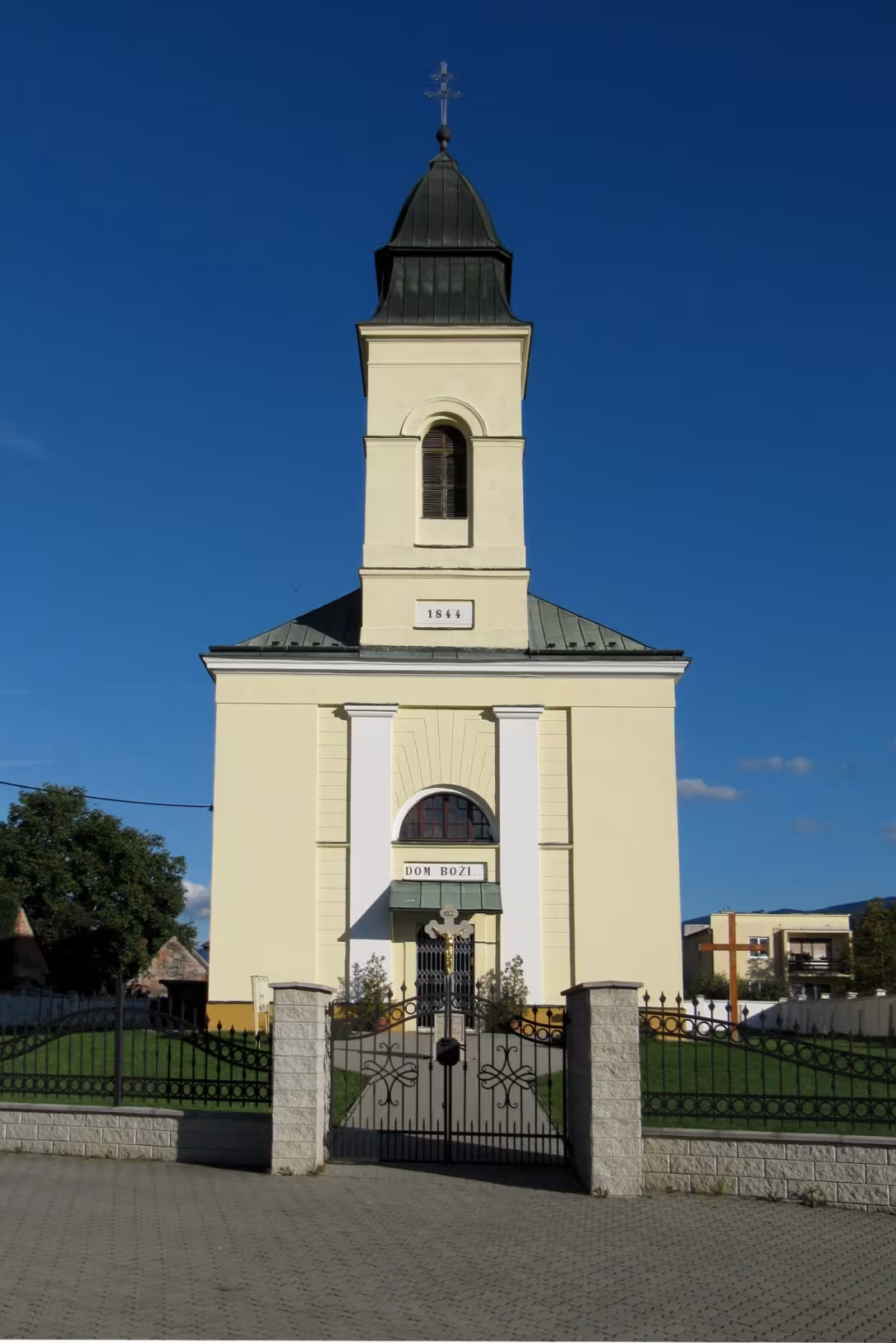
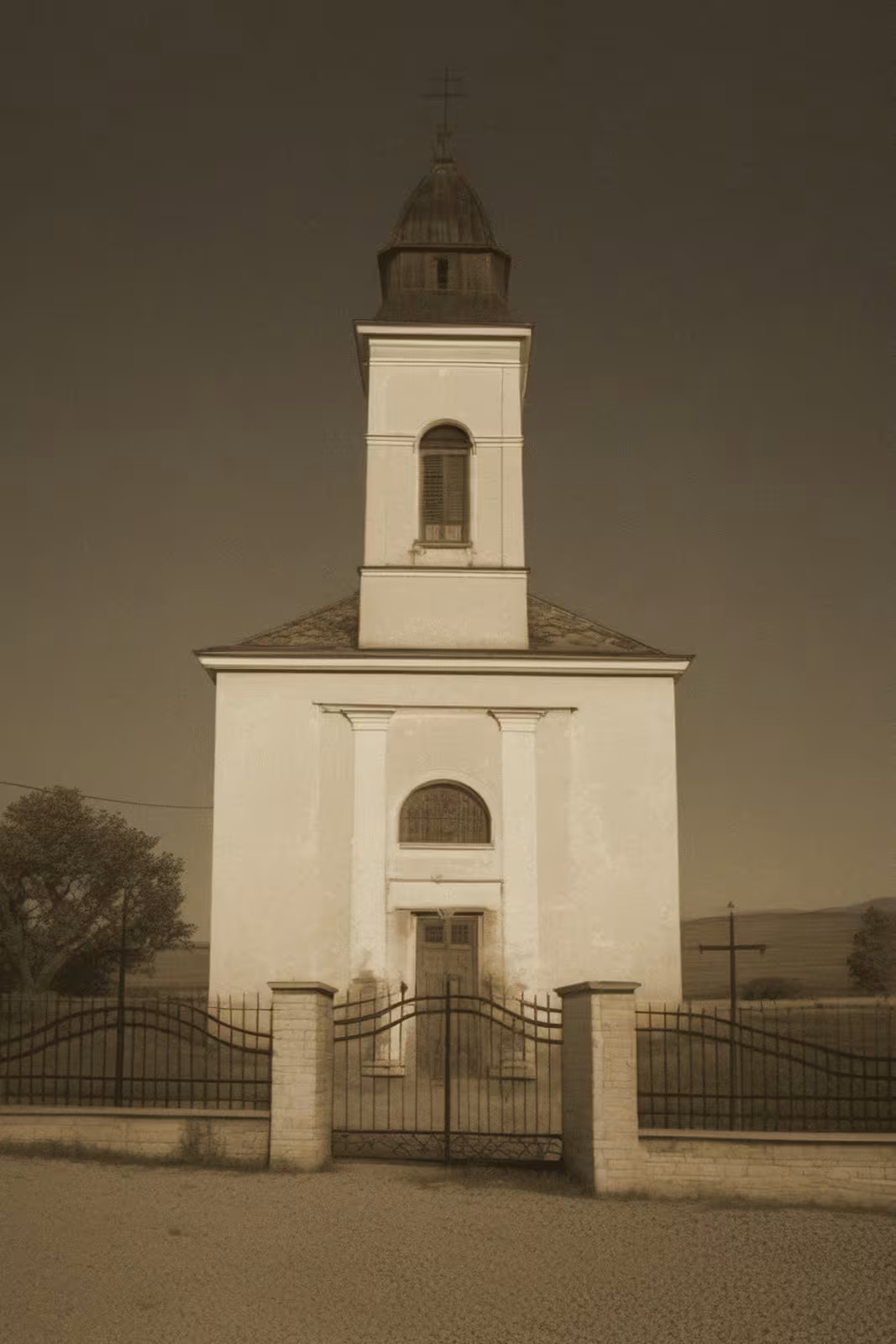
The historical view on the left is a visualisation generated by artificial intelligence and serves as inspiration.
Historical Milestones
- 1844
- Building of the classicistic church of St. Imrich in Bytčica
- 1844
- Interior construction with classicistic equipment and altar
Interesting facts
- St. Imrich church in Bytčica is a national cultural monument from 1844. - It is a classicistic single-ship building, where the boat is covered with a shallow Czech vault and presbytér by a spring vault. The main altar consists of wall painting and oil painting on canvas. - An illusive architecture and an image of St. Imrich kneeling in front of the statue of the Virgin Mary is on the wall of the sanctuary. - The interior is complemented by a classicistic pulpit with the image of the Good Shepherd, a wooden baptistery and a stone saint.
Guide
The guide was voiced by a synthetic voice created by artificial intelligence.
Show guide text
The text was prepared by artificial intelligence and has not been editorially reviewed. It may contain inaccuracies.
Welcome to Bytčica. Right now, you are standing in front of a building that is a silent witness to local history and spiritual tradition. In front of you is the church of St. Imrich, a building that by its presence gives this place peace and a sense of stability. When you look at it, you may, for example, be impressed by its balanced form and the peaceful expression typical of the period in which it originated. Look carefully at the overall impression of this building, which combines simplicity and dignity of religious architecture.
Now let's rush into the past to understand how this place was created. St. Imrich's church was built in 1844. Imagine the world in which people lived in the mid - 19th century. It was a time of change, but also a time of stability within the local community. It was this year that not only the building itself was created, but also the entire interior with its classicistic equipment and altar. Although the names of the specific architects who designed the project remained unknown at the time, their work has survived for centuries and still serves visitors and local residents. It is fascinating to think that so much time has passed since the first stones were laid, but the building still stands as a national cultural monument.
now I want you to focus on the architectural details. If you look at the overall concept, you will find that it is a classicistic single-ship structure. Classicism is characterized by a search for harmony and a return to the principles of antiquity, which manifests itself in the cleanliness of lines and the absence of unnecessary ornament. When you enter or think about the structure, note the vaults that cover the space. The church boat is covered with a shallow Czech vault, while the presbyter, the holy part behind the altar, is covered by a spring vault. The difference in these two types of arches is not only technical, but helps to define the hierarchy of space within the temple.
While you're in the atmosphere of this place, let's focus on interior equipment. The main altar is the most striking element you will notice in the interior. It is not complicated in terms of many sculptures, but fascinates with its artistic form. It consists of a combination of wall painting and oil painting on canvas. Such a combination of techniques creates depth and dynamics, which in the classical space is very elegant. It is a place where architecture and painting meet to give the visitor a sense of warmth and humility.
Let us now go to the detail, which may be the most interesting element of the whole interior. If you look at the wall of the sanctuary's conclusion, you'll see something extraordinary. There is an illusive architecture. It's an art trick that was very popular at the time. The aim was to optically expand the space and create the impression that the building continues beyond realism. It is a game of perspective and light that should have transferred the sentient to the sphere of supernatural and evoke a feeling of infinity. When you stand before this detail, try to change your position and watch how the perception of the depth of this image changes.
Although the history of this church does not mention the specific names of prominent personalities associated with it within the known legend, the building itself is a personality. It is a memory that has survived generations of people, a witness to thousands of prayers and silent conversations. The fact that it is now declared a national cultural monument testifies to its value not only for Bytčica, but for the whole of Slovakia.
Today, the church of St. Imrich is a place where history meets the present. The classicistic style you see here is not just about aesthetics, but about finding order and truth. Everything in this space is balanced, from deer to altar location. It is this balance that creates a sense of peaceful refuge that is very valuable in today's collapsed world.
Let us now take a moment quietly to perceive the genius of simplicity. Look again at the facade, see the rhythm of the windows and the overall proportion of the building to the surrounding country. It is an architecture that does not try to dominate by force, but rather by inner harmony.
Finally, I would like to invite you not to take this feeling of peace simply, but to go through every corner of this classicistic work in detail. Go through the whole space slowly while thinking about the people from 1844, who built this church with such care. I hope this short trip to history has helped you to better understand the beauty and meaning of the church of St. Imrich in Bytčica.
Thank you for your attention and we wish you a pleasant continuation in discovering the beauty of our region. Let yourself continue to be guided by the silent stories of this city and its monuments. Let your senses absorb the atmosphere of this hundred-year-old work and enjoy every moment of your stay. Auf Wiedersehen and a happy trip.
Tips for visitors
The church of St. Imrich is recommended to visit for late spring or autumn when temperatures are more pleasant and the surrounding area of Žilina looks more attractive.
When visiting the interior of this sacral building we recommend suitable clothing. Photography is suitable shortly before sundown, when light highlights the architecture of the church. The facade is recommended to capture from different angles.
Families with children can connect the visit with a walk around the city center. Since there are no other specific monuments in the immediate vicinity, we recommend exploring the surrounding streets and city center.
Frequently asked questions
Can the monument be visited?
Religious buildings are usually open mainly during services; at other times a visit is normally arranged with the parish or the operator. We have not verified specific times.
Where is the monument?
Location: Hlavná 410/13, Bytčica, Žilina, Žilinský kraj. The map on this page shows the exact spot.
Why is the monument protected?
It is listed in the Central List of the Monuments Fund of the Slovak Republic as a national cultural monument (ÚZPF no. 31B-1328).
For children
Imagine traveling back in 182 years to Žilina, in 1844, in time.
The air smells like fireplace smoke and fresh bread. On the street run wooden wagons drawn by horses, which are loudly hooved with stone tiles. People wear hats and long dresses. At this time, St. Imrich's church began to grow. Craftmen built it with hammers and stones in their hands.
Nearby
🏰 Historic sites (189)
- Kaštieľ Bytčica 0.2 km Dlhá 605/101
- Kaštieľ Bytčica 0.3 km Školský dvor 6/1
- Diagnostické centrum 1.4 km Na Pleš 337/1 +421 41 568 84 94 web
- sv. Ján Pavol II. 1.8 km
- Don Bosco 2.2 km
- Andrej Hlinka 2.2 km
- Trojičný stĺp 2.2 km
- sv. Florián 2.2 km
- Kaštieľ Bánová 2.3 km Námestie sv. Jána Bosca 1/87
- SNP 2.9 km
- Príslušníkom Červenej armády 2.9 km
- Ľudovít Štúr 3.1 km
- Príslušníkom 5. pluku 3.6 km
- Jozef Gabčík 3.7 km
- Strom života a skala nádeje 3.8 km
- Cesta bez návratu 3.8 km
- Jan Pavel II. 3.8 km
- Ferdinand Čapka 4.0 km
- Anton Bernolák 4.0 km
- Dr. Ivan Hálek 4.1 km
🍽️ Restaurants and dining (452)
- Fantasia 0.7 km web
- Kantína 1.1 km Cementárenská 98/59
- Treska Bar 1.2 km
- Zlatý Lotos Wok & Sushi 1.6 km
- Don Mauro 1.7 km
- Tian Tian Mei Shi 1.7 km
- Labužník 1.7 km
- Megafit menu 1.7 km
- ByStro 1.7 km
- Kačko u Fera 1.8 km web
- Smreková Koliba 1.8 km web
- The LUX 1.8 km web
- Zlatá líška 1.8 km
- Green Cafe 1.8 km
- Caffé Centrum 1.9 km
- Pivárnička 2.0 km
- Hostinec Veronika 2.0 km Námestie sv. Jána Bosca 70/56
- Hostinec pri potôčku 2.0 km Námestie sv. Jána Bosca 68/60
- Piváreň Zámoček 2.0 km
- Food Time 2.1 km
🏨 Accommodation (86)
- Business hotel George 1.9 km Kamenná 2822/5
- Hotel Galileo 2.8 km Hlinská 2584/25 +421417001014 web
- Dajana 2.9 km
- Šport Hotel Bôrik 3.0 km web
- U Jakuba 3.1 km
- Kamélia 3.1 km
- Turistická ubytovňa Hliny 3.1 km +421417233914 web
- Ubytovacie zariadenie Veľký Diel 3.5 km web
- Ubytovňa Dom techniky 3.6 km
- Drevenica 3.7 km
- Turistická ubytovňa Rosen 4.0 km
- Slovakia 4.1 km Antona Bernoláka 3231/2A
- A - Club Žilina 4.1 km web
- Sentami 4.2 km
- Hlavacovci 4.2 km
- Penzión Zemanov dvor 4.2 km web
- Hotel Boss 4.5 km Čepiel 1063/1
- Grand 4.5 km
- Fram 4.5 km
- VIX 4.5 km
🚲 Rentals and sport (85)
- MTBIKER Žilina 1.5 km web
- Sportisimo 1.7 km
- EXIsport 1.8 km
- OC Max 1.8 km web
- Borová 1.9 km web
- Rastislav Matejka - CYKLO 1.9 km
- Bubema 1.9 km web
- Rudiny II 2.3 km web
- OC Idea 2.3 km web
- Alphasport 2.3 km
- LA SKALA lezecké centrum 2.4 km
- Oravská 2.5 km web
- Telocvičňa 2.5 km
- Lesopark 2.6 km web
- Pole dance center 3.0 km +421 904 597 730 web
- B-Park squash centrum 3.0 km +421 902 514 677 web
- Hlinská 3.0 km web
- UNIZA 3.0 km web
- FRI 3.0 km web
- ESMO Rosinská cesta 3.2 km web
🥾 Hiking and nature (318)
- Kaštieľsky park 0.2 km
- Prameň Všiváka 1.7 km
- Vrchdiel 2.0 km
- Borgy 2.2 km
- Háj 2.3 km
- Hlinský park 2.3 km
- Františka Hanovca 2.4 km
- Háj 2.7 km
- Pozorovateľňa na Malom diele 2.9 km +421 41 763 4371 web
- Kamenné dvojkreslo 3.1 km
- Drieňovica 3.3 km
- Osičná 3.4 km
- Park Ľudovíta Štúra 3.4 km
- Za Dielom 3.4 km
- Kút 3.5 km
- Andreja Barčíka 3.6 km
- Lietavská jaskyňa 3.6 km
- Brezovec 3.8 km
- Slnečné skaly 3.9 km
- Studnička pod Mraznicami 3.9 km
Thematic route
St. Imrich's church is the only stop of this thematic route, as no other point has been mentioned in the given area. The monument is connected with the development of the town of Žilina.
The route focuses on exploring the area and interior areas of the building.
1. St. Imrich's Church (Main Objective) This Gothic church belongs to sacral buildings in Žilina. Visitors can explore the elements of medieval architecture and the religious center of the city.
2. Courtyard and entry zone (No immediate vicinity) Right in front of the church there is a space that serves as an entrance to the monument.
3. Church Tower (Part of monuments) If it is accessible, the view from the tower includes surrounding urban buildings and historical roofs Žilina.
4. Interiors and expositions (Cave of Monuments) Inside the church there are historical altars and statues that illustrate the spiritual and artistic development of the place. Here visitors will learn about local tradition and Christian inheritance.
5. Surrounding historical elements of the area (free surroundings) There are historical tombstones and old trees around the building.
The route is designed to focus on St. Imrich's Church and its immediate surroundings. It is intended for those interested in history and architecture who want to know this place in the context of Žilina history. The trip is focused on cultural and spiritual experiences right in this building.
Seasonal recommendations
In spring, the surroundings of St. Imrich's church in Žilina will wake up and nature will begin to bloom. The sun during this period provides natural lighting suitable for photography the exterior of the building. It is recommended to visit the place in the morning and wear layered clothes suitable for variable spring weather. Summer months bring intense light and rich colors of vegetation. Due to high temperatures it is advisable to choose morning or late evening hours. It is practical to wear comfortable shoes and use sun protection. Podzim in Žilina region rozwietuje landscape with golden and red tones. The lighting is softer in this period and creates deeper shadows that highlight the architecture of the church. It is advisable to wear leaky clothes and visit the site during bright days. Winter brings to the church area of St. Imrich a quiet atmosphere, which in Advent time is suggestive. Snow changes the visual nature of the environment. When visiting, it is essential to dress warmly and use nonslip shoes. For a short walk, the most suitable afternoon hours are with the greatest amount of daylight.
Visualisations and artistic views


The visualisations are generated by artificial intelligence and serve as inspiration.
Photographs from the area
Real photos taken near the monument


Source and licence are given for each image.
Visitor Tips
No tips yet. Be the first!
Log in and add your tip.
Location on Map




Visitor photos
No photos yet. Be the first to add a photo from your visit!
Log in and add your photo or leave a rating.
You get more points for a visit verified in the app — we can tell from the GPS that you are there.
Reviews and comments