








st. Stephen's fortified church Church with grounds
The fortified church of St. Stephen the King in the town district Dolné Rudina in Žilina is a Roman Catholic church from the late Roman style from the middle of the 13th century. The area includes Renaissance fortification and chapel.
The church is first mentioned in the book of Žilina from 1429. Archaeological research from 1995 and 2000 confirmed that the building was created in the early 13th century. Originally it served as a service place for surrounding settlements known as terra de Selinan. According to legend, the church was built by the first Hungarian king, St. Stephen, to commemorate the battle with the troops of Polish King Boleslav Gryffindor, which was due to take place in 1018 or 1025.
The building is made in late Roman style. In 1762, it underwent extensive Baroque reconstruction. It moved the entrance from the south side to the west side. The original small Romanesque windows were bricked and replaced by large Baroque windows, whereas the original ceiling was replaced by arches. The interior contains apostolic paintings from around 1260 which show similarities with the 12th - century incubators. Younger paintings include portraits of Hungarian kings, Saint Ladislav, Saint Imrich, St Stephen and St Elizabeth.
The area of the church is registered by the Monument Office of the Slovak Republic under number ÚZPF 1428 and consists of eight objects. In addition to the church from the middle of the 13th century and the church cemetery from the same period there are Renaissance elements from the middle of the 16th century: the wall, the northern gate and two open bastions (north-west and north-east). There is also the Chapel of the Body of God (r.k. Saint Cyril and Methodius) from the end of the 14th and early 15th centuries, which in the past served as osario.
In archaeological research, 15 skeletal graves from the 17th and 18th centuries were discovered around the church. In the interior and surroundings of the chapel were found 80 skeletal graves from the period from the 12th to the end of the 19th century, which confirms the coin from 1899. Among the findings are two iron sickles, the capital of the Richtar stick and the bronze ring from the 12th to 13th centuries with the inscription IOACIVE, which may be an abbreviation of the Latin expression Ioannes cives (a citizen of John).
The church and the entire area are in good condition. The property is accessible during religious services, cultural events or on order. It's lit at night.
Tehdy a dnes
Drag the slider and compare how the monument might have looked when it was built with the view today.
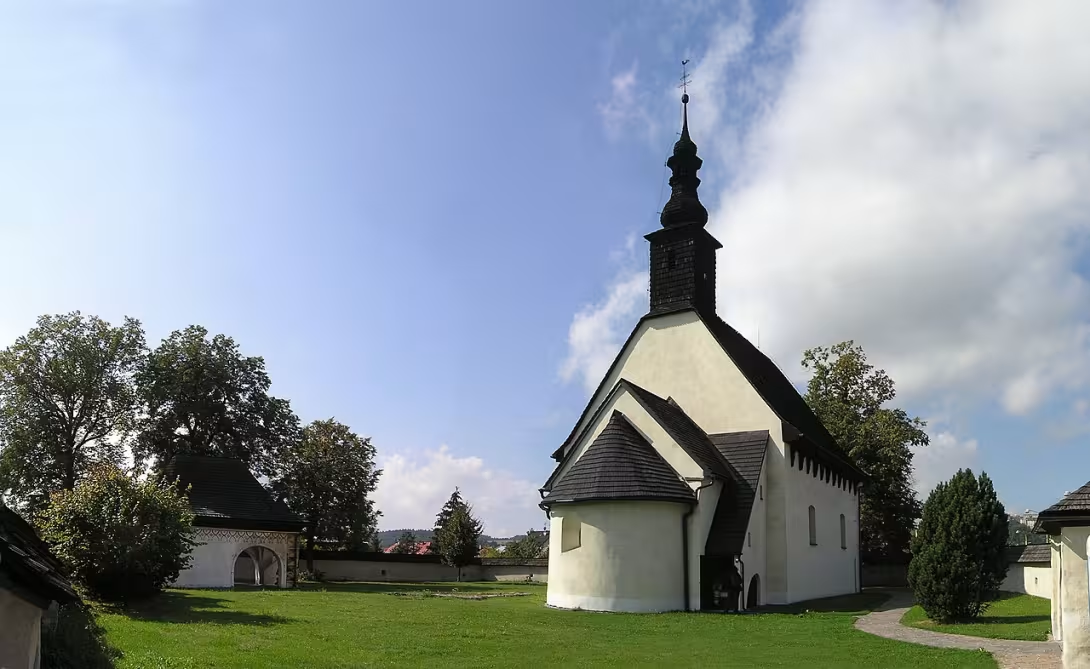

The historical view on the left is a visualisation generated by artificial intelligence and serves as inspiration.
Historical Milestones
- early 13th century
- church formation in late roman style
- 1429
- first written mention of the church in Žilina book
- 16th century
- building renaissance fortification, wall and bastion
- 1762
- extensive baroque reconstruction of the church
- 1899
- last dates grave finds in the chapel area
Restoration history
| Years | Type | Extent | Condition after restoration |
|---|---|---|---|
| 2018–2020 |
Reštaurovanie
poľná kaplnka |
Komplexná | dobrý |
Source: Monuments Board of the Slovak Republic — open data, licence CC BY 4.0
Artistic features
-
maľba dekoratívna — Fragment stredovekej nástennej maľby
vápno, freska-secco · gotika · 14.st. -
maľba iluzívna — Iluzívne architektonické prvky s dekorom
vápno, freska-secco · romanika neskorá · 1.pol.13.st. -
maľba figurálna s dekorom — Apoštoli
vápno, freska-secco · romanika neskorá · 2.pol.13.st. -
maľba figurálna s dekorom — Maiestas Domini
vápno, freska-secco · gotika · 1.pol.15.st. -
maľba figurálna s dekorom — Súbor stredovekých malieb
vápno, freska-secco · romanika neskorá · 1.pol.13.st.
Source: Monuments Board of the Slovak Republic — open data, licence CC BY 4.0
Interesting facts
- The church of Late Roman style from the middle of the 13th century originally served as a service place for surrounding settlements called terra de Selinan. - According to legend, the building was built by the first Hungarian king, St.
Guide
Show guide text
The text was prepared by artificial intelligence and has not been editorially reviewed. It may contain inaccuracies.
Welcome to the heart of Zilina. Right now you are facing one of the most important historical monuments of this city, which is the fortified church of St. Stephen. When you look at it, you may feel the calm spirit of sacral space at the first moment, but at the same time this area carries the strength and determination of the defence complex. Feel the atmosphere of this place, where centuries of faith and the need for protection from the enemy are entangled. In front of you there is an area that is not just an ordinary church but a witness to the dramatic changes that have taken place in Žilina and the whole region.
Now let's rush deep into the past to understand how this construction came about. The foundations of this place date back to the early 13th century. It was this time that the church was established in late Roman style. It was not just a building for local inhabitants in that period context, but it originally served as an important service place for all surrounding settlements, which were associated under the name terra de Selinan. So imagine this place as a spiritual center of the entire wider surroundings, to which people from several surrounding villages have traveled. Although the building has existed since the thirteenth century, the first written mention of it appears later in the historical records, namely in the year thousand four hundred twenty nine, when it is mentioned in the book Žilina.
Pay attention to what you see right in front of you. When you look around the area, notice that this church is not just a religious building but is fortified. If you look at the surrounding walls, you'll see traces of the Renaissance period. In the middle of the sixteenth century, a complex fortification was built, which included a wall and strategically located babastes. At that time, safety was not a self-evident thing, and churches often took refuge for the population in case of danger. These walls are a silent witness of the time when the religious center had to turn into a fortress.
In addition to the Renaissance elements in the face side of the complex you can see the effects of later periods. If you look at the building of the church itself, you will see the result of the extensive Baroque reconstruction from the year thousand seven hundred and fourty-two. Baroque brought dynamics and new aesthetics into the architecture, which affected the overall appearance of the building you see today. It is fascinating to see how, on one construction site, the centuries have covered their tracks: from Romanesque foundations to Renaissance walls to Baroque details.
But who built this church? Here we come to one of the most interesting parts of the history of this place. Although we do not know the official architects, local traditions and legends speak a completely different language. According to an old story, the first Hungarian king, St. Stephen, had this building built himself. The legend claims that the church was created as a monument to the battle with the troops of Polish King Boleslav Gryffindor. It is a story that gives this place a deeper dimension and connects it with the highest ruler in the early history of our regions. Whether it's historical truth or a beautiful legend, it adds a certain heroic touch to the building.
If you are now a little more focused on the area around the church, feel the silence that exists here. There is a chapel in the area that hides other secrets. It was in this space that in the year one thousand nine hundred ninety-nine recorded the last dating grave finds. This reminds us that this place was not only a place of prayer and defense, but also a last rest for many people who lived in Žilina hundreds of years ago.
When you decide to enter the interior soon, we recommend you pay attention to the interior. Inside there are paintings that complement the overall picture of this monument and testify to the artistic taste and spirituality of people from different ages. At the same time as architecture, these artistic elements are key to understanding how faith and culture in the region have changed.
So you stand before a building that is like an open book of events. From the Romanesque beginning in the thirteenth century, through the Renaissance walls from the sixteenth century, Baroque face from the eighth century to archaeological findings from the late 19th century. It is a place where the legend of St. Stephen meets hard facts from the book of Žilina.
We're inviting you now to another study. Walk slowly through the perimeter of the wall, think about how people who were looking for protection in these walls must have felt, and then slowly move to the details inside the church. Let yourself be guided by the atmosphere of this unique area and give yourself a moment of silence in the society of history. Thank you for being with us in this audio guide and wish you a pleasant delay in Žilina.
Tips for visitors
We recommend a visit in spring and summer, when the area of the fortified church of St. Stephen in the flower and the building is well lit by natural light.
To move around the ground area we recommend shoes with fixed soles. Since it is sacral construction, we recommend adequate clothing.
When photographing are suitable details of the fortification and facade of the church. The best light for exterior images is early in the morning or before sunfall, when the shadow sides are less contrasting.
Families with children can search the area for architectural elements of defence buildings.
Frequently asked questions
Can the monument be visited?
Religious buildings are usually open mainly during services; at other times a visit is normally arranged with the parish or the operator. We have not verified specific times.
Where is the monument?
Location: Závodská cesta 2845/11, Žilina, Žilinský kraj. The map on this page shows the exact spot.
Why is the monument protected?
It is listed in the Central List of the Monuments Fund of the Slovak Republic as a national cultural monument (ÚZPF no. 31B-1428).
For children
Imagine you're going through an invisible gate in time right now. It's not just a small jump, it's a huge way back to the past. Exactly 426 years ago, in 1600, everything seemed completely different. It's like you're entering an old fairy tale where history meets unexpected events.
Nearby
🏰 Historic sites (173)
- Jozef Gabčík 0.1 km
- Cesta bez návratu 0.1 km
- Strom života a skala nádeje 0.1 km
- Príslušníkom 5. pluku 0.3 km
- Hasičom 0.8 km
- Pevne držme zástavu, za ktorú krv dali bratia 0.9 km
- Anton Bernolák 1.0 km
- Ľudovít Fulla 1.0 km
- Ferdinand Čapka 1.1 km
- Fero Kráľ 1.1 km
- Eduard Šoltýsik 1.1 km
- Pieta 1.2 km
- Mariánsky stĺp 1.2 km
- Dr. Dušan Makovický 1.2 km
- Jan Vrtílek 1.2 km
- Na pamiatku Privilegia Pro Slavis 1.2 km
- Obetiam komunizmu 1.3 km
- Juraj Tvrdý 1.3 km
- Chráňme si slobodu a nezabúdajme 1.3 km
- Rudolf Martinka 1.3 km
🍽️ Restaurants and dining (449)
- City restaurant 0.1 km
- Drevenica 0.3 km +421904657974 web
- Stanica Bar 0.4 km
- Rondel klub 23 0.5 km
- Rondel point 0.6 km
- U Jakuba 0.6 km
- Rosa cafe 0.7 km
- SOHO1 Caffé 0.8 km +421 918 779 999 web
- EL ŽUŽO 0.8 km web
- Quick snack & pub 0.9 km
- Stará Menza 0.9 km
- Čierny kohút 0.9 km
- Koníček 0.9 km +421 915 502 995 web
- Street Cafe 0.9 km
- Gottham 0.9 km +421 944 799 043
- Piváreň Junior 0.9 km
- Piváreň Márnica 0.9 km
- CheckPoint Restaurant 0.9 km web
- Bar a kaviareň Galéria 1.0 km
- Gaya 1.0 km
🏨 Accommodation (80)
- Drevenica 0.3 km
- U Jakuba 0.6 km
- Turistická ubytovňa Hliny 0.9 km +421417233914 web
- Dajana 1.0 km
- Slovakia 1.0 km Antona Bernoláka 3231/2A
- Hotel Galileo 1.1 km Hlinská 2584/25 +421417001014 web
- Grand 1.2 km
- VIX 1.2 km
- Penzión V inom svete 1.3 km J. M. Hurbana 329/40
- Hotel Boss 1.3 km Čepiel 1063/1
- G hotel 1.3 km
- Dubná Skala 1.4 km J. M. Hurbana 345/8 +421 41 507 91 00 web
- Kamélia 1.5 km
- Ubytovňa Dom techniky 1.5 km
- Šport Hotel Bôrik 1.5 km web
- Slovan 1.6 km Andreja Kmeťa 657/4
- Ubytovanie Sasinkova 1.6 km web
- Sentami 1.6 km
- Penzión Majovey 1.6 km
- Penzión Central Park 1.6 km Sad SNP 663/18 +421 41 562 20 21 web
🚲 Rentals and sport (84)
- Stanica Žilina - Záriečie 0.4 km web
- Lezecká stena K2 Žilina 0.5 km +421 948 255 307 web
- Daxnerova - Jednota 0.5 km web
- Veľká Okružná 0.8 km
- Internáty Hliny 0.9 km web
- Hlinská 0.9 km web
- DPMŽ Kvačalova 0.9 km web
- Somro 0.9 km web
- Pole dance center 0.9 km +421 904 597 730 web
- Dual Sport 1.0 km web
- Bulvár 1.0 km web
- NBS 1.1 km web
- Sportisimo 1.1 km web
- Garmin 1.1 km
- Aupark 1.2 km web
- Fit Up! 1.2 km
- 4camping.sk 1.2 km web
- Cykloservis 1.2 km +421 902 302510
- Mestský úrad 1.2 km web
- Námestie mladosti 1.2 km web
🥾 Hiking and nature (298)
- Andreja Barčíka 0.4 km
- Dom umenia Fatra 1.1 km
- Krajská hvezdáreň v Žiline 1.2 km +421 41 564 3200 web
- Burianova veža 1.3 km
- Park Ľudovíta Štúra 1.3 km
- Frambor 1.3 km
- Františka Hanovca 1.4 km
- Sad na Studničkách 1.4 km
- Hlinský park 1.5 km
- Sad Slovenského národného povstania 1.6 km
- Park Carla Gustava Swenssona 1.9 km
- Háj 2.0 km
- Biely vrch 2.1 km
- Pozorovateľňa na Malom diele 2.1 km +421 41 763 4371 web
- Chlmecký vrch 2.1 km
- Za Dielom 2.2 km
- Jozefa Červinku 2.3 km
- Budatínsky park 2.3 km
- Háj 2.4 km
- Prameň Hôrka 2.5 km
Thematic route
As there are no other sites in the area of the area, I propose a thematic route in the area of the main objective.
Route in the area of the fortified church of St. Stephen
1. Fortified church of St. Stephen - a tour of the architecture of the church. 2. The area of the church - walk through the area, which in the past served as a refuge and defense system. 3. Defense wall and courtyard - remains of the fortification that testify to the strategic role of this place. 4. Interior and exposition - visit the interior of the church with artistic and religious objects.
Seasonal recommendations
In spring, the area of the fortified church of St. Stephen is surrounded by green nature, which creates a contrast to the historical stone. The sun does not drown during this period, allowing for long walks without feeling a feeling of distress. It is recommended that footwear with a firm sole, as the rainy surfaces may be wet. Suitable are morning hours when light is purest.
Summer season brings intense lighting, which under bright sky highlights the details of architecture. The atmosphere is warm and dynamic. Light, airy clothes and a visit in the early morning or late evening hours are recommended to avoid the strongest glow.
Autumn in Žilina brings a color change of leaves around the monument, creating scenes for photography. The air is refreshing and the light takes a golden tone. It is practical to put on layers of clothing that can respond to sudden temperature fluctuations.
You're getting colder. Snow often covers the details of the terrain and highlights the silhouette of the building. The atmosphere is moderate and in advent time the place acts stunned. Due to low temperatures and possible ice, footwear with anti-slip sole and warm, waterproof clothing are essential. The shortest days of the year force a visit to be planned by early afternoon.
Visualisations and artistic views


The visualisations are generated by artificial intelligence and serve as inspiration.
Photographs from the area
Real photos taken near the monument


Source and licence are given for each image.
Visitor Tips
No tips yet. Be the first!
Log in and add your tip.
Zdroje a literatura
The factual basis for this text was the article na Wikipedii, whose authors are Wikipedia contributors. The article is available under the licence CC BY-SA 4.0.
Location on Map
More monuments – Žilina
Show all in the town



Visitor photos
No photos yet. Be the first to add a photo from your visit!
Log in and add your photo or leave a rating.
You get more points for a visit verified in the app — we can tell from the GPS that you are there.
Reviews and comments