








temple gr.k.sv.Michel Wooden church
St Michael the Archangel Church in the village of Príkra in Prešov region is a Greek Catholic wooden church from 1777. It is a three-part log building, declared a national cultural monument in 1968.
The year of construction 1777 results from dating on the portal. The building stands on an elevated stone foundation that balances the slope of the terrain in the western direction. The entrance to the lobby is from the west side. Architecturally, it is characteristic for the roofing spaces between the tower and the ship, as well as between the ship and the sanctuary. The cabin and the two upper floors of the towers are covered with vertical boards and rails.
The hallway of the temple, known as the Babinec, forms a tower. The self-supporting tower and the three-stage four-angle pyramid cut dome above the ship and the sanctuary are finished with baroque bulbs with forged crosses. The roof of the building and the tower are covered with shingles.
The interior is decorated with four rococo candlesticks from the second half of the 18th century. The wooden polychrome iconostasis from the second half of the 18th century consists of four rows of icons and royal doors with carving and painting. Some icons come from the 17th century and one from the 16th century.
The main icons are depictions of St. Nicholas, the Mother of God Hodegetrie, Jesus Christ the Teacher and St. Michael the Archangel. The royal two - winged doors contain six medallions with four evangelizers and scenes of Preaching; the deacon doors are not fitted with a wing. The second series contains icons of the main festivals of the Greek Catholic Church with the icon of the Last Supper in the Center. The third row consists of the icons of the apostles and the center of the icon of Christ the Pantocrat. The fourth row consists of ten medallions depicting the prophets. The iconostasis top consists of the icon of Crucifixion with the characters of the Mother of God and the holy evangelizer John. On the altar decorated with the people's year, there is a wardrobe goddess and the icon of Crucifixion. The equipment also includes the icons of Veraikon, Saint Michael and Saint Nicholas from the 17th century.
The monument was renovated in 1902 and between 1946 and 1947. The present appearance is the result of works from 2001 to 2002.
In 1915 two of the original three bells (the smallest and the largest) were hung up and used for military purposes. Currently, three bells are suspended in the tower, one from 1759 and two others from the financial collection of the village inhabitants in the 20th century.
Tehdy a dnes
Drag the slider and compare how the monument might have looked when it was built with the view today.
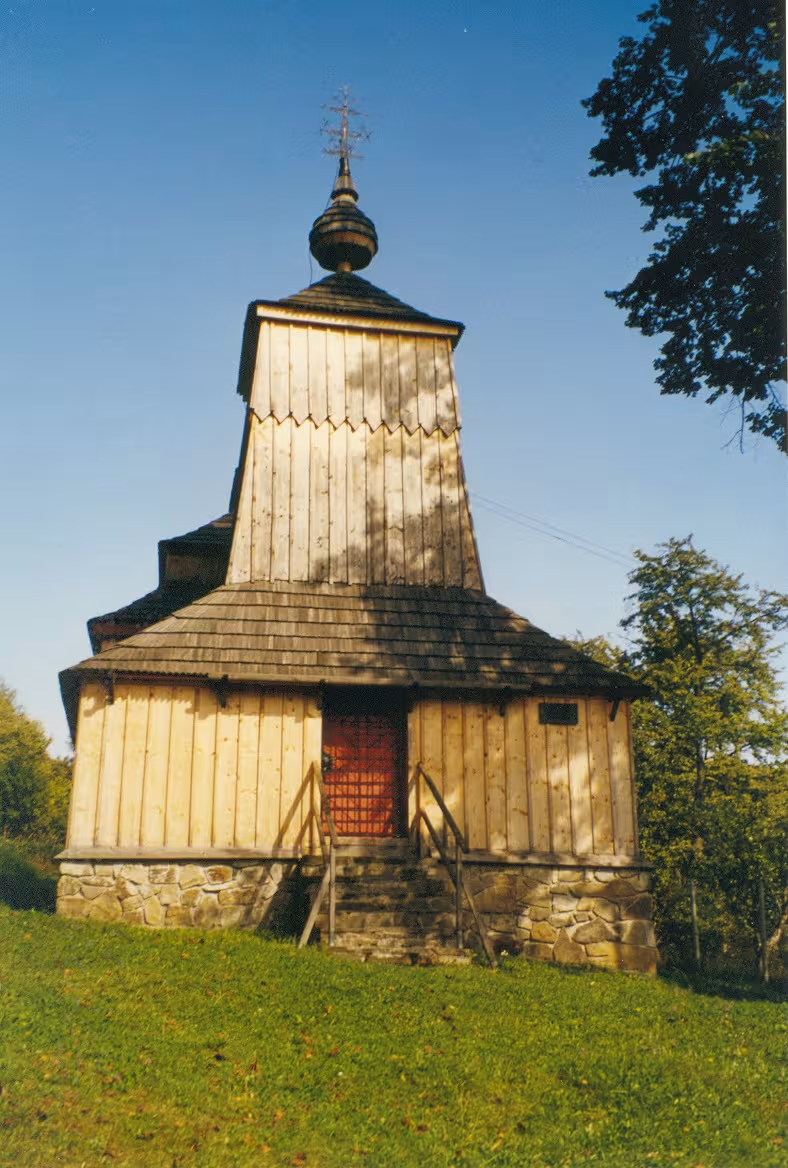
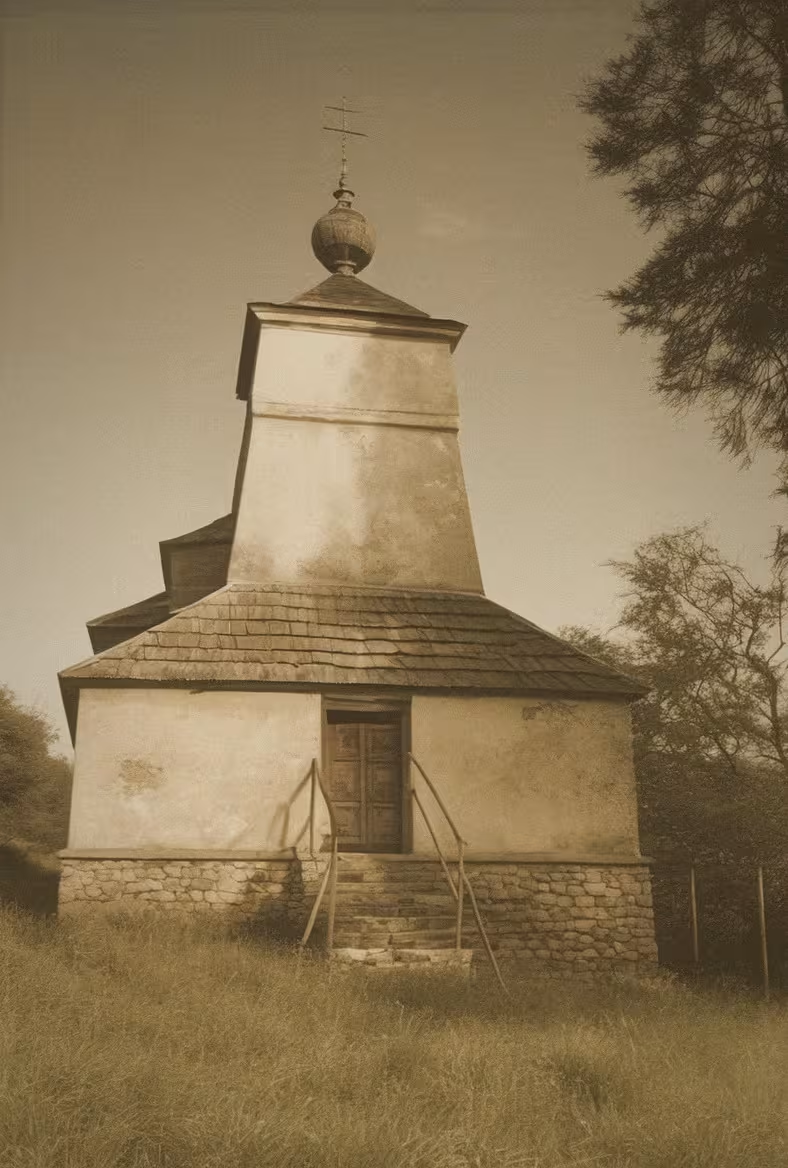
The historical view on the left is a visualisation generated by artificial intelligence and serves as inspiration.
Historical Milestones
- 1777 - construction of the temple
- 1902 - reconstruction
- 1946-1947 - reconstruction
- 1968 - declaration as a national cultural monument
- 2001-2002 - reconstruction
Interesting facts
- It is a three-part log building from 1777, which was declared a national cultural monument in 1968. - The interior is decorated with four rococo candlesticks and a polychrome iconostasis, the oldest icon of Saint Nicholas comes from the 16th century. - Architecturally, it is characteristic of the overlap of roof spaces between the tower, ship and sanctuary. - In 1915 two of the original three bells were hung up and used for military purposes. - One of the currently hung bells comes from 1759, while the other two were added in the 20th century from the financial collection of the inhabitan
Guide
Show guide text
The text was prepared by artificial intelligence and has not been editorially reviewed. It may contain inaccuracies.
Welcome to the village of Príkra, in the heart of Prešov region, where time seems to be stopped for a while. You stand before one of the most precious monuments of this area, the temple of Greek Catholic Saint Michael. Now that you are looking at it, you may first be impressed by its humility and the nature with which it fits into the surrounding land. It is a place that exudes peace and sincerity and at the same time testifies to the deep spirituality of people who lived here many years ago. Feel this atmosphere of silence and reflection that surrounds this wooden structure, and allow yourself to detach from every hustle for a moment.
Let's now look at when and how this temple originated. Although the exact names of architects or builders remained unknown at the depth of time, the knowledge of the time of its creation is clear. It is a three-part log building, which dates back to 1777. Imagine the period of the second half of the eighteenth century, when wooden temples were a natural part of the Slovak country and a reflection of local traditions. This object is not only a mere building, but an animal proof of history, as confirmed by the fact that already in 1968 it was declared a national cultural monument. It is a recognition of its value not only for local inhabitants, but for the whole of Slovakia.
Nyni pay attention to the architecture itself. When you review the exterior, note the characteristic log system that is typical of this type of construction. Zružová technique from behind the wood walls to create a stable and natural structure. Look at the overall composition of the building, which consists of three parts. It is this three-partness that gives the temple its balanced and harmonious appearance. Note how wood changed with age, how it gained its paint that tells the story of the ten centuries, rains, snows, and sunny days.
If we move to the interior now, there is a space waiting for you, full of details and spiritual meanings. Inside the temple you can discover elements that contrast with the simplicity of the outer wooden coat. Your attention should be drawn to four rococo candlesticks. Rokoko, with its elegant and playful shapes, gives the interior tumor and softness. They are objects that testify to the aesthetic taste and effort to bring the best of contemporary art to the local temple.
However, the key point of the interior is a polychromed iconostasis. Iconostasis in Greek Catholic temples is not only a decorative stsnoa but a spiritual boundary between the earthly world and heavenly glory. Polychrome, a multicolored design, adds depth and intensity to the iconostasis. As you look closer, you will see images that carry the prayers of generations.
And now we come to one of the most fascinating parts of this place. Among the many icons is one that is unique in its age. It's the icon of St. Nicholas. While the temple itself comes from 1777, this particular icon dates back to the sixteenth century. Imagine what that means. This icon is older than the building itself in which it is located. She survived for over two hundred years in a different environment, perhaps in another temple, before she found her place here in Prírozj. It is a silent witness to events that took place during the Renaissance and brings to this space a depth of history that reaches far before the construction of this log temple. It is such a small mystery and a treasure that bears the secrets of past ages.
Note, too, how the architecturally characteristic overlap of the building complements the overall picture of this unique object. All these elements together create a whole that is not just a set of wood and colors, but a place of identity and memory of the community.
As you look around, view this temple as a bridge between past and present. It is fascinating that although we do not know exactly who designed it or who laid the first stone or beam, his work has survived for centuries and still attracts us today with its simplicity and sincerity.
We're about to finish our short tour. I hope you took the time to see the details of this beautiful wooden temple of St. Michael. I invite you now to go through the surroundings in peace, perhaps once again to see the details of the iconostasis, or simply to feel the peace it offers. Let your curiosity guide you and explore this corner of the Prešov region further. Thank you for your attention and I wish you a pleasant rest of the day in discovering the beauty of our history.
Tips for visitors
We recommend a visit in spring or autumn, when natural light is suitable for observing details of wooden construction.
You come to the site by car or public transport; check your current connections in online search engines.
Take water and comfortable shoes into uneven terrain.
Photos recommend places with natural daylight that highlight wood texture.
Families with children can visit historical architecture.
Frequently asked questions
Can the monument be visited?
Religious buildings are usually open mainly during services; at other times a visit is normally arranged with the parish or the operator. We have not verified specific times.
Where is the monument?
Location: č. 28, Príkra, Prešovský kraj. The map on this page shows the exact spot.
Why is the monument protected?
It is listed in the Central List of the Monuments Fund of the Slovak Republic as a national cultural monument (ÚZPF no. 41C-235).
Nearby
🏰 Historic sites (78)
- Chrám sv. Mikuláša 2.5 km web
- Gun 3.6 km
- Gun 3.6 km
- Ruiny niemieckiej placówki granicznej 3.7 km
- Anna Soľanková 3.8 km
- Grob Żanety Fucziła 1942-2008 4.0 km
- Zniszczona cerkiew pw. Opieki Matki Boskiej (Pokrow) 4.0 km
- Delo - 152 mm kanónová húfnica vz. 37 4.6 km
- Delo - 122 mm húfnica vz. 38 4.6 km
- Delo - 122 mm húfnica vz. 38 4.7 km
- Lietadlo Lisjunov Li-2 5.0 km
- Cerkiew pw. Świętego Mikołaja Cudotwórcy 5.6 km
- Dedinské múzeum 6.0 km +421 915 213 757
- Delo 6.2 km
- Vojenské historické múzeum 6.2 km
- T-34 6.2 km
- Delo z 2. svetovej vojny 6.3 km
- Tank T34 6.3 km
- Památník a hřbitov příslušníků 1. československého armádního sboru 6.4 km
- 6.X.1944 6.6 km
🍽️ Restaurants and dining (34)
- Motorest Poľana 4.3 km
- Krčma Vyšný Komárnik 5.2 km
- Čierno 5.8 km
- Bar na Przejściu Granicznym 7.1 km
- Wild Bean Cafe 9.3 km
- Penzión Habura 9.6 km +421 907 929607 web
- Karczma Bieszczadzka Waderka 9.9 km
- Pohostinstvo Vesna 9.9 km
- Bar Czeremcha 9.9 km +48 507 076 332 web
- U Stacha 10.1 km
- Dzikie Wino 10.4 km web
- U Duba 10.6 km
- Motorest Alpinka 11.2 km
- Domeniko 11.7 km
- Royal pizza & restaurant, Svidník 12.6 km +421 908 030 011 web
- Zajazd "Bartnik" 12.6 km +48 13 4330729
- Fresh Corner 12.9 km
- Hostinec u Jakuba 12.9 km
- Monte Carlo 13.0 km
- Hanoi Bistro Svidník 13.0 km 8. mája 696/54
🏨 Accommodation (25)
- Chata Tajomné Karpaty 5.0 km +421 949 852 904 web
- Agroturystyka Ostoja w Lipowcu 5.8 km web
- Pole namiotowe przy chatce w Zyndranowej 5.8 km web
- Aktywny Lipowiec 5.9 km web
- Penzión Driečna 6.8 km
- Gutkowa Koliba 7.4 km +48502357760 web
- Strażacka Polana 8.3 km
- Wellness Zrubová Chata 8.8 km web
- Schronisko Zaścianek 9.9 km +48 13 431 02 55 web
- Pod Bieszczadem 9.9 km +48 668 331 892 web
- Noclegi na Trakcie Węgierskim 10.1 km
- Forrest Glamp 10.2 km web
- Dzikie Wino 10.4 km web
- Chata Evička 10.4 km +421 905 657 515 web
- Country house 10.8 km
- Siedlisko Zakucie 10.9 km web
- Penzión v údolí 11.1 km +421 905 472 489 web
- Miejsce Biwakowania Stasiana 11.4 km
- Zajazd Domeniko 11.7 km +48 605 662 051;+48 13 433 55 77 web
- Drymak 12.4 km
🚲 Rentals and sport (2)
- AquaRelax 12.9 km
- Peem Servis 13.4 km web
🥾 Hiking and nature (206)
- Čierťažík 0.9 km
- Grúň 1.4 km
- Záruby 1.9 km
- Rusinov 2.0 km
- Chotčianka 2.4 km
- Góra Pstrzyńska 2.4 km
- Popadyna 2.5 km
- Dranec 3.2 km
- Stavenec 3.5 km
- Okopy Konfederatów Barskich Czeremcha 3.6 km
- Klin 3.6 km
- Matovka 4.1 km
- Jałowa Kiczera 4.2 km
- Klepka 4.2 km
- Prokopec 4.2 km
- Bunkre Štábu 3. Českoslovesnkej Brigády 4.5 km
- Mäsiarske 4.5 km
- Wierszek 4.6 km
- Czerwony Horbek 4.7 km
- Delo - 152 mm kanónová húfnica vz. 37 4.7 km
Thematic route
As there are no other locations in the area of the area, I propose a thematic route focused on the main monument.
Route in the area of the church gr.k. St. Michael in the village Príkra
1. Courtyard of the temple - Entrance part of the complex. 2. Temple gr.k. St. Michael - Example of wooden church. 3. Interior and exposition - Space with traditional equipment and iconostasis. 4. Area and surroundings of the building - Walk around the building, which allows you to know the construction of the building from all sides.
Seasonal recommendations
In spring, the surroundings of St. Michael's wooden church in Príkra will awaken to life and the landscape will be surrounded by fresh greenery. In the morning light is fine and highlights the texture of wood. Suitable for wet terrain and layered clothing are recommended.
Summer season brings intense lighting, which is favorable to photograph the exterior of the building accompanied by a flower of local nature. Due to high temperatures, it is advisable to set off early in the morning or before sunbathing. Remember light clothes and sun protection.
Autumn creates the colorfulness of tree leaves contrasting with the dark wood of the temple. October and November have more stable weather and a quieter atmosphere. Warm clothes and waterproof shoes are suitable, as it is humid in the Prešov region.
Zimą operates a wooden building in Príkra significantly, especially if it surrounds the snow. Visiting advent time brings a sense of peace and quiet. Warm winter clothes, solid shoes with anti-slip soles and sufficient time to travel are essential, as winter days are short.
Visualisations and artistic views


The visualisations are generated by artificial intelligence and serve as inspiration.
Photographs from the area
Real photos taken near the monument

Source and licence are given for each image.
Visitor Tips
No tips yet. Be the first!
Log in and add your tip.
Zdroje a literatura
The factual basis for this text was the article na Wikipedii, whose authors are Wikipedia contributors. The article is available under the licence CC BY-SA 4.0.
Location on Map
Visitor photos
No photos yet. Be the first to add a photo from your visit!
Log in and add your photo or leave a rating.
You get more points for a visit verified in the app — we can tell from the GPS that you are there.
Reviews and comments