

Basket Ruined church
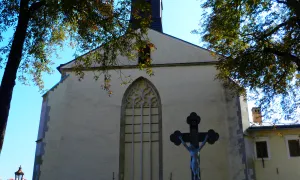
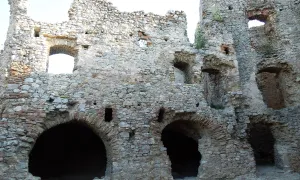
In the village Víťaz in Prešov region there is a cultural monument Košpeľsko. It's an extinct medieval church. The object has not been studied, therefore no data on its architectural style are available.
The complex consists of one building - the extinct church with registration number 2059/1. The register does not contain information on other relevant structures. Due to the state of the building missing data on building characteristics, available, material and floor plan.
The monument is located in the locality of Dolina in the village Víťaz. It is declared as a national cultural monument and registered by the Monument Office of the Slovak Republic under number ÚZPF 2059. The building represents the trail of medieval architecture in the village Víťaz.
Tehdy a dnes
Drag the slider and compare how the monument might have looked when it was built with the view today.
The historical view on the left is a visualisation generated by artificial intelligence and serves as inspiration.
Historical Milestones
- round 1300
- Predicted creation of a medieval church in the village Víťaz.
- round 1500
- Church extinction due to historical changes in the region.
- 2000
- Enrollment of the church in the register of national cultural monuments.
Interesting facts
- Košpeľsko in the village The winner is an extinct medieval church. - The building represents the trail of medieval architecture in the village Víťaz. - The monument is located in Dolina and is declared a national cultural monument. - As the object has not been studied, no data on its architectural style are available. - Due to the state of the building missing data on building characteristics, available, material and floor plan.
Guide
Show guide text
The text was prepared by artificial intelligence and has not been editorially reviewed. It may contain inaccuracies.
I welcome you to one of the silent witnesses of the past who hide the stories of ancient times. You are standing in front of a place that is now no longer the center of the community, but a silent note. In front of you there is a place where there used to be a church in Košpelisko. Although you can no longer see the magnificent walls or the high tower, the very atmosphere of this place in the village of Víža immediately surrounds you with a feeling of peace and nostalgia. It is a place where nature meets the remains of human activity and where every stone and every piece of earth talks about a time that goes forward tirelessly. As you look around you, you may feel a special contrast between the present surroundings and the forefathers. The cocoon is not just a common name on the map, but a symbol of an extinct settlement. The exact chronology of the church's origin remained unknown at the time, giving this place some depth and mystery. We do not know exactly in which century the first stones were laid or who were the builders who put their work and faith into this object. At the time this church served its community, it was likely a spiritual center and meeting place for all the inhabitants who lived and worked here. At present, we can no longer look at the detailed analysis of architectural elements, as the building as such no longer exists in its original form. I can't invite you in or show you the concrete decorations of the facade or altar, because time and circumstances have led to the death of this temple. Note, however, the terrain itself and the way in which the country around the Winner naturally returns to its original state. Look at how nature gradually grows in places where bells and prayers used to sound. It is in this silence and the absence of material details that the power of this place lies. Feel the atmosphere of emptiness that paradoxically fills your mind with questions about the monuments we left behind and about those that have definitely disappeared. Who were the people who attended Sunday services? Who in these walls sought comfort at difficult times or celebrated the coming of a new life? Names of architects and historical personalities associated with this particular church were not lost only in archives, but washed from the memory of generations. The prám at this point, the visit to the memorial becomes a philosophical journey. You are standing in a place that has been for someone the whole world, the centre of his social and spiritual life, and today it is a place that requires our imagination. It is at this point that we come to the greatest mystery of this place. Why did the church in Košpelisko disappear? What led to a building that was supposed to testify to eternity that had fallen short of time or other circumstances? It is a question that remains without a clear answer, and it is this unknownness that draws the most emotion out of visitors. It is a reminder that nothing is permanent and that even the most solid buildings can go into oblivion. This extinct church is like a silent whisper from the past that makes us think about our own existence and what we leave behind. Let's go stand in complete silence for a while. Try to imagine what this place would look like in the time of its glory. Close your eyes and try to feel the presence of people who lived here hundreds of years ago. Imagine the wind that is blowing through this place today, and imagine that it still contains remnants of ancient songs and conversations. It is fascinating that, although there is no physical building that we can clarify in detail, the presence of this extinct church of Košpeľsko is still felt in this area. This area in the village The winner teaches us humility. It teaches us that history is not only about great kings, victorious battles, or famous builders whose names are engraved in marble. History is mainly about ordinary people, about their faith, their struggles and their quiet departure. Koschaeľsko is a story about the passing, but also about the survival in the memory of the country. I hope this short stop has helped you feel the depth of this place. Although you do not see monumental walls, you see something more important - a testimony to the passing and natural cycle of life and death. Now I'm going to ask you to walk around in peace, inhale the clean air of the Prešov region and give yourself a moment to think about what it means to leave a trail in time. Thank you for your journey together to this silent witness of the past. I wish you a peaceful further survey of this region and I hope you will be attracted to other places that speak in silence. Let yourself be guided by your curiosity and enjoy every moment in this beautiful country. Let yourself be part of this history for a while, which no longer has its walls, but still has its soul. On your next journey, remember to look for beauty in the details and silence that surrounds us. Have a good and happy trip.
Tips for visitors
1. The best time to visit: May and September have pleasant temperatures and live greenery. For photography are suitable mornings or late afternoons when soft light and long shadows highlight the reliefs of the land. 2. Transport and Access: Location The winner is available by car on regional roads. 3. What to take with you: Comfortable shoes, plenty of drinking water and clothes by weather. On a longer trip, we recommend taking a raincoat. 4. Photography: Look for places overlooking the remains of the extinct church. Sunrise and sunset create significant effects on stone parts and landscapes. Beware of tree shading if the site is overgrown. 5. Surroundings and families: There are no other sights in the 30-minute radius, so focus on nature around the Winner. It is suitable for families with children for a short walk; it is recommended to take snacks and toys on the road.
Frequently asked questions
Can the monument be visited?
According to the heritage register the site is not presented to the public – there are no accessible remains or information on site.
Where is the monument?
Location: Dolina, Víťaz, Prešovský kraj. The map on this page shows the exact spot.
Why is the monument protected?
It is listed in the Central List of the Monuments Fund of the Slovak Republic as a national cultural monument (ÚZPF no. 417-2059).
For children
Where was the church you played with time on the hidden
Thematic route
Basket It is the main objective of this short cruise route. It is a locality of the extinct church in the village Víťaz in Prešov region. Visitors can see the preserved building blocks here.
As there are no other sights mentioned in the surroundings, the route focuses on exploring the area and its immediate surroundings.
Basket Type: Archaeological site / Extinct sacral building Why visit: The remains of the church help to understand the development of settlement in this part of Prešov region.
Court and surroundings of Košpeľsko Type: Local area Why visit: A walk around the ruin is suitable for short rest.
Surroundings of the village Víťaz Type: Local country Why to visit: The environment around the extinct church is suitable for a short walk.
The route is conceived as a quiet walk. The emphasis is on the monument and its direct surroundings. Visitors should pay attention to preserved stone elements. In the absence of other attractions in the area, this route is a choice for those looking for a historical experience without long movements.
It is recommended to come to good lighting to make the details of the ruins more visible. The trip is suitable for individuals and smaller groups. Take enough time to observe and photograph in Prešov region.
Seasonal recommendations
In spring, the surroundings of the extinct church in Košpelisko will wake up to life with the arrival of the first flowers and green grass. The sun in this period provides fine lighting suitable for photographing the details of the building. We recommend shoes to wet terrain and a visit in the morning.
Summer months bring nature to this site and rich landscape colors. Due to the intense glow of the sun, it is advisable to plan the trip to morning or evening hours. Do not forget light clothing, head cover, and plenty of drinking water.
Autumn in Prešov region is characterized by golden shades of leaves that form the background for historical monument. Due to unstable weather and morning fog, it is advisable to wear layered clothing and tight shoes.
Winter turns the face of Kospeľsko into a snowy region, where the sacral building works quietly. Contrast of white snow and walls creates visual composition. When visiting it is necessary to use warm, waterproof clothing and winter shoes. The best light for observation is in the morning.
Visualisations and artistic views

The visualisations are generated by artificial intelligence and serve as inspiration.
Visitor Tips
No tips yet. Be the first!
Log in and add your tip.
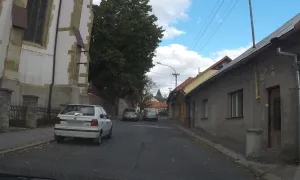
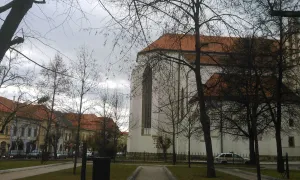

Visitor photos
No photos yet. Be the first to add a photo from your visit!
Log in and add your photo or leave a rating.
You get more points for a visit verified in the app — we can tell from the GPS that you are there.
Reviews and comments