








burgher's house Burgher house
Townhouse on the street Andrej Kmeťa 5 in Banská Štiavnica is a corner object from the middle of the 17th century. The building represents the type of townhouse late Renaissance and Baroque. It is registered by the Monument Office of the Slovak Republic under number ÚZPF 3318.
The development of burgher houses in Banská Štiavnica took place from medieval wooden buildings to brick buildings. Their form was influenced by material, the solvency of the owner, the heating method and defensive function. In the 17th and 18th centuries, the interest of nobility in residence in cities increased due to military and county administration. This led to the purchase of several plots and the building houses on the representative premises.
The house is situated in micronámestie as an end corner object. Fixes the original urban situation in relation to main and side communication. Architecturally preserved the overall expression and ground plan-space composition, although the concept of the facade was partially changed by modification of the parter. The material expression of the structure interferes with the removal of part of the volume of the side wing.
The specific features of the houses in Banská Štiavnica are their situation in a violent terrain. From the side of the square St. Trinity are three- to four-storey buildings, while the last floor serves at the same time as the ground floor in the back alley. The construction also used older unorganized buildings and narrow streets. Cellars dug into the rock subsoil in some houses passed to the galleries. Later, a terraced building was created as a result of the construction of neighboring streets and the expansion of houses.
Nowadays, townsmen's houses in the city have maintained the function of housing, although the standards have changed. Business use has been preserved in the parts of many objects, but this has been modernised.
Tehdy a dnes
Drag the slider and compare how the monument might have looked when it was built with the view today.
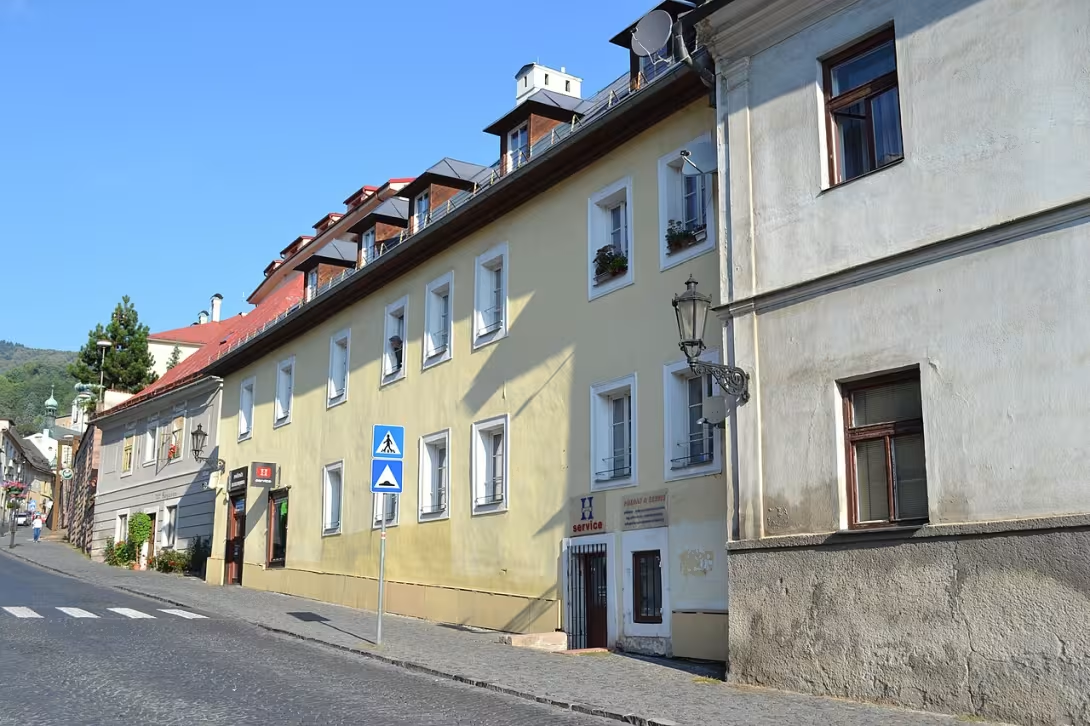

The historical view on the left is a visualisation generated by artificial intelligence and serves as inspiration.
Historical Milestones
- 17th century
- creation of a corner burgher house in the style of late renaissance and baroque
- 1700
- documented year of construction
- 17th and 18th centuries
- building houses on the representative premises due to the arrival of the nobility
- later
- creation of row buildings due to the construction of neighboring streets
Interesting facts
- It is a corner object from the middle of the 17th century, which represents the type of burgher house of late Renaissance and Baroque. - The house is situated in micronámestie and fixes the original urban situation in connection with the main and side communication. - Architecturally preserved the overall expression and ground plan-space composition, although the concept of facade was partially changed. - The specificity of the houses in Banská Štiavnica is their situation in a rough terrain, where the last floor on one side can serve as the ground floor in the back alley. - Cellars deep
Guide
Show guide text
The text was prepared by artificial intelligence and has not been editorially reviewed. It may contain inaccuracies.
Welcome to Banska Stiavnica, a city that is a lively museum under the sky. Right now, you are facing one of the many witnesses to the ancient prosperity of this city. A natural view of this remarkable burgher's house opens before you. When you look at it, you may at the first moment see only a beautiful historical building, but in fact, you are faced with a document in .
Let's now join together in the history of this construction. This corner house was built in the middle of the seventeenth century. Although the exact names of the architects who designed it remained forgotten in time, the documented year of construction is intended for the year thousand seven hundred. It is the time when the influences of the late Renaissance and the emerging Baroque were intertwined in Banská Štiavnica. It is this transition between two large epochs that gives the house its specific character. At the time, it was not just a mere dwelling, but an expression of status. The townspeople who lived in such houses were rich thanks to mining and trade and wanted their homes to reflect their social position.
Nyni, pay attention to where you are exactly. Note that the house is situated in a small micron square. It's not a coincidence. Its location fixed the original urban situation of the city. Look at how the house defines the corner between the main road and the side street. In medieval and modern cities such corner lands were extremely valuable because they provided greater visibility and better access opportunities. When you take a look at the facade, see the atmosphere of the late Renaissance and Baroque that connects here in a harmonious whole. Architecturally, the house retained its overall expression and ground plan-space solution, which is now a great happiness, because many buildings in the city centre have undergone drastic changes in later times.
If you stop and think about what's going on in these walls, we have to go back to the seventeenth and eighteenth centuries. During this period many burgher houses in Banská Štiavnica passed through the buildings. Why was that? The answer lies in the arrival of the nobility into the city. Noble families sought representative settlements that would match their high social status. The original burgher houses therefore began to be transformed into more luxurious residences. Although we do not know exactly who everyone lived in this particular house, it is likely that this object too felt the influence of these changes and became part of the representative face of the city.
An interesting thing that can first be ignored is the way the city around the house developed. If you look at the surrounding buildings, you will notice a row building. This dense building was created later, as a result of the gradual stopping of neighboring streets. Originally, the houses could have been more separated, but with a growing population and a lack of space in the enclosed area of the foothills town, the houses began to push, until a typical stiavnica street, which we know today, arose. However, thanks to its corner position, this house remained the dominant one, which still determines the rhythm of this small square.
It is fascinating to think of how many generations of people have passed through this door. Imagine the silent noise of horses on the stone pavement, traders with precious metals and nobles in times of typical clothing that passed through this very corner. This house is not only a pile of stone and mortar, but an epitome of the history of Banská Štiavnica, which survived centuries of change, wars and quarrels.
Now I'm gonna fuck you up so you can enjoy this look for a while. Look at the details of the facade, see the proportions of the building and imagine what this house looked like three hundred years ago when it was a new symbol of urban modernity. It's a place where the history of urbanism meets the personal stories of people looking for their happiness and wealth.
I hope this short trip to the past has helped you to better understand the meaning of this townhouse. Banská Štiavnica has many other hidden treasures waiting to be discovered. I invite you to continue your exploration of this beautiful city and to follow its narrow streets and historic squares. Thank you for your attention and I wish you a pleasant next walk in the footsteps of history.
Tips for visitors
Visit the house during spring or autumn. Temperatures are then pleasant to walk through the historic center and natural light highlights the architecture of the building. Since it is a residential house, we recommend to break down only its surroundings and observe facades.
Wear shoes with fixed soles suitable for historical terrain.
Photos of the facade are of the highest quality early in the morning or before sunfall when shadows are softer. The surrounding streets are also suitable.
Families with children can look for architectural details on the building while walking. We recommend then exploring the historical core of the city.
Frequently asked questions
Can the monument be visited?
This is a residential or farm building, not a museum with opening hours. Please view it from public space and respect the owners' privacy. We have no information about access to the interior.
Where is the monument?
Location: Kammerhofská 184/9, Banská Štiavnica, Banskobystrický kraj. The map on this page shows the exact spot.
Why is the monument protected?
It is listed in the Central List of the Monuments Fund of the Slovak Republic as a national cultural monument (ÚZPF no. 322-3318). It is part of a UNESCO World Heritage Site.
For children
Imagine going back to Banská Štiavnica 326 years later. There's a horse hog around you on the stone streets, and you see people in period hats and long clothes. A burgher's house is right in front of you.
The house belonged not to the king nor to the knights, but to the rich man - then businessman and merchant. The building stands on the corner of a small square, where the main and side streets meet. Thanks to this location, the owners had an overview of all the people who came to or left the city. The house served as the center of family life and instead of business arrangement.
Nearby
🏰 Historic sites (233)
- Dominikánsky kláštor 0.1 km
- Andrej Kmeť 0.1 km
- Banské múzeum 0.1 km web
- Kammerhof 0.1 km
- Glanzenberg štôlňa 0.1 km
- Július Pántik a Gustáv Valach 0.2 km
- A. Gölnerová-Gwerková 0.2 km
- Osloboditeľ 0.2 km
- Významné lesnícke miesto 0.2 km
- Anton Péch 0.2 km
- Nový zámok 0.2 km Novozámocká 149/22 web
- 22185 Štiavnica 0.3 km
- Židovská synagóga 0.3 km
- Jozef Kollár 0.3 km
- Monument Hochwies/Paulisch 0.3 km
- Karol Zachar 0.3 km
- Jozef Horák 0.3 km
- Štefan Farbaky 0.3 km
- Georg Gerzso a Marie Gerzso 0.3 km
- Sládkovičova Marína 0.3 km
🍽️ Restaurants and dining (161)
- Kaldera Cafe Bar 0.0 km
- Jazz Cafe 0.0 km
- Berg 0.1 km Kammerhofská 190/15
- Kaviareň 4sochy 0.1 km
- Kachelman 0.1 km
- ViNOCENTRUM 0.1 km
- Reštaurácia Matej 0.1 km Akademická 329/4
- Art Cafe 0.1 km Akademická 327/2 web
- Banícka Krčma 0.1 km
- Reštaurácia Amálka 0.2 km
- Trotuar Cafe 0.2 km
- U Böhma 0.2 km
- Cigar Bar 0.2 km
- Irish pub Pražovňa 0.2 km
- Divná pani 0.2 km +421 45 679 09 45 web
- Stará škola 0.3 km
- Bar AG Play 0.3 km
- Pasta per-te 0.3 km +421 907 841 794
- Istanbul Kebab 0.3 km
- Pivovar ERB 0.3 km +421456921147 web
🏨 Accommodation (107)
- Salamander 0.1 km
- Hotel Grand Matej 0.1 km
- Penzion Nostalgia 0.1 km Ing. Štefana Višňovského 208/3
- Penzión Matej 0.1 km
- Penzión Pri štôlni Glanzenberg 0.1 km
- Penzión Cosmopolitan II 0.2 km web
- Ubytovanie Tatiana 0.2 km
- Penzión Tomino 0.2 km
- Villa Botanica 0.2 km web
- Apartmán Zlatý dvor 0.2 km
- VILLA MARIA art&style accommodation 0.2 km +421 908 965866 web
- Bristol 0.2 km Andreja Kmeťa 123/11
- Penzión Rozália 0.3 km +421 948 221 213 web
- Subyt 0.3 km
- Boutique Hotel ERB 0.3 km +421 456 789 555 web
- Apartmány Perla 0.3 km Dolná 839/2 +421 908 058 905 web
- Penzión Resla 0.4 km
- Vila Magnolia 0.4 km
- Ubytovanie u Betky 0.4 km
- Penzión Cosmopolitan I 0.4 km web
🚲 Rentals and sport (18)
- Diana poľovnícke potreby 0.3 km
- Ortler sport 0.4 km
- BS-Rent 0.6 km +421 948 908 737 web
- MK bike service 0.8 km +421 904 494 573
- Tanad sport 1.0 km
- Pontónová plaváreň na Klingeri 1.3 km
- Bikepro - Hotel Salamandra 3.2 km web
- ŠK Lesy Banská Belá 4.0 km
- Požičovňa vodných bicyklov 6.6 km
- Sedací bazén 8.0 km
- Detský bazén 8.0 km
- Rekreačný bazén 8.0 km
- Jaskynný parný kúpeľ 8.1 km
- OFK Štart Prenčov 10.8 km
- Lodenica Hliník nad Hronom 12.9 km
- Cyklosport 3000 13.6 km Májová 280/3
- Bazén Ďuricov majer 14.4 km
- Plážové kúpalisko Žiar nad Hronom 14.5 km
🥾 Hiking and nature (587)
- Z Katovej 0.1 km
- Glanzenberg dedičná štôlňa 0.1 km web
- Park SNP 0.2 km
- Z Dolnej ružovej 0.2 km
- Z Hornej ružovej 0.2 km
- Kaufhaus šachta 0.3 km
- Na centrum 0.3 km
- Banka lásky 0.3 km web
- Banskoštiavnicky betlehem 0.4 km web
- Michal štôlňa 0.4 km
- Od Červeného kríža 0.4 km
- História mesta (reliéf) 0.4 km
- Z Lichardovej 0.5 km
- Z Vodárenskej 0.5 km
- Schindelberg 0.5 km
- Na kalváriu 0.5 km
- Žigmund šachta 0.6 km Na Zigmund šachtu 1647/15
- Cherubín dedičná štôlňa 0.6 km
- Na Trojičnom vrchu 0.7 km
- Ján štôlňa 0.7 km
Thematic route
Banská Štiavnica has preserved the atmosphere of the medieval mining centre. The thematic route focuses on exploring the townhouse and its historical context within this area.
Townhouse The building is an example of stiavnica burgher building. Interior spaces and façade exhibit architectural features from the period of mining boom. Visitors here can imagine the daily life of stiavnica townspeople and their social status.
Courtyard of the townhouse The interlocking or semi-permeable structure of the house creates a private zone for the family. The architecture was adapted to local climate and weather protection. Window frames, doors, and courtyard tiles testify to the craft skills of local masters.
Facade and construction details Decorative elements of the facade bear traces from different periods of reconstruction. These details show changes in style and materials over the centuries. The texture of plasters and the shape of windows help to understand the historical development of the mining urban environment.
Surroundings of the house and street space The street in which the house is located is part of the historical environment of Banská Štiavnica, where traces of mountain tradition and urban culture intersect. A walk around the house allows you to see the connection between the buildings and the city's urban plan.
This route focuses on one architectural monument and its immediate surroundings. It is suitable for visitors who prefer details and historical context.
Seasonal recommendations
In spring, the townhouse in Banská Štiavnica is surrounded by flowering vegetation. Morning light highlights the details of the facade. It is recommended to layered clothes and visit in the morning when the streets of the city are quieter.
Summer sunlight brightens the colors of the house and emphasizes its architecture. The atmosphere is more vivid in this period. It is practical to choose the time early in the morning or late in the evening when temperatures are more comfortable. Light clothing and sun protection are recommended.
Autumn brings golden tones of leaves and morning fog to the surroundings of the house. The warm filling light complements the facade materials. When planning, it is necessary to expect colder air and rain, so it is advisable to take coat and firm footwear.
In winter the details of the house are often covered with snow, creating contrast with darker elements of the building. The atmosphere is quiet, allowing concentrated outdoor observation, especially in advent time. Warm thermal clothing and winter shoes are essential.
Visualisations and artistic views


The visualisations are generated by artificial intelligence and serve as inspiration.
Photographs from the area
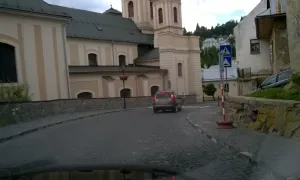
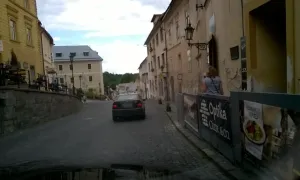
Real photos taken near the monument


Source and licence are given for each image.
Visitor Tips
No tips yet. Be the first!
Log in and add your tip.
Location on Map
More monuments – Banská Štiavnica
Show all in the town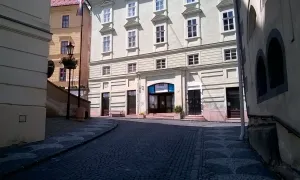



Visitor photos
No photos yet. Be the first to add a photo from your visit!
Log in and add your photo or leave a rating.
You get more points for a visit verified in the app — we can tell from the GPS that you are there.
Reviews and comments