

church of the Sacred Mother of God Church
The Church of the Sacred Mother of God in the village of Russian Poruba in Prešov region is a baroque one-ship building from the second half of the 18th century. This national cultural monument (ÚZPF 412-143) forms part of the cemetery complex.
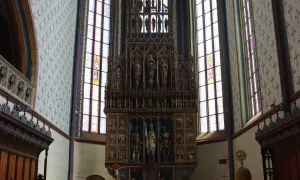
The building was built in 1775 - 1779. In 1925 the first renewal took place. In the period 1936 - 1943 the interior was painted by painter Nicholas Jordan. The building was damaged in 1944 during World War II, then it was repaired again. A comprehensive renewal took place in 1977.
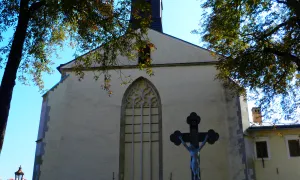
It is a one-ship baroque building with a semicircular finish of the Presbytery and the imagined tower. Facades are smooth with semi-circular windows and profiled crown ledge. The corner-rounded tower is divided by a cordon ledge, ended by a crown ledge with a clock with a clock and a baroque helmet with a lateral. Above the presbytery and boat are the same type of helmets. The interior is encircled by Prussian vaults, the device comes from the 20th century.
The entrance to the area leads through a brick gate on a square ground plan with a tent roof and a small onion. At the cemetery there is a polychromed wooden cross with a 1951 corpus.
The church belongs to the Greek Catholic parish of Russian Poruba. The exterior was renovated in 2006-2007 and interior in 2013.
Tehdy a dnes
Drag the slider and compare how the monument might have looked when it was built with the view today.
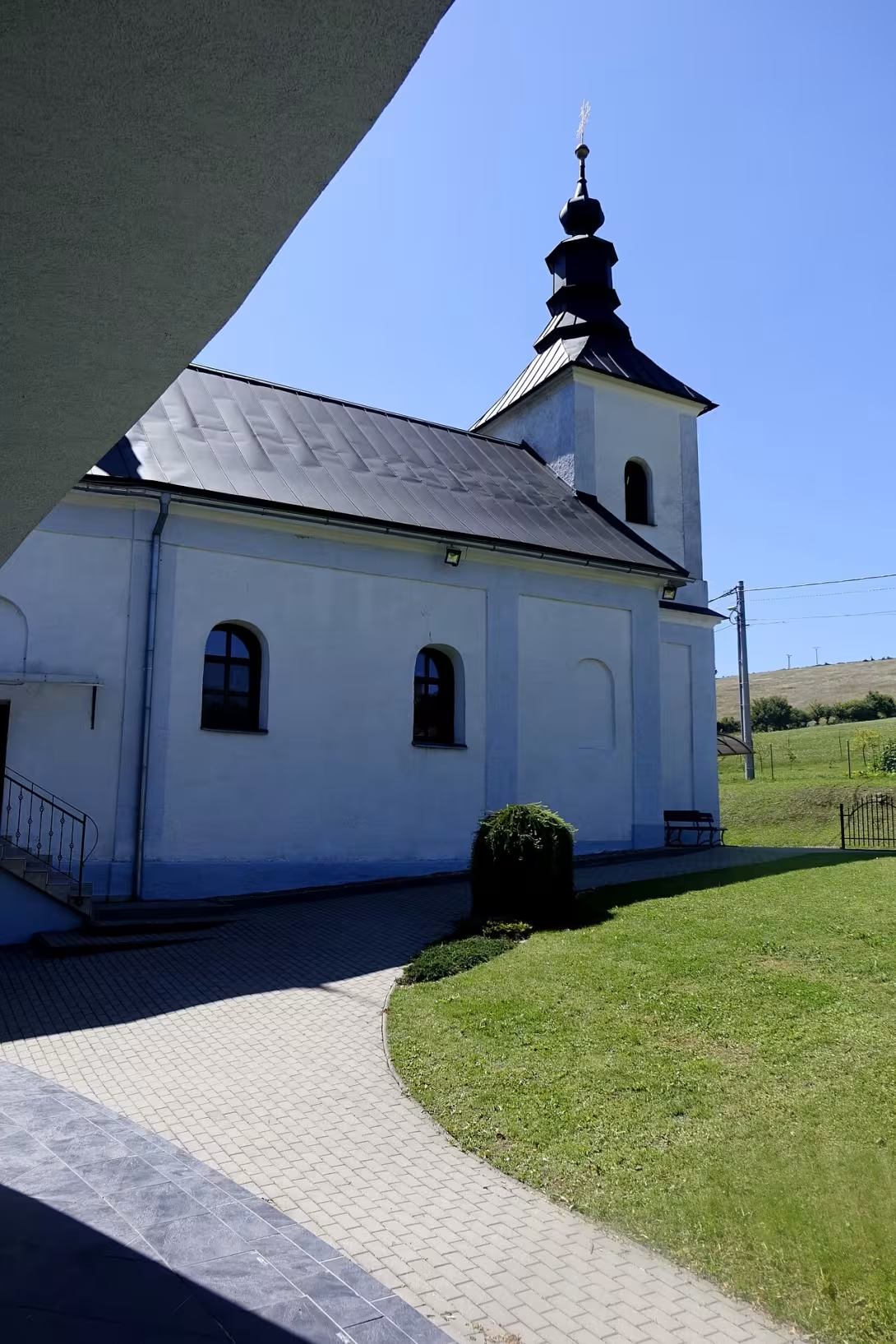
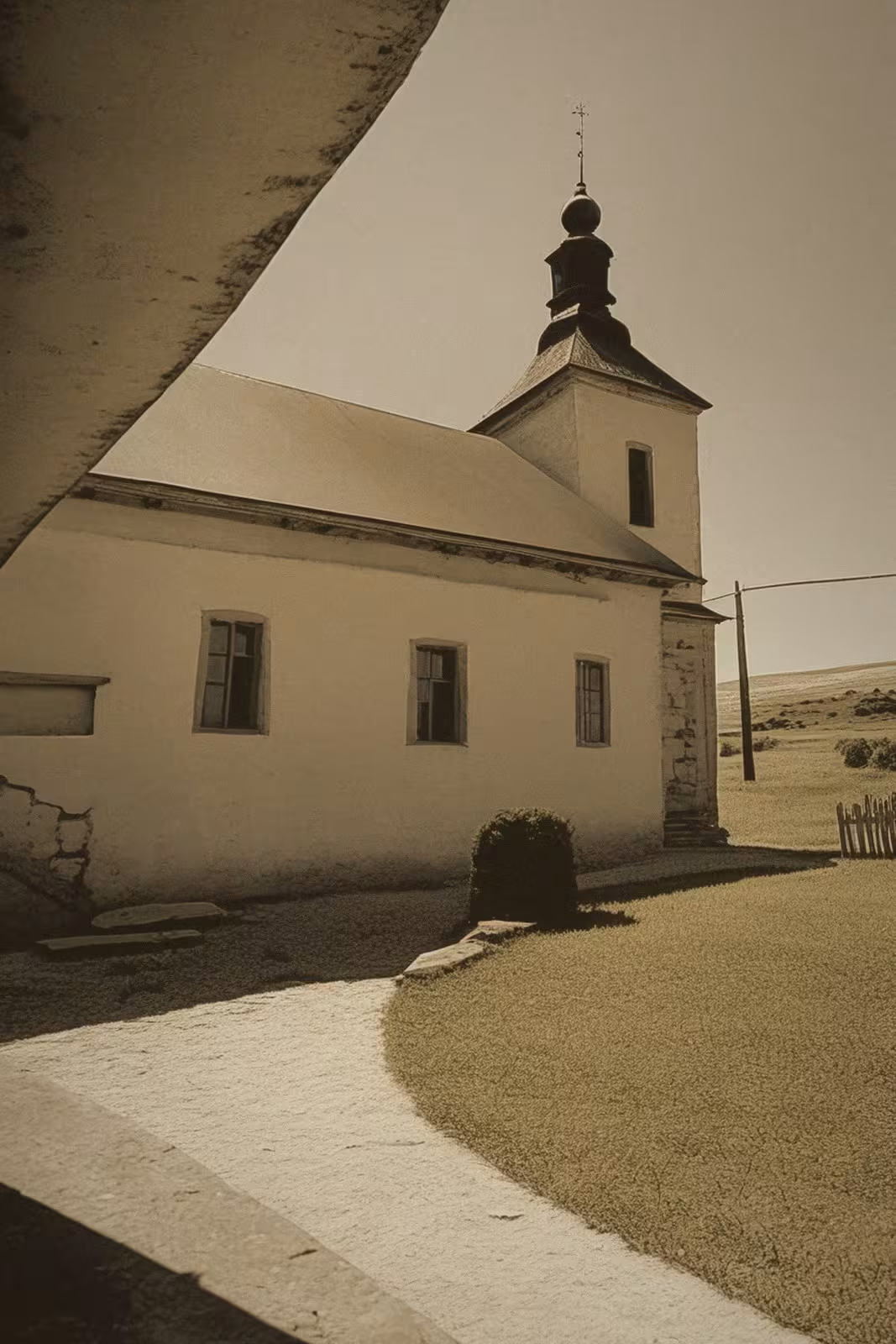
The historical view on the left is a visualisation generated by artificial intelligence and serves as inspiration.
Historical Milestones
- 1775
- the establishment of the church (the construction lasted until 1779)
- 1925
- renovation
- 1936
- beginning of interior painting by painter Nicholas Jordan (completed 1943)
- 1944
- building damage during world war ii and subsequent renovation
- 1977
- comprehensive restoration of the temple
- 2006
- exterior restoration (completed 2007)
- 2013
- interior renovation
Interesting facts
- It is a baroque building from the second half of the 18th century, namely 1775 - 1779. - In the period 1936 - 1943 the interior was painted by painter Nicholas Jordan. - The building was damaged during World War II in 1944, later it was repaired. - The entrance to the area leads through a brick gate on a square ground plan with a tent roof and a small onion. - On the church cemetery there is a polychromed wooden cross with a corpus from 1951.
Guide
The guide was voiced by a synthetic voice created by artificial intelligence.
Show guide text
The text was prepared by artificial intelligence and has not been editorially reviewed. It may contain inaccuracies.
Welcome to the village of Russian Poruba, where history meets the peace of Prešov region. Right now you are standing in front of the Temple of the Sacred Mother of God, which, together with the respective church cemetery, forms the spiritual and historical centre of this area. When you look at the construction, you may first experience the peace and harmony that this temple brings into the country. It is a place that has borne witness to many generations of the population and has survived periods of prosperity and difficult trials. Look at the overall form of the building and perceive the atmosphere of this sacred space that surrounds you. Let us now look at how this temple originated and what its historical context is. The building you see before you comes from the second half of the eighteenth century. Work on it began in 1775 and lasted until 1779. At that time, the building of such a significant temple in the room of large undertakings, which required not only funds but also deep faith and community effort. Although the names of the specific architects who designed the project remained unknown in time, their work has survived for centuries and still serves as a place of prayer and reflection. If I am now focusing on architecture, note that it is a baroque single-ship structure. As a style, Barok brought dynamism and emotion to the architecture, which is apparent even when looking at the disposition of this temple. One-ship floor plan means that the space is organized in such a way that all the attention of believers is directed directly to the altar, creating a sense of unity and concentration. I recommend you now perceive the overall composition of the building. Notice how the temple naturally connects with its surroundings. One of the most prominent elements you can see at the beginning is the brick gate that leads to the area. This gate is not only a functional element but symbolically separates the world of the world from the world of the spiritual one you are now entering. As we move deeper into the history of this place, we find that the building has gone through several important stages of reconstruction that helped it maintain its original character. The first major renovation took place in 1925, when the community made sure that the building remained in good condition for the next generations. However, the most interesting story is related to inner decoration. If you look into the interior in the future, you can see the trail of a talented painter named Mikuláš Jordan. Work on interior painting began in 1936 and lasted until 1943. Imagine the patience and precision that the painter put into each area of the walls during almost seven years of his work. It is a testimony to a high artistic feeling and an effort to bring beauty to the temple that would elevate believers over daily concerns. Unfortunately, history has not always been kind to this temple. In 1944, during the tragic events of World War II, the building was damaged. The war also left its mark in Russian Poruba, but the strength of the local people and their devotion to the temple outweighed the devastating force of the conflict. After the war ended, the restoration followed, which restored its function and appearance to the building. This process of repair was a symbol of a new beginning and restoration of hope in a country that was exhausted by war. Then came other important steps in the care of the pancreas. In 1977, the church underwent a complex renovation that ensured its stability and long-term life. The most recent significant interventions took place in 2006 when exterior renovation began, which was successfully completed in 2007. Thanks to these regular cares, you can now admire the temple in a state that reflects its historical value and Baroque origin. You may now wonder if there are any secrets connected to this place. Although history does not mention any dramatic legends, the secret lies precisely in silence and continuity. Look at the church cemetery that surrounds the temple. It is a place where the ancestors of the local inhabitants reside, and where each tombstone tells its own, quiet story. This connection between the temple and the cemetery creates a powerful emotional charge. It's where life and death meet, faith and memory. The names of builders from 1775, whose identity was lost in time, remain a mystery, but their work speaks for them. Now that you have learned of the way of this temple from its establishment in 1775 to the last renovation in the new century, I invite you to my own research. Go through the slowly brick gate, see the texture of the walls, and let yourself be surrounded by the peace of this area. You can stop by the church cemetery and think about the time it raced through this place. Thank you for your attention and for devoting time to this historical monument in Russian Poruba. We hope that this short trip to the past has enriched you and that you are leaving with a sense of inner peace. We wish you a pleasant continuation of your journey and discovering the beauty of the Prešov region. Goodbye.
Tips for visitors
A good time to visit is the spring and summer. We recommend coming at dawn or before darkening the sun, when light is suitable for capturing the details of sacral architecture.
Since this is sacral space, we recommend suitable and discreet clothing.
Photos recommend views of the facade of the temple and pictures of tombstones in the church cemetery. Watch the impact of natural light on the walls of the building to pick up the texture of the material.
Families with children can use the visit for a short lesson on local architecture and church cemeteries. It is important to heed silence and respect for the place.
Frequently asked questions
Can the monument be visited?
Religious buildings are usually open mainly during services; at other times a visit is normally arranged with the parish or the operator. We have not verified specific times.
Where is the monument?
Location: č. 54, Ruská Poruba, Prešovský kraj. The map on this page shows the exact spot.
Why is the monument protected?
It is listed in the Central List of the Monuments Fund of the Slovak Republic as a national cultural monument (ÚZPF no. 412-143).
For children
Close your eyes and imagine pressing the invisible time button. Boom! You'll fly deep into the past, exactly 251 years back. Cars, cell phones and asphalt roads will disappear around you. We are in 1775 in the village of Ruska Poruba. The air smells like fireplace smoke and fresh bread. There's something special coming up right now.
Nearby
🏰 Historic sites (8)
- Obete 7.2 km
- Miesto Tokajickej tragédie 7.2 km
- Tokajícka tragédia 7.5 km
- Múzeum Tokajíckej tragédie 7.6 km
- Osloboditeľom 9.1 km
- Vojnový cintorín z 1. svetovej vojny 10.9 km web
- Stropkovský hrad 11.9 km Zámocká 519/3
- kpt. Adolf Weinhold 12.0 km
🍽️ Restaurants and dining (16)
- Pizza Ďapi 9.1 km +421 951 441 358 web
- Motorest Breznica 9.6 km +421 944 706 639
- Fresh Corner 11.0 km
- Motorest Alpina 11.1 km
- Zámocká Pivnica 12.0 km
- Victoria Bar 12.0 km
- Penzión Goral 12.0 km +421 915 250 442 web
- Maják 12.1 km
- Letná krčma 12.2 km
- Pizzeria Marhaba Bar 12.2 km
- Bistro na pláži 12.2 km
- MiniBar 12.8 km
- Rumpeľ 13.2 km web
- Dreveňák 13.2 km
- U Jara 13.7 km
- STEAK HOUSE u Mamy 14.1 km
🏨 Accommodation (9)
- Autocamping Krym 12.4 km Nová Kelč 72 +421 905 359 413
- Poľovníček 12.6 km
- Jodo 12.7 km
- Hotel Šport 13.0 km
- Tatra 13.0 km
- Horal 13.1 km
- Autokemp Domaša Tíšava 13.2 km +421 911 299 843 web
- Valkov 13.2 km
- Hotel Zátoka 14.4 km +421 908 808 654 web
🚲 Rentals and sport (2)
- Krytá plaváreň 12.0 km
- Kúpalisko Stropkov 12.4 km web
🥾 Hiking and nature (161)
- Kopanica 1.1 km
- Veľká Dubina 1.3 km
- Medvedia 1.9 km
- Kačarník 2.0 km
- Skalné 2.1 km
- Suchý vrch 2.2 km
- Šinkov 2.8 km
- Babia 3.0 km
- Dielec 3.0 km
- Lipovica 3.1 km
- Vlčie 3.2 km
- Ferligov 3.6 km
- Vajcovka pri potoku 4.3 km
- Debrianske 4.3 km
- Hora 4.7 km
- Kamence 4.9 km
- Meľov 4.9 km
- Vápno 5.0 km
- Domanské 5.1 km
- Gaboška 5.2 km
Thematic route
The proposed thematic route within the monument area:
1. Church of the Sacred Mother of God - a building with characteristic architecture and spiritual character. 2. Church cemetery - historical part of the area with graves of local inhabitants. 3. The area of the temple - an outdoor space for rest and silence before entering the sanctuary.
Seasonal recommendations
Spring return to Russian Poruba brings to the country around the temple and cemetery a gradual revival of nature. Trees and shrubs will awaken, creating a peaceful atmosphere for a quiet walk. Soft and scattered light allows to capture the details of the construction without sharp shadows. The visit is particularly suitable in the morning, when it is the most peaceful in the space. Layered clothing with windproof layer is recommended, as spring days tend to be variable and moist. Footwear with non-slip sole is essential, as grassy surfaces and paths can be muddy.
Summer brings maximum sunlight and rich green vegetation that frames the church bell tower and cemetery. In the afternoon, the surrounding area is full of crickets and noise sheet. For photos is ideal early morning or late evening, when warm light highlights the texture of stone and wood. Clothing should be light and breathable, with a hat and sunglasses. Due to the increased number of visitors it is advisable to plan a trip away from weekends and holiday dates. Sufficient hydration during longer walks is important.
Autumn in Russian Poruba brings a variety of warm colors when the leaves around the cemetery turn golden, orange and red. Lower light creates deep shadows and highlights architectural elements of the building. Clothes should be layered and warm, as temperatures fall and mornings become timid. Footwear should be waterproof, as leaves and moisture make paths slippery. The most convenient are the noon hours, when the light is brightest and the milk wears off, which allows a better overview of the landscape.
Winter in Russian Poruba brings a snow cover that covers the cemetery and surrounding trees. Short and pale light creates a peaceful atmosphere and the building is distinguished from the white background. The clothing must be warm, including a hat, gloves and a scarf. Footwear with high soles and good catch is essential for snow and ice. Visit is the most appropriate in the noon, when the temperature is the highest and light brightest. Winter landscape allows perception of history and architecture without summer rush.
Visualisations and artistic views


The visualisations are generated by artificial intelligence and serve as inspiration.
Visitor Tips
No tips yet. Be the first!
Log in and add your tip.
Location on Map
More monuments – Ruská Poruba
Show all in the town
Visitor photos
No photos yet. Be the first to add a photo from your visit!
Log in and add your photo or leave a rating.
You get more points for a visit verified in the app — we can tell from the GPS that you are there.
Reviews and comments