








Dubnický manor house Manor house with grounds
Dubnický manor house - Renaissance-baroque residence of the genus Ileshazi
Dubnický mansion, also referred to as Ileshaziovský, is a Renaissance-baroque noble residence located in the village Dubnica nad Váhom in the district of Ilava. It is one of the national cultural monuments and its history is closely related to the genus Ileshazi, one of the prominent tycoons of Hungary in early modern times. It served as a representative seat, a centre of estate management and a centre of cultural and social life. Today it is partially restored and there is a museum in its premises.
The manor house was established in the first half of the 17th century as a new residence of the Ileshazi family, which was previously based in Trenčín Castle. The basic buildings were built by the magnate Gašpar Ileshazi in 1637-1642 on the site of an older panic from the 16th century. Originally it had a four-wing disposition with defence elements - towering corner and water ditch with a falling bridge, indicating its original function as a fortified mansion. During the 17th century there were other adjustments that extended the area.
In 1704 it was during the uprising of Francis II. Rakoci was severely damaged by the chicken armies. Reconstruction and Baroque reconstruction took place in 1719-1723 under the leadership of architects Paul Taller and František Palma. During this period, the mansion received a new entrance portal in the Baroque style and the Renaissance Tower over the entrance was restored. In the following years, Mikuláš Jozef Ilešházi participated in the manor house, which focused the adjustments on the chapel of the Assumption of Our Lady (completed in 1730), which gained rich sculptures and painted decorations.
In the 18th century the manor house was an aristocratic residence with extensive library, art collections and family archives. The library contained rare manuscripts, including the 1480 Dubnick Chronicle, which is now located in Budapest. The area was complemented by a Franco-English park with an orangery from 1733 - one of the oldest in Central Europe - and an artificial grotto with a view tower. In the 19th century, a classicistic wing was built, which gave the manor house its present form.
The last member of the Ileshazi family, Štefan II., sold the manor house in 1835 to a Vienna banker of Greek origin Juraj Sina from Hodos. The Sin family owned it until 1909, when it sold it to the Budapest Bank. In the following decades he passed several owners and authorities of the Czechoslovak Republic, which adversely reflected his state. In 1963 it was declared a national cultural monument, but only in the 1990s did extensive reconstruction work begin. Since 1992 the manor house is the property of Dubnica nad Váhom, and since 2010 the Dubnické Museum has been operating in its premises.
Today the manor house is a four-wing baroque building with a built classicistic wing. The area consists of three registered objects: the manor house itself, the house of the service from the first half of the 19th century and the manor park with natural-lander character. Elements of original defence, such as the moat, as well as Baroque and classicistic interior and exterior elements, are also preserved.
For visitors there is a restored part of the manor house with museum expositions, which present the history of the Ileshazi family, regional culture and natural wealth of surroundings. The area also offers a walk in the preserved park with a grotta and historical elements.
Tehdy a dnes
Drag the slider and compare how the monument might have looked when it was built with the view today.
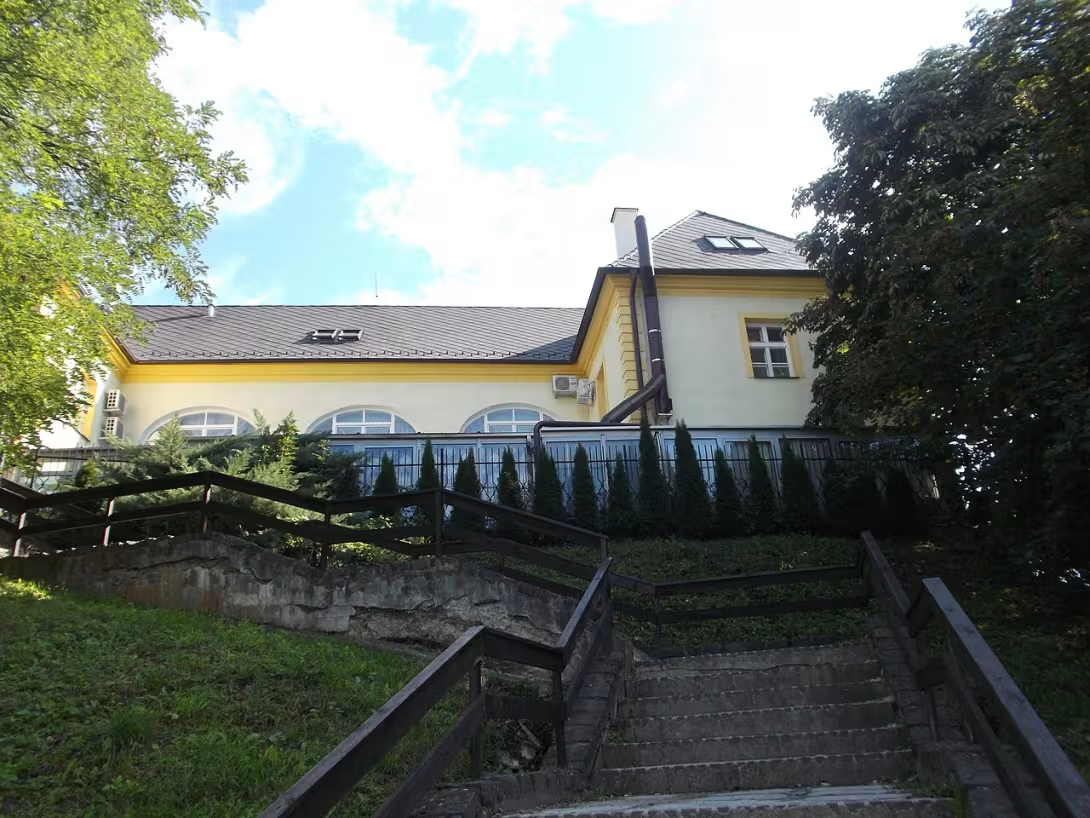

The historical view on the left is a visualisation generated by artificial intelligence and serves as inspiration.
Historical Milestones
- 1637
- The basic buildings of the manor house on the site of an older mansion (about the 16th century) at the command of Gašpar Ileshazi.
- 1652
- The first expansion of the mansion by other members of the Ileshazi family.
- 1676
- Second mansion expansion.
- 1704
- Manor damage during the uprising of František II.
Restoration history
| Years | Type | Extent | Condition after restoration |
|---|---|---|---|
| 2007 |
Obnova
dom záhradníkov,hotel |
Komplexná | dobrý |
Source: Monuments Board of the Slovak Republic — open data, licence CC BY 4.0
Interesting facts
- The manor house was built in 1637-1642 by Gašpar Ileshazi on the site of an older 16th century panoramic treatment. - Originally he had a four-wing disposition with defense elements, including towering corner and water moat with a falling bridge. - There is an orangery from 1733, which is one of the oldest in Central Europe. The 18th - century library contained rare manuscripts, such as the 1480 Dubnick Chronicle. - Since 2010 the Dubnické Museum has been operating in the manor house.
Guide
Show guide text
The text was prepared by artificial intelligence and has not been editorially reviewed. It may contain inaccuracies.
Welcome to Dubnica over Vah. Right now you are facing one of the most important monuments of the Trenčín region, which is Dubnický manor house. When you look at it, you will see a building in front of you that bears traces of several centuries of history and testifies to the ancient power of noble families that have found their home in this area. Feel the atmosphere of this place, where elements of defence and representativeness are combined, and allow yourself to turn on for a moment in the past. Let us now look at how this complex originated and in what historical context it stood. The story of this place does not start with the building you see today, but much earlier. In this place, in the sixteenth century, there was an older mansion. It was this more modest structure that preceded what you see in front of you. However, a new chapter began in 1637. Gašpar Ileshazi decided to build a new, much bigger manor house, while the construction took place between 1637 and 1642. At that time, it was not only the construction of a luxurious dwelling, but also the expression of status and at the same time the security in the seventeenth century turbulent times. Now that you have a closer look at the architecture and general appearance of the area, note its original disposition. The manor house was designed as a four - winged building that provided symmetry and stability. However, it is important to note that at the time of its creation, it was not just a mere home but had coded defensive elements in it. If you look at the structure of the building, you can imagine how the towering corner used to be used in the past to track the surroundings and defense. An even more interesting detail, which may not be so visible today, but which defined the original character of the building, was a water ditch. Imagine that the road to the inside of the manor house led through the trap bridge, which in case of threat could be raised, making the building an almost impenetrable fortress. Over the next decades, the area has undergone several changes. Chronology leads us through the years 1652, 1676, 1704 and 1719 until 1723. Each of these data represents a period of adjustments, changes in ownership or reconstruction that shaped the present form of the monument. Although the names of particular architects remained unknown in time, their work is evident in how the building adapted to the new needs of its inhabitants. Nyni pay attention to the wider area that surrounds the main building. If you move by looking or slow step further, you will encounter one of the most beautiful elements of the entire complex. It is an orangery built in 1733. Orange trees were at that time a symbol of enlightenment and luxury because they allowed exotic plants to be grown that would not survive in our colder climate without special space. It is this building that gives the area a fall and shows that with the passing of time the emphasis shifted from defence and security to aesthetics, recreation and discretion. It's fascinating to think about how many stories are hidden in these walls. Although we may not be able to name exactly all the personalities that have gone through here today, we know that this home was the centre of social and political life in the region. Every detail, from thick walls to elegant orangery, speaks of the ambitions of the genders who lived here. One of the most interesting things you can consider when visiting is the contrast between the original water ditch with the falling bridge and the later orangery. It's a direct picture of how the world was changing. From a time when man had to be in constant readiness to attack and protect himself behind thick walls and water, we reached the time when we began to invest in beauty, flowers, and architecture designed to delight the eyes. This transformation from a defensive seat to a representative mansion is the key to understanding the history of this place. Now that you have looked at the main elements and learned about the origins of the building, I invite you to further research. Go through the entire area slowly, see the silence of these historical walls and try to imagine how the pre-promoting centuries lived here, how from sounded their steps on the floors and how the view from windows to surrounding landscapes changed. Thank you for your attention and for discovering the beauty of Dubnické manor house with us. We wish you a pleasant follow-up tour and hope that you will enjoy the atmosphere of this historic place.
Tips for visitors
Dubnický manor house is a historical monument, the interior is currently being reconstructed. The visit is especially suitable for those who want to observe the exterior and the location of the object in the country. Comfortable footwear is recommended as access routes may be seasonally uneven. Photos can be taken in the morning or late afternoon when light is soft and highlights the details of the facade and surrounding greenery; the most appropriate view of the overall contour of the building provides a place overlooking the surroundings. There are no other sights nearby, so you can take advantage of a walk along the banks of Váh or local trails that are suitable for families with children and allow you to enjoy nature.
Frequently asked questions
Can the monument be visited?
Some buildings of this kind are open for guided tours, others serve another purpose or are privately owned. We have not verified whether and when this monument is open – please ask the operator.
What are the opening hours and admission?
We have not verified the opening hours or admission. Current information is published by the operator.
Where is the monument?
Location: Pod kaštieľom 949/49, Dubnica nad Váhom, Trenčiansky kraj. The map on this page shows the exact spot.
Why is the monument protected?
It is listed in the Central List of the Monuments Fund of the Slovak Republic as a national cultural monument (ÚZPF no. 222-713).
For children
Dubnický manor house - a secret behind the water
389 years ago - when even the grandparents of many people were not yet in the world - a massive manor house stood on the bank of the Váh. It was a building that resembled the castle from the argument, but without fantasy elements. However, its walls still have several mysteries. It was built by the rich owner Gašpar Ileshazi, who wished: I want to have a seat that is as solid as a rock and beautiful as a spring garden
Nearby
🏰 Historic sites (166)
- sv. Ján Nepomucký 0.3 km
- Dubnické múzeum 0.4 km
- Ján Baltazár Bagin 0.4 km
- Alexander Dubček 0.5 km
- Mariánsky stĺp 0.8 km web
- Kaštieľ Bolešov 2.6 km
- sv. Ján Nepomucký 2.7 km
- Kaštieľ Borčice 2.7 km web
- Mestské Múzeum Nemšová 3.6 km web
- Galéria European Art House 3.8 km
- Králikov mlyn - múzeum mlynárskeho remesla 3.8 km web
- Pomník obetiam havárie pri Červenom Kameni 2015 4.4 km
- V3S Ještěrka 4.4 km
- Letecké múzeum Slavnica 4.4 km
- Naším hrdinom 4.6 km
- sv. Ambróz 4.6 km
- Protitankové zátarasy z 2. sv. vojny 4.6 km
- Štefan Straka 4.7 km
- TREŽ 4.9 km web
- Kaštieľ Klobušice 5.1 km Trenčianska 410/87 web
🍽️ Restaurants and dining (412)
- Spartak 0.2 km
- Academus 0.4 km
- Fanúšik 0.4 km
- Portofino 0.4 km
- U Kolena 0.4 km
- Doors 0.4 km
- u Milana 0.5 km
- Lavante 0.5 km
- Domáca pizza Dubnica nad Váhom 0.6 km web
- Garage pub 0.6 km
- Admiral 0.7 km
- Sedmička 0.7 km
- Galéria 0.7 km
- Plaza Cafe 0.7 km
- Captain's pub 0.7 km
- Per lei 0.8 km
- Tabak press, Bressman 0.8 km
- Bistro Kolonky 0.8 km
- Bistro 33 0.8 km
- Fontána 0.8 km
🏨 Accommodation (113)
- U32 0.6 km
- Hotel Dubnica 0.8 km
- Kristína 1.1 km
- Metal 1.8 km Dukelská štvrť 948/11 web
- Hotel Dynamic 2.8 km Topoľová 26/2
- Dubno Eat & Sleep 2.9 km Petra Jilemnického 789/21 +421 915 404043 web
- Elite Hotel 3.2 km SNP 874/100 +421 911 327 649 web
- Penzión Fanúšik 3.3 km web
- Penzión Fox 3.4 km +421 940 330 165 web
- Atrium 4.5 km M. R. Štefánika 375/28 web
- KIWI park 5.5 km web
- Panorama 5.6 km Nádražná 1902/12 web
- Kristoff Plaza 5.7 km Nádražná 538/14
- Aqua 5.7 km Šrobárova 183/6 +421 32 655 24 88
- Penzión Bystrina 5.7 km +421 2 57 510 170 web
- Lívia 5.7 km Šrobárova 180/3 +421 32 655 36 90 web
- La Diva residence 5.8 km
- Vila Anna 5.8 km web
- Kúpeľno-liečebný ústav Ministerstva vnútra SR Arco 5.8 km web
- Slovakia 5.8 km T. G. Masaryka 565/3 web
🚲 Rentals and sport (64)
- Slovkolex 0.6 km
- Bike Centrum 0.7 km
- Cyklo 105 0.7 km
- KLINGO-SPORT 0.7 km
- Dutaf 1.3 km web
- Off-Road Club Dubnica nad Váhom 2.4 km web
- Cykloservis 2.7 km +421 905 625 072
- Kúpalisko Letka Nová Dubnica 2.8 km web
- Crazyfly 2.8 km Púchovská 2096/6 web
- Krytá plaváreň 2.9 km Petra Jilemnického 784/784
- Cyklo-Hanka 3.0 km
- Dobre Cyklo 3.2 km web
- Cyklošopa 3.2 km +421 903 849 421 web
- Bike Mechanic 3.3 km +421 948 887 987 web
- Bikesport 3.3 km +421 950 766 767 web
- NTS Nemšová 3.3 km
- Linda Sport 3.5 km
- Mestská športová hala Nemšová 3.8 km
- Cyklošport CUBE Šatka 5.0 km Trenčianska 245/65 +421 908 454 462 web
- didek šport 5.9 km
🥾 Hiking and nature (275)
- Grotta 0.1 km
- Park Jána Baltazára Magina 0.2 km
- Erby družobných miest 0.5 km
- Ostrý vrch 2.9 km
- Studnička Medzihorie 3.1 km
- Holá hora 3.3 km
- Pliešky 3.5 km
- Jankov laz 3.6 km
- Kolačínsky potok 3.9 km
- Dubovec 4.0 km
- Markovica 4.2 km
- Pliešky 4.3 km
- Pliešky 4.3 km
- Slimáková 4.6 km
- Park Jozefa Lacu 4.7 km
- Bôčky 4.8 km
- Grófovec 5.1 km
- Starý háj 5.1 km
- Drieňová 5.2 km
- Vyhliadka Sady pod Dedovcom 5.2 km
Thematic route
Dubnická mansion cruise route
1. Dubnický manor house Type: Renaissance-baroque manor house with large area. It belonged to the Sprince family and later to the Sprince family. Its architecture and exposition devoted to the history of the manor house are the main attraction for visitors.
2. Manor Chapel Type: Baroque chapel with decoration and art, part of the castle complex.
3. Manor park Type: Park with historical trees and elements of park architecture, suitable for walks and relaxation.
Route: Start the visit in Dubnick Castle, where you can read information about its history and exposure. Then go through the mansion area to the mansion chapel. Walk through the manor park offers a pleasant environment and the opportunity to observe historical details. When you return to the area you can take pictures and watch architecture.
Transport: The manor house is located in the village Dubnica nad Váhom, which is accessible from Trnava or Zvolena. The manor house is approximately 500 metres from the center of the village. For a comfortable journey it is advisable to use the bus connection or taxi.
Seasonal recommendations
Jaro In Dubnická manor house spring is manifested by a fine game of light and alternating colors. The weather here is prominent - from sunny days with warm winds to daylight cliffs that give the surrounding forests and gardens a mysterious atmosphere. Around the mansion flowering prime trees (e.g. maple, lime), and green shoots appear in the fields. In the morning and evening, there is a colder heat, so it is advisable to have a sweater or a soft coat. The best times to visit are noon, when sunlight highlights the details of the facade, or morning hours when the surrounding area is calm. During this period you can follow the development of nature - for example flowering poppy or the first honey in the surrounding apiaries. Leto Summer in Dubnica nad Váhom brings bitter sunny gout and living nature around the manor house, which changes in the green corridor with high trees and flowering shrub plants. In the main summer season there is increased temperature, night humidity and occasional burgers. For a visit is suitable for soft, breathable clothing (such as skirts, shirts) and sunscreen - hat or sunbolts. The best times are a slow morning or evening when the heat is more comfortable. Surroundings of the manor house offers the possibility of resting in the tin trees or water areas that refresh in the summer bucket. Podzim Podzim in Dubnická mansion manifests itself with rich leaf colors and quiet atmosphere. The surrounding area is transformed into a mosaic of red, yellow, and brown shades, while fallen leaves begin to accumulate in the woods. Weather tends to be colder, with frequent cliffs and milks. It is suitable for visiting warm but unenforced clothing - sweater, jinn or hooded coat. The best times are the afternoon hours when sunlight spills leaves with a golden cold or morning moments when the air is clean. During this period migrating birds or first frosts can be observed. Winter Winter in the Dubnick mansion creates a calm atmosphere when the white snow cover is reflected from the walls and trees covered with ice. The neighborhood becomes quiet, with long seams and cold air. In Advent time, there is an increase in the feeling of an idyll when bells from nearby churches are sometimes called. For the visit is important warm but difficult clothes - wool sweaters, gloves and hat. The best times are clear winter gouts when sunlight is reflected from the sun, or short in the afternoon. During this period, traces of animals in snow or the first frost on window frames can be observed.
Visualisations and artistic views


The visualisations are generated by artificial intelligence and serve as inspiration.
Photographs from the area
Real photos taken near the monument


Source and licence are given for each image.
Visitor Tips
No tips yet. Be the first!
Log in and add your tip.
Location on Map
More monuments – Dubnica nad Váhom
Show all in the town

Visitor photos
No photos yet. Be the first to add a photo from your visit!
Log in and add your photo or leave a rating.
You get more points for a visit verified in the app — we can tell from the GPS that you are there.
Reviews and comments