

funeral chapel Burial chapel
Funeral chapel in the village Hnúšťa in Banská Bystrica region is a neo-renaissance building from 1902. It serves as the crypt of the Fay family and is registered as a national cultural monument.
The building was from the beginning intended as a funeral building with crypt for the Faya family. In the past it was also used as a house of mourning.
It's a block structure in the New Renaissance style with a dome roof. The Corinthian columns emphasize entry. There was a sign above the portal.
The building is registered as a cultural monument under the number 2614/1 from 9 September 1970. The Monument Office of the Slovak Republic records the site under number ÚZPF 2614. The building is located at Križanova 153 in the village Hnúšťa.
Tehdy a dnes
Drag the slider and compare how the monument might have looked when it was built with the view today.
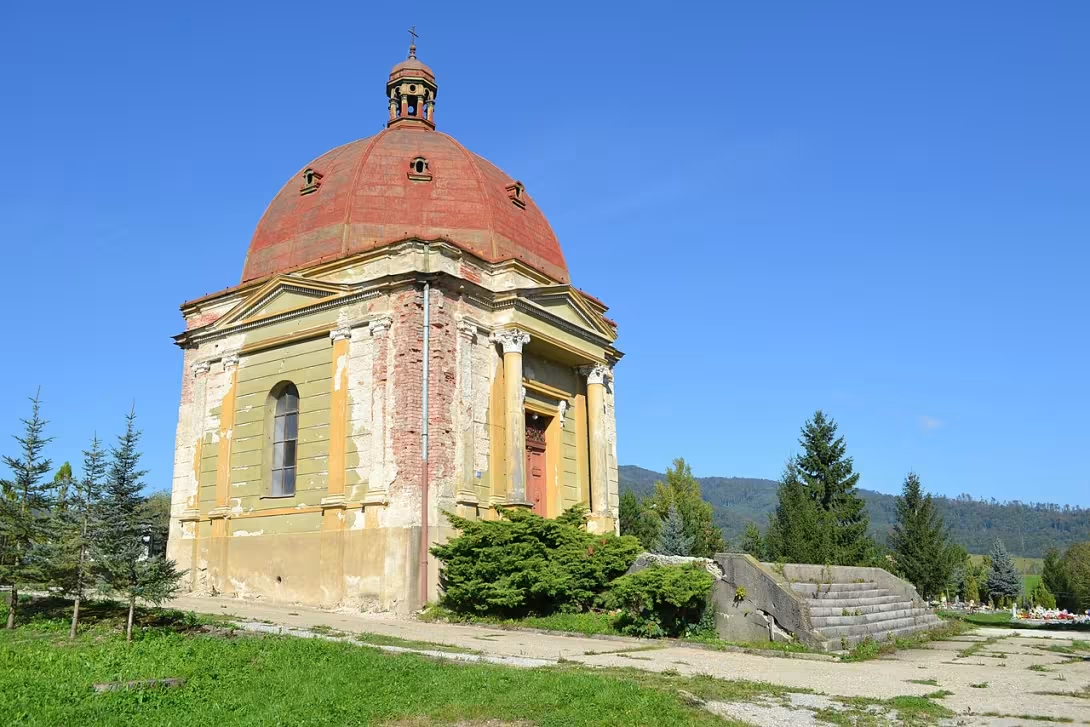

The historical view on the left is a visualisation generated by artificial intelligence and serves as inspiration.
Historical Milestones
- 1902
- Building a neo-Renaissance funeral chapel for the Faya family
- 1970
- Registration of the object as a national cultural monument
Interesting facts
- It is a neorenaissance building from 1902. - It serves as a crypt of the Faya family and was used in the past as a house of mourning. - The building has a dome roof and its entrance is highlighted by Corinthian columns. - There was a sign above the portal. - The building has been registered as a cultural monument since September 9, 1970.
Guide
The guide was voiced by a synthetic voice created by artificial intelligence.
Show guide text
The text was prepared by artificial intelligence and has not been editorially reviewed. It may contain inaccuracies.
Vite in Hnúšt, in the heart of Banská Bystrica region, where the historical layers of this town overlap with the nature and everyday life of the inhabitants. You stand in front of the funeral chapel, a place that requires quiet respect and thought. Right in front of you lies this modest but significant building, which served as the last rest area for many families and individuals in the region. At first glance, you are likely interested in its simplicity and moderation, which is typical for funeral architecture of this type. It is not a monumental cathedral nor a beautiful Baroque building with rich decoration, but rather an intimate space where death meets hope, sadness with peace. The atmosphere around the chapel is often penetrated by silence, which allows you to better perceive the details and feel the weight of history that has accumulated here for centuries.
When we look at the origin and historical context of this monument, we encounter a challenge unknown. The exact year of construction and the names of architects who gave it shape did not appear in the available records. However, this anonymity is not a shortcoming, but rather a mirror of common practice in the past, where many smaller sacral buildings were built on the basis of local initiatives, often without keeping detailed documents. Funeral chapels in Slovak towns and villages were a common part of urban character, usually located near graveyards or on the edge of urban buildings. Their purpose was to provide space for religious ceremonies associated with funeral rituals, such as dashes, prayers for the deceased, and the blessing of graves. In Hnúšť, which has a rich history associated with mining and mountaineering tradition, such a chapel probably also served mountaineers and their families who faced the risks of working underground and sought spiritual comfort and rest for those who had not returned.
Looking at the architecture of this chapel, you should pay attention to the overall shape and proportions of the building. Although we do not have a detailed description of the architectural style, it is possible to observe how the building is inserted into its surroundings. Try to see what materials were used to build it. Whether it is a stone structure that testifies to a dream of durability or a brick building with plaster, each detail bears a trace of time. Look at the chapel windows. They are often smaller and simpler with funeral chapels, contributing to the intimate atmosphere of the interior. If you are in construction, try to imagine how prayers sounded in the past and how the light from the windows illuminated the environment during holy ceremonies. The facade of the chapel, although perhaps lacking rich ornamentation, has its own beauty in its moderation and functionality. It is an architecture that is designed not to impress but to quietly accompany people in their most sensitive moments.
Historical personalities directly associated with this particular chapel do not appear in the available resources. This does not mean, however, that there were no significant figures passing through. The move was in the past an important centre where people from different levels of society met. The mountaineers, craftsmen, officials, and clergymen met not only in business matters but also in spiritual events. It is possible that local notables were buried here, who contributed to the development of the city, or vice versa, ordinary people whose stories were lost in the dust of history, but their presence here is still felt. This anonymity reminds us that history is not only about big names, but also about the silent fates of ordinary people who formed the tissue of this place.
One of the interesting things a visitor can find is the very existence of such a building in the context of a modern city. At a time when graves often move and cemeteries reorganize, chapels like this remain as permanent witnesses of the past. They serve as a bridge between generations, reminding us that death is an integral part of life and that the place where we deal with it has its own sacred place. Another aspect worth considering is the change in the function of such structures over time. Some funeral chapels later became a place for silent prayer only, others preserved as historical monuments that are no longer used for the original purpose but serve as symbols of local identity. In Hnúšť this chapel is part of a wider historical environment, which includes other sacral buildings and historical buildings, creating a unique urban and spiritual landscape.
The mystery surrounding many such buildings is the precise data and identification of architects. Why are they so little known? Is this the result of insufficient archiving, loss of documents during historical events, or simply insufficient interest in documentation of smaller sacral buildings? This unknown offers us space for imagination and exploration. Perhaps you could try to overcome the limits of available information and look for clues in local archives, family chronicles, or the oral traditions of the elderly. Any such contribution helps to complete the image of this monument and make it more vivid.
Finally, I would like to invite you to take a moment to think. You stand before a building that testifies to people's deep relationship with their spiritual needs and respect for the deceased. Although we do not know exactly who built it and when, we know that it served its purpose for generations. Look at her with respect and openness. Try to imagine how the outside sounded in the past, how people stood in mourning, and how they sought comfort here. This chapel is part of the soul of the Mouth, and its protection and respect is our shared responsibility. When you continue your walk around the city, remember to look back and appreciate the quiet beauty of this place. Thank you for your attention and I wish you a pleasant discovery of other historical jewels in Hnúš. May this trip bring you not only information but also a deeper sense of belonging and understanding to the history of this territory. We'll say goodbye here, by the quiet walls of this chapel, with the hope that you'll carry with you not only the consciousness but also the peace that this place offers.
Tips for visitors
Visit the funeral chapel late in spring or autumn when the temperatures and colors of the landscape around Hnúštey complement the atmosphere of the building. We recommend traveling to the site by car or local transport; check the links in the internet search engine.
We recommend to wear the terrain and in colder months warm clothes. Given the nature of the object, we ask for responsible access to the site.
Photos of architecture in the context of the country can be taken from surrounding elevates or from the immediate surroundings of the building. The ideal time for shots is the golden hour shortly before the sun is arrested.
In the surroundings you can focus on the architecture of the chapel and nature of the Banská Bystrica region. Families with children can connect the visit with an educational walk about sacral buildings.
Frequently asked questions
Can the monument be visited?
Religious buildings are usually open mainly during services; at other times a visit is normally arranged with the parish or the operator. We have not verified specific times.
Where is the monument?
Location: Križanova 153, Hnúšťa, Banskobystrický kraj. The map on this page shows the exact spot.
Why is the monument protected?
It is listed in the Central List of the Monuments Fund of the Slovak Republic as a national cultural monument (ÚZPF no. 329-2614).
For children
Close your eyes and imagine you're moving in time. It's 1902. There are no modern cars, no cell phones or the internet around you. We're in Moor exactly 124 years ago! The air smells of fireplace smoke and silence interrupts the horse's lurking on the road. It was at this time that a very strange and mysterious building arose, which looks like it came from a completely different world.
Nearby
🏰 Historic sites (47)
- Múzeum socialistických kuriozít 0.2 km +421 948 001 079 web
- Ján Francisci Rimavský 0.4 km
- Expozícia histórie priemyslu v Hnúšti 0.5 km +421 47 202 88 28 web
- Petrivaldského vila 0.8 km +421 47 202 88 28 web
- Banské múzeum Hnúšťa 3.1 km +421 907 318 119 web
- Padlým v II. svetovej vojne 4.7 km
- Karol Salva 4.7 km
- Elena Rampáková 4.7 km
- Karol Pajer 4.7 km
- Založenie MO-KSČ 4.7 km
- Padlým v I. svetovej vojne 4.7 km
- Ľudovít Kubáni 4.9 km
- Tank T-34 5.2 km
- Nálezisko obydlia človeka kyjatickej kultúry 6.8 km
- Pamätník padlým 6.8 km
- Evanjelický a. v. kostol 7.3 km
- Jozef Škultéty 7.8 km
- Kaštieľ Kokava nad Rimavicou 8.2 km Štúrova 271/68 web
- SNP 8.2 km
- Pomník Václava Vraného 8.9 km
🍽️ Restaurants and dining (29)
- Koliba 0.2 km Hlavná 919/1
- Pizzeria Kaštieľ 0.3 km +421 908 421 801
- Trio Kebab 0.6 km
- KOCKA bar&restaurant 0.7 km +421 949 222 503 web
- Hostinec Maťo 0.8 km
- Zlatá hus 2.7 km
- u Sveťa 4.8 km
- Hostinec Hiková 4.9 km
- Pohostinstvo Pohoda 4.9 km
- Bar Majka 7.5 km
- Koliba Studienka 8.1 km
- Pizzeria Favore 8.1 km
- Kokavská izba 8.2 km
- Reštaurácia Kokava 8.2 km
- Hostinec u Táni 8.2 km
- Oáza Bar 8.2 km
- Kulturák 9.3 km
- Cukráreň 10.5 km
- Pizzeria Meredith 10.8 km
- Darián 10.9 km
🏨 Accommodation (9)
- Robotnícky dom 0.6 km
- Hotel Vepor 4.8 km web
- Chata Hámor 7.9 km web
- Penzión Kokava 8.2 km
- Penzión na Ráztočnom 9.4 km web
- Penzión Močiar 13.4 km
- Nemcová 13.6 km
- chata Voniaca 13.7 km web
- Bodnárka 14.5 km
🚲 Rentals and sport (3)
- Mestské kúpalisko Hnúšťa 1.1 km
- Športová hala 5.4 km SNP 1173/51
- Športový areál 10.7 km
🥾 Hiking and nature (162)
- Štepový vrch 1.5 km
- Burianka 2.6 km
- Hora 2.6 km
- Laz 2.9 km
- Studnička Cigánka 3.5 km
- Železná tabla 3.9 km
- Ohrablo 3.9 km
- Sinec 4.1 km
- Matejov hrb 4.2 km
- Cigán 4.4 km
- Hrb 4.5 km
- Protitankový kanón 4.7 km
- Malý Sinček 4.7 km
- Divá kyslá 4.9 km
- Kyslá voda 5.0 km
- Hruštie 5.2 km
- Sinček 5.3 km
- Ostrá 5.3 km
- Kvakov vŕšok 5.3 km
- Bodnárka 5.4 km
Thematic route
Since the section is empty, I propose a thematic route focused on the monument and its immediate surroundings in the village Hnúšťa.
Funeral Chapel The main road point at the local cemetery. The building reflects local funeral customs and spiritual life of the inhabitants of Hnušte in the past.
The Courtyard of the Burial There's an old burial ground right by the chapel. A walk between historical tombstones allows you to explore epitaphs and find out more about local families. The quiet atmosphere of the place contrasts with the busier center of the village.
Surroundings of the cemetery and local trees Old trees grow around the chapel and burial ground. These natural elements often served as landmarks for local residents. A walk on the outskirts of the village allows you to enjoy the natural environment surrounding the monument.
Gateway and access road The route begins or ends at the entrance gate of the cemetery. The access road to the chapel is paved in places and leads through greenery.
This compact route is suitable for those interested in local history and architecture. It does not require long walks. It is recommended to visit the place in a quieter time of the day.
Seasonal recommendations
In spring, the surroundings of the funeral chapel in the village Hnúšťa will wake up to life and the landscape will cover green shades. The sun during this period provides natural lighting suitable for photography the exterior of the building. It is recommended that footwear with a firm sole, as the surfaces around the sacral structure may be wet after rain.
Summer months bring strong sunlight, which highlights the details of architecture and wall contrasts. Visiting in the morning or evening helps to avoid the highest temperatures. It is advisable to choose light, breathable clothing and protection from direct sunlight.
Autumn in the Banská Bystrica region is characterized by a colour change of the leaf, creating a peaceful environment around the chapel. The golden tones of nature complement the historical object. Due to fluctuating temperatures and frequent morning fog, it is advisable to wear layered clothing and jacket.
Winter in Hnúšt brings snow that can cover the surrounding details. The lighting is colder in this period and the days are short. For visitors, footwear with anti-slip soles and warm, waterproof clothing are essential.
Visualisations and artistic views


The visualisations are generated by artificial intelligence and serve as inspiration.
Visitor Tips
No tips yet. Be the first!
Log in and add your tip.
Location on Map
More monuments – Hnúšťa
Show all in the town

Visitor photos
No photos yet. Be the first to add a photo from your visit!
Log in and add your photo or leave a rating.
You get more points for a visit verified in the app — we can tell from the GPS that you are there.
Reviews and comments