








kaplnka Panny Márie Ružencovej Chapel
The Chapel of Our Lady of Roshencová, located in the village of Senohrad in the district of Krupina, is a Baroque monument from the year 1748. This object is recognized by the Monument Office of the Slovak Republic under number ÚZPF 11190 and represents the only element part of the area, which is devoted to religious art and the history of the region. The chapel is interesting not only by its architecture, but also by its spiritual importance to the village.
The formation of the chaplain dates back to 1748, indicating its origin in the Baroque period. This building style is characterized by dramatic forms and rich ornaments that are typical of this period. The Chaplain was apparently built as evidence of religious devotion and enabled the communities to express their whirlpools through architecture.
The architectonically chaplain of Our Lady of Rosary demonstrates the elements of Baroque strength, which are visible in its construction and decoration. Although details of materials used and specific architectural elements are not provided, it can be assumed that the chaplain contains typical baroque features such as dynamic lines and rich decoration. These elements are often associated with construction techniques from this period.
Historically, there is no specific information on the owners or management changes of the chaplain that would be included in the available sources. This suggests that its historical record may be limited to what is architecturally visible and administratively recorded.
The Chapel of Our Lady of Rosary does not contain in the background specified specific key events or attractions that would be documented. This indicates that its meaning can be more associated with architectural and religious value than with particular historical events.
Today Chaplain of Our Lady Rosary stands as a monument to the past, which is open to visitors. It is a place where travelers can gain insight into the baroque period and spiritual heritage of the region. Visiting this chaplain offers an opportunity to explore architectural styles and religious history of Slovakia.
The Chapel of Our Lady Rosence is an important cultural monument that represents Baroque architecture and spiritual heritage of the Senohrad region. It is a place where historical and religious values are preserved for future generations. Visiting this chaplain offers a unique view of the past and an opportunity to explore the wealth of Slovak culture.
Tehdy a dnes
Drag the slider and compare how the monument might have looked when it was built with the view today.
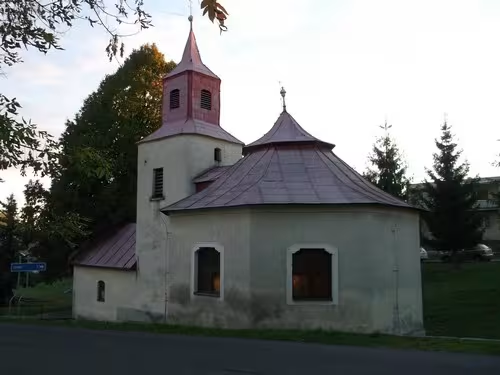

The historical view on the left is a visualisation generated by artificial intelligence and serves as inspiration.
Historical Milestones
- 1748
- The creation of the chapel in baroque style.
- 18th century
- Expansion of Baroque sacral architecture in the region.
- Current
- Register of chapel in the register of the Slovak Monument Office.
Interesting facts
- The Chapel of Our Lady of Rosence is located in the municipality of Senohrad in the district of Krupina. - It is a baroque monument from the year 1748 and is recognized by the Monument Office of the Slovak Republic under the number ÚZPF 11190. - Chaplain is the only element of the area devoted to religious art and the history of the region. - Architecturally manifests elements of baroque strength, characterized by dramatic forms and rich ornaments. - It is a place open to visitors who can gain insight into the Baroque period and spiritual heritage of the region.
Guide
Show guide text
The text was prepared by artificial intelligence and has not been editorially reviewed. It may contain inaccuracies.
Welcome to Senohrad, the beautiful corner of the Banská Bystrica region, where time seems to slow down and allows us to perceive the traces of ancient generations. Right now, you are facing a very small but very significant sacral construction that carries the peace and spiritual depth of the centuries. Before you is the chapel of Our Lady of Rosary. The first sight of this construction will likely draw you into the atmosphere of humility and silence. Feel this moment, the breath of the surrounding nature and the shape of the building, which has been vigiling over this place for almost 300 years. It is a place where human faith meets the artistic expression of one of the most significant ages of European history.
To understand why this chapel is so special, we have to go back a long time in our minds. The year 1748, when this building was created, carries us into the middle of the eighteenth century. At this time, our region, and specifically the areas around Krupina, experienced a real expansion of baroque sacral architecture. Baroque was not just a building style, it was an expression of deep emotions, dynamics, and efforts to bring heavenly glory to earthling man. The creation of the Chapel of Our Lady Rosary fits into this very period, when small shrines and chapels were built in every village and on every significant hill, which served as stops for prayer, places of comfort and symbols of protection for local inhabitants.
Now, when you look at the architecture of this building, take note of its baroque character. Although it is a more modest object, in its overall form you can feel the spirit of the day. Look at the facade and perceive the harmonic lines that are typical of the baroque. This style has always tried to create a sense of wonder and depth, even on such a small scale. Notice how the chapel naturally fits into the landscape around it. We don't have to look for monumental towers to feel the sanctity of the place. It is in this direness and simplicity of Baroque expression that its strength lies. Look at the details that time and weather had thrown into the material, and imagine what this construction looked like in 1748 when it was new and became the center of local spirituality.
If you are looking for the names of great masters or famous architects who would be worth building a chapel, you will come across one of the many silent mysteries of our history. The names of architects who designed and implemented this project remained unknown in time. It's not history's fault, but rather the natural state of the day. Many of these beautiful buildings were built by local craftsmen, masons, and carpenters, whose names were not recorded in the great chronicles, but their work survived for centuries. It is this anonymity that gives the chapel some charm. It is not the work of one famous individual, but the result of the common faith and efforts of the people who lived here before us. It is a memory created by the hands of people who wanted to leave a trace of their love for religious art and respect for the Virgin Mary.
An interesting fact that gives this place a special status is that the Chapel of Our Lady Rosence is not just a random building in the country. It is currently registered in the Register of the Monument Office of the Slovak Republic under the number ÚZPF 11190. This code may sound technical and strenuous, but in fact it is such a historical passport that guarantees that this monument will be protected for future generations. What is even more fascinating, however, is that this chapel represents the only element of the complex devoted to religious art and the history of this particular region. Imagine it as the last but very strong witness to how the relationship between man, faith, and art has been perceived in this area in the past. It's like a piece of puzzle that helps us compile a picture of the spiritual life of the inhabitants of Senohrad and its surroundings in the eighteenth century.
Stop for a moment and think about how many people have gone through the same paths over the last two hundred and seventy-six years. How many prayers were uttered in the shadow of this wall, how many hopes were sought, and how many silent promises were made. Virgin Chapel So Mary Rosary is not only an architectural object but a living archive of human destinies. It is fascinating that a small building in the village of Senohrad can survive regimes, wars and changes of centuries and still stand there to remind us of our roots.
Now that you have learned the basic knowledge of this Baroque jewel, I recommend that you enjoy the peace and quiet that this place offers for a while more. Go around the chapel slowly, perceive its proportions and try to imagine the atmosphere of the day when it was dedicated in 1748. Let yourself be guided by your intuition and feelings, because history is not only about dates and numbers, but above all about feeling from place.
Before we say goodbye and you go on to discover the beauties of the Banská Bystrica region and the surroundings of Krupina, look again at the facade of this Baroque pearl. It is a symbol of the fact that even the smallest monuments can have the greatest meaning if there is a memory of people and their values.
Thank you for your journey together in time before the Chapel of Our Lady of Rosary. I wish you a peaceful further survey and semoga you in every next step accompanied by curiosity and joy of discovering our common roots. Let it burn in the Senohrada, and let this short stop you in spiritual silence accompany you long after you put down your headphones. Now get in the next part of your journey and explore further. Goodbye.
Tips for visitors
The best time to visit the Chapel of Our Lady Rosary is in summer, when the weather is most pleasant and you can enjoy nice weather. It is ideal to visit a place in the morning or evening when the light is warm and poses a romantic atmosphere.
If you choose public transport, we recommend finding the current connection in the online search engine or on site, as there may be different options available from nearby municipalities.
When visiting the chaplain, leave a photographer or mobile phone with you to capture beautiful surroundings. We also recommend wear comfortable shoes and in case of visits in colder months warm clothing.
Photography is best at the beginning or end of the day, when light is soft and depicts beautiful seams. Remember to focus on the details of the chaplain, which are often overlooked.
There are not many alternative attractions in the immediate vicinity, but you can enjoy beautiful moments in the natural landscape. If you visit your family with children, look for resting places and the possibility of walking on picturesque roads.
Frequently asked questions
Can you visit the monument?
Sacral buildings are mainly open during religious services, outside which the tour is usually arranged with a parish or administrator. We didn't check the exact times.
Where is the monument located?
Location: No. 36, Senohrad, Banskobystrický kraj. The exact location shows the map on this page.
Why is the monument protected?
It is registered in the Central List of the Monument Fund of the Slovak Republic as a national cultural monument (ÚZPF number 325-11190).
For children
Imagine that we travel in the past in 278 years. The year is 1748. The air is cold, the streets of the village Senohrad in Banská Bystrica region are hollow, and people are moving in long robes. Something very important happened in this picturesque village. Some people have decided that they need a small place to pray and remember. They built a beautiful chapel. Not a large, impressive cathedral, but rather a cozy, baroque building, which boasts the name Chapel of Our Lady Rosary. Imagine masters building walls of stones and clay. Each stone was carefully enclosed to last centuries.
Nearby
🏰 Historic sites (20)
- Branislav Žigmund 0.2 km
- Kostol Lešť 7.9 km
- Pamätník padlých vojakov 8.1 km
- Múzeum Andreja Sládkoviča 9.8 km +421 917 761 157
- Pamätník Andreja Sládkoviča 9.9 km
- Kostol Turie Pole 11.2 km
- Turie Pole (ruiny) 11.3 km
- hrad Strahora 11.6 km
- Rodný dom Samuela Zocha 11.8 km
- Štefan Tuček 12.9 km
- Kováčska vyhňa 12.9 km
- Via Magna 13.0 km
- Ľudové náhrobníky Novohradu 13.6 km
- Dunduk Michajlovič Ivanov 13.9 km
- Ľudové náhrobky Novohradu 14.0 km
- Čabraď 14.2 km
- Pamätná tabuľa partizánskej brigády Karasiova Stepanova 14.3 km
- Pamätník SNP 14.4 km
- Pomník padlým partizánom 14.5 km
- Litava (Cerovo) 14.8 km
🍽️ Restaurants and dining (18)
- Dolce Vita 8.1 km
- Z Pizza 8.2 km +421 903 222 913
- Hostinec 8.2 km
- Kaffe na hrade Bzovík 9.2 km
- Profile 9.7 km +421 918 104 930 web
- Fresh Snack Bar 9.7 km +421 915 830 046
- Noodles&Rice Vietnamské Bistro Krupina 9.8 km
- Charisma 9.8 km
- Pizzeria Vito 9.8 km
- Galaxia 9.8 km
- Family Pizza 10.0 km
- Ranč Bezekov laz 11.3 km
- Kukučka 11.6 km
- Hostinec na ceste 13.3 km +421 903 709 705 web
- Motorest Devičie 13.9 km web
- Pizzeria Veterán 14.5 km
- Kaviareň Niva 14.6 km
- Lom Beach Bar 14.8 km
🏨 Accommodation (12)
- Turistická ubytovňa 8.5 km Školská 29/15 +421 45 556 2401 web
- Hanišberg 9.6 km
- Slovan club 9.6 km
- Krupinkovo 11.6 km +421 905 063 296 web
- Camping Lazy 11.6 km web
- Modrá Farma 11.7 km
- Camping & Glamping Slovakia 13.2 km web
- Biely Domček 13.9 km +421 908 649 404
- Malý Domček 14.0 km +421 908 649 404
- Ubytovanie 14.3 km Slobody 498/18
- Chata Španí Laz 14.4 km
- Chata Šváb 14.4 km +421 911 155 378 web
🚲 Rentals and sport (2)
- Tepličky 9.1 km
- bicykle Mama šport 9.7 km
🥾 Hiking and nature (214)
- Žiar 2.6 km
- Žarnovište 2.7 km
- Veľký Hrb 3.0 km
- Kráľov hrb 3.1 km
- Kopaný závoz 3.2 km
- Starý laz 3.3 km
- Nad Rakytinou 3.3 km
- Lieštie 3.3 km
- Nad Trpíncom 3.5 km
- Sebatin kút 3.5 km
- Rimajov vŕšok 3.7 km
- Kozí laz 3.9 km
- Drvotniská 3.9 km
- Malý Hrb 4.0 km
- Babin vrch 4.0 km
- Medveďov vrch 4.1 km
- Polomka 4.1 km
- Lazec 4.3 km
- Javorok 4.3 km
- Háj 4.4 km
Thematic route
1. Chapel of Our Lady Rosary (sacral object) - Discover peace in the interior and pay attention to the spiritual atmosphere of this place. 2. Courtyard chapel (areal) - Go right before the entrance, where you can observe the architecture of the building from close range. 3. The immediate Chapel area (green area) - Relax in silence and peace in the space directly surrounding this sacred place.
Seasonal recommendations
Jaro: In the spring period, the chapel of Our Lady Rosary is beautified with flower shrubs and plants, which will add to the view of the Baroness. The sunny bright along with the warm wind fills the environment with a pleasant atmosphere, ideal for a relaxing moment. When visiting, we recommend wearing lightweight clothes, as temperatures are already pleasant. The best time to visit is in the morning or evening when the crowds are not and you can enjoy a calm view of the chapel. Léto: In summer, the Chapel of Our Lady of Rosary is popular among tourists. Sunny days and warm night evenings add a pleasant atmosphere to the visit. When planning the trip, we recommend consistently use the morning time when there are lower temperatures and smaller crowds. Nositec additions to the sun and sufficient drinking water are a necessary addition to the summer visit. Under: The chapel of Our Lady of Rosary will be transformed into a peaceful refuge between the golden and ore leafiness of the surrounding trees. Atmosphere during this period is very good, which contributes to enjoying the picturesque environment. When visiting, we recommend wearing a warm scarf or shirt and trousers because they can be cooler days. The best time to visit is in the humane hours when the light is sufficient to photograph. Winter: In winter, the Chapel of Our Lady of Rosary will be transformed into a peaceful and quiet corner surrounded by dreams. The atmosphere is tainted, which adds character to the visit. During the planned visit we recommend wearing warm clothes including fur and gloves because they can be cold days. The best time to visit is in the morning when the dream is clean and the chapel in the best light. Opening hours may be shorter, so be aware of this before you travel.
Visualisations and artistic views


The visualisations are generated by artificial intelligence and serve as inspiration.
Visitor Tips
No tips yet. Be the first!
Log in and add your tip.
Location on Map
Visitor photos
No photos yet. Be the first to add a photo from your visit!
Log in and add your photo or leave a rating.
You get more points for a visit verified in the app — we can tell from the GPS that you are there.
Reviews and comments