








ľudový dom s hospodárskou časťou Vernacular house with farm wing
This folk house with economic part is located in the village of Bacuch, which is part of Banská Bystrica region. According to data from the Register of Monuments of the Slovak Republic (ÚZPF), this object is registered under the number 11341 and protected as a national cultural monument. The house was exhibited at the beginning of the 20th century and represents folk construction, which is characteristic of this time.
The area of the monument consists of only one object: folk house with economic part. This type of building is characterized by its brick construction system, which is typical for its period of origin.
According to the available data no details are provided on the building characteristics of this house, such as disposition, flooring or used material. This information could help to better understand the architectural value and technique of the created object.
The Folk House with an economic part is located at the address B.Nemcová 329/49 in the village Bacuch. This area is protected as a national cultural monument, but specific information on the date of the conservation declaration, the existence of a conservation belt or a protection zone is not provided. The current state and use of this object also unknown.
This folk house with economic part is an interesting example of folk architecture in Slovakia. Its location in the village of Bacuch makes it an important place for understanding regional cultural heritage and traditions. Visitors can appreciate its historical importance and architectural features that are representative of this time period. This object is an interesting destination for anyone interested in historical and architectural monuments of Slovakia.
Tehdy a dnes
Drag the slider and compare how the monument might have looked when it was built with the view today.
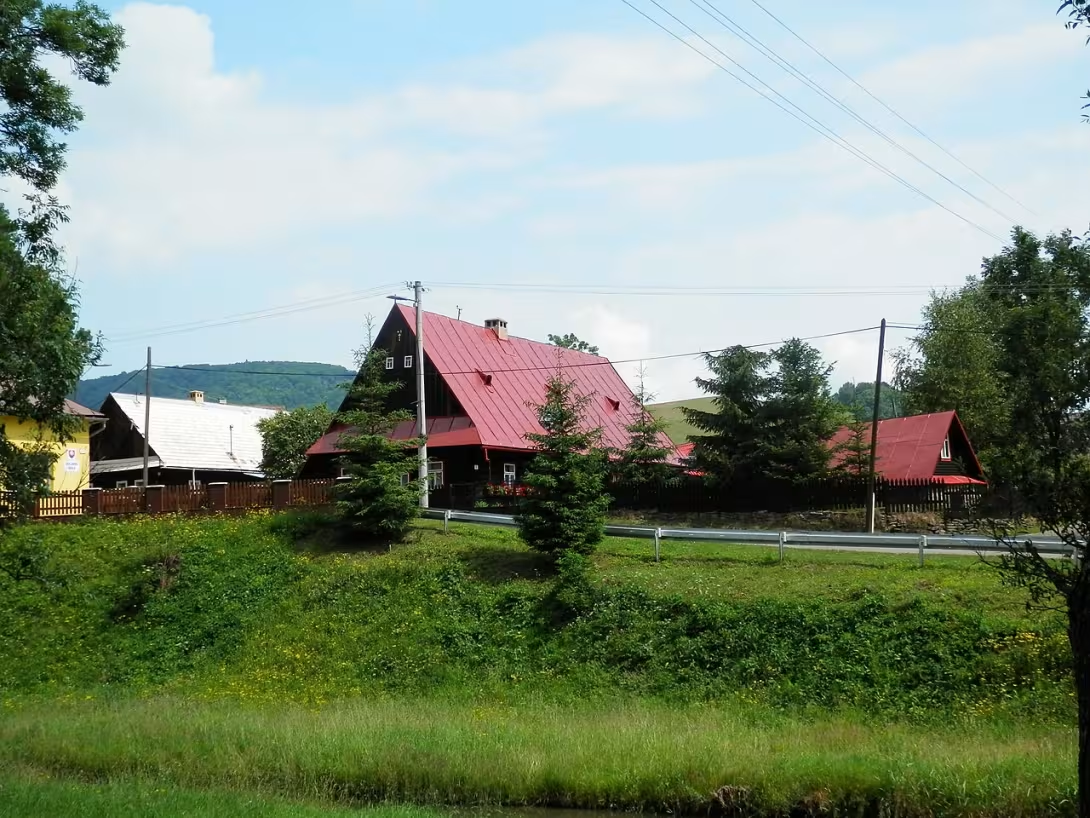

The historical view on the left is a visualisation generated by artificial intelligence and serves as inspiration.
Historical Milestones
- round 1900
- Creation of a folk house with an economic part in the village Bacuch.
- 2000
- Registration of the object as a national cultural monument under the number 323-11341 in the register of monuments of the Slovak Republic (ÚZPF).
Interesting facts
- The folk house with economic part is located in the village Bacúch, which is part of Banská Bystrica region. - This object is protected as a national cultural monument and registered under the number 11341 in the Register of Monuments of the Slovak Republic (ÚZPF). - The house was exhibited at the beginning of the 20th century and represents folk construction, which is characteristic of this time. - The area of the monument consists of only one object: folk house with economic part, which is characterized by its brick construction system. - The folk house with an economic part is an inter
Guide
Show guide text
The text was prepared by artificial intelligence and has not been editorially reviewed. It may contain inaccuracies.
Welcome to the village of Bacuch, in the heart of the Banská Bystrica region, where time seems to flow slower and where nature harmoniously complements the human footprint in the country. You are standing before an object that is a silent witness to ancient times and the daily efforts of the generations who have robbed this earth. Before you lies a folk house with an economic part, a building that represents the basic building block of our traditional villages. The first sight of this parrot will not tell us everything immediately, but it invites us to stop and consider how our ancestors lived. Feel the atmosphere of this place, the silence surrounding it, and the simplicity of its form, which carries deep practical meaning.
When we stop at the origin of this house, we have to admit that history does not offer us precise dates or names of concrete builders in this case. Chronology of construction remains unknown, but this is relatively common in the case of folk architecture. These houses were not designed by famous architects in the studies, but were derived from the need, tradition and knowledge that was passed on from father to son. The builders were local masters, people who knew the material and understood the conditions in which the building had to survive both winter and summer heat. This house was not built for representation or luxury, but as a functional space for life and work. It is an architecture of anonymity where more important than the name of the author is the very purpose of the building and its ability to provide refuge and livelihood.
Now, please concentrate and look at the overall layout of the object. Notice that there is not just an ordinary house in front of you, but a complex that connects housing to the economy. It is this connection between the former and the economic part that is a key element to note. In a traditional rural environment, the border between home and work was not as strict as today. The economic part that you see connected to the residential area was the heart of survival. Here the grain was stored, the pets found refuge, and here the crops were processed from the fields. Take a look at how these two parts work together. It is a logical arrangement that minimizes the need to go out in bad weather and allows for effective surveillance of the economy. Feel the simplicity of the lines and the functionality of the entire floor plan, which reflects the rhythm of the day of the inhabitants of the Slovak village.
Although there are unknown names in the archives of particular personalities who lived in this house, we can imagine the stories that took place here. Every corner of this house, every part of the farmhouse bears the footprint of an unknown man. Imagine the morning rising at sunrise, when the house woke up in life, sounds from the economic part, the smell of wood, and calls from family members. This house was not just a building but a living organism. This is where children were born, where they cared for their grandparents, and where they dealt with crop and weather concerns. Although we do not know who exactly lived here, we know that their lives were firmly linked to the rhythm of nature and hard work in fields and farms. It is this unknownness of men and dates that makes us perceive this house not as a museum of a particular person, but as a symbol of the whole state type and lifestyle that has defined our country for centuries.
You may be interested in one interesting thing connected with similar constructions in our region. The secret to these homes lies in their ability to adapt. Human builders did not work with plans on paper, but with intuition and experience. Each house was slightly different from what material was available in the area and what needs a particular family had. The mystery remains how many changes and modifications have been made to this house during its existence. Each new generation put something of its own into it, added or changed to meet new conditions. Now that you're looking at the facade and the overall appearance, you actually see layers of time that have been written into the building without anyone writing it into the chronicle. It's a quiet history that we have to read from material and shapes, not texts.
This folk house in Bacuch is a reminder that the true value of architecture may not lie in its size, ornament or glory of its creator. The value lies in the truth, in the sincerity of the material and in the fact that the building was fulfilling its role and protecting people from the adversaries of the world. It is the architecture of humility and practicality that teaches us to appreciate simple things and to understand the relationship between man and his environment.
Let's finish our short tour of this object. I invite you to walk slowly around the house now, bypass it from all sides and try to imagine what this space would look like in a full hover decades ago. Look for details that may have escaped at first sight and see the peace that Bacuch offers. I hope this short trip to the world of folk architecture has helped you to better understand the spirit of this place. Thank you for your attention and I wish you a pleasant continuation in discovering the beauty of Banská Bystrica region. Let something new and interesting be revealed in every next step. We'll say goodbye and have a nice day.
Tips for visitors
Folk house with economic part is a significant Slovak cultural monument. Best to visit during the summer, especially in autumn months, when the climate is more favourable.
It is recommended to wear comfortable footwear and protective eyelid. Don't forget the water and sun cream.
Photography is best in the morning or evening when light is soft. The best perspectives are from the surrounding paths or at the entrance to the house.
Nearby there is a park suitable for relaxation moments and a local market, where soft and local production can be discovered.
Frequently asked questions
Can the monument be visited?
This is a residential or farm building, not a museum with opening hours. Please view it from public space and respect the owners' privacy. We have no information about access to the interior.
Where is the monument?
Location: B.Němcovej 329/49, Bacúch, Banskobystrický kraj. The map on this page shows the exact spot.
Why is the monument protected?
It is listed in the Central List of the Monuments Fund of the Slovak Republic as a national cultural monument (ÚZPF no. 323-11341).
For children
Imagine sitting on an old wooden bench and finding yourself in 2000. It was a time when mobile phones were already commonly used in the world, but many villages stood in silence that rained only with rain and sun. At that time, exactly 50 years ago, a special house was created in the village of Bacuch in Banská Bystrica region. No, it was a flat in the building. It was a folk house with an economic part that we today protect as a valuable monument. There were no robots or dragons at the time, but the living people who built this building with their own hands. Imagine what it was like.
Thematic route
1. Folk house with economic part (residential part) - interior and traditional way of living in the past. 2. Economic part (service buildings) - historical animal breeding equipment and working tools. 3. Courtyard and area (outdoor area).
Seasonal recommendations
In spring Bacuch blooms and the surroundings of the folk house will be filled with fresh green color. The atmosphere is full of vitality and awakening nature, which adds natural charm to the memory. We recommend to wear layered clothing because spring weather is unstable. It's best to come in the morning.
Summer season brings bright lighting and rich colors of the country, highlighting the details of traditional architecture and economic part. In the main summer season there are more visitors around, so it is advisable to arrive as soon as possible in the morning. Do not forget light, breathable clothing and sufficient fluid intake.
Autumn in Banská Bystrica region is characterized by golden tones of leaves. Nature around the house creates ideal conditions for photography in soft light. Due to humidity and frequent rains, waterproof shoes and warmer clothing are essential, while the most pleasant are the visits in the afternoon.
In winter there is a folk house in Bacuch. There is peace and silence that will transfer the visitor to the ancient times of rural life. Warm thermoregulatory clothing and strong, insulated footwear are essential.
Visualisations and artistic views

The visualisations are generated by artificial intelligence and serve as inspiration.
Visitor Tips
No tips yet. Be the first!
Log in and add your tip.
More monuments – Bacúch
Show all in the town


Visitor photos
No photos yet. Be the first to add a photo from your visit!
Log in and add your photo or leave a rating.
You get more points for a visit verified in the app — we can tell from the GPS that you are there.
Reviews and comments