








parish church of St Church and wall with chapel
Parish church of the Holy Spirit in the village of Žehra in the district of Spišská Nová Ves is a late Roman sacral building from the second half of the 13th century. It belongs to a group of Spiš two-ship churches and is decorated with Gothic wall paintings. The Monument Office of the Slovak Republic records this area under the number ÚZPF 827 as two objects, which are the church and the wall with the chapel.
Construction of the church with fortification system was initiated by the Tatar raids and the bustling landscape. Spiš Prior In 1245 Matej confirmed her beginning to Count John of Žehra. Construction works were carried out between 1245 and 1275, while in 1275 the original document was confirmed by the Spiš Prior Mutimír. The patronage law over the church was maintained by the gentlemen of Žehra until the extinction of the genus in 1453. In 1563 the church became evangelical and Catholic after 1638, when the village became owned by the Čáki.
The building was created in a temporary late Roman style and Gothic style. Originally it was a one-ship church with a rectangular presbytery and a western tower, which was added by the end of the 13th century to the top floors with two rows of associated windows. The older elements include the Southern Early Gothic Portal. In the 14th century, the presbytery received a vault, and around 1380 the ship was encircled by the central pillar, creating Spiš double ships. On the octagonal pillar below the arched ribs there is a gender coat of arms. In the 17th century, the mobilizer was baroqued. In the 18th century there was a brick hall from the south, a northern sacristy and in 1769 a characteristic shingle-covered onion-like roof of the tower. Part of the area is a wall with a chapel from before 1769.
The interior of the church is decorated with medieval wall paintings from the 14th and 15th centuries. They cover the presbytery, the winning arch and the northern wall of the ship. They include the smuggling cycle, the scenes of Byzantine icons on the vault, the busts of the prophets, the Hungarian kings Stephen I and Ladislav I, the Coronation of the Virgin Mary, the Preaching, the anti-sea saints of Kozma and Damian, the Ladislava legend and the Last Court. Among the preserved exudations are the fresco of the tree of life from the end of the 14th century and the older Devon paintings Piety and Live Cross from the period around 1420. In the interior there is a stone baptismal from the 13th century. The restoration of wall paintings took place in 1870, 1877 and 1956 to 1959.
The church underwent construction modifications in the years 1638, 1652, 1928 and 1940. Archaeological research was carried out in 1884 and later. The church was declared a national cultural monument in 1985. Since 1993 it has been included in the UNESCO World Heritage List as part of the locality Levoča, Spišský castle and sights of surroundings.
Tehdy a dnes
Drag the slider and compare how the monument might have looked when it was built with the view today.
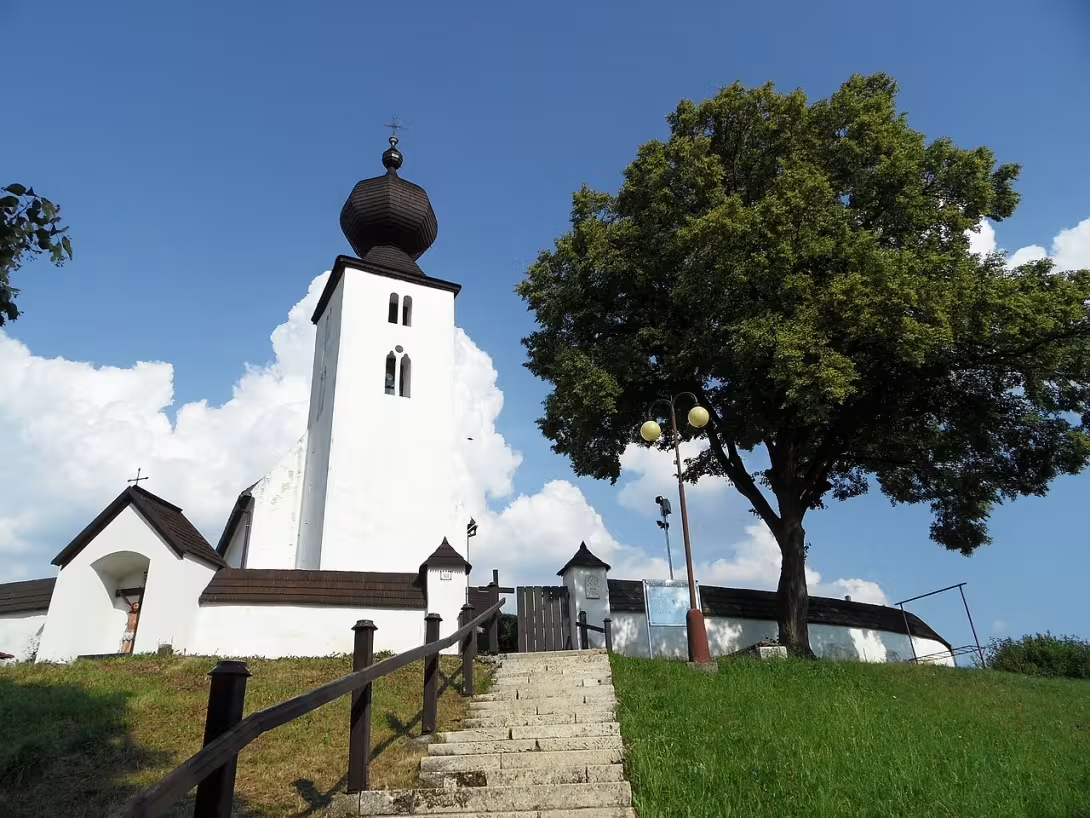

The historical view on the left is a visualisation generated by artificial intelligence and serves as inspiration.
Historical Milestones
- 1245: Spiš Prior Matej confirmed the construction of the church with the fortification system of Count Ján from Žehra
- 1275: completion of church construction
- 1380: the ship received a stone vault supported by a central column, creating a spiš double-boat
- 1563: the church became evangelical
- 1638: catholic church, wall paintings restored
- 1652: baroque interior
- 1993: UNESCO World Heritage List
Restoration history
| Years | Type | Extent | Condition after restoration |
|---|---|---|---|
| 2019 |
Obnova
farský kostol sv.Ducha |
Časť obnovená komplexne | dobrý |
| 2008 |
Obnova
farský kostol sv.Ducha |
Čiastočná | vyhovujúci |
Source: Monuments Board of the Slovak Republic — open data, licence CC BY 4.0
Interesting facts
- Construction of the church with fortification system was initiated by the Tatar raids and devastated landscape, while construction works were carried out between 1245 and 1275. - The wheel of 1380 was the ship encircled on the central pillar, creating the Spiš two-ships, while on the octagonal pillar below the vaulted ribs there is a gender coat of arms. - The interior of the church is decorated with medieval wall paintings from the 14th and 15th centuries, which include for example the smuggling cycle, the Ladislav legend or fresco of the tree of life from the end of the 14th century. -
Guide
Show guide text
The text was prepared by artificial intelligence and has not been editorially reviewed. It may contain inaccuracies.
Welcome to Zahra. You stand in front of a unique historical monument in front of the parish church of the Holy Spirit, which together with the surrounding wall creates a remarkable complex hidden in this picturesque corner of the Košice region. Now that you look before you, your eyes will rest on a building with solid walls bearing deep traces of ancient centuries. Try to stop for a moment, take a breath of local air, and see this quiet witness of the past, who seems to be guarding the peace of the entire community. The surrounding wall adds to this whole place a special atmosphere of security and closure, reminiscent of times when the need for protection was a primary concern of the people here. Let's go back in time and see why this church was created and what historical context shaped it. The very construction of this tabernacle together with its fortification system was a direct response to difficult and uncertain times. The country was marred and devastated by devastating Tatar raids that left people with fear but also a huge wave of determination to protect their lives, faith, and possessions. It was these dramatic historical events that initiated the creation of the building, whose construction has been going on for a relatively long time, namely between 1245 and 1275. Imagine these people, the ancestors, who, with their own hands and with huge tension, built walls to protect them from further danger. Now pay attention to the architecture itself and the details ahead. When you carefully look at the exterior and enter the premises of this church, you can admire the outcome of medieval construction art. Around 1380 the building underwent a significant construction adjustment. The church boat was encircled on the central pillar, creating typical Spiš double boats. If you look at this octogonal pillar under arched ribs, you will see an architectural element that bears the full weight of this space and gives it its distinctive character. Although the names of architects or concrete building masters have fallen into oblivion, their work speaks for itself and continues to this day. Although the particular historical personalities associated with this place remain hidden in the shadow of the archives, the story of this church is primarily the story of ordinary people who had to face the cruel reality of their time. The Tartar danger was not just a distant threat but a real experience that changed the shape of this country forever. The inhabitants of Žehra did not give up, but they joined the power of faith with the power of defense. For them, this church has become not only a place of spiritual refuge but also a real fortress where they could find security. An interesting thing that fascinates this place is the connection of sacral function to defence fortification. In the Middle Ages, it was not common for God's temple to act as a castle or a safe haven from invaders. However, the harsh times required their own, and a complex was created where prayer was associated with vigilance and solid walls protected not only souls but also lives. Finally, I invite you to further explore this beautiful place. Enjoy the silence that prevails, walk around the wall of the wall, and let your imagination travel to many centuries ago. Thank you for giving your time and attention to this extraordinary church. I wish you a pleasant next stay in Žehra and into early vision when discovering other historical treasures of our region.
Tips for visitors
The most appropriate time to visit the parish church of St. Ghost in Žehra is the late afternoon when the setting sun illuminates the outer stone wall and the Gothic complex. It is worth travelling by car; check your local timetable for accurate traffic. Take with you a sufficient supply of drinking water, comfortable shoes suitable for movement in uneven terrain and camera. Photos are advised to use side light to highlight the segmentation of the historical building and its installation in the rural environment. Since there are no other special points listed in the official documents in close proximity, you can pay full attention to the detailed admiration of this monument and its surrounding nature.
Frequently asked questions
Can the monument be visited?
Religious buildings are usually open mainly during services; at other times a visit is normally arranged with the parish or the operator. We have not verified specific times.
Where is the monument?
Location: č. 108, Žehra, Košický kraj. The map on this page shows the exact spot.
Why is the monument protected?
It is listed in the Central List of the Monuments Fund of the Slovak Republic as a national cultural monument (ÚZPF no. 42A-827). It is part of a UNESCO World Heritage Site.
Nearby
🏰 Historic sites (58)
- 100 rokov ochrany Dreveníka 1.9 km
- Kaštieľ Spišské Vlachy 2.8 km Partizánska 117/2
- Spišský hrad 3.0 km web
- Pomník obetiam SNP 3.2 km
- Generál M.R.Štefánik 3.3 km
- František Tondra 3.3 km
- Mariánsky stĺp 3.4 km
- Mariánsky stĺp 3.8 km
- Panna Mária s Ježiškom 4.3 km
- sv. Ján Nepomucký 4.5 km
- LáSKa 4.7 km
- Archeologické nálezisko na Pažici 4.7 km
- Kaštieľ Bijacovce 4.7 km web
- Vdp. Jozef Krišanda 6.6 km
- Kaštieľ Spišský Hrušov 7.2 km
- Kostol sv. Stanislava 8.3 km web
- Obetiam 1. svetovej vojny 9.4 km
- 20. výročie Nežnej revolúcie 9.5 km
- Osloboditeľom 9.5 km
- zákop 9.5 km
🍽️ Restaurants and dining (68)
- Giulia 2.0 km Hlavná 33/26 web
- Na Rázcesti 2.1 km Hlavná 30/23
- Spiš Castle 3.0 km
- Nova 3.3 km
- Snack Bar 3.3 km
- Zlatý klas 3.4 km
- Bagetka 3.4 km
- U Spišských bratríkov 3.5 km
- Reštaurácia Dreveník 3.6 km +421 949 339 789
- Pod hradom 3.7 km
- Imperio 3.8 km
- U kastelána 3.9 km
- Kolkáreň 4.0 km
- Domino Bar 4.0 km
- Sport club 4.1 km
- U Medveďa 4.2 km
- St. Martin Restaurant 4.4 km web
- Eso Club 4.8 km
- Spišský salaš 5.4 km web
- Sabinka 5.9 km web
🏨 Accommodation (38)
- Penzion Dreveník 1.9 km
- Privát Milano 2.0 km
- Sedemnástka 3.1 km
- Skautské táborisko Žehrica 3.3 km
- A+S Penzion Podzamok 3.7 km
- Penzion Chalupka 3.8 km web
- Pacák 3.8 km
- Vargas 3.8 km
- Penzión St. Martin 4.4 km web
- Penzión Živa 4.7 km +421 917 796 088
- Sivá Brada 6.0 km Levočská cesta 665/13
- Motorest Branisko 6.7 km
- Simona pod Smrekovicou 8.8 km
- Galmus 9.0 km web
- Penzión Piller Kaštieľ 9.6 km +421 918 189 572
- Alena 9.8 km Cintorínska 986/8
- Dievka 10.0 km
- Askony 10.0 km
- Hotel Plejsy 10.8 km +421 53 429 8015 web
- U Alžbetky 11.3 km
🚲 Rentals and sport (4)
- Soof 3.3 km
- Telocvična 4.0 km
- Turlíky Spišské Vlachy 5.1 km +421 902 416 379 web
- Obecné športové a oddychové centrum 11.4 km
🥾 Hiking and nature (259)
- Puklinová jaskyňa 1.0 km
- Šikmá jaskyňa 1.1 km
- Netopieria jaskyňa 1.2 km
- Medúzová jaskyňa 1.3 km
- Úzka jaskyňa 1.3 km
- Esovitá jaskyňa 1.3 km
- Jaskyňa v závale 1.4 km
- Kozia hora 1.6 km
- Dvojvchodová jaskyňa 1.6 km
- Strecha 1.6 km
- Syslia jaskyňa 1.6 km
- Kamenný raj 1.6 km
- Dreveník 1.6 km
- Jereňaš 1.6 km
- Nová priepasť 1.6 km
- Hlboká jaskyňa 1.6 km
- Veľká jaskyňa 1.6 km
- Jaskyňa v rokline 1.6 km
- Jaskyňa v rokline 1.6 km
- Jaskyňa pod vrcholovým bodom 1.6 km
Thematic route
Draft thematic cruise route:
1. St. Ghost parish church (Church and wall) Type: Historical monument / sacral building Why it is worth visiting: This medieval church in the village of Žehra is listed in the UNESCO World Heritage List and hides murals. The area surrounds the defence wall.
The route continues with a tour directly in the monument area.
2. Area and wall of St. Ghost church Type: Historical exterior / Architectural detail Why it is worth visiting: Walking around the wall provides a view of the sacral building and approaches the defence character of the complex. Details of the exterior can be seen on site.
Seasonal recommendations
Spring brings nature to the surroundings of Spiš, while the slopes under Spiš Castle and surrounding meadows are gradually greened and bloomed. Stone walls of medieval fortification near the parish church of St. Ghost are exposed to spring sun. The terrain around the church can be soaked and slippery after winter rains, therefore it is recommended to have strong and waterproof shoes. On spring weekends, fewer visitors arrive.
Summer months bring long sunny days, during which you can observe the wall and the building of the parish church of St. Ghost. The surrounding grass surrounds the monument. In the afternoon there is a minimum shadow around the church.
Autumn changes the appearance of Eastern Slovakia and acts as a historical place around the parish church of St. Ghost. The low sun creates shadows and light falling on masonry structures.
Winter brings snow cover to the Spiš region, which covers the wall of the parish church of St. Ghost. The light is reflected from snow and the contours of the sacral monument are visible against the sky. During the visit during this period warm clothing and skid shoes are recommended as access roads and slopes can be icy.
Visualisations and artistic views


The visualisations are generated by artificial intelligence and serve as inspiration.
Photographs from the area
Real photos taken near the monument

Source and licence are given for each image.
Visitor Tips
No tips yet. Be the first!
Log in and add your tip.
Zdroje a literatura
The factual basis for this text was the article na Wikipedii, whose authors are Wikipedia contributors. The article is available under the licence CC BY-SA 4.0.
Location on Map
Visitor photos
No photos yet. Be the first to add a photo from your visit!
Log in and add your photo or leave a rating.
You get more points for a visit verified in the app — we can tell from the GPS that you are there.
Reviews and comments