

parish church of St Church
The parish church of St. Klimenta stands in the center of the village Hronec in Banská Bystrica region and represents a classicistic sacral building from the years 1821 to 1826. It is registered in the Central List of Monument Fund of SR under number 44/1 and serves its purpose to this day. The attention of the choice of the object lies in the preserved unillity of the classicist exterior as well as in interior furnishings that document the continuity of decoration from the 19th century to the early 20th century, including significant stained windows from the Budapest workshop.
The church was built by the builder L. Gašparec in the first half of the 19th century, at a time when classicalism influenced sacral architecture in Slovakia. The building represented an older object or met the needs of a growing parish, and its implementation took place between 1821 and 1826. The complex consists of one object registered by the Monument Office of the Slovak Republic, which is classified as a church with classicistic features and dated to the above period. The historical context places the origin of this building in a period of sacred classicalism, when representative parish churches with simple but monumental composition were established in the regions with mining tradition.
Architecturally it is a single-shipd church with a flat cap of the presbytery and built-in tower on the west facade. The space of the ship is encircled by Prussian vaults, which sit on the covered pillars, creating the ritual structure of the inner space. Above the main entrance there is a brick chorus, below which the arcade space opens into the ship. The built-in tower is finished with a bell helmet and forms a slight rizalit with a segmented tympan. Facades are divided by lyrics and rustics, which is typical for classicistic aesthetics that emphasizes horizontal and vertical division of matter. The entrance to the church is organized through the tower rizalit, which strengthens the symmetrical character of the western facade.
Ownership and administration of the church is a parish which the object uses liturgically since the construction. The documents do not include dramatic changes of ownership or significant alterations changing the original concept; the building has served its purpose continuously. The key figure at the beginning was the work of the builder L. Gašparc, who realized the design in the classical spirit. Other names mentioned in connection with decoration belong to artists and workshops that delivered interior elements in later years.
Key events in church decoration history are documented. In 1826, at the completion of the building, the main altar of St. Klimenta was placed with a classicistic altar architecture, on which a mining sign is displayed - a reference to the economic character of the region. The painting on the main altar dates back to the 20th century. The same year 1826 also data the classicistic pulpit. The side altar of St. John Nepomuk with a central image was added in 1840. At the turn of the 19th and 20th century the interior was enriched by the Tirol sculptor J. Runggaldier: in 1900 he added the statue of the Divine Heart, in 1901 he performed the statue of St. Peter and Paul and in 1902 he performed the side altar of the Virgin Mary. Colorful stained windows with biblical scenes were made in 1913 in the Budapest workshop J. Palka and installed in church windows.
The current state of the church is good, the object has undergone reconstruction and fully serves the liturgical needs of the parish. It is located in the central part of the village, which ensures easy accessibility for visitors and believers. The church is worth a visit mainly due to the authentic classicistic spatial arrangement with Prussian vaults, preserved altar architecture with a mining mark and a quality set of stains from the Budapest workshop J. Pálk, which brings colour light to the interior and complements the picture of the development of sacral art in this locality for decades.
Tehdy a dnes
Drag the slider and compare how the monument might have looked when it was built with the view today.
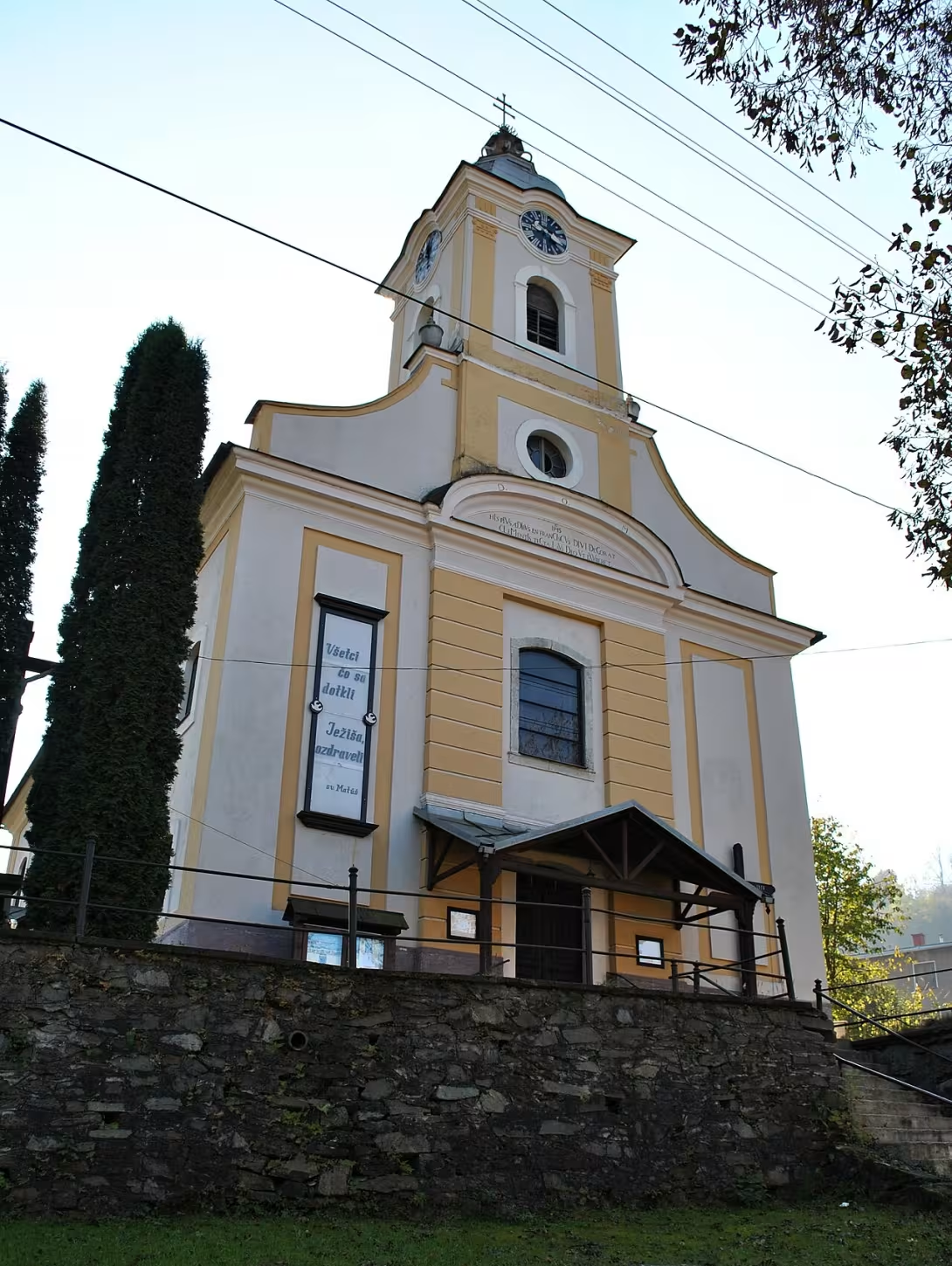
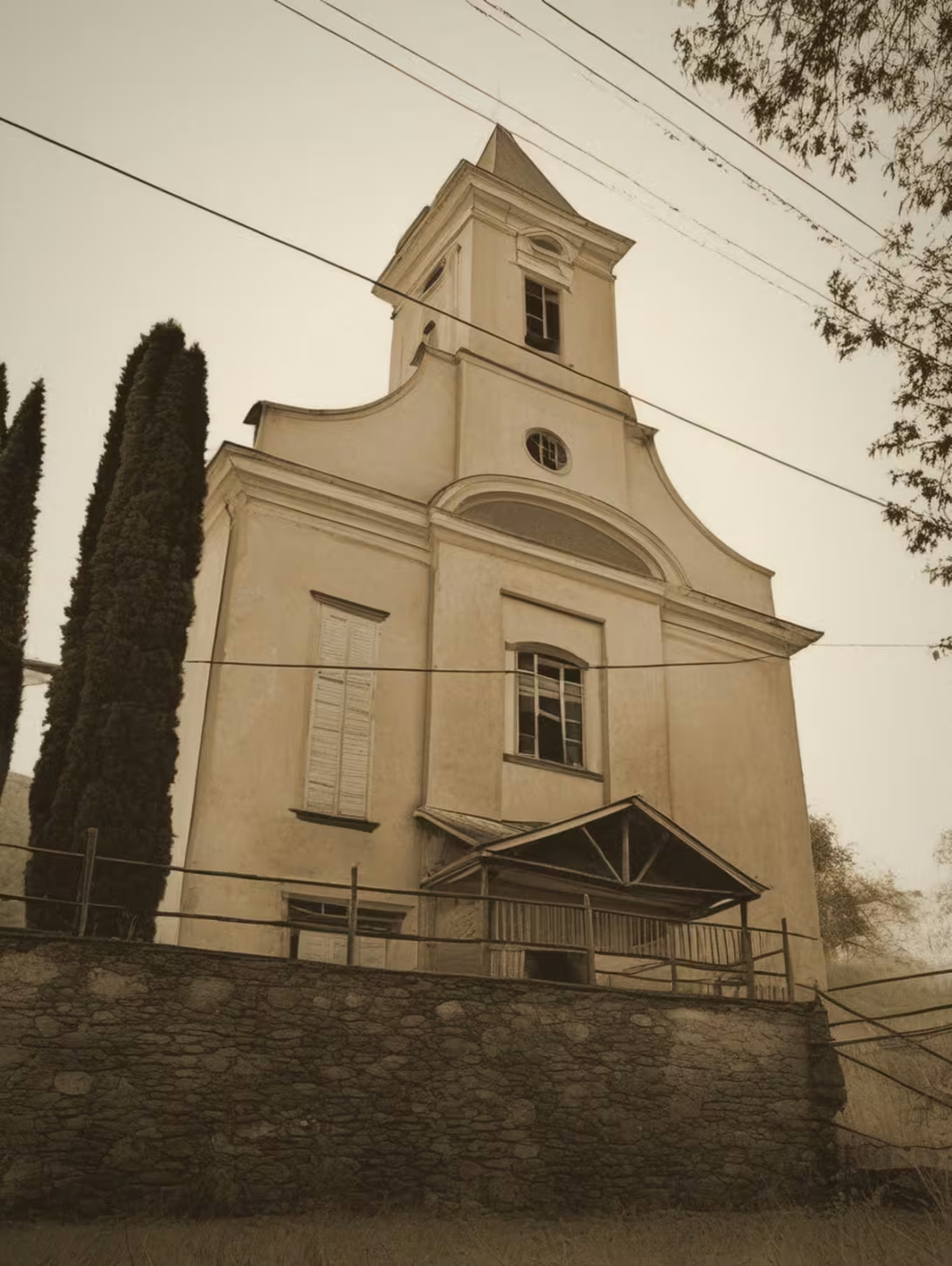
The historical view on the left is a visualisation generated by artificial intelligence and serves as inspiration.
Historical Milestones
- 1821-1826
- construction of a classicistic church
- 1826
- the location of the monumental main altar of St. Clement and the classicistic pulpit
- 1840
- location of the side altar of St. John Nepomuk
- 190-1902
- the location of the statues of the Divine Heart, St. Peter and Paul and the side altar of the Virgin Mary by J. Runggaldier from Tirol
- 1913
- production and installation of stained glass windows in the Budapest workshop J. Pálka
Artistic features
-
vitráž figurálna s dekorom — Kristus na večeri u farizeja Šimona
sklo, vkladanie do siete · historizmus · 1911-1920 -
vitráž figurálna s dekorom — Pieta
sklo, vkladanie do siete · historizmus · 1911-1920 -
vitráž figurálna s dekorom — sv.Rodina v tesárskej dielni
sklo, vkladanie do siete · historizmus · 1911-1920 -
vitráž figurálna s dekorom — Kristus vyháňa kupcov z chrámu
sklo, vkladanie do siete · historizmus · 1911-1920 -
vitráž figurálna s dekorom — Zjavenie Krista emauzským učeníkom
sklo, vkladanie do siete · historizmus · 1911-1920 -
vitráž figurálna s dekorom — Narodenie Krista
sklo, vkladanie do siete · historizmus · 1911-1920 -
vitráž figurálna s dekorom — Krst Krista
sklo, vkladanie do siete · historizmus · 1911-1920 -
vitráž figurálna s dekorom — Kristus v Getsemanskej záhrade
sklo, vkladanie do siete · historizmus · 1911-1920 -
vitráž figurálna s dekorom — Dobrý pastier
sklo, vkladanie do siete · historizmus · 1911-1920
Source: Monuments Board of the Slovak Republic — open data, licence CC BY 4.0
Interesting facts
- The parish church of St. Klimenta is registered under number 44/1 and serves its purpose to this day. - The interior of the church preserves continuous decoration from the 19th century to the beginning of the 20th century, among which there are colored windows from the Budapest workshop. - The church was built in 1821-1826 by the builder L.
Guide
The guide was voiced by a synthetic voice created by artificial intelligence.
Show guide text
The text was prepared by artificial intelligence and has not been editorially reviewed. It may contain inaccuracies.
Welcome to Hronec, in the beautiful part of Banská Bystrica region, where time seems to slow down and history speaks through the walls of old buildings. Right now you are standing in front of the parish church of St. Climony, which dominates the local landscape and has served as the spiritual center of this village for almost two hundred years. When you look at it, you see not only the religious structure but, above all, the witness to the changes that the region has undergone. Feel the calm atmosphere that surrounds this space, and before you enter, stop for a moment and note the overall harmony of this building. This church was not built suddenly, but it was the result of a particular era and the needs of the community. Its construction took place between 1821 and 1826. If we think about what time we are, we will see that this is the time when classicalism triumphed in architecture. Classicism brought with it a desire for order, balance, and a return to pure lines inspired by antiquity. Although we do not know the names of the specific architects who designed this project, it is clear that they wanted to create an area that emits peace and dignity. It is this style that defines the overall character of the building before you. Now I invite you to slowly enter. When you cross the threshold, watch how light and silence change. The interior of the church is fascinating especially because it does not find one single dominant style from one period, but rather a continuous decoration that evolved from the nineteenth century to the beginning of the twentieth century. It's like reading a book about the faith and art of locals, where every new decade has written its own chapter. The first point you should draw your attention to is the monumental main altar dedicated to Saint Climony. It was located in 1826, immediately after completion of the construction. This altar is the heart of the entire temple, and its greatness and majesty were then, even today, to remind the greatness of the divine presence. Other elements from the same time, namely the classicistic pulpit, are closely associated with the main altar. Note its shape and details that perfectly match the overall spirit of classicism, where they avoided too much strenuousness but also rejected chaos. As you slowly look around the area, take note of the side parts of the church. In 1840 a side altar dedicated to St. John Nepomuk was added to the interior. This saint is very honored at our ends, and his presence in this church testifies to the deep tradition and spiritual need of the people who lived here in the mid - 19th century. It is a gentle addition to the original equipment that expands the spiritual dimension of the space. Let us now move forward a few decades in time, except for the evil century itself. Between 1900 and 1902, the interior went through another enrichment that brought influences to Hronec from the far south of Alpies. It was during this period that the statues of the Divine Heart, Saint Peter and Paul, as well as the side altar of the Virgin Mary, were placed. These works of art come from the workshop of Joseph Runggaldier from Tirol. It is interesting to imagine how these statues traveled from the Tyrol mountains to the heart of the Slovak country to bring new aesthetics and emotions to the local temple. These elements add depth to the interior and show that Hronec was not an isolated place, but was open to European art. However, one of the most exciting elements that you should not miss in this church is the colored stained glass windows. These glass paintings were made and installed in 1913 in the Budapest workshop of Jozef Palka. I recommend you now stop, lift your sight and observe how light penetrates these colorful glass. Vitriarchs are not just decorations; they are filters that turn natural daylight into sacral brightness that fills the whole space with color and peace. The Budapest workshop was known at the time for its precision and quality, and the fact that they got here underlines the importance of this church for the local community. What's really fascinating about this place is the continuity. The parish church of St. Klimenta is not only a museum of the past, but a living organism. It is registered under registration number 44/1 and, most importantly, still serves its purpose. This means that ceremonies are still held in these walls, people pray, and music is heard. Everything you saw - from Classicist altars from 1826, through Tyrol statues from the turn of the century, to Budapest's 1913 stained glass - forms one whole story. It's a story of how a place of comfort and hope was built together. You may be interested in this little mystery or rather interesting: in many historical buildings, with the arrival of new fashion, old elements are discarded or rewrited. But this is different. The interior of the church preserved its layered identity. Each added element respected what was already there. It's a rare example of how history can linger without losing its original essence. When you look at these details today, you see basically a visual time axis that guides you through the nineteenth century and the beginning of the twentieth century. Before you leave this sacred space, I urge you to find a moment of silence. Close your eyes for a moment and imagine the people who stood before us a hundred or two hundred years ago. They saw the same colourful reflections from the stained stains, staring at the same monumental altar of St. It is in this sense of association with the ancestors that they connect with this place the strongest. Now that you have come to know the main artistic and historical treasures of this temple, you can quietly walk around the rest of the space, perceive the game of light and shadows and let the atmosphere of classicism and piety surround you. Thank you for a walk in the history of the parish church of St. Climony in Hronec. I wish you a peaceful day and a pleasant sequel to discovering the beauty of Banská Bystrica region. May the harmony you experienced here today inspire you. We say goodbye, but the inside of this church remains open to anyone seeking peace and beauty.
Tips for visitors
Visit the building in favorable weather.
Check your current links in internet search engines for the location of your car or public transport.
It is recommended to take a head covering or sunglasses.
Photography is suitable in the morning or late afternoon.
The place is also suitable for visits with children.
Frequently asked questions
Can the monument be visited?
Religious buildings are usually open mainly during services; at other times a visit is normally arranged with the parish or the operator. We have not verified specific times.
Where is the monument?
Location: Jilemnického 500/131, Hronec, Banskobystrický kraj. The map on this page shows the exact spot.
Why is the monument protected?
It is listed in the Central List of the Monuments Fund of the Slovak Republic as a national cultural monument (ÚZPF no. 323-44).
For children
Close your eyes and imagine pressing a secret button on a time machine. Boom! It took you exactly 205 years back. You're in Hronec. The air smells like smoke from fireplaces and in the street you can hear the stomping of horses. It's 1821 and there's something big going on.
Nearby
🏰 Historic sites (73)
- Obetiam 1. svetovej vojny 0.0 km
- Tomáš Hromada (1793 - 1870) 0.0 km
- Pamätník SNP 0.2 km
- Pamätník SNP 0.2 km
- sv. Florián 0.2 km
- Založenie prvého robotníckeho spotrebného družstva na Horehroní (1875) 0.2 km
- Pamätník 2. svetovej vojny 1.2 km
- Hutnícky skanzen 2.0 km +421 908 170 857 web
- Ladislav Chudík 2.7 km
- Obetiam 2. svetovej vojny 3.5 km web
- DOUBLE RED Cars Museum 3.7 km web
- Pamätník SNP 3.8 km
- Obetiam SNP 4.2 km
- Samuel Sekuris 4.3 km web
- Opevnenie mesta Brezna 4.4 km
- Gustáv Kazimír Zechenter-Laskomerský 4.6 km
- Padlým v 2. svetovej vojne 4.7 km web
- Horehronské múzeum - Meštiansky dom 4.7 km +421 48 6112283 web
- Milan Rastislav Štefánik 4.7 km
- Martin Rázus 4.7 km web
🍽️ Restaurants and dining (102)
- Pizzeria Hronka 0.1 km
- Hostinec pod skalou 0.1 km
- Sat Bar 0.1 km Hronská 133/57
- Kaviareň Koruna 0.1 km
- Vtáčnik 0.2 km
- Perla 1.4 km
- Cafe Maestro 1.4 km web
- Ski Hlobišov Bistro 21 1.9 km web
- Pltník 1.9 km
- Bar Trojka 1.9 km
- Hostinec pod Úbočou 2.1 km Cesta osloboditeľov 202/47
- Hostinec Groš 2.7 km
- Bufet Banisko 3.0 km
- Kiosk 3.6 km
- Mc Kebab 3.6 km
- Praženica pub 3.7 km
- VELÍN cafe s.r.o. 3.8 km +421 901 797 777 web
- Nábrežie Café 4.1 km web
- 2M kaviareň a bar 4.2 km
- Televízor 4.3 km
🏨 Accommodation (73)
- Turist Hotel DROTÁR 2.9 km Mlynská 411/104
- Rekreačné zariadenie Poniklec 3.0 km Mlynská 444/102 web
- Turistická ubytovňa 3.5 km web
- Vila Dom hostí 4.1 km Kolkáreň 33/42 +421 903 575 712
- Hotel Stavbár 4.5 km Rázusova 974/51
- Alžbetka 4.8 km
- Hotel Ďumbier 4.8 km
- Penzión Bystrá 4.9 km
- Penzión Bystrinka 5.0 km +421 905 413 495 web
- Vila Stella 5.1 km +421 905 928 820 web
- Chata pod Bielou skalou 5.2 km
- Chalupa u Havranov 5.2 km +421 903 272 555 web
- Chalupa Bystrá 5.2 km web
- Turistická ubytovňa 5.3 km web
- Ubytovanie u Zaja 5.5 km +421903624033 web
- Chata Ďumbier 5.5 km +421 907 745 483 web
- Chata pod Chopkom 5.5 km +421 907 745 483 web
- Apartmány Bystrá-Chopok 5.6 km web
- Privát Eva 5.7 km +421907647250 web
- Perla 5.7 km Dolná 42/53
🚲 Rentals and sport (21)
- Cyklo Servis Šport 1.5 km
- BMT 1.9 km web
- Hronec - Majer 3.5 km web
- Sportisimo 3.7 km
- Tennis center 4.0 km
- Kolkárnička 4.2 km Sládkovičova 79/15
- SIGO e-bike Servis 4.2 km +421 908 658 594
- BikeLandia 4.6 km web
- Yogi sport 4.6 km web
- E-bike Rental 4.6 km +421 911 633 119 web
- Bike šport 4.8 km web
- Bystrá 94 5.7 km
- Wellness Bystrá 6.3 km +421 48 6195 835 web
- Národné biatlonové centrum Osrblie 6.6 km +421 918 900 774 web
- Ski Alp Point 7.2 km
- Lanový park Tarzania 8.4 km web
- Pool Polianka 9.0 km
- Kúpalisko Jasenie 10.6 km web
- Geosport 12.9 km web
- Brusno 14.4 km
🥾 Hiking and nature (203)
- Hrončianska zvonica 0.2 km
- Liatinový most 0.3 km
- Prameň Ladislava Chudíka 0.4 km
- Muškov hrb 0.8 km
- Lipová 1.2 km
- Hnusné 1.3 km
- Bukovina 1.4 km
- Chvatimech 2.1 km
- Skala lásky 2.4 km
- Hájny grúň 2.6 km
- Prameň Panny Márie 2.9 km
- Horné lazy 3.0 km
- Samanovský vrch 3.1 km
- Kozí chrbát 3.2 km
- Brezinky 3.3 km
- Viselnice 3.3 km
- Prameň sv. Petra 3.4 km
- Chamarová 3.4 km
- Prameň sv. Štefana 3.4 km
- Prameň sv. Martina 3.5 km
Thematic route
1. The exterior of the parish church of St. Klimenta - Architecture, facade and the overall form of the building. 2. Interior of the church - sacral space and interior arrangement of the church. 3. Main altar - Artwork. 4. Church area - Outdoor space in the immediate vicinity of the building.
Seasonal recommendations
In spring, the surroundings of the parish church of St. Klimenta in Hronec will live. The fresh colors of grass and flowering trees complement the architecture of the construction. We recommend to visit the locality in the morning with gentle light. Due to variable weather, it is advisable to dress with layers.
Summer season brings clear sunny days and rich colors of Banská Bystrica region. The church is in a full sunny world well visible and its facade stands out in contrast with deep green vegetation. Visit it early in the morning or later in the evening to avoid the cold temperatures. Light and breathable clothes are suitable.
Autumn will clothe the surroundings of the temple with golden and red tones. The lush mornings create a quiet atmosphere, while the afternoon sun illuminates the details of the building. Due to the colder air we recommend taking a warmer sweater or jacket.
In the winter months the snow covers the landscape around Hronec. The contrast between the snow and the walls of the church is particularly noticeable during short days with a low sun. Due to the frosts, we need to put on waterproof shoes and put on warm layers.
Visualisations and artistic views


The visualisations are generated by artificial intelligence and serve as inspiration.
Photographs from the area
Real photos taken near the monument

Source and licence are given for each image.
Visitor Tips
No tips yet. Be the first!
Log in and add your tip.
Location on Map
More monuments – Hronec
Show all in the town

Visitor photos
No photos yet. Be the first to add a photo from your visit!
Log in and add your photo or leave a rating.
You get more points for a visit verified in the app — we can tell from the GPS that you are there.
Reviews and comments