

Sea chapel, Chapel in the grove, Chapel Chapel
The Chapel of the Holy Cross, also known as the Chapel of the Sea or the Chapel, is a Roman Catholic Baroque building from the first half of the 18th century. It is located in the village Hronský Beňadik in the Banská Bystrica region and is registered as a national cultural monument under the number ÚZPF 1230.
The construction was established between 1713 and 1715 as a reminder of the plague epidemic that struck the region between 1709 and 1710. The construction of the chapel was initiated by the Tekov county yeomanship led by Andrej Hunyady. Officially, the chapel was consecrated in 1716.
Architecturally, the object has an octogonal floor plan and is encircled by the dome. The facade is divided by pilasters, which include windows with half-circle finishes. Entrance to the building consists of a famous porticus with a timpanon, above which there is a memorable tablet documenting the construction and repair of the chapel along with the coat of arms of the Hunyady family. The upper part of the building ends the crown ledge with a bell roof, which is complemented by a lateral and onion roof.
Imrich Kürtössy painted the interior of the chapel. Inside there is a chorus, which is lined with two columns and access to it leads through a wooden fractured staircase. The main altar originally contained an image of the martyred Christ and the statue of Saint Roch and Saint Sebastian. In the past there was about 100 steps from the chapel wooden belfry from the 18th century.
Today, regular pilgrimages are still taking place in the Chapel of Sea on the Beňadická Rock.
Tehdy a dnes
Drag the slider and compare how the monument might have looked when it was built with the view today.
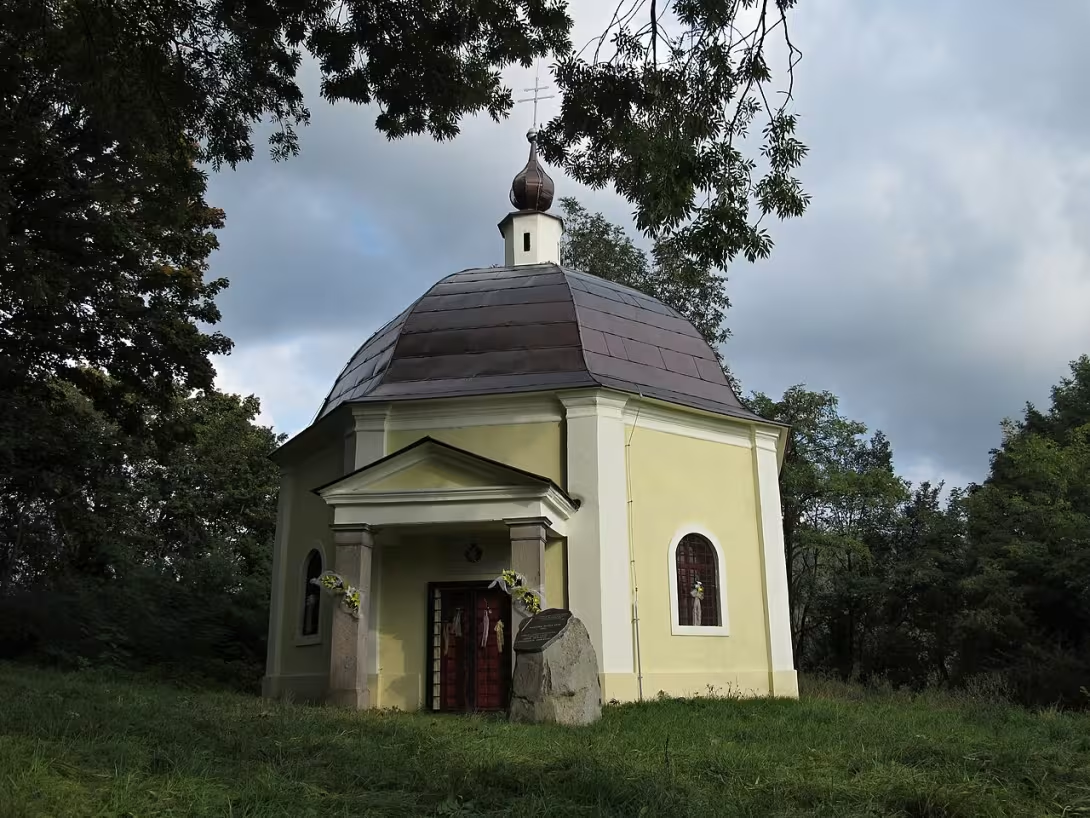
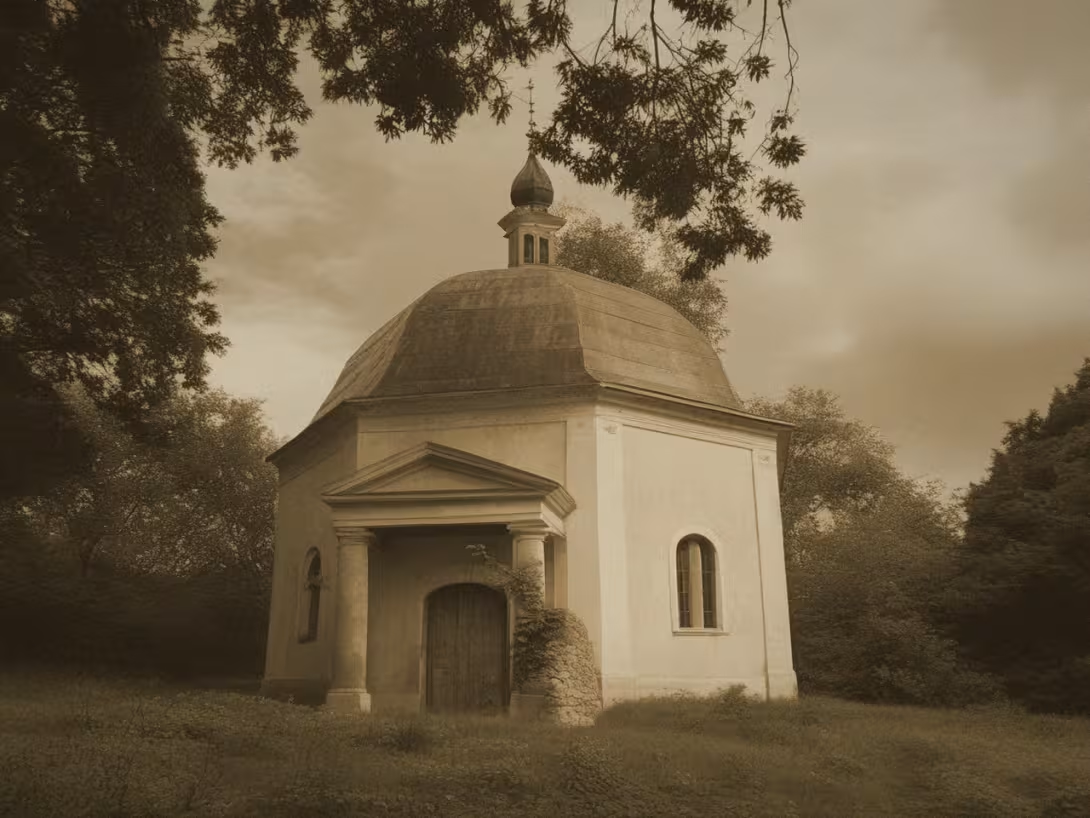
The historical view on the left is a visualisation generated by artificial intelligence and serves as inspiration.
Historical Milestones
- 1709
- Region was hit by a plague epidemic
- 1713
- The start of construction of the chapel led by Andrei Hunyady
- 1715
- Completion of Baroque construction
- 1716
- Official consecration of the chapel
Interesting facts
- The construction was established between 1713 and 1715 as a reminder of the plague epidemic that struck the region between 1709 and 1710. - The object has an octagonal floor plan and is encircled by the dome. The interior of the chapel was painted by Imrich Kürtössy. - The main altar originally contained an image of the martyred Christ and the statue of Saint Roch and Saint Sebastian. - At present, regular pilgrimages are held in the Chapel of Sea on the Beňadická Rock.
Guide
The guide was voiced by a synthetic voice created by artificial intelligence.
Show guide text
The text was prepared by artificial intelligence and has not been editorially reviewed. It may contain inaccuracies.
Welcome to Hronsky Beňadik. You are standing in a place where time has stopped and where history meets deep human emotion. In front of you there is a sea chapel, also known as the chapel in Háj or the chapel. Before you start walking through its proximity, try to stop your movement for a while and just look around. Feel the atmosphere of this place, which is not just a mere sacral building but, above all, a silent witness to the tragic events that have had a profound impact on the lives of the people of this region centuries ago.
If you look at this structure, you may be interested in its peaceful and serious presence. This chapel did not arise as an expression of triumph or glory, but as an expression of gratitude and remembrance of a period that was extremely difficult for the whole area. To understand why this chapel is standing here, we must return to 1709 and 1710. At that time the region was affected by a plague epidemic that brought death and fear to many households. It was a time when people felt helpless before forces they could not control.
It is this tragedy that has become the driving force for the creation of this object. The chapel was built as a pestilence, as a memory of survival and as an expression of faith in protection from further danger. The construction itself started in 1713. Did you know that Andrei Hunyady led the entire construction process? Although we do not know the exact details of his personal life, we can assume that his decision to invest in this building was a powerful act of solidarity and faith in the community. It was thanks to these efforts that the chapel was completed in 1715 and was officially consecrated in 1716, making it a full place of prayer and refuge for souls seeking peace.
Now that you have imagined the historical context, pay attention to the very architecture of the chapel. When you look at it close, notice its unconventional geometry. The chapel is not built on a classic quadrilateral, but it has an octagonal, or octagonal, ground plan. This form gives the building a unique character and creates a feeling of harmonious, closed space. Above your heads there is a dome that covers the interior and adds a baroque touch to the entire building. Barok is not just about decorating, it is a style that has the task of acting on emotions, and this architecture plays an important role here.
When you decide to enter, pay special attention to what surrounds you. The interior of the chapel is a real work of art that bears the mark of a significant artist. The paintings that adorn these walls were created by Imrich Kürtössy. His artistic feeling helped to transform this little space into a place where visual beauty is associated with spiritual significance.
Please also see the main altar, which is the heart of the entire chapel. Originally part of the altar was an image of the martyred Christ, reminiscent of self - sacrifice and suffering. Around him were statues of St. Roch. If you ask why he is the one, the answer is directly linked to the history of this place. Saint Roch was traditionally considered a protectionist from the sea and epidemics. His presence in the chapel is not accidental; he was a spiritual watchman called into his life at a time of greatest uncertainty.
Stop for a moment with the idea that this chapel is basically a bridge between the last century and the present. Every stone and every painting here has its weight. It is fascinating to think about how many people have come here over the last three hundred years to find comfort, and how many generations of Hronsky Beňadik took this place to the heart as a symbol of the resilience of their ancestors.
Perhaps you are interested in one small thing that gives this place depth. Although we do not know the architects of this building, their vision has survived for centuries and can still reach us in its form. There is something mysterious about it that, while times, political regimes, and ways of life are changing, this small otogonal object remains still, as if guarding the peace of the area.
I won't hold you much longer now. We invite you to go through the chapel in peace, to see its details and to be carried away by the atmosphere of Baroque art. When you leave, try to look again at her silhouette against the sky and think of those who stood before you in 1716 when the chapel first opened up to the world.
Thank you for spending time with us and for discovering the story of the plague chapel with us. Would you like to see more historical places around here? Continue your journey and be surprised by the beauty and history of this region. Goodbye.
Tips for visitors
We recommend a visit late in spring or autumn when temperatures are suitable for walks.
Due to uneven terrain around the building we recommend shoes with fixed soles. In the summer months we recommend taking insect repellent.
For photography are suitable moments shortly before sun flood, when light highlights the details of the building and landscape. We recommend looking for angles that capture the chapel in the context of nature.
For families with children, visiting the chapel is an opportunity for a short trip to nature and to meet local history.
Frequently asked questions
Can the monument be visited?
Religious buildings are usually open mainly during services; at other times a visit is normally arranged with the parish or the operator. We have not verified specific times.
Where is the monument?
Location: Pod Kláštorom 5/31, Hronský Beňadik, Banskobystrický kraj. The map on this page shows the exact spot.
Why is the monument protected?
It is listed in the Central List of the Monuments Fund of the Slovak Republic as a national cultural monument (ÚZPF no. 32C-1230).
For children
Imagine you're a time traveler. You don't go to a spaceship, but only in your mind. Your time machines are gonna spin, and you're walking right back 313 years. The year is 1713. The world around you is completely different from the one you're used to. No computers, no cell phones and not even street lamps. At that time the night was truly dark, and the only light was the small flames of candle or fire that cast long shadows on the road.
Nearby
🏰 Historic sites (118)
- Obranný val, Hradisko na Beňadickej skale 0.0 km web
- Beňadická vartovka 0.6 km
- Bulharským partizánom počas 2. svetovej vojny 0.9 km
- Drndička 0.9 km
- sv. Ján Nepomucký 1.1 km
- Hradisko Krivín v Rybníku 1.2 km web
- Obranný val, Hradisko Krivín v Rybníku 1.4 km web
- Obranný val, Hradisko na Lipníkoch 1.7 km web
- sv. Urban z Langres 1.7 km
- Hláska Luchtov 3.5 km
- Val obrov, orovnický úsek 4.3 km
- Val obrov, orovnický úsek 4.4 km
- Ľudový dom 4.6 km
- Val obrov, orovnický úsek 4.9 km
- sv. Ján Nepomucký 4.9 km
- Obetiam 1. a 2. svetovej vojny 5.0 km
- Obranný val, Hradisko Festúnok 5.4 km web
- SNP 5.6 km
- Milan Rastislav Štefánik 5.6 km
- Pamätník SNP 5.7 km
🍽️ Restaurants and dining (210)
- Hostinec Alžbetka 0.9 km
- Hostinec Alžbetka 0.9 km Hronská 120/53
- Pohostinstvo pod bránou 1.0 km
- Cukráreň 1.0 km
- Pizzeria Via Rio 2.9 km +421 902 265 985 web
- Tekovská kúria 3.3 km web
- Motorest STOP 3.4 km
- Espresso Café 3.5 km +421 366 342 812 web
- Tanker 4.9 km
- Reštaurácia Krivín 5.3 km +421 948 860 061
- Peklo 5.4 km
- Pivaren 5.5 km
- Cukráreň u Katky 5.5 km
- Stanley's Pizza 5.6 km
- Fajka 5.6 km
- Motorest Zubor 5.8 km
- Motorest Šofér 5.8 km
- Lipa 6.0 km Kozmálovská cesta 153/1
- Pohostinstvo MONEL 6.2 km
- U Starej mamy 6.5 km
🏨 Accommodation (39)
- Penzión pod katedrálou 0.9 km
- Apartments Čaradice 4.9 km +421 910 553 333 web
- Ubytovňa Spoločenský dom 5.5 km
- Penzión LAMEX 5.7 km +421 905 659 460 web
- Motel Šofér 5.8 km Olichov 637/47
- Rekreačné stredisko Calex 6.3 km
- Pastierska koliba 7.7 km web
- Chata Žuhračka 8.1 km +421 36 63 45 122 web
- Penzión u Adama 8.3 km web
- Penzión Bažantnica 10.2 km Hronská 681/32
- Drozdovo 10.2 km
- Ranč u Bobiho 10.7 km web
- Semmelrock 11.3 km
- Hotel Hron 11.4 km
- Penzión No. 1 11.4 km
- Poľovnícka chata Madajka 12.7 km
- Hotel Eminent 12.9 km web
- Penzión Byron 13.0 km web
- Penzión HOBEX 13.2 km
- ViOn 13.2 km Továrenská 2127/57A
🚲 Rentals and sport (28)
- Bike Centrum Psiare 0.9 km web
- Telocvičňa 5.8 km Topoľová 166/6
- Telocvičňa 8.9 km
- Telocvičňa 10.8 km
- Jozef Valach - Cyklo NB 11.1 km +421 911 493 768 web
- Intersport 12.7 km
- TJ Tatran Pukanec 12.8 km web
- Bike Centrum Levice 12.8 km web
- tenisový klub HANAKA 13.0 km Robotnícka 49
- Tribo šport 13.1 km Janka Kráľa 45 web
- SKI Servis DUVI ŠPORT 13.1 km web
- Rafuta Arena 13.2 km +421 903 803 626 web
- Street sport 13.2 km
- Plaváreň 13.2 km Turecký rad 3918/5 web
- Kúpalisko 13.2 km
- Športová Hala 13.3 km Turecký rad 4886/3
- Dom športu 13.4 km Ľ. Podjavorinskej 2344/3 web
- MAJÁK (Ing. Mášik) 13.6 km
- V Sport 13.6 km
- Merida bikes 13.6 km
🥾 Hiking and nature (190)
- Vartička 0.6 km
- Krivín 1.2 km
- Kliča 2.3 km
- Stará hora 2.3 km
- Kamenec 2.9 km
- Bukovský vrch 3.5 km
- Pustý hrad 3.5 km
- Pustá hora 4.1 km
- Skala 4.5 km
- Obecná hora 4.8 km
- Smutný vrch 4.9 km
- Hrebeňová hora 5.0 km
- Kamenná žaba 5.3 km
- Sejovský vrch 5.5 km
- Lesopark Zubor 5.7 km +421 907 999 699
- Slance 5.8 km
- Ceriny 6.2 km
- Varta 6.2 km
- Obecný park 6.3 km
- Ostrovica 6.5 km
Thematic route
The proposed thematic route in the area of the main objective:
1. Sea chapel (Fail on the Hája / Chapel) - Architectural unit and main point of the visit. 2. The immediate area of the chapel - Outdoor space, where you can see the installation of the building into the country and its exterior decoration. 3. Surroundings of monuments in the village Hronský Beňadik - Walking tour around the chapel and in the center of the village.
Seasonal recommendations
In the spring, the surroundings of Hronsky Beňadik will awaken into life and nature around sacral construction bloom. The sun in this period provides fine lighting suitable for outdoor photography. We recommend shoes to wet terrain and a visit in the morning.
Summer months bring rich green vegetation that creates a natural frame around the monument. Due to the intense glow it is advisable to avoid noon and choose the early morning or late evening. Practically easy, breathable clothing and sun protection.
Autumn in the Banská Bystrica region is characterized by the color change of leaves. During this period the lighting is more pronounced. In planning, layered clothing should be considered due to morning cold and humidity around the building.
Winter transforms the landscape into a minimalist form, while snow can highlight the architectural contours of the chapel. Warm, unrestrained shoes with anti-slip soles and layered winter clothes are essential.
Visualisations and artistic views


The visualisations are generated by artificial intelligence and serve as inspiration.
Photographs from the area
Real photos taken near the monument

Source and licence are given for each image.
Visitor Tips
No tips yet. Be the first!
Log in and add your tip.
Location on Map
More monuments – Hronský Beňadik
Show all in the town
Visitor photos
No photos yet. Be the first to add a photo from your visit!
Log in and add your photo or leave a rating.
You get more points for a visit verified in the app — we can tell from the GPS that you are there.
Reviews and comments