

st. Basil the Great's filial temple Church
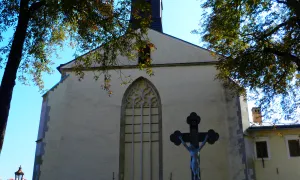
The philial church of St. Basil the Great in Makovce is a Baroque-classicist sacral building from 1836. In 1946 the object was repaired, in 1949 a modern figurative painting was created in the interior.
The church has a floor plan according to the Baroque principles of Eastern Slovakian construction of the teresian building office. It consists of a ship, a round presbytery and a built-in tower. Spaces are covered with spring vaults. Smooth facade is divided by windows with semi-circle finished shape, above the entrance is a small thermal window. The tower is closed by a tall baroque mine with lateral. Inner device from the second half The 19th century includes iconostasis, the main and side altar with the motifs of the late Baroque, Rococo and Classicism. The modern figurative painting was created in 1949 by M. Klimčák.
The monument is listed in the Central List of the Slovak Monument Fund under number ÚZPF 10 377/1. Located in the western part of the village Makovce. The current state of the church is good and serves its purpose.
Tehdy a dnes
Drag the slider and compare how the monument might have looked when it was built with the view today.
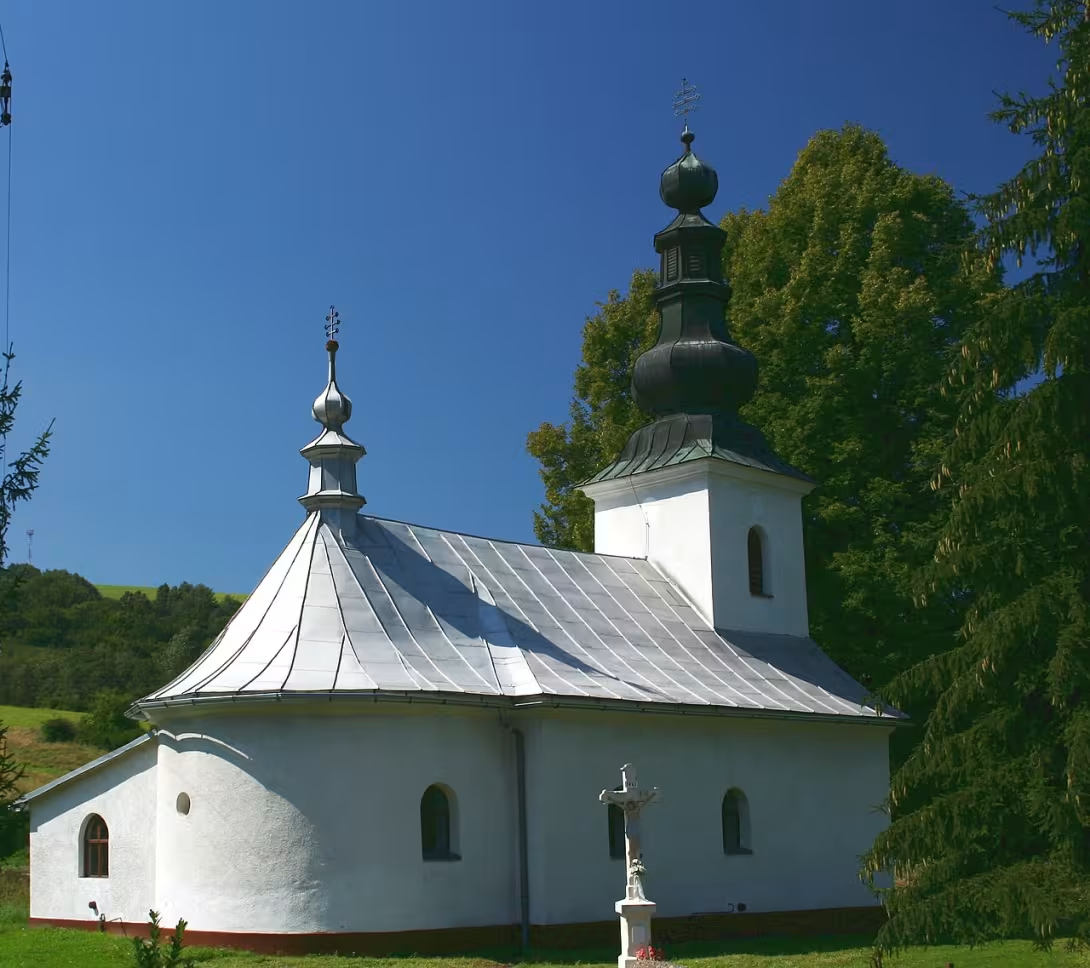
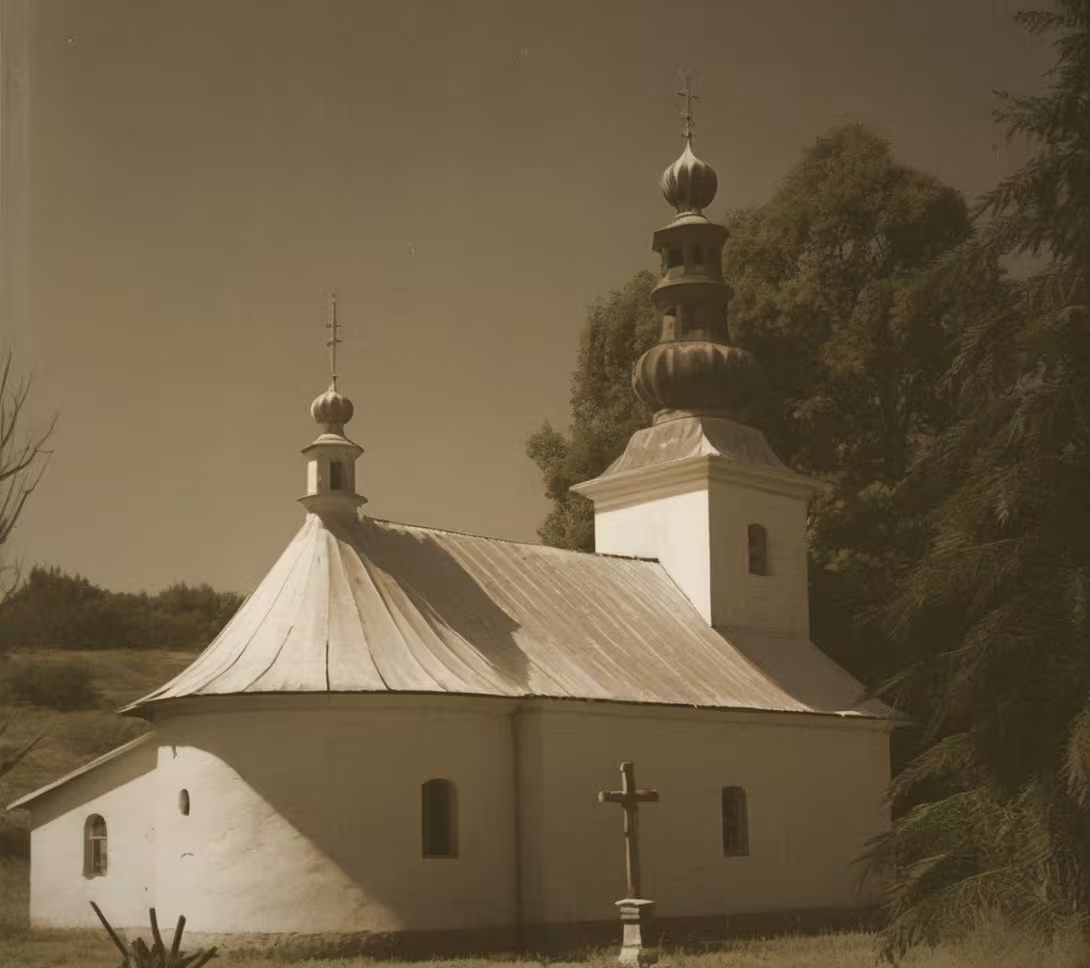
The historical view on the left is a visualisation generated by artificial intelligence and serves as inspiration.
Historical Milestones
- 1836
- construction of the church
- 1946
- repair of structures
- 1949
- realization of the modern figurative painting from M. Klimčák
Interesting facts
- It is a Baroque-Classicist sacral building from 1836. - The layout of the church is based on the Baroque principles of Eastern Slovakian construction of the teresian building office. - Interior equipment from the second half of the 19th century includes iconostas and altars with motifs of late Baroque, Rococo and classicism. - In 1949 M. Klimčák created a modern figurative painting in the interior. - The monument is registered in the Central List of Monument Fund of the Slovak Republic under number ÚZPF 10 377/1.
Guide
Show guide text
The text was prepared by artificial intelligence and has not been editorially reviewed. It may contain inaccuracies.
Welcome, dear visitors. You are standing before the imposing purple temple of St. Basil the Great in Makovce, in the heart of the Prešov region. At first glance, you will be impressed by the majesty of a building that protrudes from a quiet village landscape and radiates peace and dignity. Look at the wide stone walls that form a solid frame of this sacral space, and note how their simple but strong profile is associated with fine architectural details that indicate the rich history of this place. The air around you is filled with the silent noise of leaves and the delicate smell of wood that touches your senses and prepares you for the journey to the past.
The church was built in 1836, at a time when Eastern Slovakia developed under the influence of Terezian's building office. The architects ' exact names did not survive, but their works were preserved in stone and in the spirit of time. The construction of this temple was likely initiated by the local community, which sought a place for prayer and spiritual life. At that time, it was common for the smaller municipalities to establish purple churches that served as branches of larger diocese centers. In 1946 the building was repaired after World War II in order to maintain its stability and functionality. Three years later, in 1949, an important artist M. Klimčák came to the scene, who realized a modern figurative painting, bringing a new artistic dimension to the interior and connecting tradition with modern approach.
The architecture of the temple is a unique combination of Baroque and classical elements, giving it the character of Baroque-Classicist sacral building. The floor plan is based on Baroque principles that were typical of Eastern Slovakian buildings under the direction of Terezian's building office. This means that the basic form is symmetrical, with the central entrance and side spaces that create a harmonious whole. When looking at the facade, note how simple lines and geometric shapes overlap with fine ornaments that refer to baroque elegance. The window above the entrance, often decorated with a simple frame, allows you to enter the light that penetrates inside and underscores the spiritual atmosphere.
Enter the interior and focus your attention on iconostasis and altars, which come from the second half of the 19th century. These elements are decorated with the motifs of the late Baroque, Rococo and Classicism, creating a rich visual story. The iconostasis, which separates the sanctuary from the sea, is made of wood and decorated with fine carvings that capture holy characters and biblical scenes. The altars, placed on the sides, carry ornaments that reflect the transition from baroque luxury to simpler but still elegant classicism. All these details together form a harmonious space where tradition and artistic expression meet.
Although we do not know much about the specific historical personalities associated with this church, the very presence of M. Klimčák and its modern figurative painting from 1949 brings an interesting story about how the local community tried to revive and update its spiritual center after difficult years. Klimčák's work has brought a new color language into the space, which complements historical elements and shows that even in a smaller village art and culture can develop and contribute to the spiritual life of the inhabitants.
One of the most interesting contexts you can notice is the way the church reflects architectural trends of its period while maintaining the regional character of Eastern Slovakia. The ground plan, which is based on the Baroque principles of Terezian's office, is typical for this part of the country, where practicality is combined with aesthetic feeling. This combination is visible not only in the exterior, but also in the interior, where baroque ornaments overlap with classicist forms, creating a unique space that is also historic and alive.
An interesting mystery that may inspire your curiosity is the question of why it was precisely in 1836 that this place was selected for the construction of St. Although the exact reasons are not documented, we can assume that the strategic location of Makovce near important trade routes and their role as a spiritual center for the surrounding village played a key role. Perhaps the local community also saw the symbol of hope and protection as Saint Basil the Great, motivating them to build such an important building.
Now that you have gone through the outer and inner space, we invite you to find a moment for peaceful meditation. Enjoy the silence that fills the sanctuary and let yourself be carried by the atmosphere that has been going on for over a hundred years. Pay attention to the details you have noticed - symmetry of the facade, carvings on the iconostasis, color shades of Klimčák's painting - and realize how these elements share the story of faith, art and community.
Finally, we want to thank you for taking the time to discover this historical treasure. Saint Basil the Great Temple in Makovce is not only a witness of the past, but also a living place where tradition and present meet. After this introduction, we recommend that you continue to visit the village, discover other historical buildings and discover the stories that shaped this part of the Prešov region. May the journey be accompanied by a sense of respect for the past and the joy of discovering new details. Thank you and wish you a pleasant rest of your trip.
Tips for visitors
The best time to visit St. Basil the Great's filial temple is soon after sunrise or afternoon, when light is softer and the colors of the stone facade are best displayed. In the spring and autumn there are fewer tourists.
What to take with you: comfortable shoes on stone trails, bottle with water, sunglasses and windshield, because the weather in the mountains can change quickly.
Photography - the exterior of the temple looks most noticeable at the golden dawn of the morning or at sunset when long shadows arise on the stone. If you can enter, use the contrast of light through the stains and catch the details with a wide-angle lens.
Tips for families with children: bring a simple map or application with information on temple buildings to make a visit an educational game. In the surroundings you can use the natural trails in Makovce for short walks and picnics.
Frequently asked questions
Can the monument be visited?
Religious buildings are usually open mainly during services; at other times a visit is normally arranged with the parish or the operator. We have not verified specific times.
Where is the monument?
Location: č. 61, Makovce, Prešovský kraj. The map on this page shows the exact spot.
Why is the monument protected?
It is listed in the Central List of the Monuments Fund of the Slovak Republic as a national cultural monument (ÚZPF no. 41B-10377).
For children
Close your eyes and imagine pressing a secret button on a time machine. Can you feel the wind? We're going deep into the past, exactly 190 years ago. We are landing in Makovce, where something quite exceptional is now emerging. The year is 1836 and the air smells fresh wood and lime.
Nearby
🏰 Historic sites (40)
- Vojnový cintorín z 1. svetovej vojny 2.3 km web
- Pamätník padlých občanom v II. sv. vojne 2.5 km
- Pamätná miestnosť Miková Warhola 6.6 km
- Dedinské múzeum 7.8 km +421 915 213 757
- Stropkovský hrad 9.4 km Zámocká 519/3
- kpt. Adolf Weinhold 9.6 km
- Knieža Laborec 10.5 km
- Kukorelli 10.8 km
- SNP 10.8 km
- Chrám sv. Mikuláša 10.9 km web
- Miniskanzen 11.1 km
- Anna Soľanková 11.1 km
- Pomník deportovaným Židom 11.2 km
- Pamätník Českej družiny 11.2 km
- Múzeum moderného umenia A. Warhola Medzilaborce 11.3 km Andy Warhola 748/36 web
- Andy Warhol 11.3 km
- Chrám sv. Michala archanjela 11.8 km web
- Hrad Svidník 12.0 km
- Galéria Dezidera Millyho 13.4 km web
- Kaštieľ Svidník 13.4 km Partizánska 45/20 web
🍽️ Restaurants and dining (36)
- U Jara 5.5 km
- STEAK HOUSE u Mamy 9.2 km
- Pizzeria Marhaba Bar 9.4 km
- Zámocká Pivnica 9.5 km
- Victoria Bar 9.5 km
- Letná krčma 10.0 km
- Fresh Corner 10.1 km
- Pohostinstvo Vesna 10.9 km
- Inkognito Café Bar 11.1 km +421 907 107 991
- INKOGNITO Café Bar 11.1 km +421907107991
- Buena 11.2 km +421948477211 web
- Art hotel 11.2 km +421 57 73 21307 web
- Penzión Habura 11.2 km +421 907 929607 web
- Občerstvenie Salero 11.3 km +421421096375
- Motorest Polianka 11.5 km Stročín 120
- Čierno 11.9 km
- Motorest Breznica 12.5 km +421 944 706 639
- Motorest Poľana 12.8 km
- Motorest Alpinka 13.6 km
- Slávia 13.6 km
🏨 Accommodation (13)
- Chata Tajomné Karpaty 6.9 km +421 949 852 904 web
- Penzión Driečna 7.2 km
- chata na Kozej brade 7.7 km
- Poľovníček 9.3 km
- Art hotel 11.2 km Andy Warhola 195/28 +421 57 73 21307 web
- Pension Andy 11.3 km
- Horal 12.1 km
- Slávia 13.5 km Gen. Svobodu 706/37 web
- Comenius Apartments - Apartmány na rohu 13.9 km Komenského 315/24
- Hotel RUBÍN 13.9 km Centrálna 274/9
- Stara Posta 14.2 km web
- Chata Evička 14.8 km +421 905 657 515 web
- Country house 14.8 km
🚲 Rentals and sport (4)
- Krytá plaváreň 9.2 km
- Kúpalisko Stropkov 9.7 km web
- Peem Servis 13.5 km web
- AquaRelax 13.8 km
🥾 Hiking and nature (151)
- Kozubová 1.3 km
- Čelo 1.8 km
- Kruh 2.0 km
- Radový 2.7 km
- Poľana 3.3 km
- Petriansky vrch 3.4 km
- Ždiar 3.6 km
- Bukovská hôrka 3.7 km
- Maleník 3.7 km
- Vajcovka 3.8 km
- Chyžka 3.8 km
- Kasperov 4.2 km
- Lysá hora 4.2 km
- Matovec 4.3 km
- Vysoká 4.4 km
- Polom 4.9 km
- Švabľovka 4.9 km
- Gil 5.0 km
- Kýčera 5.1 km
- Ždiare 5.2 km
Thematic route
1. The philial church of St. Basil the Great (Church) - The main point of the route where visitors see the interior and sacred elements of historical construction. 2. Church Tower ( Tower) - Route point for observing the architecture of the building and its historical character from a higher perspective. 3. Courtyard and immediate area (Areal) - Space for walk and perception of the atmosphere of the historical surroundings of the temple.
Seasonal recommendations
Spring visit to this sacral object brings a special atmosphere of waking nature. The surroundings of the church are gradually green and on the outskirts of the village Makovce is waking up the fauna, creating a peaceful environment for meditation. The light in this period is still soft and soft, highlighting the architectural details of the building in good condition. It is ideal for visitors to wear layered clothing because spring temperatures can vary significantly. In the morning is often the calmest time when groups of tourists do not yet stretch, and the air is fresh after night cold.
Summer brings long days and bright sun to the Prešov region, which reveals the full beauty of the surrounding area. Nature is in full blossom, giving the entire environment a vibrant and energetic atmosphere. When visiting, it is crucial to prepare enough water and to protect yourself from the direct sun, especially if you are planning longer walks around. Clothing should be easy and breathable, suitable for higher temperatures. In the afternoon, more visitors often appear in the region seeking refuge from the spring, so it is advisable to visit the monument either early in the morning or later in the afternoon when the light becomes warmer and the atmosphere quieter.
The winter season offers a unique color game when the leaves in the trees turn into golden and red shades. The atmosphere is cooler and often the sky offers dramatic images that contrast with the stone structure of the church. The light is lower and warmer, creating a more intimate impression of architecture. It is essential for visitors to wear layered clothing, including windbreakers, because winter days can be windy and cool. The morning fog, which is often kept in the lowlands, may be very attractive photographically, but it requires caution when moving around the building, possibly wet terrain.
The winter season brings to Makovice a quiet and often snowy white cover that gives the whole environment a magical and soothing character. Short days and low sun create dramatic shadow effects on the church facade. The atmosphere is cold, but during the Christmas and Advent season, the region often feels a special spiritual mood associated with traditional holidays. Clothes must be warm and layered to enjoy outdoors without discomfort. A visit in the midday, when the sun reaches the highest point, can be the most pleasant because it provides the most warmth and light otherwise in a cool environment.
Visualisations and artistic views


The visualisations are generated by artificial intelligence and serve as inspiration.
Photographs from the area
Real photos taken near the monument


Source and licence are given for each image.
Visitor Tips
No tips yet. Be the first!
Log in and add your tip.
Location on Map
Visitor photos
No photos yet. Be the first to add a photo from your visit!
Log in and add your photo or leave a rating.
You get more points for a visit verified in the app — we can tell from the GPS that you are there.
Reviews and comments