

st John the Baptist's Church Church
St John the Baptist church in the village of Trhovište in the Košice region is a Roman Catholic church from 1759. It is a national cultural monument (ÚZPF 10284), whose architecture combines elements of late Baroque and Classicism.
The building was built in 1759. At the beginning of the 19th century, it underwent a classicistic adjustment. In 1885 the building was restored and acquired a new three-stage neoclassical roof. The subsequent renovations took place in 1909, 1937 and 1942, the last of which was the expansion of the church.
The building has a single-ship area closed with rolling vaults with lunetts. The building has a tower and the presbytérium has a semi-circular closure. The church belongs to the parish of Marketplace.
Tehdy a dnes
Drag the slider and compare how the monument might have looked when it was built with the view today.
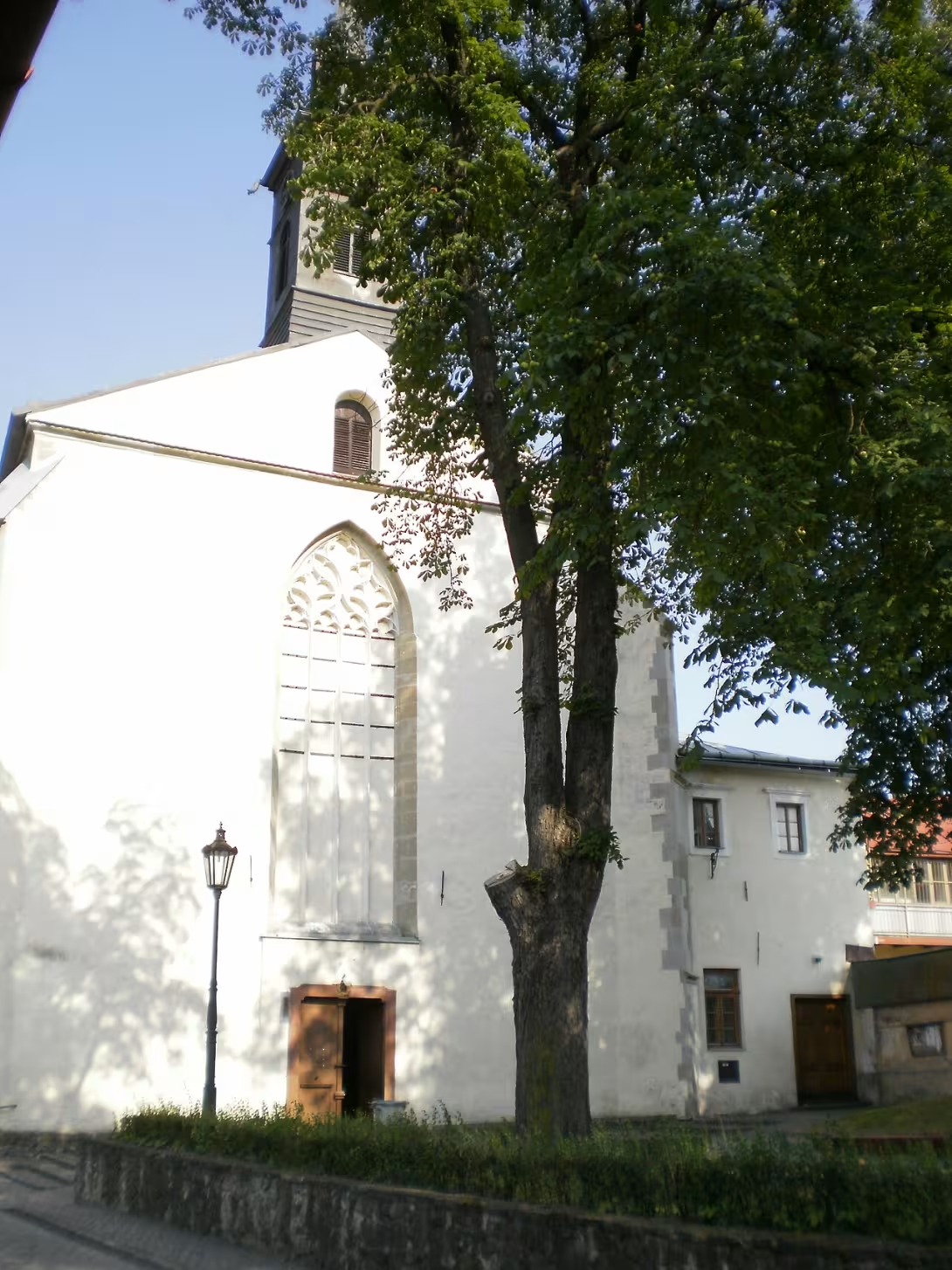

The historical view on the left is a visualisation generated by artificial intelligence and serves as inspiration.
Historical Milestones
- early 19th century
- classical modification of the church
- 1885
- reconstruction of the church and construction of a new three-stage neoclassical roof
- 1909
- restoration of the church
- 1937
- restoration of the church
- 1942
- restoration and extension of the church
Interesting facts
- St. John the Baptist church in the village of Trhošte comes from 1759. - The architecture of the temple combines elements of late Baroque and classicism. - At the beginning of the 19th century, the building underwent a classicistic adjustment and in 1885 it acquired a new three-stage neoclassical roof. - During the last renovation in 1942, the church expanded. - The building has a single-ship area closed with rolling vaults with lunettes, a tower and a presbytery with a semi-circular closure.
Guide
The guide was voiced by a synthetic voice created by artificial intelligence.
Show guide text
The text was prepared by artificial intelligence and has not been editorially reviewed. It may contain inaccuracies.
Welcome to the village of Trhovište. Right now you are standing before the church of St. John the Baptist, who is a silent witness to the history of this region. When you look at it, you will see a structure that combines the peace of the local environment with the dignity of religious architecture. Let yourself be swallowed up for a moment by the atmosphere of this place and see the harmony this temple brings to the surroundings. It is a place where faith meets history and where every detail tells its own story about the endurance and care of local residents. Now let's keep warm in time to understand how this church came into being. The foundations of this building date back to the middle of the eighteenth century, namely 1759. At that time the construction of such an important building in the village Trhošte was a manifestation of deep spirituality and social development of the region. Although we do not know exactly who the architects who designed the project, it is clear that the temple was to serve as a center of spiritual life for the entire community. Since its establishment, the church has undergone several stages of change, which reflected not only the aesthetic trends of the time, but also the needs of parishioners who regularly fought here. Nyni, pay attention to the architecture before you. If you look carefully at the overall shape of the building, you will notice an interesting combination of styles. The architecture of this church combines elements of late Baroque and classicism. Baroque brings some dynamism and emotion to the building, while classicism gives the whole the necessary balance, cleanliness of line and rationality. It is a fascinating contrast that creates a unique visual character. Now look up towards the roof. Here is one of the most striking elements of this building. At the beginning of the 19th century, the church underwent a classicistic treatment that gave it a new character. Even more significant changes occurred in 1885, when a new three-stage neoclassical roof was built. This detail is not only a technical element but defines the entire silhouette of the church in the country. Neoclassicism in this case has manifested itself in an effort to return to the ancient ideals of symmetry and simplicity, which you can perceive even when looking at today's form of roof structure. When we stop at the history of the maintenance of this temple, we will see that the local community took care of it with great precision. The church was not only reconstructed once, but passed through a series of renovations that ensured its survival for future generations. In 1909 there was another reconstruction, which was likely to remedy the damage caused by time. Then came the restoration in 1937, which was the period before the great world turmoil, when it was still possible to invest in the beauty and stability of local monuments. The most significant changes in the modern period, however, occurred in 1942. At this time it was not only the normal restoration, but the expansion of the church. This shows that the community in the Marketplace grew and the original space was no longer sufficient for all the needs of believers. The expansion of the building during this period shows how important the church of St. John the Baptist had for the people who lived here and how much they cared for the temple to remain a functional and dignified place of prayer. Although there are no specific names of known or famous builders in historical records, the church itself is a monument to thousands of nameless people. They are generations of Marketist residents who celebrated baptisms, weddings, and with their last greetings accompanied their loved ones. It is in this anonymity that the true power of this place lies. It is not a monument to one famous personality, but a common monument to the whole village. The interesting thing you might be interested in is this layer of styles. It is rare to see in one smaller building so a clear transition from the Baroque spirit to the classicistic moderation and then to the neoclassical details of the roof. It's like reading a book about the history of architecture attached to a building. Each of these elements represents a different era, a different way of thinking and a different view of beauty. Now that you have gone through the main points of history and architecture, we recommend that you go around the church. See how the perspective of the building changes depending on which angle you look at it. Look at the details of the facade and try to imagine what this temple looked like in 1759, when it was first dedicated, and how it gradually changed to the form you see today. We hope this short trip to the past has helped you to better understand the meaning of the church of St. John the Baptist. It is a place of peace and stability that has survived centuries of change. Now you can continue to explore the beauty of the village and its surroundings. Thank you for your attention and we wish you a pleasant day full of new discoveries.
Tips for visitors
St John the Baptist's church in Trhošti is recommended to visit in late spring or autumn. Pleasant temperatures and natural light then best highlight the architecture of the building. You come to the village by car or public transport; check the current links in the internet search engine.
We recommend taking comfortable shoes and clothing suitable for sacral space. For photographers are the most suitable places around the church, where morning or evening light picks up the details of the facade.
In the surroundings you can focus on exploring the local architecture and atmosphere of the village Trhošte. Families with children can connect the visit with a short walk around.
Frequently asked questions
Can the monument be visited?
Religious buildings are usually open mainly during services; at other times a visit is normally arranged with the parish or the operator. We have not verified specific times.
Where is the monument?
Location: Trhovište, Košický kraj. The map on this page shows the exact spot.
Why is the monument protected?
It is listed in the Central List of the Monuments Fund of the Slovak Republic as a national cultural monument (ÚZPF no. 427-10284).
For children
Close your eyes and imagine shooting down a time machine. You set it exactly for 1759 and with loud boom! you will land in the village of Trhovište. There are no cars, no mobile phones or asphalt roads around you. It's a world some 267 years ago. The air smells like fireplace smoke and fresh bread. It was at this very time that the building, which stands here to this day - the church of St. John the Baptist.
Nearby
🏰 Historic sites (73)
- Trhovišská mohyla 1.8 km
- kniha - Pavol Horov 2.0 km
- Kúria 2.3 km
- Dopravná nehoda 6.9.2003 2.6 km
- Oslobodenie obce 2.7 km
- ISTEN DICSÖSÉCERE 4.1 km
- Kaštieľ Sirmaiovcov 4.5 km web
- Kúria 4.5 km
- Kúria 6.0 km
- Hatalovská mohyla 6.2 km web
- Július Barč Ivan 6.4 km
- Oslobodenie obce 6.4 km
- Zlamany most 7.1 km
- Protilietadlový kanón 7.2 km
- Pamätník obetiam 2. svetovej vojny 8.4 km
- Kaštieľ Sirmaiovcov 8.5 km web
- Domov sociálnych služieb (DSS) 8.8 km
- T-34 8.9 km
- zakladny kameň 12.10.1930 9.5 km
- ThDr. Štefan Hlaváč 9.7 km
🍽️ Restaurants and dining (129)
- Family bar U Maťa Davida 0.3 km
- BUBO Reštaurácia 4.7 km +421 908 460 643 web
- Kameňák 5.0 km
- 3angel 5.6 km
- Alcala 7.3 km
- Lucas grill 7.4 km +421947954189 web
- Pohoda 8.1 km
- U Janka 8.1 km
- Fresh Corner 8.2 km
- Fresh Corner 8.3 km
- Slnečný dvor 8.4 km
- Pizzéria a kaviareň Fajta 8.4 km +421 905 831 907 web
- Fresh Corner 8.9 km
- Capulet 8.9 km
- Rio Club 8.9 km
- Enjoy 8.9 km
- Zemplínska reštaurácia 9.1 km S. H. Vajanského 6580/63A web
- Areca 9.2 km
- Areca 9.2 km
- Zbojnícka koliba 9.2 km
🏨 Accommodation (13)
- Slnečný dvor 8.4 km
- Ubytovňa Alf 8.9 km web
- ZEMPLEN 9.1 km N. V. Gogoľa 6919/2 +421902820018
- Hviezda 9.2 km
- Biela Labuť 9.3 km
- Hotel Mousson 9.8 km web
- Tokaj 10.1 km
- Stadio 10.2 km
- Družba 10.6 km
- Zemplín 11.1 km
- Domino 11.2 km
- Korzo 11.7 km
- Penzion Breza 13.5 km
🚲 Rentals and sport (27)
- MČ Milhostov 7.4 km +421 650 777 888 web
- Intersport 9.1 km web
- Plaváreň 9.5 km
- Sportisimo 9.7 km
- Chemkostav aréna 9.7 km Karola Kuzmányho 6225/24
- Sídlisko Sever 9.8 km +421 650 777 888 web
- R+R Fitness Centrum 9.9 km
- Cyklosport 10.0 km
- Ul. M.R. Štefánika 10.1 km +421 650 777 888 web
- Športová hala GPH 10.1 km
- Autobusová stanica 10.1 km +421 650 777 888 web
- Nám. Š.B. Romana 10.1 km +421 650 777 888 web
- Tenisové centrum 10.3 km
- Krytá plaváreň 10.3 km Škultétyho 2281/20A
- Fitness Centrum 10.3 km
- Kúpalisko 10.3 km
- OC Kaufland 10.3 km +421 650 777 888 web
- Bicykle 10.4 km
- Velobiker 10.4 km
- EXIsport 10.4 km
🥾 Hiking and nature (41)
- Veľká kračina 3.7 km
- Zirava 5.0 km
- Černiny 5.1 km
- Ostráň 5.2 km
- Gruň pri kaplnke 5.8 km
- Hora 6.8 km
- Úboč 6.9 km
- Štepník 7.7 km
- Verejný park Dvorianky 8.1 km
- Veterník 8.7 km
- Kozák 9.0 km
- Čongov 9.5 km
- Viničky 9.7 km
- Marakana 9.7 km
- park Dominika Trčku 9.9 km
- Hrádok 10.0 km
- Hvezdáreň Michalovce 10.0 km web
- Hôrka 10.3 km
- Park študentov 10.3 km
- Park Mieru 10.4 km
Thematic route
As there are no other objects in the area of the area of the main objective, I propose a thematic route:
1. St John the Baptist church - A visit to the medieval temple. 2. Interior of the church - inspection of the altar, artistic details and historical equipment. 3. Church area - Walk around the building and focus on the layout of the monuments in the village Trhošte.
Seasonal recommendations
In spring, the surroundings of the church of St. John the Baptist in Trhošti will awaken into life and the landscape will bloom. The sun during this period provides fine lighting suitable for photographing the exterior of the building. We recommend shoes to wet terrain and a visit in the morning.
Summer months bring intense lighting and rich colors of nature, which contrast with the architecture of the church. Due to high temperatures, it is advisable to arrive early in the morning or later in the morning. Practical is light, breathable clothing and sunscreen protection.
Autumn in Košice region marks with golden and red shades of leaves. The light is softer and naturally warm in this period, highlighting the details of the facade. Due to unstable weather and morning mist, layered clothing and waterproof footwear are suitable.
Winter works construction in Marketošti ascetically, especially if it is covered by snow. The atmosphere is quiet and the day is short. During the visit, warm clothing and footwear with anti-slip soles are necessary to avoid falling on frozen origin.
Visualisations and artistic views


The visualisations are generated by artificial intelligence and serve as inspiration.
Photographs from the area
Real photos taken near the monument

Source and licence are given for each image.
Visitor Tips
No tips yet. Be the first!
Log in and add your tip.
Location on Map
More monuments – Trhovište
Show all in the town
Visitor photos
No photos yet. Be the first to add a photo from your visit!
Log in and add your photo or leave a rating.
You get more points for a visit verified in the app — we can tell from the GPS that you are there.
Reviews and comments