

st. Juray's fortified church Church with grounds
The fortified church of St. George in the village Podbrezová in the Banská Bystrica region comes from the end of the 14th century. It combines Gothic elements, Baroque reconstruction and Renaissance defence wall.
The church was established in Gothic style at the end of the 14th century. In 1752, it was baroqued, re-enclosed and extended to the tower.
Architecturally it is a one-ship church with a polygonal altar cap. The space of both the ship and the presbytery is encircled by cross ridges. From the original Gothic phase remained broken portals, pastophorium and polychrome window in the presbytery closure. By the tower's extension, the presbytery came into its interior. The tower is finished with a baroque latern mine. In its interior there were two Baroque sculptures from the 18th century.
The church complex (ÚZPF 69) consists of a set of four objects. Apart from the church (ÚZPF 69/1), it includes a wall of brick structure (ÚZPF 69/2) from the middle of the 16th century. It is a low stone fence with guns that served as a temporary defense wall in the 17th century. The complex includes a historical tomb with a tombstone from the 1930s (ÚZPF 69/3) and an unexplored medieval church cemetery from the end of the 14th century (ÚZPF 69/4), which was located in the fence.
The building fulfills its original function and stands on a hill in the northwestern part of the village. The monument has undergone reconstruction and is listed in the Central List of Monument Fund of the Slovak Republic.
Tehdy a dnes
Drag the slider and compare how the monument might have looked when it was built with the view today.
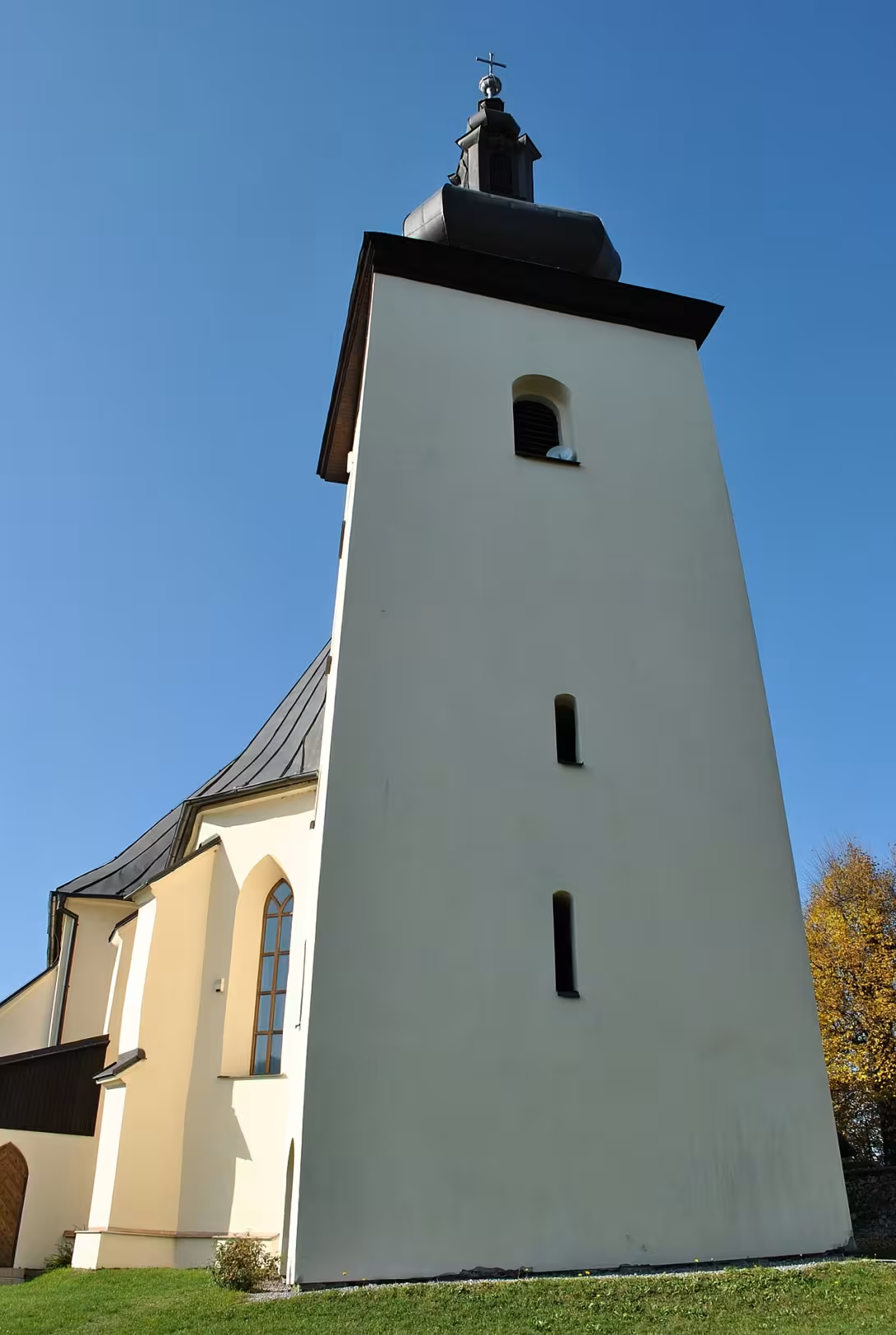
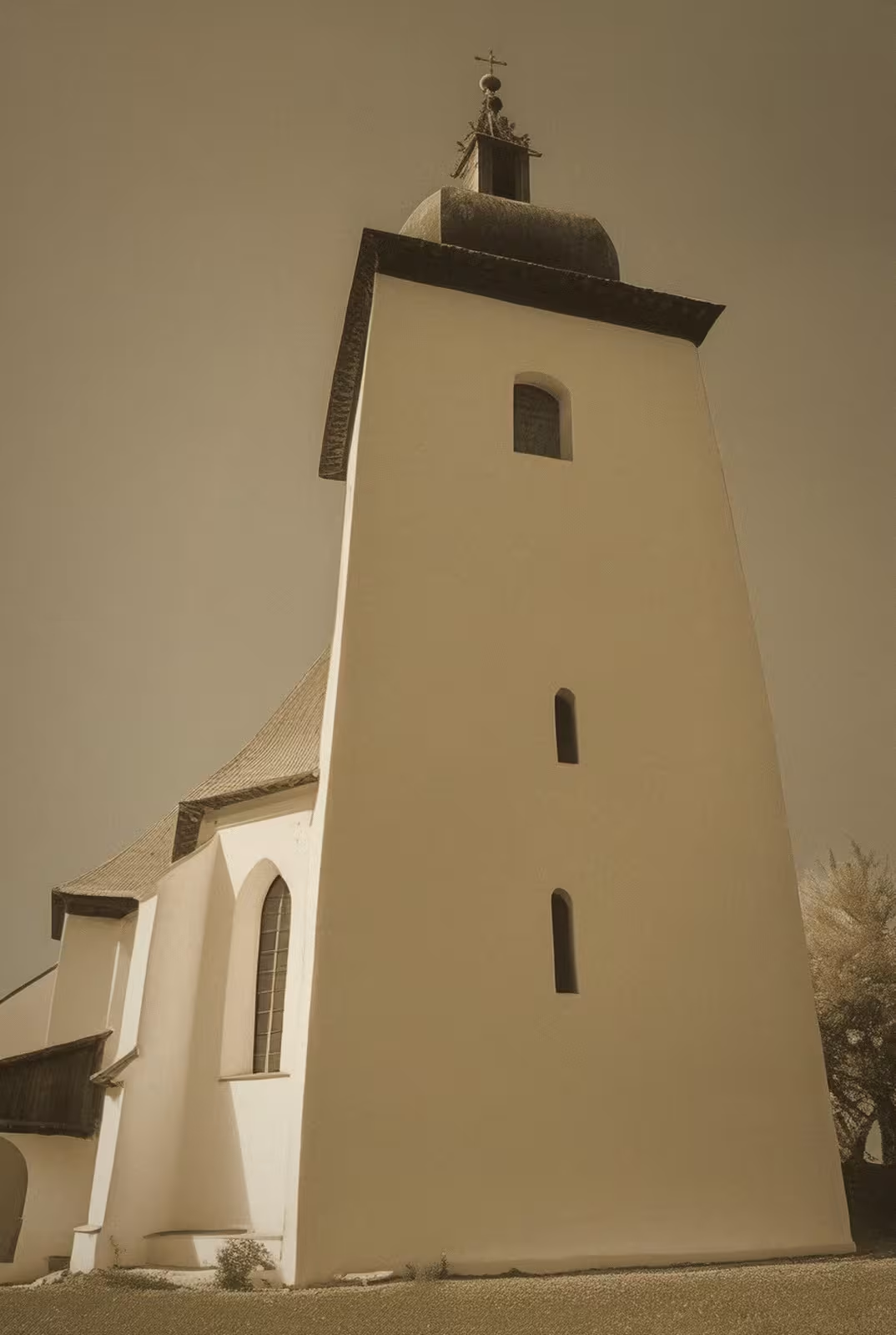
The historical view on the left is a visualisation generated by artificial intelligence and serves as inspiration.
Historical Milestones
- end of the 14th century
- creation of a gothic church and a church cemetery
- 16th century
- building a brick wall
- 1752
- baroqueization of the church, new glazing and extension of the tower
- 30 years 19th century
- creation of a historical tomb with a tombstone
Interesting facts
- The church comes from the end of the 14th century and combines Gothic elements, Baroque reconstruction and Renaissance defence wall. - In 1752 it was baroqueized, re-enclosed and expanded with a tower that reached the interior of the presbytery. - The original Gothic phase preserved broken portals, pastophorium and polychrome window in the presbytery closure. - The area includes a low stone fence with guns from the mid - 16th century, which served as a temporary defense wall in the 17th century. - Part of the complex is a historic tomb from the 1930s and unexplored medieval church cemeter
Guide
The guide was voiced by a synthetic voice created by artificial intelligence.
Show guide text
The text was prepared by artificial intelligence and has not been editorially reviewed. It may contain inaccuracies.
We welcome you to Podbrezová, in the heart of Banská Bystrica region, where one of the most important spiritual and historical pillars of this area lies before you right now. You stand in front of St. George's fortified church. The first sight of this area immediately gives us a sense of security and stability. It is not just a mere temple, but a complex that combines sacred space with defensive functions. Note how the building itself is dominant in the country and how it is surrounded by a brick wall that makes the church a so-called fortified church. It is a place where faith meets the need for protection, and it is this contrast that gives the memory its unique atmosphere.
Now let's rush deep into history to understand how this area was formed. The story of this place begins at the end of the 14th century. At this time the original Gothic church was established along with the port cemetery. Imagine, then, the medieval age, the time of knights and deep religiosity, when such buildings were the center of the social and spiritual life of the entire community. Gothic with its vertical lines and the spirit of staggering towards the heavens has given the church a basic character, which is present in many details to this day.
However, times changed, along with the needs of the population. In the middle of the sixteenth century, in the period when instability increased in Europe and in the territory of today's Slovakia and threatened attacks, it was decided to build a brick wall around the temple. It is this element that changes the character of the building from a clean church to a fortified area. This wall was not merely a symbolic boundary between holy and secular space, but it was to be realistic in protecting the people and arid objects inside the temple from possible attacks.
Now, when you look at the architecture in front of you, notice that it is not uniform. It's a fascinating set of layers from different ages. If you carefully discuss the details, you will see traces of Gothic, Renaissance and Baroque. The most significant changes occurred in a thousand seven hundred fifty-two. This year the church passed through baroqueization. Baroque brought dynamic, decorating and a new sense of space into the architecture. At that time the church was re-enclosed and a tower was added to it. However, this tower is not just an aesthetic addition. Its construction also had practical consequences for the interior area, as this change brought the presbytery into the interior.
Now I recommend you pay attention to the details that have survived centuries and reveal to us the original face of the building. Look for broken portals that are typical for Gothic style. These elements are medieval witnesses who carry us back to the end of the 14th century. Another interesting detail is the pastophorium, a special niche designed for the exposure of holy relics or paintings, which also comes from the original Gothic phase. It is fascinating how these tiny architectural elements survived over time and major rebuildings and still tell us the story of the original design of the builders.
If you now move by looking at the surrounding parts of the area, note the historical tomb. This building was created immensely later, namely in the 1930s. It is a tomb in the spirit of historism, which is complemented by a tombstone. History was a style that returned to forms of the past to express respect and seriousness, which is very common in family tombs. This tomb closes the chronological cloud of the area, from the medieval Gothic to the nineteen-century monument.
Although the names of the specific architects who worked on the building are now unknown, the building itself speaks for them. It's the intercourse of a sorry and genius as three great eras connect in one object. Gothic gave the foundation, the Renaissance brought security in the form of a wall and the Baroque gave the building a contemporary majestic and vertical dominance in the form of a tower.
An interesting thing that might interest you is this combination of functions. Imagine this church as a safe haven. In case of danger, people could resort to the walls you see, and within the temple they could seek refuge and spiritual support. Thus, this area was not only a place of prayer, but at certain moments in history it also served as a pre-defense defense for local inhabitants. It is a place where faith and survival have become one whole.
Now see the atmosphere of this place. You stand at a point where the roads of generations of people from Podbrezova crossed. Every stone in the wall and every cloud in the portal testifies to thousands of hours of work and to the deep need to create something permanent. He is a silent witness to the changes that have passed through our country, from the medieval lazy sorry to modern times.
Before you go on your next trip, I recommend you go around the whole area again. Look at the wall from different angles, note the broken lines of Gothic elements and take a breath of peace that this fortified church of St. George exudes. It is a place that invites you to stop and consider how time shapes space.
Thank you for your attention and for discovering the history of Podbrezová with us. We hope that this short trip to the past has helped you to better understand the beauty and meaning of this unique temple. We wish you a pleasant next day and pleasant journey through other sights of this beautiful region.
Tips for visitors
We recommend a visit in spring or autumn when there is pleasant light and fewer visitors in Podbrezová. Since it is a sacral structure, suitable clothing is recommended. When taking pictures of the facade and details of the fortification of the church of St. George, the most suitable morning or evening hours are. We recommend taking time to observe the monument and its historical context. The location is also suitable for families with children who can get to know the historical elements of the fortification and the story of St. George.
Frequently asked questions
Can the monument be visited?
Religious buildings are usually open mainly during services; at other times a visit is normally arranged with the parish or the operator. We have not verified specific times.
Where is the monument?
Location: č. 516, Lopej, Podbrezová, Banskobystrický kraj. The map on this page shows the exact spot.
Why is the monument protected?
It is listed in the Central List of the Monuments Fund of the Slovak Republic as a national cultural monument (ÚZPF no. 323-69).
For children
Imagine a trip to the Middle Ages. There are no cars or cell phones around you, you can only hear horse roaring, the noise of the leaves and the ringing of the bells. You stand in front of a building that resembles a small fortress. Welcome to the fortified church of St. George in Podbrezová.
Nearby
🏰 Historic sites (87)
- Obetiam SNP 1.0 km
- Hutnícky skanzen 2.0 km +421 908 170 857 web
- Samo Chalupka 3.0 km
- Pamätná izba Sama Chalupku 3.0 km +421 940 606 436 web
- Padlým v 1. a 2. svetovej vojne 3.1 km
- Pamätník 2. svetovej vojny 3.2 km
- Obetiam 1. svetovej vojny 3.3 km
- Obetiam 2. svetovej vojny 3.3 km
- Tomáš Hromada (1793 - 1870) 3.3 km
- Založenie prvého robotníckeho spotrebného družstva na Horehroní (1875) 3.4 km
- Pamätník SNP 3.5 km
- Pamätník SNP 3.5 km
- sv. Florián 3.5 km
- Pamätník SNP 3.8 km
- Ladislav Chudík 4.4 km
- sv. Florián 5.8 km web
- SNP 6.3 km
- Obetiam 2. svetovej vojny 6.5 km web
- 2. česko-slovenská paradesantná brigáda 6.5 km
- Pamätník SNP 6.6 km
🍽️ Restaurants and dining (107)
- Pizzeria a Reštaurácia LUCIA 1.1 km +421915713013
- Gurmán - Bezlepkové občerstvenie 1.1 km
- 2M kaviareň a bar 1.1 km
- C - KLUB PIZZA 1.3 km +421 911 700 139
- C KLUB - Hostinec STANICA 1.3 km
- C-Klub 1.4 km
- Cafe Maestro 2.3 km web
- Perla 2.3 km
- Motorest Tomi 2.4 km
- Pltník 2.5 km
- Hostinec pod Úbočou 2.6 km Cesta osloboditeľov 202/47
- Hostinec Groš 3.1 km
- Sv. Juraj 3.2 km
- Piváreň U nás 3.2 km
- Pizzeria Hronka 3.3 km
- Hostinec pod skalou 3.4 km
- Kaviareň Koruna 3.4 km
- Sat Bar 3.4 km Hronská 133/57
- Vtáčnik 3.5 km
- Sunrise pub 3.6 km
🏨 Accommodation (76)
- Vila Dom hostí 0.9 km Kolkáreň 33/42 +421 903 575 712
- Turist Hotel DROTÁR 3.1 km Mlynská 411/104
- Turistická ubytovňa 3.1 km web
- Rekreačné zariadenie Poniklec 3.1 km Mlynská 444/102 web
- Motel Route 66 3.2 km Družby 322/60
- Penzión Bystrá 5.0 km
- Penzión Bystrinka 5.3 km +421 905 413 495 web
- Vila Stella 5.4 km +421 905 928 820 web
- Chata pod Bielou skalou 5.6 km
- Chalupa u Havranov 5.6 km +421 903 272 555 web
- Chalupa Bystrá 5.7 km web
- Perla 5.7 km Dolná 42/53
- Ubytovanie u Zaja 6.0 km +421903624033 web
- Chata Ďumbier 6.1 km +421 907 745 483 web
- Chata pod Chopkom 6.1 km +421 907 745 483 web
- Apartmány Bystrá-Chopok 6.1 km web
- Zerrenpach 6.2 km web
- Privát Eva 6.2 km +421907647250 web
- Penzión Bystrá 94 6.2 km +421918738331
- Zruby Bystrá 6.2 km +421 910 922 218 web
🚲 Rentals and sport (23)
- Kolkárnička 0.9 km Sládkovičova 79/15
- SIGO e-bike Servis 1.0 km +421 908 658 594
- Cyklo Servis Šport 2.2 km
- Hronec - Majer 3.5 km web
- BMT 5.2 km web
- Bystrá 94 6.2 km
- Národné biatlonové centrum Osrblie 6.3 km +421 918 900 774 web
- Sportisimo 6.4 km
- Wellness Bystrá 6.6 km +421 48 6195 835 web
- Tennis center 7.2 km
- Kúpalisko Jasenie 7.2 km web
- Pool Polianka 7.4 km
- E-bike Rental 7.5 km +421 911 633 119 web
- BikeLandia 7.5 km web
- Yogi sport 7.5 km web
- Bike šport 7.7 km web
- Lanový park Tarzania 8.1 km web
- Ski Alp Point 8.2 km
- Geosport 9.9 km web
- Brusno 11.6 km
🥾 Hiking and nature (211)
- Brezová 1.0 km
- Skala lásky 1.1 km
- Bruchačka 1.6 km
- Samanovský vrch 1.8 km
- Chvatimech 2.0 km
- Belohrad 2.3 km
- Svrkľa 2.4 km
- Klokoč 2.7 km
- Brezinky 2.9 km
- Lipová 2.9 km
- Muškov hrb 2.9 km
- Jubilejný háj RČS 1918-1928, Predajná - Predajnianske Čelno 3.0 km
- Liatinový most 3.1 km
- Prdimuchova upírska izba 3.2 km +421 903 513 535 web
- Prameň Čelno 3.4 km
- Hrončianska zvonica 3.4 km
- Čelno 3.4 km
- Prameň Ladislava Chudíka 3.5 km
- Chodorov vrch 4.0 km
- Jubilejný háj RČS 1918-1928 - Gajdoška 4.0 km
Thematic route
As there are no other sites in the area of the area, I propose a thematic route focused on the main monument:
1. Fortified church of St. George (external and wall) - Type: Architectural and defence equipment. The visit begins with a roundabout area, where you can explore the fortification, which in the past served as a refuge for the local inhabitants.
2. Courtyard and church area - Type: Public space. Walking through the interior allows a detailed view of the connection of sacral space with defence elements.
3. Interior of St. George's Church - Type: Temple. Inside the church in the village Podbrezová contains artistic details and historical equipment.
4. Church Tower - Type: Sightseeing Part. The exit to the tower offers views of the surrounding town and the landscape of Banská Bystrica region.
Seasonal recommendations
In spring, the surroundings of the fortified church of St. George in Podbrezová obahrod with fresh greenery. Nature in Banská Bystrica region during this period blooms, creating contrast with the stone walls of the area. The place is suitable to visit in the morning when the light is gentle. For variable weather, layered clothing and waterproof footwear are recommended.
Summer months bring intense sunlight, which highlights the details of the building. Due to high temperatures, the best time is early in the morning or late in the evening. It is practical to take a hat and enough drinking water.
In the fall, the surroundings of the memorial turn into a variety of gold and red colors. The low sun creates long shadows and highlights the texture of the fortification. A shorter day should be envisaged when planning the trip, so it is ideal to come by noon. Layered clothing and windshield are recommended.
Winter is the fortified church of St. George otherwise, especially if the area covers snow. Due to the frost and snow it is necessary to clothe yourself in warm clothes and use footwear with anti-slip sole. A bright winter day is appropriate when snow reflects light.
Visualisations and artistic views


The visualisations are generated by artificial intelligence and serve as inspiration.
Photographs from the area
Real photos taken near the monument

Source and licence are given for each image.
Visitor Tips
No tips yet. Be the first!
Log in and add your tip.
Location on Map
More monuments – Podbrezová
Show all in the town

Visitor photos
No photos yet. Be the first to add a photo from your visit!
Log in and add your photo or leave a rating.
You get more points for a visit verified in the app — we can tell from the GPS that you are there.
Reviews and comments