

st. Michael's Church Church
The church of St Michael the Archangel in the village Veľký Klíž, in the local part of Klížske Hradište, is a Romanesque sacral building from the 12th century. The register of monuments shows the year of establishment 1200 and the year of construction 1130. The building is registered in the register of monuments under number ÚZPF 225-184 as a national cultural monument. It is a single-boat church with rectangular floor plan, semicircular apsid and cylindrical tower at the western facade. It is located in a functional cemetery and currently does not serve liturgical purposes.
The building was probably created at the initiative of the local nobleman. The church falls under the parish of the Great Kliz.
Architecturally it is a Romanesque single-ship church with rectangular floor plan and semicircular apsid. The circle tower is situated near the west facade and a cylindrical tower is attached to the boat. The entrance to the boat is located to the right of the tower. The ship's lighting is provided by two small romantic slit windows and one window in the apside. The ceiling of the ship has wooden beaming. In the tower there are narrow spiral stairs leading to a small wooden empor. Interior equipment is modest and includes a stone altar menza in apside.
The building is located on the northern edge of the Klížske Hradišť.
The church retains the original building details, such as slit windows and cylindrical tower.
Tehdy a dnes
Drag the slider and compare how the monument might have looked when it was built with the view today.
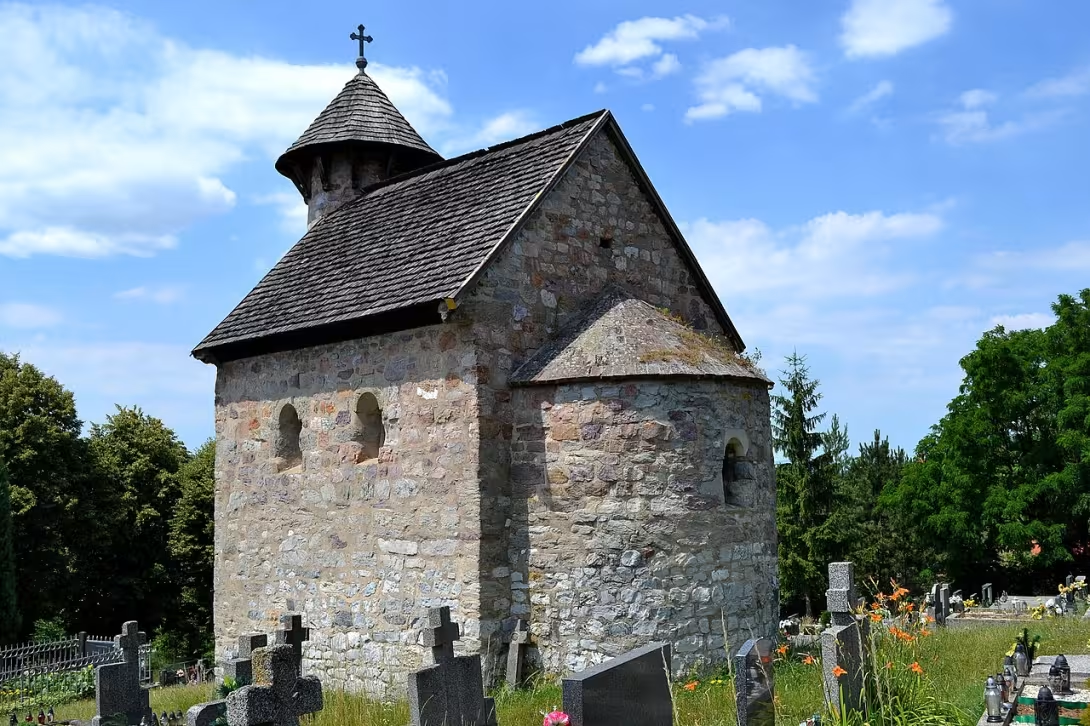
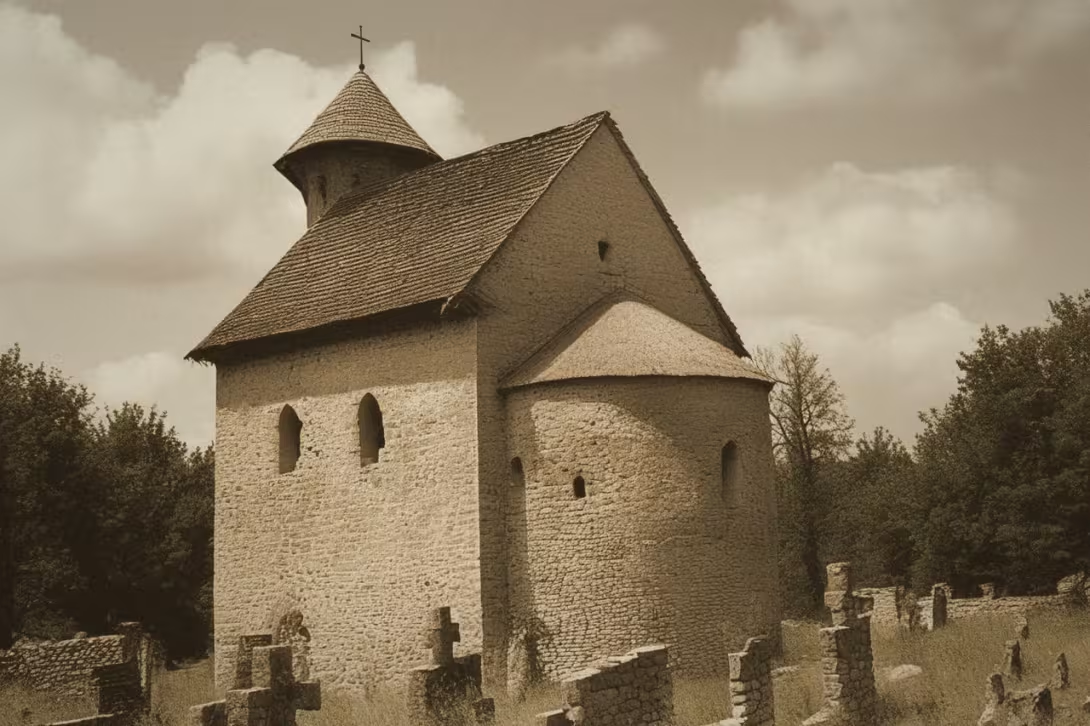
The historical view on the left is a visualisation generated by artificial intelligence and serves as inspiration.
Historical Milestones
- 1130
- Beginning of the Romanesque church construction
- 1200
- Completion of construction according to records in the register of monuments
- 1200
- Creation of sacral construction with cylindrical tower and semicircular apsid
Interesting facts
- It is a Romanesque sacral building from the 12th century, while the register of monuments lists the year of establishment 1200 and the year of construction 1130. - The church has a rectangular floor plan, a semicircular apsid and a cylindrical tower at the western facade. - The building was probably created at the initiative of the local nobleman. - In the interior there are narrow spiral steps in the tower leading to a small wooden empor and stone altar menza in the apside. - The church is located in a functional cemetery and currently does not serve liturgical purposes.
Guide
The guide was voiced by a synthetic voice created by artificial intelligence.
Show guide text
The text was prepared by artificial intelligence and has not been editorially reviewed. It may contain inaccuracies.
Welcome to the village of Veľký Klíž. Right now, you are facing one of the most precious sights of our country, the church of St. Michael. Stop for a moment, take a breath and see the atmosphere of this place. Before you, the st Builds, which survived almost a thousand years of history. When you look at it, you may be interested in its moderation and simplicity for the first time, but it is in this inconspicuousness that immense historical value lies behind. This church is not just a building of stone, it's intercourse with ancients, with a time when the world around us was different from that of today in every detail. Let's now join together in the story of its origin. In order to understand what lies ahead, we must return deep into the Middle Ages, namely the 12th century. According to historical records in the register of monuments, the construction of this Romanesque church started in 1130. Imagine what the period must have been like. The world was then full of uncertainty, but also of deep spirituality. Construction of such an important object was not only a question of vortex, but also a question of power and prestige. Although the exact names of architects are unknown, we know that the creation of this shrine was probably the local nobleman. At that time, noble families were the ones who, with their means and influence, supported the building of churches, ensuring not only the favor of the heavens but also recognition in the eyes of their contemporaries. However, be interested in the fact that the road from first stone to completion was not short. The records indicate that the building was not finished until 1200. This means that construction lasted almost 70 years. It is fascinating to think that generations of craftsmen have been able to work on this project. Maybe the old master started building and his grandson finished it. This long construction period tells us about the patience of medieval builders and how important it was for the result to conform to the strict rules of the then architecture. Now, please take a closer look at the church architecture itself. Note its overall form. St. Michael's church is a typical representative of Roman style. Right now you see its rectangular ground plan, which is characteristic of many sacral buildings of the time. This simple geometric shape should symbolize stability and order. Now if you slowly move to the rear of the building, you will see a semicircular apsid. Apsida is the elevated, rounded part where the altar is located. In the Roman architecture, the semicircular ending had a profound symbolic meaning and helped with acoustics inside the temple. But the most striking element that you now see at the Western façade is the cylindrical tower. Look at her carefully. Such towers were not just a place in the Middle Ages for bells that called believers for prayer. They resembled defense structures with their shape and robustness. In times of danger, these towers could serve as a refuge or as search points from which the surroundings could be watched. It is this combination of sacral space and defensive element that makes St. Michael's church a unique object. Feel this massive wall, which was supposed to make you feel safe and calm. Although we do not have the names of specific personalities in this church, we can imagine thousands of people who have come here during the last nine hundred years. Imagine the locals, the nobles covered in coats, priests, and travelers who sought peace and comfort in the shadow of this cylindrical tower. Each of them brought his prayers here, his fears and his over's. This church stood here at times of war, at times of peace, at times of bloom and at times of decline, and it is still standing before you as a witness of time. If we now consider something that may not be visible at first sight, but is part of the secret of this construction, we must look inside it. In the interior there are narrow spiral stairs. Imagine them climbing up into the tower. These stairs are medieval engineering in their purest form. They are sturdy, steep and dark, creating a contrast to the open space of the main church ship. These very details, such as spiral stairs or thick walls, remind us that in the 12th century it was not about comfort, but about functionality and durability. The interesting thing you might be interested in is the time gap that we talked about. Year 1130 and year 1200. Why did it take so long? Historians often wonder whether construction has not been interrupted by lack of resources, political unrest, or simply by the gradual expansion of construction according to the needs of the community. It's a little mystery that stays before every visitor. Was it one continuous process or a series of exhibitions divided by decades? It is these questions that give St. Michael's church some charm and depth. Now that you're facing this Romane jewel, try to imagine what the Great Gem looked like almost a thousand years ago. There were no modern roads around you, but only nature and simple domestic. This church was probably the highest and most important point in the area. It was the center of spiritual and social life. When you look at it today, you see not only architecture but the memory of human endurance. Now that you know the basic lines of this fascinating place, I invite you to go around the church. Note how light hits the stone walls, perceive the texture of the material, and try to feel the silence that surrounds this place. Let your intuition guide you and give yourself a moment of meditation on what this church has seen and experienced. Thank you for escorting me to this short tour of St. Michael's Church in the Great Climb. I hope this information has helped you to better understand the value of this Roman pearl. I wish you a pleasant rest of the day and a pleasant journey along the beautiful places of the Trenčín region. Auf Wiedersehen and let you thrive in other discoveries.
Tips for visitors
A good time to visit the church of St. Michael and the village Veľký Klíž is the spring and summer. You can reach the village by car or public transport; check the current links in the internet search engine.
We recommend shoes with fixed soles for walks on local roads. Since it is sacral construction, we recommend adequate clothing.
Photography is recommended shortly before sunfall, when light highlights the architecture of the church. Seek the angles that capture the construction in the context of the country of the Trenčín region.
Families with children can connect the visit with short walks around the village and get to know its history.
Frequently asked questions
Can the monument be visited?
Religious buildings are usually open mainly during services; at other times a visit is normally arranged with the parish or the operator. We have not verified specific times.
Where is the monument?
Location: Klížske Hradište, Veľký Klíž, Trenčiansky kraj. The map on this page shows the exact spot.
Why is the monument protected?
It is listed in the Central List of the Monuments Fund of the Slovak Republic as a national cultural monument (ÚZPF no. 225-184).
For children
Close your eyes and imagine pressing a secret button on a time machine. Boom! After a few seconds, you will be transported exactly 826 years back to the past. Cars and asphalt and cell phones have disappeared around you. Instead, you see thick forests, green meadows, and people in thick woolen clothes. Welcome to the Middle Ages, to the picturesque village of the Great Christ!
Nearby
🏰 Historic sites (109)
- sv. Margita Uhorská 0.1 km
- Praveké a neskôr stredoveké osídlenie 2.6 km web
- Michalov hrad 2.6 km web
- Kostol sv. Michala 2.7 km
- Kaštieľ Janova Ves 4.0 km web
- SNP - Hrob neznamého vojaka 4.5 km
- Kaštieľ Klátova Nová Ves 5.0 km web
- Kaštieľ Klátova Nová Ves 5.1 km web
- Hradisko Kostrín - Národná kultúrna pamiatka 5.3 km
- Letohrádok Babylon 5.7 km web
- Hradisko Kostrín - Národná kultúrna pamiatka 5.8 km
- Vápenice 5.9 km
- Slovanské múzeum A. S. Puškina 6.1 km web
- Albín Grznár - SNP 6.1 km
- sv. Ján Nepomucký 6.1 km
- sv. Florián 6.1 km
- Predrománsky kostolík 6.2 km web
- Praveké hradisko 6.5 km web
- Skýcov 6.5 km
- Hradisko Šiance 6.8 km
🍽️ Restaurants and dining (177)
- Hostinec Mária Šusterová 0.2 km
- Salaš Kostrín 4.1 km web
- Salaš Cibajky 4.2 km web
- Kostrín 5.0 km
- Hostinec A+C 5.6 km
- hostinec korunka 6.4 km
- Geradza 6.4 km
- Bistro Ad 6.5 km
- Hostinec Hrušov 6.6 km
- Salaš Partizánske 6.7 km +421 905 625493 web
- Malý Salaš Bufet pri Hrádzi 6.8 km web
- Bistro Media 7.1 km
- Pohostinstvo na kameni 7.1 km
- Kameň 7.1 km
- Garage Cafe 7.2 km +421 905 444 942
- Šport Centrum Dukas 7.2 km
- Hostinec Základňa 7.2 km
- Piváreň Šípok 7.2 km
- Sport bar 7.2 km
- Ulita 7.2 km
🏨 Accommodation (27)
- Chata Podskalie 5.9 km +421 918 333 610
- Salaš Partizánske 6.7 km Pod salašom 1857/1 +421 905 625493 web
- Chata Breziny 6.8 km
- Penzión Kardinál 7.1 km
- Kalinka 7.6 km
- AZUL Hotel & Restaurant 7.6 km Nádražná 2204/8 web
- Vegas 7.7 km
- AeroCafe 7.8 km Kúpeľná 106/26 +421 903 805 427 web
- Orchidea 7.9 km
- Chata Želka 8.0 km
- Chata Fredy 8.0 km
- Cassian Inn 8.1 km Mostová 231/17 web
- Penzión Baťovka u Hoffera 8.4 km Hlavná 18/2 +421 914 324 102 web
- Penzión Arthur 8.8 km +421 917 754 943 web
- Stará pumpa 9.3 km
- Dávid 9.4 km
- Stanovisko 9.9 km
- PZ Tríbeč 2 - Solčany 11.3 km
- Ubytovanie u dvoch bratov 11.8 km
- Areál zdravia 12.1 km
🚲 Rentals and sport (12)
- Motor Parts Directcrossová trať Ješková Ves - Brody 3.1 km +421908742809 web
- Mestská športová hala 7.1 km Februárová 1082/11
- Cyklo Luhy 7.3 km
- Boris Kráľ FIRMA - BOKRA 8.0 km +421 38 749 5651
- GRAVITY-shop.sk 8.2 km Mostová 223/37 web
- Bike Peak 9.7 km +421 46 549 23 32 web
- Požičovňa E-bike Zlatno 11.2 km
- Letné kúpalisko Topoľčany 13.7 km
- Intersport 13.8 km
- Sportisimo 14.5 km
- Mestský futbalový štadión 14.8 km
- Dostihová dráha v Topoľčiankach 15.0 km web
🥾 Hiking and nature (215)
- Veľký Cerok 1.5 km
- Rozhľadna Chotenovec 1.6 km
- Chotenovec 1.6 km
- Malá Ostrá 1.9 km
- Kopanica 1.9 km
- Skále 1.9 km
- Šimonov 2.0 km
- Michalov vrch 2.7 km
- Plešovica 3.0 km
- Malá Slopňa 3.0 km
- Lubín 3.1 km
- Malá Suchá 3.1 km
- Vtáčnik 3.2 km
- Juríkov vrch 3.2 km
- Kolianová 3.4 km
- Veľká Slopňa 3.6 km
- Veľká Suchá 3.6 km
- Lubín 3.6 km
- Hôrka 3.8 km
- Kabátov vrch 3.9 km
Thematic route
1. Church of St. Michael (Church) - The main historical building, which forms the architectural and spiritual center of the locality. 2. Church Interior (Exposition) - The inside of the building allows you to admire sacral elements and artistic details. 3. Church Tower (Architektonic Point) - A significant part of the building that exceeds the surrounding objects. 4. Courtyard (Areal) - Space directly around the building, which provides a peaceful environment for observing sights.
Seasonal recommendations
In spring, the greening surroundings of the church of St. Michael in the Great Climb and the country of the Trencin region. Fine light during this period is suitable for photography the exterior of the building. It is recommended that footwear with a firm sole as the surfaces may be wet after rain. Premier hours are a good time to visit.
Summer months bring intense lighting and rich colors of nature. The possibility of thunderstorms should be envisaged. Due to high temperatures it is advisable to visit the place early in the morning or late in the evening. Light, breathable clothing and sun protection are recommended.
Autumn in this location brings gold and brown tones that form the background for historical construction. The air is cleaner and the visibility is higher in this period, highlighting the details of architecture. The shorter day and colder mornings should be taken into account when planning; it is appropriate to dress with layers.
In winter the snow covers the details of the terrain. Lighting is weaker and colder, which underlines the moderation of sacral construction. Warm and leaky clothing, including insulated footwear, is essential to ensure stability on the frozen or snowy surface.
Visualisations and artistic views


The visualisations are generated by artificial intelligence and serve as inspiration.
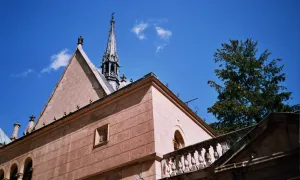
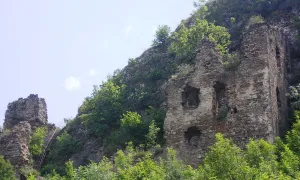
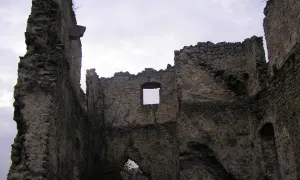
Photographs from the area
Real photos taken near the monument


Source and licence are given for each image.
Visitor Tips
No tips yet. Be the first!
Log in and add your tip.
Location on Map

Visitor photos
No photos yet. Be the first to add a photo from your visit!
Log in and add your photo or leave a rating.
You get more points for a visit verified in the app — we can tell from the GPS that you are there.
Reviews and comments