

st. Michael's fortified church Church with grounds
The fortified church of St. Michael in the village of Pobedim in Trenčín region is a laterenesančno-baroque sacral building from the second half of the 17th century. The church is surrounded by a high wall with bastions and entrance tower.
The initiator of the construction was the New Town Prior James Haško. According to one source, the church was built between 1673 and 1674, another source, based on canonic calling, states the period 1674 to 1678. The older sacral object from the late 16th or early 17th century probably preceded the current construction. During this period, the fortification was also created, which originally could consist of a wooden palisade.
It is a three-ship hall space with a polygonal closure Presbytery, built-in sacristy and a tower. The interior has cross vaults, facades are divided by pilasters with cargo and semicircular windows. On the western front there is a massive tower with an entrance portal and a bell roof with a lateral one. In 1923 the building extended the architect Milan Michal Harminc by two side boats.
The area consists of a high wall with shooters and four corner round bastions. The entrance consists of a prism tower fortification with a stone portal. There was a cemetery between the wall and the church; the southwest bastion was used as a carner after 1688. The complex is registered in the Central List of Monument Fund under numbers 1299/1 to 1299/8.
The main baroque altar in the Presbytery has a pillar architecture in a gentle concave with a volute shield. In the center is the statue of St. Michael on the devils, in the shield of the image of God-Father with kneeling angels and on the sides four Baroque statues of saints (holy Paul, Saint Peter, archangel Rafael and guardian angel). From the original altar remained stone and brick mensa, the sculpture of Pelikán and the statue of the risen Christ.
The altar of the Most Holy Heart of Jesus and the southern altar of the Heart of the Virgin Mary is located in the northern ship. Their architecture is the work of Hlohovsky builder Jozef Seilnacht, the central sculptures and statues of St. Joseph and St. Theresa come from the workshop of Ferdinand Prinoth from Tirol, Italy. In the southern ship there is a pulpit with St. Michael's top sculpture and a Baroque wooden baptistery with a statue of St. John the Baptist. Equipment complements organ from the 19th century, stops of the cross road, baroque cross in the basement and stain in the presbytery and chorus. The 1935 interior painting is the work of Julius Ádam.
The findings include the consecration cross from 1678. The building underwent repairs and reconstructions between 1970 and 1971 and 2000 to 2004.
The church is located in the central part of the village of Pobedim and is accessible to visitors.
Tehdy a dnes
Drag the slider and compare how the monument might have looked when it was built with the view today.
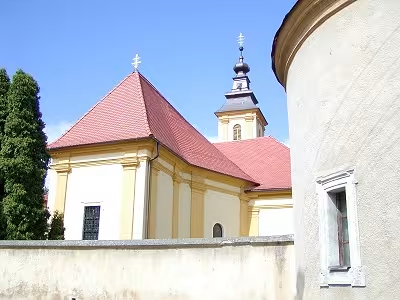
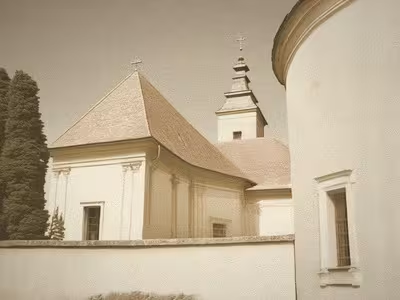
The historical view on the left is a visualisation generated by artificial intelligence and serves as inspiration.
Historical Milestones
- 1673
- The beginning of construction of late-Renaissance-Baroque church with fortification.
- 1674
- Complete the construction of the church.
- 1678
- The date of canonic calling and discovery of the consecration cross.
- 1923
- Reconstruction and expansion of the church by two side boats architect Milan Michal Harmincom.
- 1935
- Church painting by Julius Ádám.
Restoration history
| Years | Type | Extent | Condition after restoration |
|---|---|---|---|
| 2011 |
Obnova
opevnenie kostola |
Čiastočná | vyhovujúci |
Source: Monuments Board of the Slovak Republic — open data, licence CC BY 4.0
Artistic features
-
vitráž figurálna — Kráľ Dávid
sklo, vkladanie do siete · eklektizmus · 1.pol.20.st. -
vitráž figurálna — sv.Juraj
sklo, vkladanie do siete · eklektizmus · 1921-1930 -
vitráž figurálna — sv.Cecília
sklo, vkladanie do siete · eklektizmus · 1.pol.20.st. -
vitráž figurálna — sv.Michal Archanjel
sklo, vkladanie do siete · eklektizmus · 1921-1930
Source: Monuments Board of the Slovak Republic — open data, licence CC BY 4.0
Interesting facts
- It is a late-renaisan-baroque building from the second half of the 17th century, whose initiator was Jakub Haško. - The church is surrounded by a high wall with a gun, four corner round bastions and an entrance tower. - The southwest bastion was used as a carner after 1688. - In 1923 the object was expanded by the architect Milan Michal Harminc by two side boats. - The findings in the building include the consecration cross from 1678.
Guide
The guide was voiced by a synthetic voice created by artificial intelligence.
Show guide text
The text was prepared by artificial intelligence and has not been editorially reviewed. It may contain inaccuracies.
Welcome to the village of Pobedim, in the heart of the Trenčín region. Right now, you are facing one of the most prominent sights in this area, which will immediately interest you in your appearance. Before you lies the fortified church of St. Michael. When you look at it, you may wonder why it looks so unusual. It is not just a mere temple where people seek spiritual peace, but a structure that in the past should have performed a much more practical and strict function. Note that the building is not freely accessible, but is demolished by a high wall that, combined with other elements, creates the impression of an impregnable fortress. It is a place where two completely different spheres are joined: the sphere of divine, represented by the church, and the sphere of defensive, as evidenced by walls and bastions.
Let's now go back together to understand why this complex was built just like this. The story of this place begins in the second half of the seventeenth century, when the security of the population was a priority. Construction of this late-Renaissance-Baroque church started in 1673. The initiator of this ambitious project was Jakub Hasko, who wanted to create a place that would serve not only for prayer, but in case of threat would become a safe haven for local residents. The work progressed quickly and already in 1674 the construction of the church was completed. A few years later, in 1678, an important detail appeared in the canonical business cards, which was the discovery of the consecration cross, indicating that the temple was properly dedicated and became the center of spiritual life in the region.
Now that you are right in front of the building, pay attention to the details that define its unique character. Look at the perimeter wall. The high wall that surrounds the church is not just a decorative element. If you take a closer look, you'll see the shooters. It was these holes that allowed the defenders to protect the temple and its people from possible attacks. This defense system includes four corner round bastions that strategically protected every corner of the area. The entry into this safe area was facilitated by the entry tower, which served as the main point of control and access. The whole composition of the building thus creates a harmonious but strict picture of late-renaissance and Baroque architecture.
Let us now look at one particular part of the complex, which carries a strong symbolic meaning. Notice the southwest bastion. Although it now appears to be part of the defence system, after 1688 it began to perform a completely different function. She became a carder, a place to save bones from a local cemetery. It is a fascinating contrast that the space that was primarily designed to defend and fight later became a place of quiet memory and rest of the deceased. This detail reminds us how the functions of buildings have changed over the centuries according to the needs of the community and time.
Although the church's basic structure dates back to the seventeenth century, the building later undergone significant changes in order to meet the needs of the increasing number of believers. If you look at the overall size of the temple, you may notice that it is more spacious than it would have been in the original project. This is the result of the rebuilding of 1923. At that time two side ships joined the original construction, which significantly expanded the interior space. Milan Michal Harminiec was responsible for this architectural change. Not only did it increase the capacity of the church, but also preserved its historical identity. Another important asset for the aesthetic of the temple was the 1935 painting created by Julius Ádám. These 20th - century clamps complement the original Baroque essence and create a layered history that you see right now.
An interesting thing that may not be immediately visible at first sight is precisely this combination of defense system and sacral space. It is not common to see churches that are so strongly fortified in the forests and valleys of the Trenčín region. It is a testimony to an uncertain time in which people had to be prepared for the worst scenarios, but at the same time there was a strong faith in them that motivated them to build something so monumental. The idea that, in case of danger, entire villages locked themselves behind these walls and sought to attack near the altar gives this place a special sense of security and tension.
Now that you have learned the basic historical facts and noted the architectural details, I will invite you to your own research. Walk around the high walls, think about the function of round bastions and see the atmosphere of this unique place where history of defense meets the history of faith. Let your curiosity guide you and try to imagine what this place looked like hundreds of years ago when James Hasko first laid the foundation stone.
Thank you for your attention and for discovering with us the secrets of St. Michael's fortified church in Pobedima. We wish you a pleasant further stay in this beautiful country and a pleasant journey through other historical monuments.
Tips for visitors
Visit the fortified church of St. Michael in spring or autumn. Pleasant temperatures allow detailed bypass around the building and observation of architecture without summer crowds. To the village of Pobedim you will transport by car or public transport; check the current links in the internet search engine.
We recommend footwear with fixed soles, as the terrain around the building can be uneven. Since it is a sacral building, we recommend suitable clothing.
For photographers are suitable moments shortly before sundown, when the side light highlights the texture of the brick fortification and details of the facade. Images from lower angles highlight the size of the building.
Families with children can take advantage of a visit to teach that churches have served in the past not only for prayer but also as a defense fortress.
Frequently asked questions
Can the monument be visited?
Religious buildings are usually open mainly during services; at other times a visit is normally arranged with the parish or the operator. We have not verified specific times.
Where is the monument?
Location: č. 460, Pobedim, Trenčiansky kraj. The map on this page shows the exact spot.
Why is the monument protected?
It is listed in the Central List of the Monuments Fund of the Slovak Republic as a national cultural monument (ÚZPF no. 224-1299).
For children
Imagine sitting on a hard wooden chair in a quiet church. It's dark around you, there's a candle burning on the wall. Suddenly you hear the heavy footsteps of a man in leather armor. The year is 1674 and James Hasko stands before you. He holds a long rod in his hand and points to the ground. Here, he speaks quietly, but with a strong voice, we will build a wall here. So tall, we can't get any robbers
Nearby
🏰 Historic sites (188)
- sv. Ján Nepomucký 0.0 km
- Ján Hollý 0.1 km
- sv. Florián 0.4 km
- Trojičný stĺp 1.1 km
- Najsvätejšia Trojica 1.8 km
- sv. Vendelín 1.9 km
- Pieta 2.6 km web
- Trojičný stĺp 3.0 km
- Svätá rodina 3.3 km web
- Jozef Pánik - SNP 3.3 km
- Jozef Marek 3.3 km
- Ježiš Kristus 3.4 km
- Trojičný stĺp 3.4 km
- sv. Florián 3.4 km
- Praveká kniežatská mohyla 3.5 km
- Trojičný stĺp 3.8 km web
- Park miniatúr 3.9 km +421 32 743 75 05 web
- sv. Donát 4.2 km
- Najsvätejšie Srdce Ježišovo 4.3 km
- Kaštieľ Častkovce 4.6 km
🍽️ Restaurants and dining (317)
- Rybník Bašovce 2.2 km
- Rio taverna 3.0 km
- Dami 3.0 km
- Kotva 3.1 km
- Restaurant 70 3.1 km
- Pohostinstvo Martina 3.4 km
- Reštaurácia Sedliacka stodola 3.4 km +421908097917 web
- Chilli Caffe 3.4 km web
- Stuart's Pub 3.6 km
- Bufet pod Lipami 3.9 km
- Pizza Mia 4.5 km
- Stop Cafe 4.5 km
- Krčma u Mankyho 4.7 km
- Vrtuľa 5.2 km
- Bar u námorníka 5.2 km
- Pohostinstvo 5.2 km
- U Notára 5.4 km
- Starý šenk 5.4 km web
- Vŕšok 5.5 km
- Majami 5.5 km
🏨 Accommodation (69)
- Penzión u predsedu 5.5 km web
- Abako 5.7 km
- Magura 5.9 km Pod Párovcami 1317/58 web
- Penzión Fuete 6.2 km web
- Astra 6.4 km
- Športhotel 6.4 km
- Penzión Kulko 6.5 km
- Hotel Park 6.5 km +421 337 951 111 web
- Löwe 6.7 km
- Penzión Tematín 6.8 km Krížna 350/4 web
- Leier Apartments 6.8 km web
- Park Avenue 6.9 km
- Penzión Čerenec 6.9 km +421 905 983 855 web
- Penzión Hedvika 7.0 km
- Villa Veres 7.0 km
- Balnea Grand 7.0 km
- Balnea Splendid 7.1 km
- Penzión Annavila 7.2 km web
- Vila Trajan 7.2 km
- Jalta 7.2 km web
🚲 Rentals and sport (41)
- Oprava bicyklov Peter Rebro 5.4 km
- Plavecká škola 5.7 km A. Hlinku 113A web
- StrapoBikes 5.8 km Žilinská cesta 16A +421 908 953 478 web
- Topšport 6.3 km
- Diplomat aréna 6.3 km Kuzmányho 7820/19
- Atletický štadión Piešťany 6.4 km
- Extrem šport 6.4 km
- Sportisimo 6.5 km web
- F4F športové trofeje, gravírovanie 6.7 km
- Welo, s. r. o. 6.7 km
- Spinning 6.8 km
- Montana sport 6.8 km
- Team Bike 7.0 km +421908616326 web
- EXIsport 7.0 km +421337740507 web
- Detský bazén 7.2 km
- Bicycle Rental 7.2 km +421 915 270 556
- Kúpalisko Eva 7.2 km +42133775 24 06
- Servis bicyklov Cyklošport 7.4 km Adama Trajana web
- SCT GYM 7.5 km Piešťanská 555/12 web
- Motokárová dráha Trebatice 7.7 km
🥾 Hiking and nature (117)
- Park Alexandra Šindelára 5.5 km
- Kostolec 5.9 km
- Biskupské 5.9 km
- Park na Hoštákoch 5.9 km
- Synagóga 6.5 km
- Panská záhrada 6.5 km
- Vrbovská veža 6.6 km
- Kozinec 6.6 km
- Mestský park 6.8 km
- Akupresúrny chodník 6.9 km
- Skalka 7.4 km
- Veľký Plešivec 7.6 km
- Malý Plešivec 7.7 km
- Salášky 7.8 km
- Vrbina 7.9 km
- Drieňovica 8.0 km
- Bôrovište 8.0 km
- Matiáška 8.3 km
- Chlm 8.3 km
- Ihelník 8.5 km
Thematic route
As there are no other locations listed in the area of the area, I propose a thematic route aimed at exploring the monument and its area:
1. Fortified church of St. Michael - The main monument. Thanks to its fortification, the temple served in the past as a refuge for the local inhabitants.
2. Area and courtyard of the church - Outdoor space. In the vicinity of the building you can observe the remains of fortifications and architecture with a defensive character.
3. Exposition and interior - Indoor space. Lock yourself on the church and information boards that explain the history of the building in the village of Pobedim.
4. Tower view - raised point. If possible, climb to the tower, from where there is an overview of the complex and surrounding landscape.
Seasonal recommendations
In the spring, the surroundings of the fortified church of St. Michael in the village Pobedim will wake up to life and landscape in the Trencin region of greenery. Fine spring light makes it easier to observe details of exterior and fortification. It is recommended that shoes suitable for wet nature and visit in the morning. Summer months bring intense lighting and rich colors of vegetation that contrast with the stone walls of the building. Due to high temperatures it is advisable to choose the early morning or late evening time. It is practical to treat light natural materials and protect them from the sun. Autumn in Pobedim rozwietuje surroundings with color shades of leaves. Often the clear sky is favorable for photography architecture. Due to the colder mornings and evenings is appropriate layered clothing. Zimą will turn the atmosphere around the church into quiet, while snow can highlight the shapes of the fortification. Due to limited natural light, it is advisable to plan the arrival by noon. Warm, waterproof footwear and winter clothing that protects against frost and wind are essential.
Visualisations and artistic views


The visualisations are generated by artificial intelligence and serve as inspiration.
Photographs from the area
Real photos taken near the monument

Source and licence are given for each image.
Visitor Tips
No tips yet. Be the first!
Log in and add your tip.
Location on Map
More monuments – Pobedim
Show all in the town
Visitor photos
No photos yet. Be the first to add a photo from your visit!
Log in and add your photo or leave a rating.
You get more points for a visit verified in the app — we can tell from the GPS that you are there.
Reviews and comments