

st. Michael's fortified church Fortified church
The fortified church of St. Michael in the village Krajné in Trenčín region is a national cultural monument from the 14th to 15th centuries. It connects the sacral building with the Renaissance fortification, which includes the wall.
The origin of the church can reach the end of the 14th century. By the 15th century at the latest, contemporary single-ships with a ship, a five-side presbytery and northern sacristy were formed. These parts were originally encircled by rolling vaults.
Construction shows signs of Baroque architecture. After reconstruction, however, gothic arches of windows and the ridge Renaissance vault of the ship stand out. The interior contains the Baroque-Classicist main altar from the end of the 18th century with the painting of St. Michael the Archangel. On the menu there is a baroque wallpaper with sculptures and defensive cherubs. A baroque baptistery from the second half of the 18th century is planted in the wall of the triumphal arch. Part of the equipment is a baroque-classicist organ wardrobe from the 18th century with acanth ornament and crucifix of folk woodcuts from the second half of the 19th century.
The church area was fortified in the 16th century. The remains of the Renaissance defense wall are visible on the northern, eastern and partly southern sides.
The history of the object was marked by the sparks. In the second third of the 16th century, the temple was burned down, causing the collapse of Gothic vaults. Subsequently, the church burned down in 1608. The electrification took place in 2007.
The monument is registered in the Central List of the Monument Fund of the Slovak Republic under number 1 239, while under number 1 239/1 is registered church and under number 1 239/2 fortification fragments.
Tehdy a dnes
Drag the slider and compare how the monument might have looked when it was built with the view today.
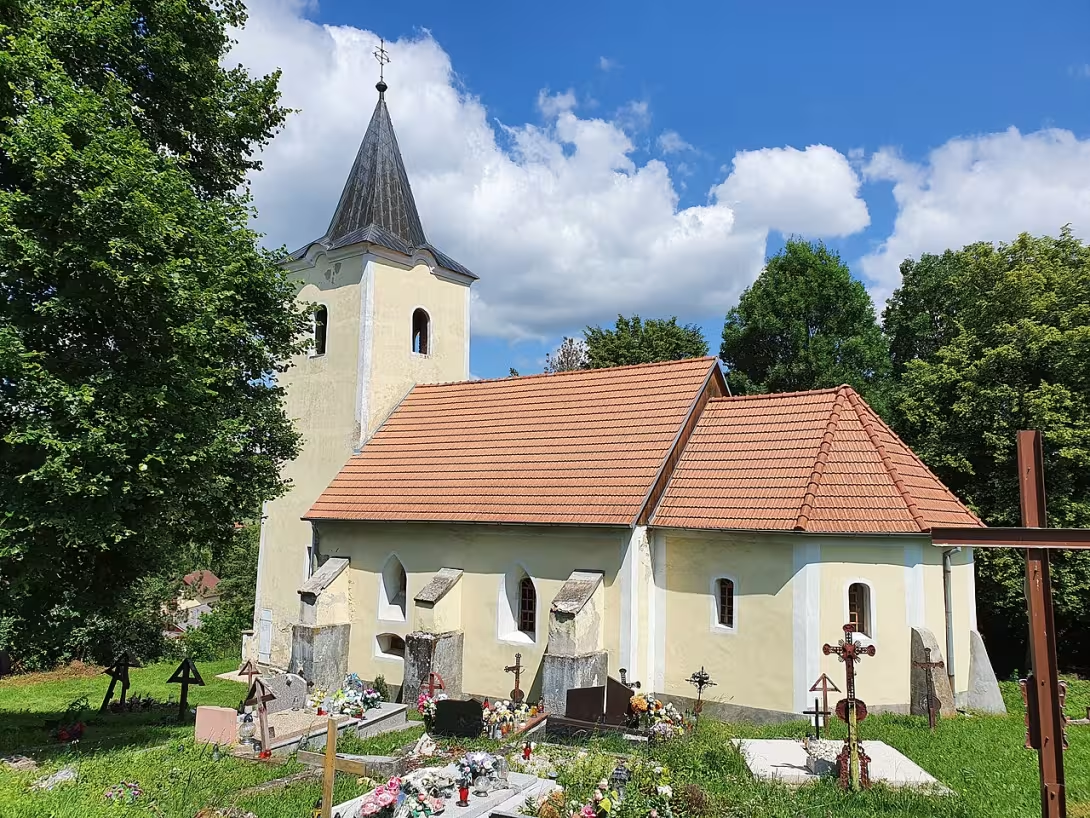
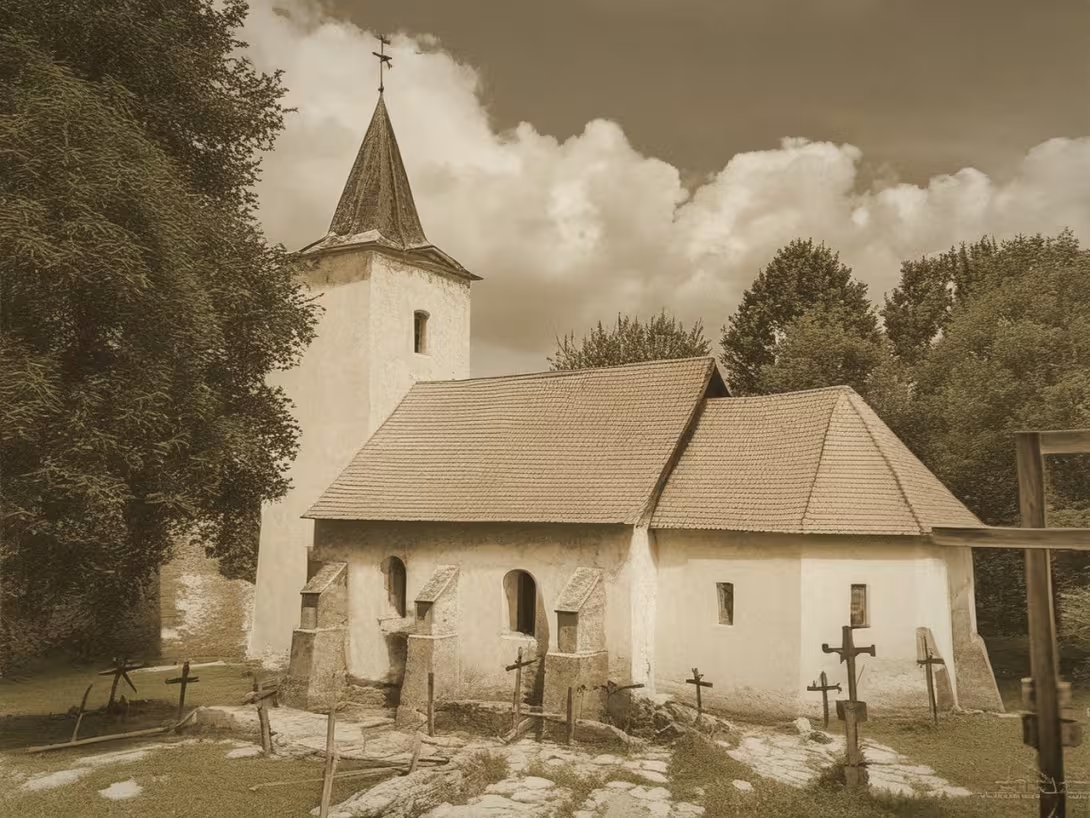
The historical view on the left is a visualisation generated by artificial intelligence and serves as inspiration.
Historical Milestones
- end of the 14th century
- Probably the foundation of the church
- 15th century
- The formation of the ship, the five-side presbytery and the northern sacristy
- the second third of the 16th century
- Temple fire and collapse of Gothic vaults
- 16th century
- Construction of Renaissance fortification and wall
- 1608
- Another Great Church Fire
- the second half of the 18th century
- Preparation of the Baroque Baptist and the main altar
Interesting facts
- It is a national cultural monument from the 14th to 15th centuries, which combines sacral construction with Renaissance fortification and wall. - The interior contains a baroque-classicist main altar from the end of the 18th century with the painting of St. - There is a baroque baptistery from the second half of the 18th century. - The area of the church was fortified in the 16th century and the remains of the defence wall are visible on the north, eastern and partly southern side. - Temple in the second third of the 16th century burned down, causing the collapse of Gothic vaults, and the
Guide
The guide was voiced by a synthetic voice created by artificial intelligence.
Show guide text
The text was prepared by artificial intelligence and has not been editorially reviewed. It may contain inaccuracies.
Welcome to the village Krajné. Right now you are facing one of the most outstanding witnesses of the history of the Trencin region, which is the fortified church of St. When you look at it, you may be interested in its unusual form for the first moment. It is not just a mere temple where people seek spiritual peace, but a building that was in the past to perform a much more practical and stringent function. Before you there is a complex that combines sacral architecture with defence elements, making it a unique national cultural monument. See this atmosphere of a place where faith meets the need for security and security in each stone.
Let's now look at how this building originated and what its historical context is. The foundation of this church dates back to the past, namely until the end of the 14th century. At that time, the first stones that formed the basic structure of the temple began to bow down. Subsequently, during the fifteenth century, the very boat of the church, northern sacristy and characteristic five-side presbytery were created. Imagine the time when these Gothic elements became the land's dominant feature, and the locals sought refuge in them from the uncertainties of the world.
However, the history of this place was not just a peaceful prayer. If you now look at the overall appearance of the building, you will notice that the church is not only a separate building but is inhabited by a wall. This Renaissance fortification system was established in the second third of the sixteenth century. Why was it necessary to fortify the church? In that period context, temples were not just cult sites, but often served as the last line of defense for the local population in the event of an attack. The Renaissance walls you see were designed to protect all who took refuge inside the area.
However, if we look at the chronology of events, we will find that the building has undergone some dramatic tests. In the second third of the sixteenth century, the temple was struck by a devastating fire that caused the gothic arches to collapse. This was a huge loss to the then community, but the construction was gradually restored. However, the tragedy was repeated later, namely in the year one thousand six hundred eight, when another major fire again damaged the church. It is fascinating to think about how much effort and faith the generations of the inhabitants of Krajné had to put into order to restore this temple again and to maintain it for the future.
Nyny pay attention to the details you can see right in front of you. Look at the wall and see its massiveness. This connection of sacral space to the defense system is what makes this church so special. It is an architecture that talks about fear, but also about resilience. When you walk around the building, watch the Gothic elements of the 15th century overlap with the later added Renaissance fortification.
If you decide to enter inside, the interior is waiting for you, which complements the overall picture of the development of this place. Although the exterior dominates the defence character, the interior reflects later artistic currents. In the second half of the eighteenth century was made the main altar, which is drawn in Baroque-Classicist style. This altar is decorated with the image of St. Michael the Archangel, who is also the patron saint of this temple. Saint Michal is known in tradition as the leader of the heavenly armies, which symbolically fits perfectly to the fortified character of the entire church.
Another detail you should look at in the interior is the Baroque Baptist. You'll find it in the wall near the triumphal arch that separates the ship from the presbytery. Like the main altar, the Baptist comes from the second half of the eighteenth century. He is a silent witness to thousands of lives that began with a new spiritual life in this church.
You may now wonder who exactly designed these structures. Here we come to one of the many mysteries of this place. Names of architects who designed Gothic foundations, Renaissance walls or Baroque altar remained unknown in time. Specific historical personalities directly related to the construction are also unknown. And that's where the gewisse romance of this place lies. This church is not a monument to one particular great personality, but a joint work of whole generations of people from the village Krajné and surroundings. It is a monument built by anonymous masters whose work today we can admire this beauty.
The interesting thing is this duality of the building. On the one hand, we have the softness of the Baroque altar and the spiritual depth of the baptismal tabernacle, and on the other hand, the hardness and severity of the Renaissance fortification. It's where it meets earthly, defensive and material, the heavenly and timeless. When you imagine how people were hiding in these walls during danger in the past, while St. Michael's protection was watching over them, you will have an idea of how powerful an emotional charge this place had for its contemporaries.
So you are facing a building that has survived centuries, fires and changes in political systems. From Gothic to Renaissance to Baroque and Classicism. Every detail, from a five-side presbytery to a wall, tells its own story of survival and endurance.
We invite you now to go through the entire perimeter of the building in peace, to touch the cold stones of the walls and, if you have the opportunity, to explore the interior with its Baroque gems. Be absorbed in the silence and history that surrounds you. Thank you for sharing this moment with us in the village Krajné. We wish you a pleasant next survey and a peaceful day.
Tips for visitors
Visit the fortified church of St. Michael in spring or autumn, when the pleasant temperatures and colors of the landscape highlight its architecture. We recommend travelling by car or local transport to the village of Krajné; check the current links in the internet search engine.
Put comfortable shoes in the terrain and drinking water, because snacks may not be available in the immediate vicinity of the building. For photographers are the most suitable places surrounding the outer fortification. We recommend coming in morning or evening light to highlight the texture of the historical masonry.
When visiting, focus on examining the sacral structure and its defence elements. Families with children can use the place for a short historical lesson in the field and a common search for details in the church fortification.
Frequently asked questions
Can the monument be visited?
Religious buildings are usually open mainly during services; at other times a visit is normally arranged with the parish or the operator. We have not verified specific times.
Where is the monument?
Location: č. 156, Krajné, Trenčiansky kraj. The map on this page shows the exact spot.
Why is the monument protected?
It is listed in the Central List of the Monuments Fund of the Slovak Republic as a national cultural monument (ÚZPF no. 223-1239).
For children
Close your eyes and imagine coming back hundreds of years ago. You don't see modern cars or cell phones anymore. Instead, you hear only the silent noise of winds and the impact of horse hogging on a dusty road. You stand in front of a building that looks like a mixed version of a temple and an impregnable fortress. Welcome to the village Outside the mysterious fortified church of St. Michael!
Nearby
🏰 Historic sites (180)
- Evanjelickým kňazom - literátom 0.3 km
- Padlým v 1. a 2. svetovej vojne 0.4 km
- Pamätník obetiam 1. svetovej vojny 3.2 km
- sv. Gorazd 3.2 km
- Obetiam prvej svetovej vojny 4.3 km
- Ján Trokan a Alexander Trokan 4.3 km
- Jozef Brunovský 5.3 km
- Čachtický hrad 6.0 km web
- Hradisko Tlstá hora 6.2 km web
- Park miniatúr 6.5 km +421 32 743 75 05 web
- Trojičný stĺp 6.7 km
- Praveká kniežatská mohyla 6.7 km
- Kaštieľ Častkovce 7.0 km
- sv. Florián 7.0 km
- sv. Vendelín 7.2 km
- Jan Bystřický 7.2 km
- Drugetovská kúria 7.3 km Medzihorská 180/3
- Trenčianske múzeum - expozícia Čachtice 7.3 km
- Kalvária 7.3 km
- sv. Florián 7.3 km
🍽️ Restaurants and dining (216)
- Krajné 0.2 km
- Bar10 2.3 km
- Krčmička na hrachu 2.5 km
- Bufetík 4.0 km Hrachovište 236 236 +421908198186
- Matejovský šenk 4.3 km
- L&P 5.3 km +421 905 488 666
- Škulec 5.5 km
- Pohostinstvo Hrašné 6.0 km
- Dúbrava 6.3 km +421 33 778 05 38
- U Anny 6.5 km +421346216688
- Dubnik 6.6 km
- Bufet pod Lipami 6.7 km
- Tri elementy 7.3 km
- Pizzeria Bathory 7.3 km +421 903 813 260
- Café Palatín 7.3 km
- Grófkin dvor 7.3 km
- Espresso & pizzeria Grande 7.3 km
- U Agnešy 7.3 km
- Kaviareň U Jara 7.4 km
- Pod hradom 7.4 km
🏨 Accommodation (31)
- Ranč Colombia 2.5 km +421 948 908 398
- Red Dingo Homestead 3.0 km +421 944 775 670 web
- Agropenzión Adam 3.6 km +421327772111 web
- Penzión u predsedu 4.5 km web
- Škulec 5.5 km +421 905 853 325 web
- Rekreačné zariadenie Javorinka 6.3 km +421 911 74 74 71 web
- Penzión Čerenec 7.5 km +421 905 983 855 web
- Hotel Lipa 8.7 km
- Penzión na Mlyne 9.0 km +421327762975 web
- Penzión Kulko 9.0 km
- Penzión Šport 9.1 km +421 911 516 333 web
- Spoločenský dom 10.8 km
- Penzión Tvarožek 11.6 km web
- Ubytovňa Milex 11.7 km Piešťanská 2676/31A +421902225522 web
- Chateau Považany 11.8 km web
- Red House 11.9 km +421 905 600 788;+421 915 322 258 web
- U dobrých gazdov 12.0 km
- Ubytovanie Dolina 12.1 km
- Kúria 12.1 km +421 904 838 789 web
- Hotel Javorina 12.2 km +421 32 771 20 67 web
🚲 Rentals and sport (25)
- Adrobike 8.7 km
- Krytá plaváreň 9.1 km
- RDA Shop 10.9 km
- Letné kúpalisko Myjava 11.2 km
- Krytá plaváreň 11.3 km
- Ski Centrum 12.1 km
- Sportisimo 12.1 km web
- Huma šport 12.1 km +421 903 752 297
- Tomino - Rybárske potreby 12.1 km
- Extra sport 12.2 km
- Rival bike sport 12.2 km +421 32 771 29 36; +421 915 867 427 web
- Rybárstvo Rojko 12.2 km
- Bazén SPŠ Nové Mesto nad Váhom 12.4 km +421 32 7465258 web
- Squash Center 12.6 km +421 905 526 740 web
- Brezovské kúpalisko 12.6 km
- Motokárová dráha Trebatice 13.0 km
- Bicygláreň 13.0 km +421 911 422 399 web
- SCT GYM 13.2 km Piešťanská 555/12 web
- 22 bikes 13.2 km +421 32 771 21 59 web
- MTBiker centrum 14.2 km +421233056730 web
🥾 Hiking and nature (129)
- Vršnice 1.0 km
- Zadné Dúbravy 2.0 km
- Drieňovica 2.2 km
- Salášky 2.6 km
- Pávičie 2.9 km
- Hlaváč 3.0 km
- Veľký Plešivec 3.5 km
- Kozinec 3.6 km
- Malý Plešivec 3.7 km
- Uhrícky vrch 4.4 km
- Sedielce 4.7 km
- Snedanisko 5.2 km
- Rozprávkový dom 5.4 km +421 904 519 571 web
- Rovienky 5.5 km
- Galovo 5.6 km
- Holý vrch 5.8 km
- Vŕšok 6.0 km
- Tlstá hora 6.2 km
- Štúrova skala 6.4 km
- Hodulov vrch 6.5 km
Thematic route
Thematic cruise route: Fortified Church of St. Michael in Krajny
The route focuses on the construction and its immediate surroundings. It allows you to know the architectural features of this fortified church.
St. Michael's Church The object is an example of sacral defence construction. The structure is surrounded by massive walls that served to protect against Turkish invasions. The facade of the church is decorated with Baroque reliefs that contrast with thick defence walls.
Church Tower The tower is part of the fortification. It served on surveillance and signalling, adding strategic importance to the construction process.
Courtyard and Gateway The premises in front of the church and the gateway are part of the defense system. There are traces of original defenses and entry mechanisms.
Church Interior The interior fittings retain their original character. The building also served as a defensive work as a spiritual center of the village. Details of ceiling arches and altar paintings complement the interior.
Church surroundings The surroundings of the church in the village Krajné is quiet. A walk in the surroundings allows you to see the overall appearance of the building from different angles.
The route is designed so that visitors can discover the fortified church of St. Michael and its place in the history of Slovak architecture.
Seasonal recommendations
In the spring, the surroundings of the fortified church of St. Michael in the village Krajné will wake up to life. Nature in Trenčín region blooms, creating contrast to massive stone walls of the building. The place is suitable to visit in the morning when light is natural. Due to variable weather, layered clothing and waterproof footwear are recommended.
Summer season brings strong sunlight, which highlights the details of stone structure fortification and texture. Due to high temperatures, early morning or late evening time is best. It is practical to take a head covering and enough drinking water.
Autumn in this location is melancholy, mainly due to the colour change of leaves. The golden and red tones of nature complement the historical character of the monument. The ideal time to visit is October, when light is softer. Clothes suitable for colder days, such as lightweight jackets or wool sweaters are recommended.
Zimą gets the fortified church of St. Michael peacefully, which underlines its defensive function. The snow combined with stone architecture creates a quiet atmosphere. Visitors should be accompanied by warm and waterproof clothing, including gloves and hats. It's best to come in daylight.
Visualisations and artistic views


The visualisations are generated by artificial intelligence and serve as inspiration.
Photographs from the area
Real photos taken near the monument

Source and licence are given for each image.
Visitor Tips
No tips yet. Be the first!
Log in and add your tip.
Location on Map
More monuments – Krajné
Show all in the town


Visitor photos
No photos yet. Be the first to add a photo from your visit!
Log in and add your photo or leave a rating.
You get more points for a visit verified in the app — we can tell from the GPS that you are there.
Reviews and comments