

st. Nicholas Church Church
The Roman Catholic parish church of St. Nicholas in the village Kračúnovce in Prešov region has a Gothic core from the beginning of the 15th century. The building bears the signs of Baroque and Classicist rebuilding. It is registered by the Monument Office of the Slovak Republic under number ÚZPF 203.
The church was founded in the 14th and 15th centuries. From the Gothic period remained the core of the perimeter masonry and tower. In the 18th century the building underwent a Baroque-Classicist adjustment. Strong wall pillars were added to the interior, on which the spring vault with belts rests. In 1901 the object was repaired in classicistic style.
The exterior of the tower decorates the late-renaissance stone portal from 1615 to 1620. It contains a rugged triangle fronton, stylized rosettes and a final shell. The facade is adapted classicistic, the tower has a climbing frame and a terrace roof ledge.
The interior is single boat. The main altar comes from the end of the 19th century. The side altar from the second half of the 18th century has a rococo Tabernacul. In the church there is the late baroque Calvary and wooden baptismal from the end of the 18th century. St. Jan Nepomuk's sculpture from the 17th century is located in the sacristy.
Interior paintings are from 1962. The rest of the vault is filled with Baroque ornaments. A picture of the Coronation of the Virgin Mary is placed in the sanctuary. The windows complement five vitriarchs from 1988, depicting the saints.
The church belongs to the parish of Kračúnovce, deanate of Stropkov and Košice archdiocese. The building is located in the center of the village.
Tehdy a dnes
Drag the slider and compare how the monument might have looked when it was built with the view today.
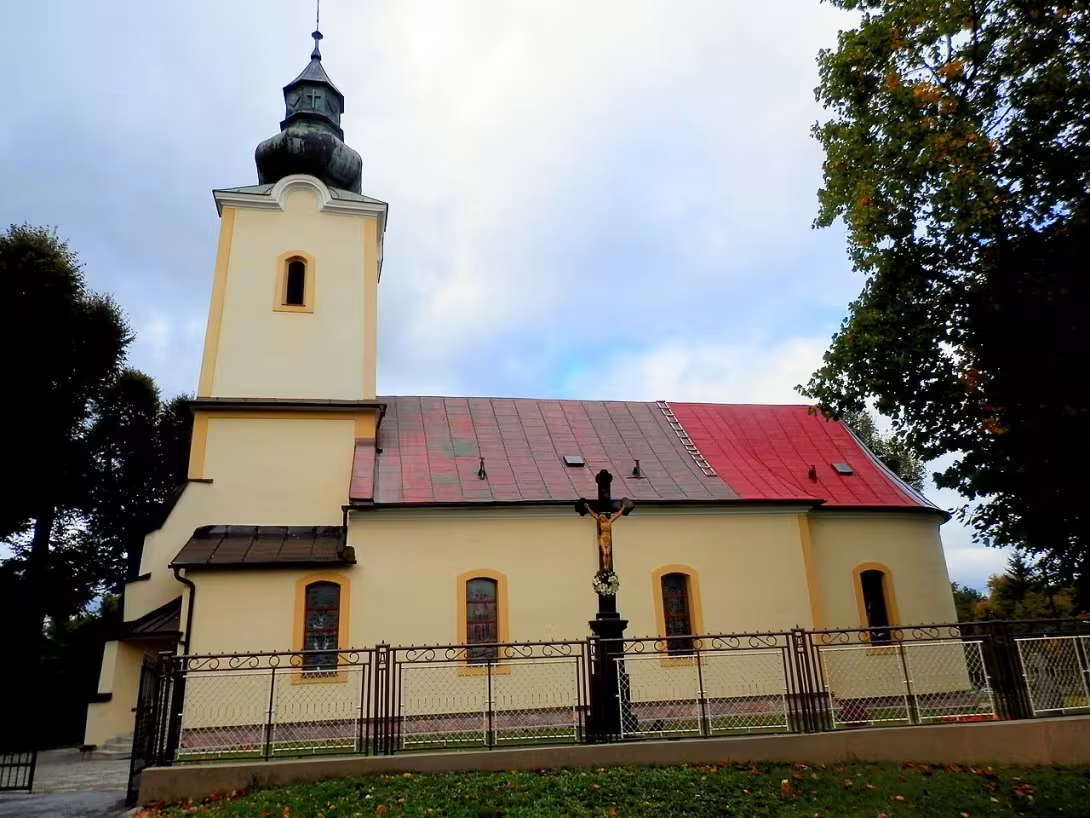
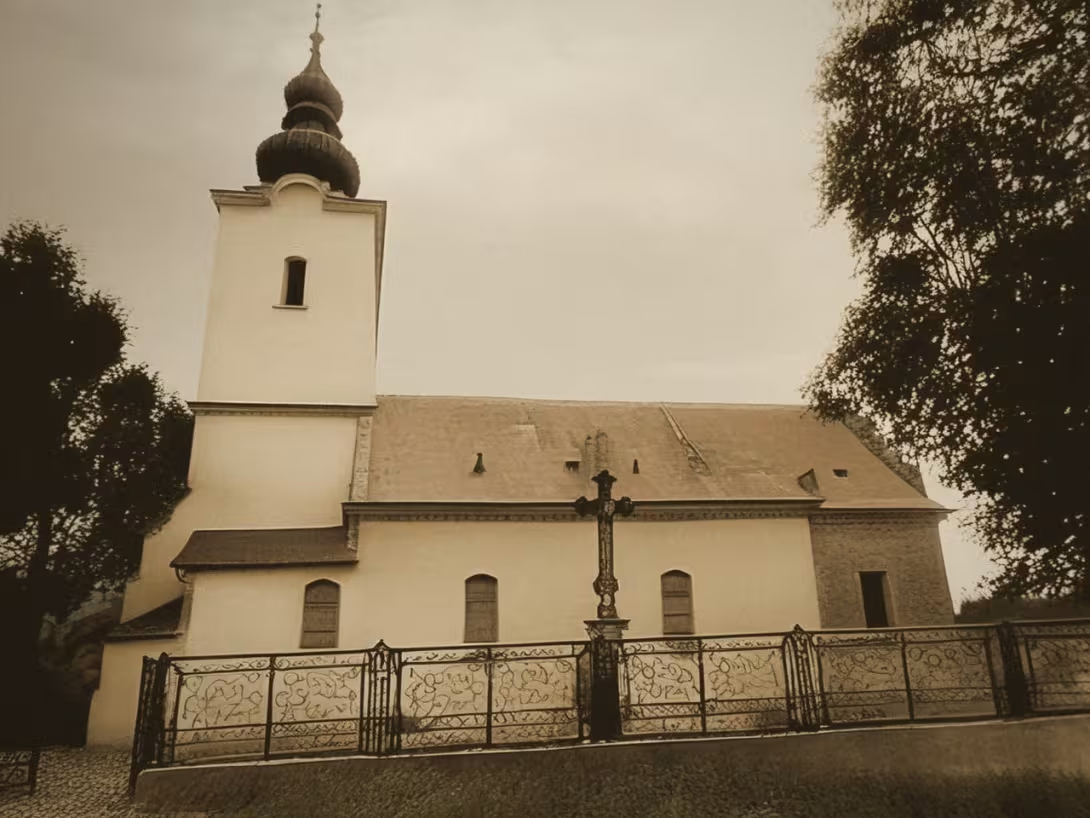
The historical view on the left is a visualisation generated by artificial intelligence and serves as inspiration.
Historical Milestones
- The beginning of the 15th century: the Gothic core of the building
- 1615 - 1620: construction of late-renaissance stone portal
- 18th century: rebuilding the baroque-classicist style
- 1901: repair of the church in classicistic style
- 1962: design of interior paintings
- 1988: installation of five glass windows
Artistic features
-
vitráž figurálna s dekorom — sv.Andrej Svorad
sklo, vkladanie do siete · moderna · 1981-1990 -
vitráž figurálna s dekorom — sv.Dominik Savio
sklo, vkladanie do siete · moderna · 1981-1990 -
vitráž figurálna s dekorom — sv.Mária Goretti
sklo, vkladanie do siete · moderna · 1981-1990 -
vitráž figurálna s dekorom — sv.Pius X.
sklo, vkladanie do siete · moderna · 1981-1990 -
vitráž figurálna s dekorom — sv.Alžbeta Uhorská
sklo, vkladanie do siete · moderna · 1981-1990
Source: Monuments Board of the Slovak Republic — open data, licence CC BY 4.0
Interesting facts
- The church has a Gothic core from the beginning of the 15th century, from which remained the core of the perimeter masonry and tower. - The exterior of the tower decorates the late-renaissance stone portal from the years 1615 to 1620 with a triple-faced fronton and shell. - In the interior there is a Prussian vault with belts, late baroque Calvary and wooden baptistery from the end of the 18th century. - St. Jan Nepomuk's sculpture from the 17th century is located in the sacristy. - The windows complement five vitriarchs from 1988, depicting the saints.
Guide
The guide was voiced by a synthetic voice created by artificial intelligence.
Show guide text
The text was prepared by artificial intelligence and has not been editorially reviewed. It may contain inaccuracies.
You know, the Krachuns. You stand right at the moment when time stops and history begins to speak with its own voice. In front of you, the church of St. Nicholas, a building that is not only a building of stone and wood, but a living witness of the centuries that raced over this country. Look at its silhouette that dominates the surroundings and creates a quiet but unbent point in this small village. Perhaps at first glance it acts as an inconspicuous part of the country, but if you stop and allow your eyes to see the details, you will find that every trace on its surface has its meaning and its unique natural rhythm. Feel the atmosphere of peace and noble old stature that emanates from this place. When we try to understand how this church originated, we must go back to the past in our minds. Although the exact names of builders, architects, and the exact years when the first stones were laid are not preserved in our records, the very essence of the building tells us more than we could imagine. The church has its Gothic core, which comes from the very beginning of the 15th century. Take that idea - you are facing something that has survived for five centuries before modern cities began to be built. What you see today is the result of a gradual layering of styles, where the Gothic fortress is rocking Renaissance elegance and Baroque sensitivity. The core, which forms the residual circumferential masonry and this tower, is the foundation stone on which this whole spiritual structure stands. It's like a tree that has old, deep roots from which new, more decorative branches grow. Let's take a closer look at the exterior together. Now pay attention to the tower, which is one of the most prominent elements of the entire object. If you look close, you will see that it is not just a simple stone structure. On its exterior is preserved late-renaissance stone portal, which comes from the period between 1615 and 1620. It is a fascinating detail that brings softness and geometric harmony of Renaissance into a more strenuous Gothic form. Note the tri-iron fronton that decorates the portal and pay attention to the detail in the form of shells. This motif of shell was at that time extremely popular and symbolized beauty and purity. It is proof that in this place too, people in the seventeenth century wanted to bring artistic balance and aesthetic value to overcome simple functionality. This portal is like a gateway to another world, when the hand of a stonemaker sought perfection in every cut-out detail. However, I invite you to prepare for the transition. When you enter the threshold, you feel the acoustics changing and the air becoming denser from history. The interior of the church will surround you with a different kind of beauty. Look up to the ceiling. There is a Prussian vault with characteristic bands, which creates a feeling of spatial height and geometric order. This vault is not just a ceiling, it is an architectural element that directs the view of the visitor and leads it further. Then, when your eyes start moving around the space, you encounter the late baroque Calvary. Barok, with his ability to express his emotions and depth, left his mark here in the form of this spiritual composition, which is intended to induce inner reflection and amazement. Finally, in a quiet corner, you can perceive the presence of a wooden baptism font. Wood in this stone and wall environment brings heat and humanity, a reminder of the rituals that have been carried out here for centuries. In this place, however, much remains unknown, which carries a special charm. Although we have such a rich architectural text before us, we still do not know who the people who created these masterpieces were. Who was the anonymous architect who designed this Gothic core in the 15th century? Who was the midget who worked the stone portal with a clam in the early seventh century with such precision? This unknownness is not a lack of information, but rather an invitation to your own imagination. Every stone, every vault and every wooden detail is a silent message from people whose names time erased, but whose abilities and visual tastes are still vivid and tangible. It is this mystery, this contradiction between visible beauty and invisible history, which makes St. Nicholas' church so special. Stop for a moment in silence and just feel this presence. The church is not just a monument; it is a dialogue between different eras that have met here and united into one whole. It is a reminder that even what is unknown can be extremely beautiful and significant. I hope this brief look at the history of St. Nicholas' church has helped you to better understand his soul. Let yourself be carried away by the atmosphere of this place for a while longer, go through the interior with a slow, discreet step and pay attention to every detail that architecture offers you. Thank you for your journey together in time and we wish you a pleasant sequel to further discovering the beauty of this location. We'll say goodbye, but history is still waiting for you.
Tips for visitors
Visit the church of St. Nicholas in Kračúnovce in spring or summer, when the surroundings in the flower and the building are well lit. You come to the village by car or public transport; check the current links in the internet search engine.
We recommend to wear the terrain and suitable clothing at the entrance to the temple. Take drinking water for a longer tour.
To photograph the facade are suitable morning or evening hours. Images arise mainly from the angle in front of the main entrance.
Families with children can use walks around the village.
Frequently asked questions
Can the monument be visited?
Religious buildings are usually open mainly during services; at other times a visit is normally arranged with the parish or the operator. We have not verified specific times.
Where is the monument?
Location: č. 178, Kračúnovce, Prešovský kraj. The map on this page shows the exact spot.
Why is the monument protected?
It is listed in the Central List of the Monuments Fund of the Slovak Republic as a national cultural monument (ÚZPF no. 41C-203).
For children
Close your eyes and imagine coming back in time. We're moving back 50 years or so to a time when the world looked completely different. No smartphones, no internet, just quiet villages and secrets hidden in old walls. Something interesting happened in the village of Kračúnovce in this period, around 2000,. We're standing in front of a building that looks like a fairy tale, but it's actually a time machine. How was it here? Imagine the narrow roads and people who wore woolen clothes and went to St. Nicholas' church.
Nearby
🏰 Historic sites (51)
- Kúria Kračúnovce 0.0 km web
- Dr. Jozef Goldberger 3.0 km
- Bánoovský kaštieľ 3.0 km Kukorelliho 335/17 web
- Kaštieľ rodiny Banó 3.1 km
- Kaštieľ Giraltovce 3.1 km Dukelská 49/53
- 100. výročie vzniku ČSR 3.5 km
- Adam Hlovík 3.5 km
- Kaštieľ Chmeľov 4.1 km
- Kaštieľ Kalnište 4.1 km web
- Na pamiatku partizánskej skupiny "Čapajev" 4.2 km
- Pád vrtulníka 2003 4.2 km
- Pamätník križovníkom 4.3 km
- Kaštieľ Želmanovce 5.3 km web
- Medziansky hrádok 5.9 km
- Ivan Baľuta 7.4 km
- Ľudovít Kukorelli 7.4 km
- Pamatník SNP 7.4 km
- Šoóšovský kaštieľ 7.4 km Zámocká 150/2 web
- Kaštieľ Hanušovce 7.5 km +421 57 445 2371 web
- Kaštieľ Hanušovce nad Topľou 7.5 km Zámocká 160/5 web
🍽️ Restaurants and dining (58)
- Chlista 0.8 km +421 902 575 272
- Zara Caffe 2.2 km
- Skalný orol 2.6 km web
- Čepcov 2.6 km
- Lidová jídelna 2.6 km
- Oáza 3.0 km
- Bizarre pub 3.1 km
- Pivareň u Dáši 3.2 km
- Tribal 3.3 km
- Pizza Jobi 3.4 km
- Simeon 3.4 km +421 907 070 204 web
- Vrtuľa 3.5 km
- Hostinec Miki 3.6 km
- Bistro Bus 3.6 km
- Pizza Tony 3.6 km
- Panoráma 3.6 km +421905444658
- Tony kebab 3.6 km
- Zara caffe 3.6 km
- Majestic Burger 3.8 km +421 917 733 111 web
- Pivko pod kaštieľom 5.2 km
🏨 Accommodation (22)
- Jami 1.1 km
- Hotel Alfa 3.5 km Dukelská 70/71
- Chata pod Haľagošom 7.3 km
- Snežienka 8.6 km web
- Chata na Doloch 9.6 km
- chata Hradzenka 10.4 km
- Chata Kopany Skrabské 11.1 km
- Zlatá studňa 11.5 km web
- Penzión Trio 11.6 km
- Valkov 12.9 km
- Jodo 13.1 km
- Hotel Šport 13.1 km
- Tatra 13.1 km
- chata za Oblíkom 13.9 km web
- Autokemp Domaša Tíšava 13.9 km +421 911 299 843 web
- Kukorelliho chata 13.9 km web
- chata Petrovce 14.0 km
- Motel Raslavičan 14.1 km
- Chata Fricka 14.2 km
- Zajacová chata 14.2 km
🚲 Rentals and sport (1)
- Aeroklub Prešov 14.9 km Vranovská 72 web
🥾 Hiking and nature (125)
- Hliny 0.9 km
- Vyšná Čerednica 1.1 km
- Lysá hora 2.3 km
- Park Mieru 2.8 km
- Váhová 3.3 km
- Vichter 3.5 km
- Zaďňa hura 3.5 km
- Veľká hora 3.8 km
- Chudákov vrch 3.8 km
- Čepcov 4.0 km
- Lavička lásky - Kobylnice 4.3 km
- Stavenec 4.6 km
- Havraní vrch 5.0 km
- Brezovský vrch 5.1 km
- Grúnik 5.3 km
- Šibenia hora 5.8 km
- Široká 6.2 km
- Na kverk 6.6 km
- Červelík 6.7 km
- Dúbrava 6.9 km
Thematic route
As there are no other locations in the area, I propose a thematic route focused on the main objective and its immediate area:
1. Church of St. Nicholas - The main monument. Visit this historic church in the village Kračúnovce. 2. Interior of the church - Indoor space. Look carefully at the artistic details, altars and church equipment. 3. Church area - surroundings of the building. Walk around the courtyard and the temple.
Seasonal recommendations
In spring, the surroundings of St. Nicholas church in Kračúnovce will be covered in green color. Fine spring light is suitable for outdoor photography. Shoe is recommended for wet terrain and visit in the morning.
Summer season brings intense lighting and rich colors of nature that create contrast with the façade of the church. Due to high temperatures it is appropriate to choose the time early in the morning or late in the afternoon. Practical is easy, breathable clothing and UV protection.
Autumn in Prešov region obahrodi monument with golden and red tones of leaves. Lower light highlights architectural details of the building. Due to colder weather and humidity around the area, layered clothing and waterproof footwear are recommended.
Zimą creates a snowy landscape minimalist background of St. Nicholas church. Low temperatures require warm and waterproof clothing, including gloves and caps. A good time to visit is a bright winter day when snow reflects light and highlights the silhouette of the building.
Visualisations and artistic views


The visualisations are generated by artificial intelligence and serve as inspiration.
Visitor Tips
No tips yet. Be the first!
Log in and add your tip.
Location on Map
More monuments – Kračúnovce
Show all in the town
Visitor photos
No photos yet. Be the first to add a photo from your visit!
Log in and add your photo or leave a rating.
You get more points for a visit verified in the app — we can tell from the GPS that you are there.
Reviews and comments