

st. Nicholas's filial church Church
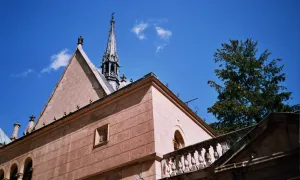
The Roman Catholic filial church of Saint Nicholas is located in Handlova, in its local part Nová Lehota in Trenčín region. It is a Baroque-classicist sacral building from the years 1785 to 1791, which was created partly on older foundations from the late 15th century and includes an older Renaissance tower. The Monument Office of the Slovak Republic leads the area in the Central List of Monument Fund under number ÚZPF 863, while the church itself is registered under number ÚZPF 863/1.
The village of Nová Lehota is first mentioned in the documents in 1487 and the first documented report on the local parish dates from 1559. At that time, the canonical presentation noted that the parish did not have its own spiritual steward, and the religious life was provided by a priest from Jan's Time. The parish later disappeared and was not restored until the 18th century when the decision to build a new brick church was made, dedicated to St. Nicholas the Bishop. From the point of view of the church report, this was a specific situation, since the church belonged to the parish of Svätokrížská parish in Banská Bystrica diocese, while the Nová Lehota was administratively associated with Handlová, belonging to the Nitra diocese.
Construction of the present temple began in 1785. The gross construction was blessed by F. Miller on 30 October 1786 and the completed church in 1791 was consecrated by F. Berchtoldt. Architecturally, it is a single-ship space with segmented presbytery closure, to which attached sacristy and hallway. Part of the facade is presented Renaissance tower covered with a pyramidal roof, in which four bells were placed. Smooth exterior facades break windows with segment finishing and single-stage support pillars. The interior of the ship has a flat ceiling.
In the 19th and 20th centuries, the growing population required structural intervention in the chorus. The original empora was expanded in 1823 and a trilateral chorus was built in 1924. The adjustments were also made to the floors; in 1841 the church was paved with stone plates and in 1923 it laid ceramic tiles. The interior is mostly from the 20th century, while historical records indicate that the altar was made by F. Šteffek and the interior was painted by L. Schrammek from Banská Štiavnica. In 2019 architectural-historical and artistic-historical research under the direction of Mgr. Renáta Kollárová and Ing. arch was carried out in the building. Grúňová, PhD.
Part of the historical context of the site is a neighbouring Baroque parish from 1787. In 1841 the then pastor and pomologist Paul Ambróse planted various foreign trees around it. To date, a sequoia mammoth, registered as a protected natural object of the Slovak Republic, was preserved near the parish.
St. Nicholas church stands in a high place in the middle of New Time. The building is in good condition and continues to serve liturgical purposes.
Tehdy a dnes
Drag the slider and compare how the monument might have looked when it was built with the view today.
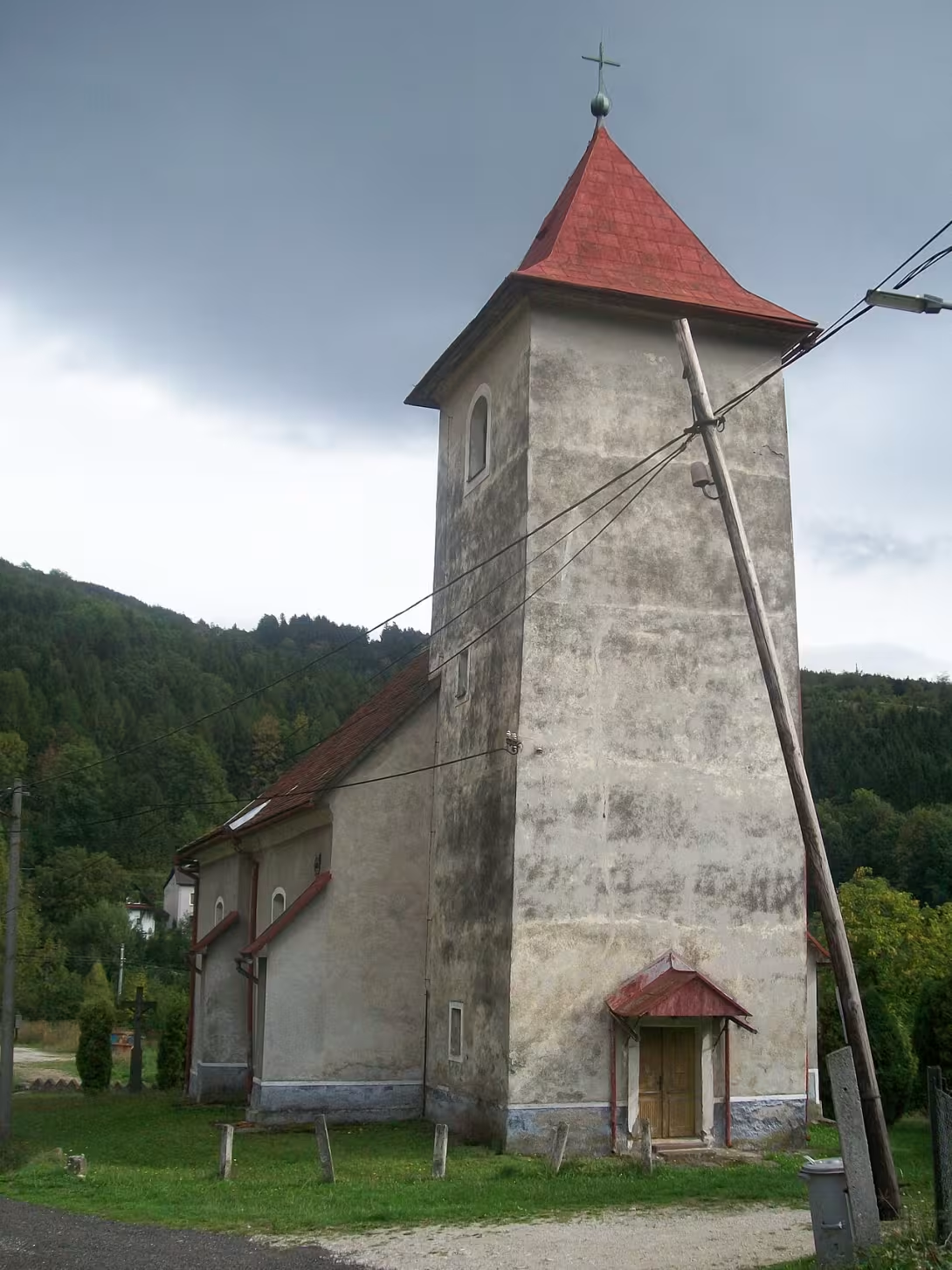
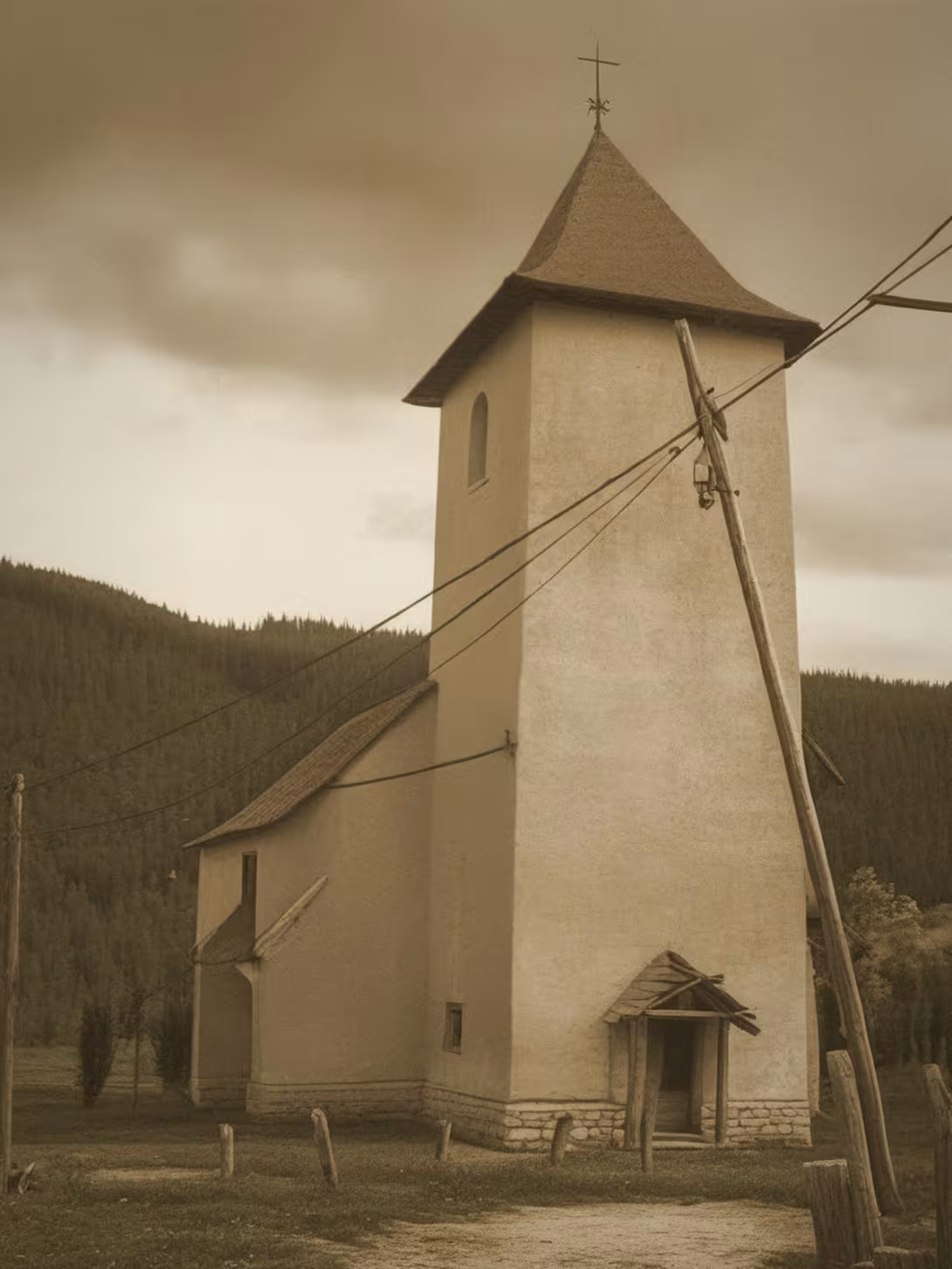
The historical view on the left is a visualisation generated by artificial intelligence and serves as inspiration.
Historical Milestones
- end of the 15th century: the establishment of an older building foundation
- 1785: the beginning of the construction of the current baroque-classicist church
- 30 October 1786: Blessings of the Gross Construction of F. Miller
- 1791: completion of the construction and consecration by Bishop Francis Berchtoldt
- 1823: extension of the chorus
- 1841: laying stone pavement
- 1923 - 1924: replacing tiles with ceramic and building a trilateral chorus
Restoration history
| Years | Type | Extent | Condition after restoration |
|---|---|---|---|
| 2013–2014 |
Obnova
filiálny kostol sv.Mikuláša |
Časť obnovená komplexne | narušený |
Source: Monuments Board of the Slovak Republic — open data, licence CC BY 4.0
Interesting facts
- It is a Baroque-Classicist building from the years 1785 to 1791, which originated partly on older foundations from the late 15th century. - Part of the facade is featuring a Renaissance tower with a pyramid roof, in which four bells were placed. - The church belonged to the Svätokrížská parish in Banská Bystrica diocese, although the New Lehota was administratively attached to Handlová under Nitra diocese. - The interior was painted by L. Schrammek from Banská Štiavnica and the altar was made by F.
Guide
Show guide text
The text was prepared by artificial intelligence and has not been editorially reviewed. It may contain inaccuracies.
Welcome to Handle. Stop for a moment, take a deep breath and let the atmosphere of this place affect you. You are standing in front of St. Nicholas's filial church, a silent and noble witness to the transformations of this mining town and the entire surrounding-flux valley. If you look at it for the first time, you may be surprised by its balanced harmony and the tranquillity that emanates from it in the midst of today's common rush. In front of you is a building whose walls bear a story lasting over five centuries, written in stone, mortar, and noble shapes.
Raise your eyes and look at the front of the temple. Your view is quite naturally attracted by the massive pictured tower, which confidently rises from the front of the building and heads straight to the heavens. It is finished with a slim pyramid roof, which gives the entire building a strict but elevated character. This tower has a renaissance origin and creates a fascinating architectural dialogue with the main church ship, which already bears the seal of another historical period. It represents a kind of fixed anchor, a visual landmark that for generations accompanied people when they returned from the surrounding fields, forests and mining works.
To understand why this church looks just like this, however, we need to take our thoughts on a journey deep into the past. Although its visible appearance today dates from 1785 to 1791, its true roots go much deeper. The church was built partly on older foundations, which dates back to the late 15th century, i.e. the late Middle Ages. Imagine the end of the fifteenth age, the restless times of the ages when the first stone sanctuary grew up in this valley. Who were the original builders and craftsmen, we can't exactly blame that from the historical documents. Their names were taken away by time, but their work, hidden in the lower layers of the masonry, remained untouched by the foundation on which the church still stands.
However, in the course of the centuries, the old space ceased to be suitable, so in the second half of the eighteenth century, more precisely between 1785 and 1791, it was decided on a fundamental rebuilding. At that time, Emperor Joseph II ruled, enlightened reforms were under way, and significant church changes were taking place. In the region there was also a new organization of religious life after the creation of Banská Bystrica diocese in 1776, under which the church began to fall, and in the past it belonged to the Saint-Crison parish. In this climate of restoration, St. Nicholas' temple received a new dress - the ship was rebuilt in the Baroque-Classicist spirit.
Note this essay as you slowly walk through the facade with your eyes. The Baroque-Classicist style at the end of the eighteenth century dropped from the booming dramaticity of the top Baroque and brought more mildness, balance and return to peaceful lines. The connection with the original Renaissance tower and ancient medieval core created a unique whole, where medieval mystery is associated with the Renaissance fortress and classicistic balance.
Now look high on the Renaissance tower under the pyramidal roof again. Up there, behind the sound windows, for centuries there was the beating heart of this community - tower bells. A total of four bells were placed here. Try listening to the silence for a moment and imagine the sound from the tower spreading all over the valley. The voice of these four bells was not merely a religious signal to prayer. It was a voice that accompanied the daily life of the locals from morning to evening. He announced joyful events, weddings, and baptisms, but he likewise escorted the deceased on their final journey. The bells warned against fires, storms, and impending danger, setting the rhythm of work and rest at a time when there were no watches in people's pockets.
The presence of four bells in the tower also shows the importance and economic strength of a community that has been able to secure and maintain such an expensive liturgical and communication tool. Each bell had its own voice, its tuning and its exact purpose, while in harmony they were able to sound the entire Handle Valley.
The church carries the patronage of St. Nicholas, the bishop of Myra, one of the most popular Christian saints. Saint Nicholas is known as the protector of the poor, the persecuted, but above all as the patron saint of pilgrims, merchants, and people who embarked on dangerous roads. In an environment of mountainous central Slovakia, where life was often hard and unpredictable and where people struggled with natural elements and pitfalls of deep forests and mining sheds, this dedication had a deep symbolism. For believers who crossed the threshold of this church, Nicholas was the embodiment of hope, generosity, and security.
One of the most interesting mysteries of this place is what remains of the human eye normally hidden. These are the older foundations of the late fifteenth century on which today's temple rests. What dramatic events led to the original building having to yield to a new one? Were these devastating fires that so often ravaged wooden and stone towns, earthquakes, or simply the natural desire of local inhabitants for a larger, more modern and more dignified temple in history? Although the archival sources do not answer all these questions with complete certainty, the building itself is clear evidence of unbreakableness. While generations were coming and going, St. Nicholas' church remained a fixed point in the midst of changing political regimes, wars and economic transformations.
Now let's move slowly and bypass the construction from the outside. Perceive the massiveness of its perimeter walls and the sensitivity of architectural proportions. The renaissance tower from every angle confirms its dominant role. Although the names of the masters of stonemasons and builders who led this reconstruction between 1785 and 1791 remain shrouded in mystery, you can admire their sense of craft after more than two hundred years. They were able to organically connect the old with the new so sensitive that the church does not seem fragmented, but forms a monolithic and dignified whole.
When you stand by the side façade and look at the walls of the church, see how many human destinies have crossed. Believers from the parish of Svätokríž, mining workers, farmers, craftsmen, mothers asking for the protection of their families - all of them have come to this same place for centuries, walked on the same land, and looked to the same tower.
We are slowly approaching the conclusion of our tour of this extraordinary historical object. St. Nicholas's purple church in Handlová is not only a fixed monument from history books, but a living witness to the region's spiritual and cultural identity. Keep a few minutes to yourself. Walk around the temple calmly, enjoy the view of the silhouette of the pyramid roof of the tower leaning against the sky, and feel the depth of the time left behind by its indelible footprint.
Thank you for your attention and I wish you a pleasant and inspiring sequel to further discovering the beauty, secrets and rich history of Handlová.
Tips for visitors
Visit of the philial church of St. Nicholas in Handlová we recommend planning in spring or autumn. Mild weather and daylight allow you to explore the exterior. In the morning or later afternoon low sun highlights the lines of the facade.
You can reach the monument by walking, car or public transport. Check the current connections in the route search engine. Access routes are reinforced and easy.
Standard clothing and comfortable shoes are enough for inspection. During sunny weather we recommend head cover and water. Use a smartphone or camera to capture architectural elements of the building.
To photograph the overall silhouette of the church including the tower choose the distance in the adjacent public space.
During your visit you can show children the shapes of windows and decorations on the facade. It is important to give them consideration to the sacral nature of the site.
Frequently asked questions
Can the monument be visited?
Religious buildings are usually open mainly during services; at other times a visit is normally arranged with the parish or the operator. We have not verified specific times.
Where is the monument?
Location: č. 2, Nová Lehota, Handlová, Trenčiansky kraj. The map on this page shows the exact spot.
Why is the monument protected?
It is listed in the Central List of the Monuments Fund of the Slovak Republic as a national cultural monument (ÚZPF no. 227-863).
For children
Imagine getting into a time machine and taking a wild ride in the past. You travel back in time until the dial stops at about 241 years ago. In 1785 this place was warmed up like a giant anthill. There was fresh wood, lime, and stone dust all around. The stonemasons were cutting massive boulders, and the workers with loud shouts raised heavy beams to heaven. It was then that St. Nicholas' filial church began to be born in Handlová.
Nearby
🏰 Historic sites (111)
- Salaš 3.0 km
- Padlým hrdinom v 2. svetovej vojne 5.5 km
- Výbuch v bani 5.8 km
- Zosnulých baníkov 5.9 km
- Pamätník obetiam banskej činnosti 6.0 km
- Ján Levoslav Bella 6.1 km
- Lipka zvrchovanosti 6.2 km
- Slovenské banské múzeum 6.2 km SNP 65/25
- Sv. Barbora 6.2 km
- Prvý revolučný národný výbor obce Handlová 6.2 km
- Pamätník SNP 6.3 km
- Zdar Boh! Baňa Handlová 6.3 km
- Brigitte Irrgangová 6.3 km
- sv. Barborka 6.4 km
- Jozef Fabo Čavelo 6.6 km
- Sivý Kameň 7.0 km
- SNP - 1944 7.2 km
- Pamätník SNP 7.2 km
- SNP 7.7 km
- Ester Adamcová 7.9 km
🍽️ Restaurants and dining (286)
- Hostinec pod lipami 0.9 km
- Motorest Korzár 2.1 km +421 907 429 867 web
- Dérerov mlyn 2.9 km
- Hostinec pod Brezami 3.2 km
- Hostinec Manbo 3.7 km
- Motorest Dubník 4.2 km
- MAURIbar 5.2 km +421 905 542 596 web
- U Evy 5.5 km
- Bistro Arched 5.5 km
- Handlovská piváreň U Sojku 5.5 km +421 46 547 51 16
- Slovan 5.8 km
- Jedáleň Slovan 5.8 km +421908966819
- Story Restaurant & Pub 6.2 km +421 908637555 web
- Štáb 6.2 km
- Arkádia - kaviareň a bar 6.2 km +421 915 662 421 web
- Moment Cafe 6.2 km
- 3POINT Handlová 6.2 km +421911085300 web
- Jedáleň Handlová 6.3 km
- 3Point 6.3 km +421 46 547 75 88 web
- Slovenská reštaurácia 6.3 km +421905885655
🏨 Accommodation (44)
- Dérerov mlyn 2.9 km
- Chata Martinka 3.7 km
- Baník 6.3 km +421465475422
- Chata Anička 6.5 km
- Chata Smrečina 7.2 km
- Penzión Sivý Kameň 7.5 km
- Horec 9.4 km
- Zámoček Mraznica 9.4 km +421902518165 web
- chata Poniklec 9.5 km
- Chata Mladosť 10.1 km +421 911 243 868 web
- Remata 10.7 km web
- Golf 11.6 km
- Turistická ubytovňa obce Kľak 12.1 km
- Turistická ubytovňa 12.3 km +421917800202
- Jolanka 12.3 km
- Katka 12.3 km
- Evka 12.3 km
- Zuzka 12.3 km
- Janka 12.3 km
- Anička 12.3 km
🚲 Rentals and sport (35)
- Hutira 5.3 km
- Jančekova skala 6.3 km
- Peleton - bicykle, šport, servis 6.4 km web
- Šport Peleton 6.7 km web
- Plaváreň mesta Handlová 6.8 km 1. mája 1925/99
- Sekaniny 7.0 km
- Motokros Lovčica 7.8 km
- Country-crossový areál Hôrka 11.3 km
- Cykložiar 12.0 km Vansovej 4
- Slovalco relax centrum 12.2 km M. Chrásteka 508/14 web
- Alpsport 12.4 km Š. Moysesa 427/75 +421948012114 web
- Domäsko 12.5 km Š. Moysesa 425 +421901767549
- Horal 13.3 km +421 907 282 382 web
- PND Hobby 13.5 km +421465423359 web
- TJ Sokol Prievidza 13.6 km web
- Telocvičňa 13.6 km Jula Horvátha 884/61
- Ski cyklo šport 13.7 km Necpalská cesta 498/6 +421903808544
- Velosvet 13.7 km M. Mišíka 730/23 +421 46 542 70 73 web
- Šport BVH 13.8 km
- Sportsnow 13.9 km +421 905 930 888
🥾 Hiking and nature (228)
- Trasľavý prameň 0.8 km
- Janov vrch 1.1 km
- Baranec 1.5 km
- Stredný rígeľ 1.8 km
- Brančiho výhľad 1.9 km
- Trasľavý vrch 2.4 km
- Rázsocha 2.8 km
- Lyžica 3.0 km
- Skalka 3.1 km
- Prameň Handlovky 3.3 km
- Obrázok 3.3 km
- Hupon 3.4 km
- Bačov kopec 3.5 km
- Biela skala 3.6 km
- Vinckova studnička 3.6 km
- Peklo 3.8 km
- Vysoká hora 4.1 km
- Plešina 4.3 km
- Grossov prameň 4.4 km
- Veľký Grič 4.4 km
Thematic route
Thematic tour of the area and interior of the monument:
1. Exterior and immediate church area Type: Sacral area The tour begins in the area where you can follow the architecture of the building and its external silhouette.
2. Entrance portal and church tower Type: Architectural element When entering the building, the solution of the historical portal and tower will be interesting. This point forms the transition from the area to the sacral space.
3. Main temple ship Type: Sacral interior In the central area of the church you can see the interior arrangement of the building, liturgical equipment and decoration.
4. Presbytery with the altar of St. Nicholas Type: Art-historical element The conclusion of the route is the priesthood with the main altar dedicated to the patron of the church. The craftsmanship of altar architecture and the symbolism of St. Nicholas deserve attention.
Seasonal recommendations
Spring: The waking nature in the handball basin brings greenery to the surroundings of St. Nicholas' filial church. The spring sun illuminates the walls of the building and makes it possible to observe its architecture. Weather is variable, so we recommend layered clothing and waterproof footwear, as the terrain can be wet. Large groups of people do not move around at this time. The best time to visit is noon or early afternoon.
Summer: Long days provide enough time to explore the exterior, but the midday sun can be intense. Light summer clothing, head covering and plenty of fluids are recommended. The visit is better planned for early morning hours or evening, when the low sun highlights the plasticity of the facade and tower. The movement of people around the area is usually moderate.
Autumn: The colour of leaves in the surrounding area creates contrast with the silhouette of the church. The morning mist over the valley gradually melts. Clothes resistant to wind, sweater or jacket are suitable for visiting, as it is considerably cooled in Handlove. The most pleasant time to stay at the church is early afternoon. At this time there is peace.
Winter: In winter and advent time the locality gets a quiet character. Snow highlights darker lines of sacral construction. Winter days are short and frosty, so warm clothing, gloves and firm footwear with non-slip soles are essential to move on the icy surface. Nearby the monument is almost quiet. The best time to visit the exterior is around noon before the early darkening.
Visualisations and artistic views


The visualisations are generated by artificial intelligence and serve as inspiration.
Visitor Tips
No tips yet. Be the first!
Log in and add your tip.
Location on Map
More monuments – Handlová
Show all in the town
Visitor photos
No photos yet. Be the first to add a photo from your visit!
Log in and add your photo or leave a rating.
You get more points for a visit verified in the app — we can tell from the GPS that you are there.
Reviews and comments