

st. Paul's temple Church
The church of St. Paraskeva in the village of Krukov in Prešov region is a Greek Catholic church from the second half of the 18th century. The building is in Baroque-Classicist style. Its building layout and historical bells are highlighted.
The church was built around 1783 on the site of an older building. The creation of the building is related to the period when the administrator of the Greek Catholic parish Ján Hlivjak (approximately 1788 - 1829) worked in the village. At the same time, he managed a branch office in the Russian Vola. In 1828 there were 468 believers under this parish. The secular patrons of the parish were the evangelical noble family Dessewffy, who owned most of the land in the village.
It is a three-space church, consisting of a presbytery, a ship and an open-ended house. The presbytery takes the form of a large semicircular apsy. The church boat covers two fields of the Prussian arch with arch bands, which are mounted on the ledges of wall pillars. Facades are smooth with semi-circular windows. The tower has a bell-shaped baroque onion roof with lateral.
Bells are placed in the bell. The bell from the second half of the 17th century was cast by the Prešov bellist Matej Ulrich; it is decorated with floral and leaf motifs. This bell has gone through World War I, when other bells have been melted to produce weapons. The other two bells were cast in 1923. Most of them, dedicated to the holy apostles Peter and Paul, cast the Buchner brothers' workshop of the Buchner brothers for the gift of Michal Masley, Michal Krucik, and Michal Dzurjanin. Smaller bells were donated by believers who emigrated from Krukov and its surroundings to America.
The village of Krukov had a varied confessional composition. According to statistics from 1862, there were 57 Gospels, 30 Roman Catholics, and 24 Greek Catholics, two of whom professed a different faith. Composition has changed over time. In 2001, 180 Greek Catholics, 48 Orthodox and 14 Roman Catholics applied. In 2011 it was 168 Greek Catholics, 35 Orthodox and 12 Roman Catholics.
The area is registered by the Monument Office of the Slovak Republic under the number of ÚZPF 10389. The church is in good condition and underwent reconstruction.
Tehdy a dnes
Drag the slider and compare how the monument might have looked when it was built with the view today.
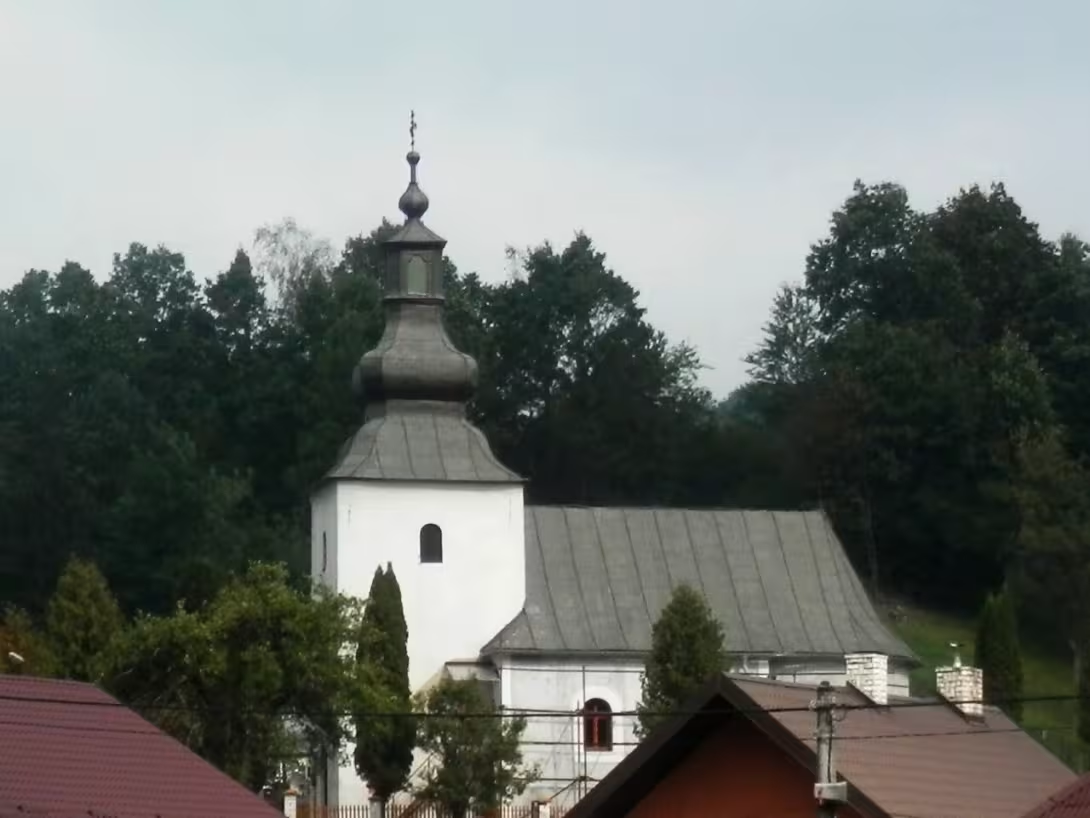
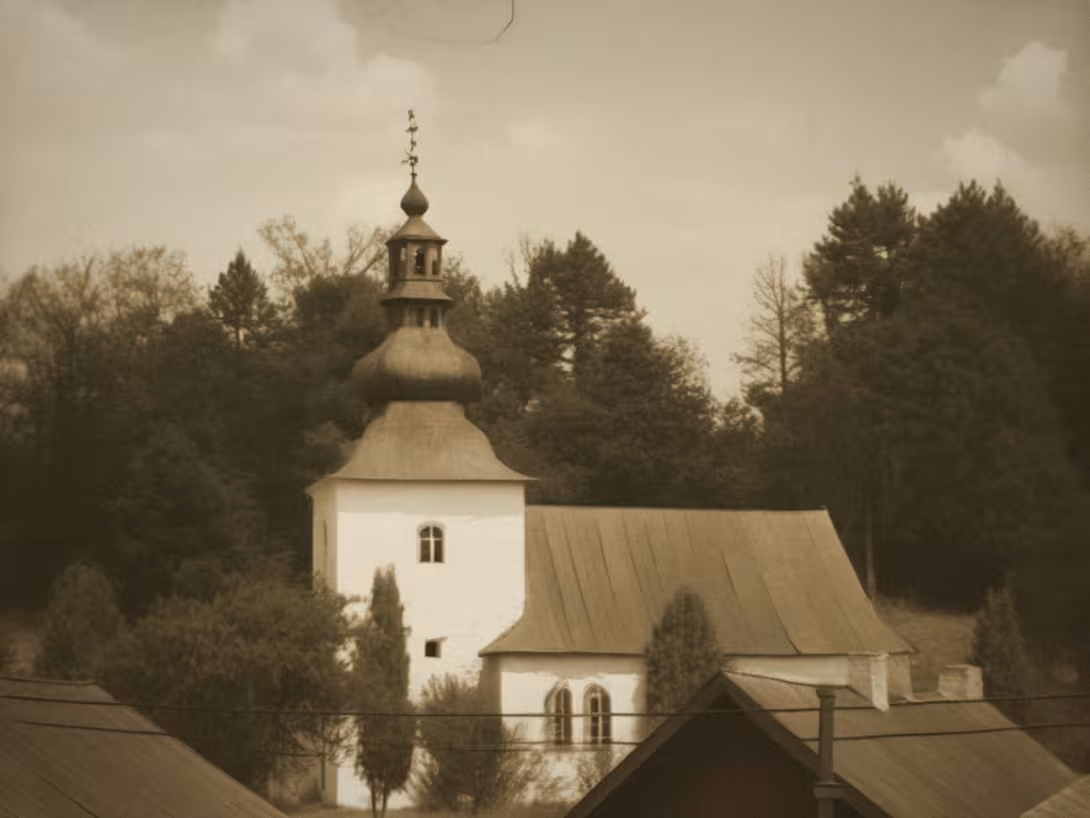
The historical view on the left is a visualisation generated by artificial intelligence and serves as inspiration.
Historical Milestones
- 1783
- construction of the church, which followed the older building
- 1788
- beginning of the Greek Catholic parish administrator John Hliviak
- 1923
- casting of two new bells
Restoration history
| Years | Type | Extent | Condition after restoration |
|---|---|---|---|
| 2018–2019 |
Obnova
chrám sv.Paraskevy |
Časť obnovená komplexne | dobrý |
Source: Monuments Board of the Slovak Republic — open data, licence CC BY 4.0
Interesting facts
- The Greek Catholic church from the second half of the 18th century is built in Baroque-Classicist style. - The building from 1783 was built on the site of an older building. - The church has a three-space layout with a presbytér in the form of a large semi-circular apsada and a tower with a baroque onion roof. The bell from the second half of the 17th century that Matej Ulrich spilled away was the first world war when the other bells were melted into weapons. - Smaller of the two bells cast in 1923 were donated by believers who emigrated from Krusov and its surroundings to America.
Guide
Show guide text
The text was prepared by artificial intelligence and has not been editorially reviewed. It may contain inaccuracies.
Welcome to the village Krukov, in the heart of Prešov region. Right now, you are standing before the temple of St. Paraskeva, which dominates the surroundings and reminds its presence of the deep spiritual tradition of the region. When you look at the construction, the first thing likely to interest you is its harmonious silhouette, which combines peace and moderation. It is a place where time has slowed down and where every detail tells a story about the faith and endurance of local inhabitants.
Let's now dive into the history of this place. Although the building you see in front of you is coherent, its story began before official dating. The present church was built in 1783, but unknown builders did not build it in the green field. This building followed up on an older building that had stood there before. This means that this place was sanctified and used for prayer long before the foundation stones of the present temple were laid. The second half of the eighteenth century was the time when the Greek Catholic identity was strengthened in this area, and it was in this spirit that this temple was created.
If we look at the architecture, note that the church is built in Baroque-Classicist style. It is an interesting combination where baroque dynamics meet classicistic purity and rationality. Now look at the overall composition of the building. The temple has a three-space disposition, which is typical for many sacral buildings from this time. In the background you can see the presbytery, which is formed as a large semicircular apsida. This round shape is not only an aesthetic detail but symbolizes infinity and divine perfection.
Nyni pay attention to the tower. Look up and watch her finish. The tower is crowned with a Baroque onion roof, which is a characteristic element for the Greek Catholic temples in our basins. It is this onion that gives the building its typical character and allows it to be seen by far, thus serving as a beacon for all believers coming to the village. The overall composition of the building shows that although we do not know the names of the specific architects who designed the project, they had a deep knowledge of the trends at that time and were able to create a structure that fits perfectly into the country.
When we talk about the people who were immersed in this place, the period of the end of the eighteenth century cannot be missed. In 1788, the administrator of the Greek Catholic parish Ján Hlivjak began to operate here. Imagine the period in which he came to Krukov. It was a time of change and community building. The parish overseer was not only a spiritual leader but also often a steward of social life in the village. It was thanks to such personalities that the church became the center of spiritual and social life, where generations of inhabitants met, celebrated holidays, and sought comfort in difficult times.
Take an interest now for a moment in something you may not see at first sight, but what is an integral part of the identity of this temple. They're bells. Bells in Christian temples are not merely church - calling instruments, they are community voices. In the history of this temple, 1923 is an important milestone when two new bells were cast. Imagine that moment in the intermilitary era when they first called over the village of Krukov. The new bells meant a new beginning and the restoration of the hot tub. Their sound complemented the atmosphere of this Baroque-Classicist space and complemented its spiritual dimension.
It is fascinating to think about how many changes this church has experienced since 1783. He survived the upheaval of regimes, wars, and social transformations, but he still stands here as a witness to the past. But the names of the people who designed it remain a mystery. Who were those anonymous masters who created this harmonious construction in the horse's potential of their time? Who designed the exact curve of an onionous roof or the dimension of a semi-circular apsid? Although their names are not written in chronicles, their work speaks for them.
Now that you've looked at the exterior and learned about the history of St. Paraskeva's temple, we suggest you take a moment quietly to perceive the atmosphere of this place. Look again at the details of the facade, you perceive the rhythm of the windows and the majesty of the tower. This church is not only a set of stone walls and wood, but a lively monument of Greek Catholic tradition in the Prešov region.
Thank you for taking this short tour with us. You can now calmly continue to explore the surroundings of the village of Krakov and look for further traces of history that hide the region. We wish you a pleasant day and a peaceful experience of your visit.
Tips for visitors
The church of St. Paraskeva in the village Krukov in Prešov region is a sacral building that we recommend to visit during the spring and summer months. For a walk, wrap up drinking water, comfortable shoes and a camera. To photograph an object is the most suitable morning light, which illuminates the front of the temple and creates shadows on the facade. There are no other attractions in the area, so you can focus on getting to know the village of Krakov and its surroundings.
Frequently asked questions
Can the monument be visited?
Religious buildings are usually open mainly during services; at other times a visit is normally arranged with the parish or the operator. We have not verified specific times.
Where is the monument?
Location: č. 77, Kručov, Prešovský kraj. The map on this page shows the exact spot.
Why is the monument protected?
It is listed in the Central List of the Monuments Fund of the Slovak Republic as a national cultural monument (ÚZPF no. 41B-10389).
For children
Close your eyes and imagine pressing a secret button on a time machine. Boom! You fly deep into the past, exactly 243 years back. It's 1783 and you're landing in the village of Krukov. The surroundings look completely different than today. No cars, no phones, just quietly interrupted by horse mowing and tree noise.
Nearby
🏰 Historic sites (32)
- Partizánskej jednotke Čapajev 6.2 km
- Adam Hlovík 6.4 km
- 100. výročie vzniku ČSR 6.4 km
- Kaštieľ Giraltovce 6.7 km Dukelská 49/53
- Bánoovský kaštieľ 6.7 km Kukorelliho 335/17 web
- Miesto Tokajickej tragédie 6.7 km
- Dr. Jozef Goldberger 6.7 km
- Obete 6.7 km
- Tokajícka tragédia 7.1 km
- Múzeum Tokajíckej tragédie 7.2 km
- Kúria Kračúnovce 9.2 km web
- Kaštieľ Kalnište 9.5 km web
- kpt. Adolf Weinhold 10.2 km
- Stropkovský hrad 10.3 km Zámocká 519/3
- Kaštieľ rodiny Banó 11.2 km
- Kúria 12.2 km
- Medziansky hrádok 12.2 km
- Ivan Baľuta 12.4 km
- Ľudovít Kukorelli 12.4 km
- padlým v SNP 12.4 km
🍽️ Restaurants and dining (59)
- Majestic Burger 6.3 km +421 917 733 111 web
- Panoráma 6.3 km +421905444658
- Zara caffe 6.3 km
- Hostinec Miki 6.4 km
- Bistro Bus 6.4 km
- Tony kebab 6.4 km
- Pizza Tony 6.4 km
- Pizza Jobi 6.5 km
- Vrtuľa 6.5 km
- Simeon 6.5 km +421 907 070 204 web
- Tribal 6.6 km
- Pivareň u Dáši 6.6 km
- Motorest Breznica 6.6 km +421 944 706 639
- MiniBar 6.6 km
- Oáza 6.7 km
- Rumpeľ 6.9 km web
- Skalný orol 7.1 km web
- Zara Caffe 7.5 km
- Dreveňák 7.9 km
- Bistro na pláži 8.2 km
🏨 Accommodation (18)
- Hotel Alfa 6.4 km Dukelská 70/71
- Jodo 6.6 km
- Hotel Šport 6.8 km
- Valkov 6.8 km
- Tatra 6.8 km
- Autokemp Domaša Tíšava 7.9 km +421 911 299 843 web
- Horal 8.2 km
- Jami 8.5 km
- Chata Kopany Skrabské 9.2 km
- Autocamping Krym 10.2 km Nová Kelč 72 +421 0905 359 413
- Poľovníček 10.8 km
- Sofia 11.7 km
- Garden Hotel Domaša 11.8 km +421 908 854 807 web
- SOFIA Yacht Club 11.9 km +421 907 242 745 web
- Hotel Zátoka 12.4 km +421 908 808 654 web
- Zelená Lagúna 13.6 km Vranovská cesta 900/2
- Monica Camp&Glamp 14.0 km +421 915 927 497 web
- Penzión Monika 14.2 km Domaša Monika - Poľany 523 web
🚲 Rentals and sport (2)
- Kúpalisko Stropkov 10.3 km web
- Krytá plaváreň 10.5 km
🥾 Hiking and nature (112)
- Mláčky 1.7 km
- Vrch 2.1 km
- Vysoký vrch 2.2 km
- Muchova hora 3.1 km
- Na kverk 3.9 km
- Sobošská 4.2 km
- Hora 4.2 km
- Lysá hora 4.5 km
- Prameň v lese 4.6 km
- Turenka 4.8 km
- Grúnik 4.8 km
- Baranov 4.9 km
- Drevené kreslo 5.0 km
- Čierťaž 5.0 km
- Stavenec 5.0 km
- Hrabovská hora 5.3 km
- Chrasť 5.3 km
- Jabloňovec 6.0 km
- Kamenná 6.1 km
- Dubina 6.1 km
Thematic route
I propose a thematic trip focused on historical and spiritual monuments in the village of Krukov and its surroundings.
1. St. Paraskeva Temple - Type: Sacral monument / Wooden church - Description: Greek Catholic wooden church from the 18th century in the village Krukov. This national cultural monument will attract traditional architecture and historical interiors.
2. Area and surroundings of the church in the village Krukov - Type: Monument zone / Exterior - Description: The surroundings of the building in the village Krukov allows for a tour of the exterior, details of wood and surrounding greenery.
Seasonal recommendations
The surrounding greenery comes to life in spring, creating a contrast to the wooden architecture of the St. Morning light highlights the details of the building. As the surrounding soil is wet, strong and waterproof footwear is recommended. Mornings and evenings are cool, so it is appropriate to layered clothing and windshield. It is best to visit and photograph in the morning.
Summer brings thick leaves that create a shadow around the area. Sun rays penetrate the treetops create shadows on the wooden walls. During warm days we recommend light clothing, head cover and a sufficient supply of drinking water, as there are no refreshments available nearby. The time to arrive is early in the morning or late in the afternoon.
Autumn changes the colors of the landscape from yellow to red. Early mist in the valleys often surrounds the sacral structure. Warmer clothes, long trousers, and waterproof shoes are essential during dry days, as fallen leaves on wet soil may be slippery. The ideal time to visit is around noon when the light is more stable and the fog retreats.
Winter brings a snow blanket that surrounds a wooden temple. The low sun creates short shadows and snow - covered roofs reflect cold light. During this period, it is crucial to wear winter shoes with non-slip soles, a warm cap, gloves and layered warm clothing. The best time to visit is around noon when daylight is strongest and the temperature is the highest.
Visualisations and artistic views


The visualisations are generated by artificial intelligence and serve as inspiration.
Photographs from the area
Real photos taken near the monument

Source and licence are given for each image.
Visitor Tips
No tips yet. Be the first!
Log in and add your tip.
Location on Map

Visitor photos
No photos yet. Be the first to add a photo from your visit!
Log in and add your photo or leave a rating.
You get more points for a visit verified in the app — we can tell from the GPS that you are there.
Reviews and comments