

st. Trinity's filial church Church
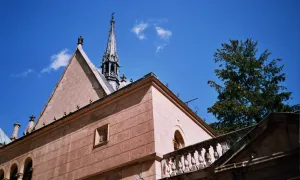
The purple church of St. Trinity in the village Divečka Nová Ves in Trenčín region is a renaissance church from the end of the 16th century. Originally he served as a Protestant church and preserved Baroque equipment.
The building was built in 1578. This is confirmed by a date carved in stone under the coat of arms of the genus Ujfalussy above the entrance to the sacristy. The object was originally without a tower. In 1695 it was renovated, in 1822 it was repaired and covered with shingle roof, and in 1937 it was adjusted facade.
Architecturally it is a building with smooth facades. The main area is encircled by rolling vaults with lunettes. Originally formed a hall space with side Protestant empors on the pillar arcades. The West Empora is based on a pillar arcade and the parapet on the floor is divided by a brick arcade. The presbytery has a polygonal cap and a lunet vault. It is joined by two constructions of sacristy with a walled vault. The stylish prism tower with a pyramid was built around 1760 by Count Charles Ujfalussy. The letters CC+UJ (comes Carolus Ujfalussy) on the cross of the tower bear witness. Under the church there is a crypt of the Rudnay family.
The interior contains several altars. The main altar of St. Trinity from the first half of the 18th century is ambited with pillar architecture, polychrome carving and painting. On the door are statues of St. Stephen and Ladislav, in the middle of the picture of the Assumption of the Virgin Mary, on the sides of the statue of St. Peter and Paul. In the extension is the picture of the floating Virgin Mary with the figures of St. Elizabeth and Helena and the group of St. Trinity on top. Side altars are baroque. The altar of St John the Nepomuk from the first half of the 18th century contains statues of St John the Baptist and saint. The altar of St. Anna from the late 17th century depicts Saint Anna with Virgin Mary and Jesus. The third side altar of the Immaculate Conception of the Virgin Mary comes from the last quarter of the 17th century. There is also a fragment of the Renaissance Protestant altar from around 1580.
The Baroque pulpit from the late 17th century had a statue of four evangelizers on the parapet, an image of Ecce homo on the back, and a statue of the Resurrection in the canopy. In the mid - 1990 ' s, a new altar was made from it. In the second half of the 1960s were professionally renovated main and side altars, pulpit and replaced baroque benches from the 17th century.
There are three bells in the tower. The largest of the year 1994 is dedicated to the Trinity with the inscription "SWITH TRIC," ONE GOD, MIX A NAMI" The second bell from 1912 is dedicated to the Virgin Mary and lial him König Frigyes in Arad. The third little bell is without a sign. The original bells of 1586 (St. Trinity) and later (St. Fabian and Šebastian) were not preserved.
The area is registered by the Monument Office of the Slovak Republic under number ÚZPF 825. The church combines Renaissance architecture with later Baroque modifications.
Tehdy a dnes
Drag the slider and compare how the monument might have looked when it was built with the view today.
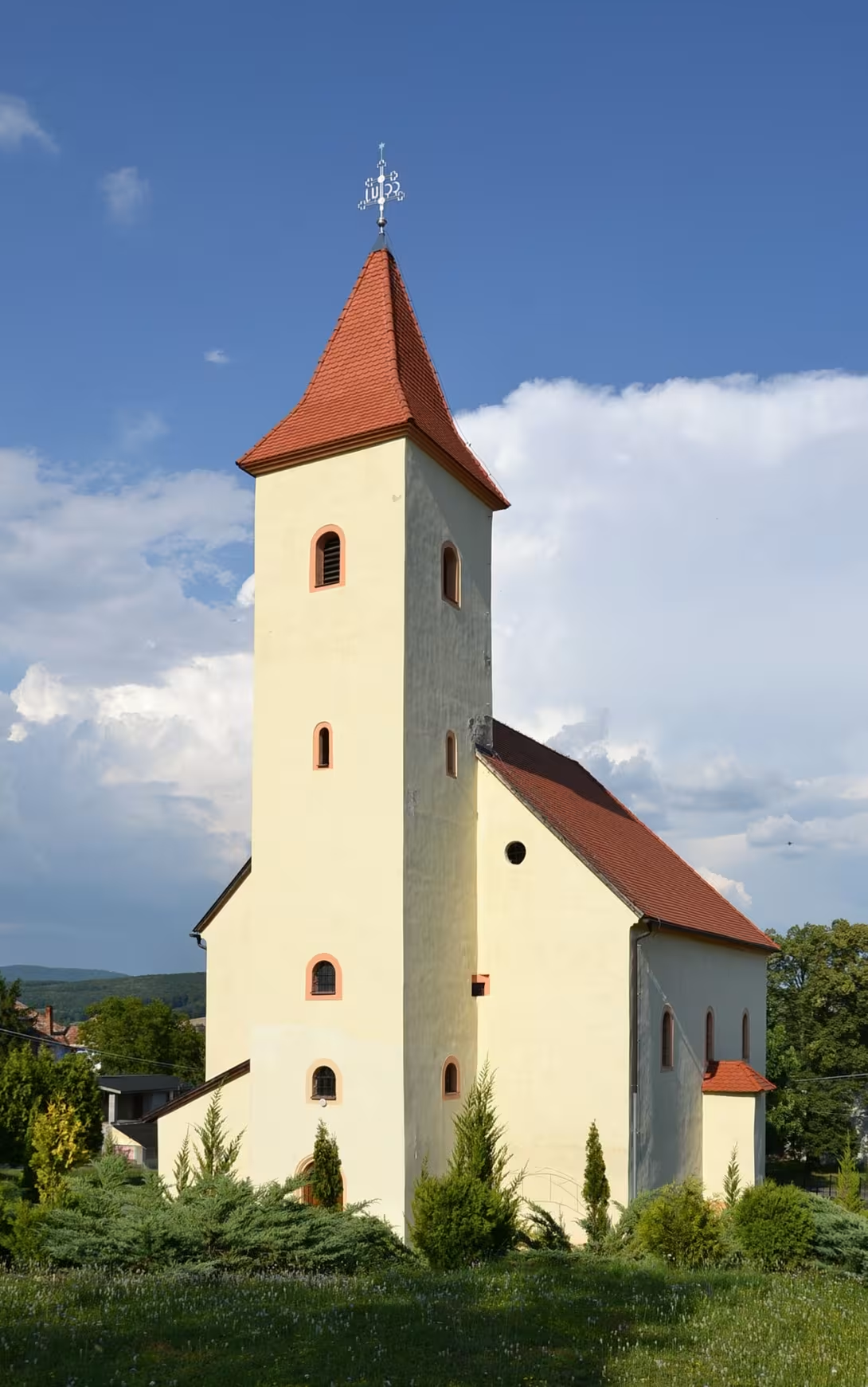
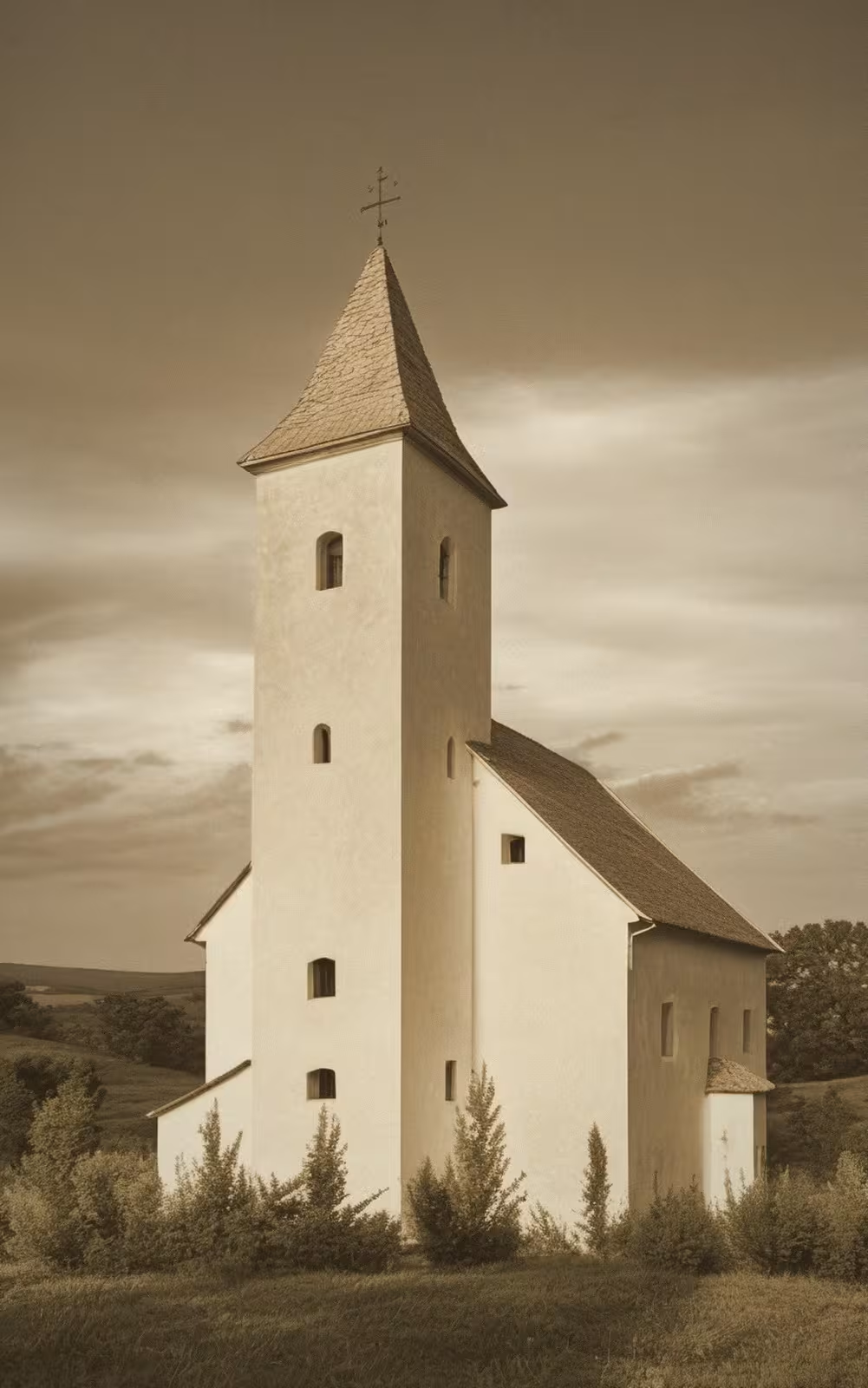
The historical view on the left is a visualisation generated by artificial intelligence and serves as inspiration.
Historical Milestones
- 1578
- building a church
- 1695
- renovation of the church
- 1760
- construction of tower by Count Charles Ujfalussym
- 1822
- roof renovation and shingle cover
- 1937
- facade adjustment
Interesting facts
- The church was originally built in 1578 as a Protestant temple and served as a hallway with side-emporators on the pillar arcades. - The stylish prism tower with a pyramid was built around 1760 by Count Charles Ujfalussy, which confirms the letters CC+UJ on the cross tower. - Under the church there is a crypt of the Rudnay family. - A fragment of the Renaissance Protestant altar from around 1580 was preserved in the interior. - The Baroque pulpit from the late 17th century, which had statues of evangelizers and the image of Ecca homo, was adapted to a new altar in the 1990s.
Guide
Show guide text
The text was prepared by artificial intelligence and has not been editorially reviewed. It may contain inaccuracies.
Welcome to Divečka Nová Ves, in the heart of Trenčín region, where the treasure of local history and spirituality lies before you. You stand in front of St. Trinity's filial church. The first look is likely to impress you with its peaceful atmosphere and the way it naturally fits into the surroundings. It is a place that bears the traces of several centuries and testifies to the change in religion, social help and the efforts of local residents to keep their memory in good condition. Look at the overall silhouette of the building and see the silence that surrounds this space.
Now let's rush deeper into the past to understand how this temple was created. The foundations of this place date back to 1578. At this time, the church was not what you see today. It was originally built as a Protestant temple. During the sixteenth century, there was strong conviction in these areas about the need for their own spiritual centers, which is why this space was created to serve the community of believers. It is fascinating to think that for almost five hundred years at this point, Divianka Nová Vesi has sounded the prayers and silent conversations of the people who lived here before us.
Now, when you look closer to architecture, take note of the details that result from the long process of replenishment and renovation. Originally the church was conceived as a hall space. This means that its inner disposition was simple and functional. A particularly interesting element was the side forces, also called galleries, which were built on pillar arcades. These elevated spaces served to accommodate more people in the temple and at the same time to separate different groups of believers, which was quite common in that period of architecture.
Nyni pay attention to one of the most prominent parts of the building you see in front of you. It's a lean prism tower with a pyramid. If you look at it, you may notice that it looks different from the very core of the church. And it's true because the tower doesn't belong to the original year 1578. It was landed much later, about 1760. Count Karol Ujfalussy was responsible for this expansion. Count Ujfalussy was not just a donor, but a man who wanted to leave a mark in the country. The evidence of his intervention is a detail you could try to locate on the cross tower. If you look carefully, there are CC+UJ letters. They are initials that confirm the identity of the founder of this particular part of the building. It is a small, almost secret detail, but it links the present with a particular personality from the eighth century.
The history of this church is not only a story about construction, but also about constant care. The building went through several key stages of renovation that helped it survive until today. The first major renovation was arranged in 1695 when the first material wear was likely to be addressed. Then came the time of Count Ujfalussy, which we talked about. Another important stage took place in 1822. They then concentrated on a roof that was completely renovated and covered with shingles. Shindel is a traditional material that gave the construction a rustic and natural look typical of our Slovak villages. The last of the large surface interventions mentioned in the records was the modification of the facade in 1937. It was then that the church was given its visual form, which you still see today.
Now take an interest in something that is not immediately visible at first sight, but what gives this place a certain mysterious touch. There are spaces below the church itself, which are not part of the usual visitor route, but are a quiet part of its fundamentals. It is these hidden parts below the building that remind us that every historical object has its secrets that are not on the surface but buried deep in the ground. It is a reminder that history is not only what we see above our heads but also what keeps us in terms of foundations.
Now that you take a look at the entire structure, from the basics to the tip of the pyramid tower, you will see the result of the work of many generations. From unknown builders from 1578 to noble families like Ujfalussy to craftsmen who in 1822 put shingles on the roof. This church is not only a building made of stone and wood, but it is a living chronicle of Diviacká Nová Vese. It shows how times changed, how people changed priorities, but how the need for beauty and spiritual refuge remained constant.
We are slowly saying goodbye to this beautiful object. Now we recommend you spend a few minutes quietly, bypassing the church around and looking again at the details we talked about. Notice the game of light on the facade and imagine how people walked here centuries ago in period clothing. We also invite you to continue exploring the beauties of the Trencin region and to look for other traces of the past that secretly hide similar stories. Thank you for your attention and we wish you a pleasant day full of new experiences and discoveries.
Tips for visitors
We recommend a visit in spring and summer, when the surroundings of the church are in flower and the building is well lit by natural light. Early morning hours or before eclipse are appropriate.
Since it is a sacral building, we recommend appropriate and respectful clothing.
For photographers are interesting exteriors and details facade. The texture of the walls of the philial church of St. Trinity best captures the light during the golden hour.
Families with children can connect the visit with a walk around the village. There are no other attractions in the immediate vicinity, so we recommend focusing on the architecture of the church.
Frequently asked questions
Can the monument be visited?
Religious buildings are usually open mainly during services; at other times a visit is normally arranged with the parish or the operator. We have not verified specific times.
Where is the monument?
Location: č. 93, Diviacka Nová Ves, Trenčiansky kraj. The map on this page shows the exact spot.
Why is the monument protected?
It is listed in the Central List of the Monuments Fund of the Slovak Republic as a national cultural monument (ÚZPF no. 227-825).
For children
Close your eyes and imagine holding an invisible time controller in your hand. You press one red button and boom! You shoot back in exactly 448 years. The surroundings are blurry and suddenly you're standing in Divica Nova Ves.
Forget cars, asphalt roads and mobile phones. The stakes of you are just dusty roads, you can hear the roaring of horses and smell the smoke of fireplaces. People around you wear strange clothes that look like a historical movie. It was at this time, in 1578, that the philial church of the Holy Trinity was established.
Nearby
🏰 Historic sites (118)
- Obecné múzeum 1.9 km
- sv. Ján Nepomucký 2.2 km
- JANKO ŠTORCEL 1951-1999 3.5 km
- Ernest Otto 4.9 km
- Kúria 5.0 km Námestie SNP 174/23
- Obetiam pracovného tábora 5.8 km
- sv. Vendelín 5.8 km
- SNP 1944-1945 6.2 km
- Ivankina alej 6.8 km
- Pamätník obetiam 2. svetovej vojny 7.0 km
- Kúria Kosztolányiovcov 7.2 km web
- Kišasonkin kaštieľ 7.2 km Ľ. Štúra 67/8 web
- Uhrovec 7.2 km web
- Karolkin kaštieľ 7.2 km Ľ. Štúra 62/2 web
- Obetiam Slovenského národného povstania 7.4 km
- Bojnický zámok 7.4 km Zámok a okolie 1/1 web
- Obetiam 1. svetovej vojny 7.4 km
- Základný kameň stavby 7.5 km
- Magna Via 7.5 km
- Immaculata 7.5 km
🍽️ Restaurants and dining (306)
- Bar Júlia 0.1 km +421907351553
- 3Vio pizza & pasta 0.6 km web
- Pohostinstvo DEWEK 2.0 km
- Federál 2.1 km
- Boršina 2.2 km
- Denný bar Krištáľ 2.4 km
- Krčma Máčov 2.8 km
- Reštaurácia Majer 3.0 km +421907973501 web
- Reštaurácia Labuť 4.4 km
- Hostinec u Čižnára 4.8 km
- Koliba Solec 4.9 km +421 905 342 707 web
- Hrádok Nováky 4.9 km +421911552295
- Obedy od Josipa 5.0 km +421 915 420 032 web
- U Kvitáka 5.1 km
- Koliba Drago 5.1 km Šimonovská 546/1 web
- Doner Kebab 5.1 km
- Alfa klub 5.1 km
- U Sonyho 5.2 km
- Hostinec KNV 5.3 km
- výčap u Kohúta 5.5 km
🏨 Accommodation (109)
- Dolina 3.0 km
- Ubytovňa BYDOS 5.2 km +421918148007 web
- Treehouse IV. 5.9 km web
- Treehouse VI. 6.0 km web
- Treehouse VII. 6.0 km web
- Aqua Vital Relax centrum 6.0 km +421 914 341 336 web
- Chata Hlboké 6.0 km +421 907 805 484 web
- Penzión Normandia 6.1 km Kolotoč 29/5
- Camping Nitrianske Rudno 6.3 km +421 948 108 280 web
- penzión Nadka 6.3 km
- Ubytovanie Mikula 6.4 km +421 902 300 405
- Hotel Hlboké 6.4 km
- Lili 6.4 km +421904535635 web
- Hrabovka Bojnice 6.4 km
- Petro 6.4 km +421 915 890 590
- Kanadský zrub 6.6 km web
- Liečebný dom Martin 6.6 km Kúpele 1945/22
- Liečebný dom Gabriela 6.6 km Kúpele 984/12
- Termal 6.7 km web
- Liečebný dom Tribeč 6.7 km Kúpele 1639/20
🚲 Rentals and sport (25)
- Delfin 5.4 km
- Národné Centrum vodného póla Nováky 5.4 km web
- Jánov kúpeľ 6.8 km
- Mestská krytá plaváreň 8.6 km +421465438267 web
- Country-crossový areál Hôrka 8.8 km
- CAMP 8.8 km +421 908 774 221 web
- Niké Aréna 9.0 km Olympionikov 462/2
- Intersport 9.4 km +421 903 409 376 web
- Board Paradise 9.4 km web
- Sportisimo 9.4 km web
- Sport Vision 9.5 km web
- Velosvet 9.8 km M. Mišíka 730/23 +421 46 542 70 73 web
- PND Hobby 10.1 km +421465423359 web
- Horal 10.3 km +421 907 282 382 web
- Ski cyklo šport 10.4 km Necpalská cesta 498/6 +421903808544
- Sportsnow 10.4 km +421 905 930 888
- Šport BVH 10.4 km
- Baby plávanie 10.6 km +421917504218
- Barrack - Bowling & Laser Game 10.6 km web
- Bikeroom 10.7 km +421948184765 web
🥾 Hiking and nature (194)
- Trstenec 1.1 km
- Smolová hora 1.3 km
- Končitý vŕšok 1.6 km
- V Háji 1.9 km
- Krížová cesta Nitrianske Sučany 2.5 km
- Dolný les 2.5 km
- Skalný previs 2.5 km
- Noviny 3.3 km
- Jankova skala 3.4 km
- Sučianska studnička 3.5 km
- Brložná diera 3.6 km
- Plevňa 3.8 km
- Malý Rokoš 3.9 km
- Jaskyňa Váhanka 3.9 km
- Zadné diely 4.0 km
- Kováčov vrch 4.2 km
- Predný Rokoš 4.3 km
- Havrania skala 4.4 km
- Kostolná hora 4.4 km
- Koláč 4.6 km
Thematic route
As there are no other objects in the area of the area, I propose a thematic route aimed at exploring the monument and its area:
1. St. Trinity - The main destination of the visit to the village Divečka Nová Ves.
2. Interior of the church - Tour of interior space, altar and equipment.
3. Church area - Walk around the building and tour exterior elements.
Seasonal recommendations
In spring, the surroundings of the philatelic church of St. Trinity in Divica Nová Ves will be covered in green. The sun during this period provides fine lighting suitable for photographing the exterior of the building. It is recommended to wear shoes into wet grass and visit in the morning.
Summer season brings strong sunlight, which highlights the details of the facade. Due to high temperatures it is advisable to choose the early morning or late evening time. Practically easy, breathable clothing and sun protection.
Autumn in Trenčín region brings a change in the colors of the leaves. Lighting is golden and soft during this period, creating contrast with architecture. Due to the colder mornings and evenings is appropriate layered clothing and tight shoes.
Zimą acts sacral building in Divica Nova Ves moderate, especially if it surrounds the snow. The atmosphere is quiet, typical for Advent. Due to the low temperature and frost, warm clothing and footwear with anti-polysed soles are essential.
Visualisations and artistic views


The visualisations are generated by artificial intelligence and serve as inspiration.
Visitor Tips
No tips yet. Be the first!
Log in and add your tip.
Location on Map
More monuments – Diviacka Nová Ves
Show all in the town


Visitor photos
No photos yet. Be the first to add a photo from your visit!
Log in and add your photo or leave a rating.
You get more points for a visit verified in the app — we can tell from the GPS that you are there.
Reviews and comments