

temple of the Nativity of the Holy Mother of God Church
The Greek Catholic Temple of the Nativity of the Holy Mother of God in the village of Oľšinkov in Prešov region is a baroque-classicist church from 1776. The building together with the church cemetery is entered in the Central List of Monument Fund of SR under the number 140/1.
In 1891 the building underwent reconstruction, where the interior elements were modified and added iconostasis.
It is a brick single-ship building with a flat cap Presbytery, which covers cross vaults. The facade is divided by lysenes and contains semi-ringed windows. On the western facade there is a tower. Its roof is mounted on the rooftop ledge and is covered with a baroque metal mine, which was originally shingle.
In the interior there is a canopy main altar from the second half of the 18th century, adapted in 1891. Iconostas comes from the period of construction of the church and was partially completed in 1891.
The church stands in the southeastern part of the village, next to it and behind it lies the cemetery. The current state of the building is good, the temple serves its purpose and is subject to reconstruction.
Tehdy a dnes
Drag the slider and compare how the monument might have looked when it was built with the view today.
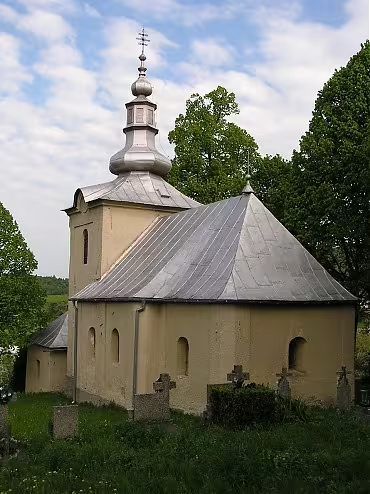
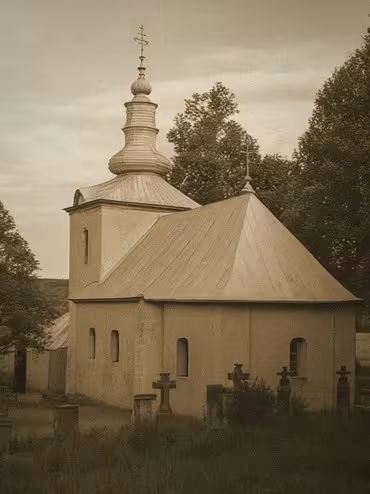
The historical view on the left is a visualisation generated by artificial intelligence and serves as inspiration.
Historical Milestones
- 1776
- Building the Greek Catholic Temple of the Nativity of the Holy Mother of God
- 1776
- The origin of the iconostasis from the period of temple construction
- 1775
- The creation of a canopy-new main altar (second half of the 18th century)
- 1891
- Reconstruction of construction, interior modification and addition of iconostasis
Interesting facts
- It is a Baroque-Classicist Greek Catholic church from 1776. - The building is brick and single-boat with a flat cap Presbytery, which covers cross vaults. - The baroque-shaped tin mine on the tower was originally shingle. - In the interior there is a canopy main altar from the second half of the 18th century. - Iconostas comes from the period of construction of the church and in 1891 it was partially completed.
Guide
Show guide text
The text was prepared by artificial intelligence and has not been editorially reviewed. It may contain inaccuracies.
Welcome to the village of Oľšinkov. Right now, you are facing one of the local spiritual and historical dominants, which is the temple of the Nativity of the Holy Mother of God. Together with the church cemetery, this place forms a peaceful area, which has been witnessing the faith and traditions of local inhabitants for almost three centuries. Now, when you look at the building in front of you, you will see the design of architecture that connects two major artistic currents. It is a baroque-classicist Greek Catholic temple, which by its appearance creates a feeling of stability and humility.
Let's now look at when and how this temple originated. History of this construction takes us back to 1776. It was this year that the Temple of the Nativity of the Holy Mother of God was built to serve the Greek Catholic community. It was a time when religious structures were strengthened in this part of the country and buildings were created, which would be not only the place of prayer, but also the centre of the community's social life. Although the names of the specific architects who designed the project remained unknown in time, their work has survived for centuries and still defines the character of this place.
If you now focus on the architecture itself and the details you see, note that it is a brick building. It's a one-shiped temple, which means the space is organized into one main axis. If you look at the back of the building, you will see a presbytery with a flat cap. Inside this section there are cross vaults that give the space the necessary strength and aesthetic value.
Let us now pay attention to the tower. Look up to finish it. Today you see a metal mine with a typical baroque shape. However, it is a detail that has undergone a change. Originally, the mine was not covered with sheet metal, but with shingles, which was more common at the time and corresponded to available material from the surrounding environment. This detail reminds us of how buildings change over time to better maintain and adapt to new materials.
When we move to an interior that you can still perceive now, we find that the temple hides real artistic treasures. One of the most important elements is the canopy's main altar. This was established in the second half of the 18th century, namely in 1775, which means that his work was overtaken by the completion of the temple wall itself by one year. The Baldakhyn altar is characterized by its superstructure, which resembles the royal dashik, thus highlighting the sanctity of the place.
Another key element you should focus on inside is the iconostasis. Iconostas is an integral part of the Greek Catholic tradition, as it separates the room for believers from the holy area of the altar. The first iconostasis was created in 1776 at the same time as the construction of the temple. However, time and use required maintenance. In 1891 the church underwent a comprehensive renovation. During this period, not only the interior and the overall building was modified, but also the iconostasis was added to meet the then aesthetic and liturgical requirements.
Although historical records do not show the names of particular personalities associated with this temple with personal stories, the temple itself is the story of the whole community of Oľsinkov. Every stone and icon at the iconostasis represents generations of people who came here to seek comfort, celebrate the birth of children, or say goodbye to the closest ones in the church cemetery.
It is this continuity between architecture and artistic equipment that is not visible at first sight. It is fascinating that the altar of 1775 and the iconostasis of 1776 form the basic spiritual core of the temple, which was later sensitively supplemented in the 19th century. This process of layering history makes the building a living organism that evolved along with the people who surrounded it.
Now that you have gone through the main historical and architectural points, I recommend you to dedicate a moment's silence. Walk around the temple, see the atmosphere of this place, and think about how many changes have gone through the world since 1776, while this temple remained a witness to the past.
We invite you to further explore the area and visit other sights in the area. We hope that this short trip to history has helped you to better understand the value of the Temple of the Nativity of the Holy Mother of God in Oľšinkov. Thank you for your attention and we wish you a pleasant day.
Tips for visitors
The Temple of the Nativity of the Holy Mother of God in the village of Oľšinkov is recommended to visit in spring or autumn.
Pack drinking water, comfortable shoes suitable for the temple and cemetery, as well as raincoating.
Photography of the exterior of the building and the adjacent cemetery is most appropriate early in the morning or before sunset when low light highlights architectural details.
In the vicinity of the memorial is a quiet rural environment suitable for a walk associated with getting to know local history and sacral architecture.
Frequently asked questions
Can the monument be visited?
Religious buildings are usually open mainly during services; at other times a visit is normally arranged with the parish or the operator. We have not verified specific times.
Where is the monument?
Location: Oľšinkov, Prešovský kraj. The map on this page shows the exact spot.
Why is the monument protected?
It is listed in the Central List of the Monuments Fund of the Slovak Republic as a national cultural monument (ÚZPF no. 415-140).
For children
A mysterious church in the forest that whispers history
Nearly two hundred and fifty years ago, when people wore clothes made of thick canvas and the light glowed only from candles, in the small village of Olshinka, who was born? Church! But not ordinary - it was like a jewel hidden in a forest that would be home to prayer and silent secrets.
Nearby
🏰 Historic sites (35)
- Szaniec Konfederatów Barskich 4.0 km
- ruiny cerkwi w Zubeńsku 5.4 km
- SNP 6.7 km
- Pociąg salonka Edwarda Gierka 6.9 km web
- T-34 8.7 km
- Účastníci odboja 1944-1945 v Palote 8.7 km
- Osloboditeľom 10.2 km
- Pamätník osloboditeľom 10.3 km
- Pomnik kurierów AK 10.7 km
- Monastyr Zoslania Svätého Ducha 10.9 km
- Múzeum moderného umenia A. Warhola Medzilaborce 12.6 km Andy Warhola 748/36 +421 57 748 0072 web
- Andy Warhol 12.6 km
- Pamätník Českej družiny 12.6 km
- Ekomuzeum „Na Wypale” 12.7 km +48 888 982 080 web
- Plukovný kanón vzor 1943 12.8 km
- hrdinom sovietskej armády 12.8 km
- Tank T-34/85 12.8 km
- Pomník deportovaným Židom 12.9 km
- Pamätník padlým v 1. a 2. svetovej vojne 12.9 km
- Miniskanzen 13.2 km
🍽️ Restaurants and dining (12)
- Zayda 2.5 km
- Pensjonat w Łupkowie 6.8 km
- Zagroda Chryszczata 8.3 km Smolnik nad Osławą 7b +48 604 059 957 web
- Latarnia Wagabundy 9.9 km web
- Krčma u Borisa 10.3 km +421 905 899 738 web
- Občerstvenie Salero 12.0 km +421421096375
- Art hotel 12.9 km +421 57 73 21307 web
- Buena 13.0 km +421948477211 web
- Inkognito Café Bar 13.0 km +421 907 107 991
- INKOGNITO Café Bar 13.0 km +421907107991
- Admiral club 13.0 km
- Bar Dusza Jeziorek 14.0 km +48 505 167 210
🏨 Accommodation (14)
- Zayda 2.5 km +421 917 750 405 web
- Chatka pod Gwiazdami 5.3 km web
- Schronisko Agroturystyczne Radosne Szwejkowo 5.9 km +48 503 719 140 web
- Zakątek Łupkowski 6.3 km +48 607 546 971
- Agroturystyka Lemciówka 6.9 km +48693167662 web
- Kolejowy Smolnik 8.2 km +48 601 311 677 web
- Jedlinka 8.7 km
- Noclegi przy Cerkwi w Smolniku gm. Komańcza 9.5 km
- Turistická ubytovňa Borovka 10.2 km +421 944 946 810 web
- Maniówka 11.6 km +48 508 159 432 web
- Szczerbanówka na Maniowie 11.9 km +48 733 071 111 web
- Pension Andy 12.6 km
- Art hotel 12.9 km Andy Warhola 195/28 +421 57 73 21307 web
- Daria i Stefan Boiwka 15.0 km +48 13 46 77 134 web
🥾 Hiking and nature (231)
- Gušina 0.9 km
- Koszarka 2.4 km
- Koszarka 2.4 km
- Beskid 3.0 km
- Ułutyn 3.1 km
- Szcołb / Ščob 3.1 km
- Hojdov 3.4 km
- Megelov grúň 3.5 km
- Kudrovec 3.9 km
- Horb 4.2 km
- Pasika 4.3 km
- Głęboki Wierch / Hlboký vrch 4.4 km
- Dielec 4.5 km
- Parilov 4.5 km
- Ščob 4.8 km
- Hlboký vrch 4.8 km
- Czergów 4.9 km
- Kobyla 4.9 km
- Maślanka 5.0 km
- Hirka 5.1 km
Thematic route
The Temple of the Nativity of the Holy Mother of God Type: Sacral monument Why it is worth visiting: This wooden church and cemetery in the village of Oľšinkov are examples of folk architecture and spiritual heritage of Prešov region.
Seasonal recommendations
Spring In March and April, with the melting of snow and the coming of the sun, the surroundings of the Temple of the Nativity of the Holy Mother of God in Oľšinkov are being built. Blooming trees and green meadows create a quiet atmosphere. In the morning and evening, sunny paprika penetrates the trees and throws the woods into the stone walls. It is recommended to visit in the morning when the air is clean and there are fewer visitors. Clothing should be easy, but with the possibility of adding a sweater, because spring weather is unstable. You can also visit the surrounding forests, where you can observe the first spring plants and hear birds singing.
Summer In June and July, the surroundings of the Temple of the Nativity of the Holy Mother of God are turned into a green oasis. Sunny days illuminate the church and the cemetery, giving rise to stone details. Trees provide shade from the direct sun. In the main summer season, families with children visit the space around the sacral building. The most appropriate are morning or late afternoon hours when the temperature is milder. Light, breathable clothes and a hat to protect against the sun are recommended. For greater peace it is appropriate to consider a visit on weekdays.
Fall In September and October, the colors are leafed around the Nativity of the Holy Mother of God to be golden and brown. Autumn sun and fog create a peaceful atmosphere. During this period there is silence around, which allows you to observe the architecture and nature in peace. Visit is suitable in sunny days, but also in fog, when the church and cemetery are connected to the country. Clothing should be warmer, a sweater or a cape will suffice.
Winter In December and January, the surroundings of the Temple of the Nativity of the Holy Mother of God are covered with snow. Cold air and clean light contrast with the dark stone walls of the church. In Advent time, the prevailing quiet atmosphere. It is best to visit the place in sunny winter days. Clothing should be warm and insulated - jackets, gloves and caps are suitable. For maximum peace we recommend morning hours or winter evenings.
Visualisations and artistic views


The visualisations are generated by artificial intelligence and serve as inspiration.
Visitor Tips
No tips yet. Be the first!
Log in and add your tip.
Location on Map

Visitor photos
No photos yet. Be the first to add a photo from your visit!
Log in and add your photo or leave a rating.
You get more points for a visit verified in the app — we can tell from the GPS that you are there.
Reviews and comments