

temple of the Nativity of the Holy Mother of God Church
Church of the Nativity of the Holy Mother of God in the village Rafajovce in Prešov region is a Greek Catholic church with a church cemetery from the second half of the 18th century. The building shows signs of Baroque-Classicist architecture and is associated with the tradition of miraculous icon.
Contemporary stone church was built in 1750. The visiting protocol of Bishop Michal Manuel Olšavský from 1752 states that there was a wooden church from 1701 in the village. This older temple was then described as large, in good condition, and equipped with icons, a large altar, and a wooden goddess.
It is a single-boat baroque space with presbytery covered by Prussian vaults. Into the western facade is a pictured tower. Facades are smooth. The interior of the temple contains a painting and iconostasis from the restoration period in 1931.
Rafajovce parish is mentioned as a Parochian with seven branches in Schematism, 1792. Of these, only Piskorovce were purely Greek Catholic, while others were dominated by Roman Catholic religion. The first known priest who worked here was Stefan Bačinsky, who died in 1825.
An icon that lamented in 1705 is an interesting feature of the temple. Although the protocols of the bishops' then investigations are not preserved in the parish, the event is documented and became the basis for pilgrimages and forgiveness at the Feast of the Nativity of the Purified Virgin Mary. In the village there is also a tradition of a forgiving ceremony at the Festival of the Singing of the Holy Spirit, which is related to the existence of the Basilian monastery from 1695.
The building is registered in the Central List of Monument Fund of SR under the number ÚZPF 11004/1 and is subject to conservation. The church is located in the center of the village near the cemetery. The state of the building is good and the temple fully serves its purpose.
Tehdy a dnes
Drag the slider and compare how the monument might have looked when it was built with the view today.
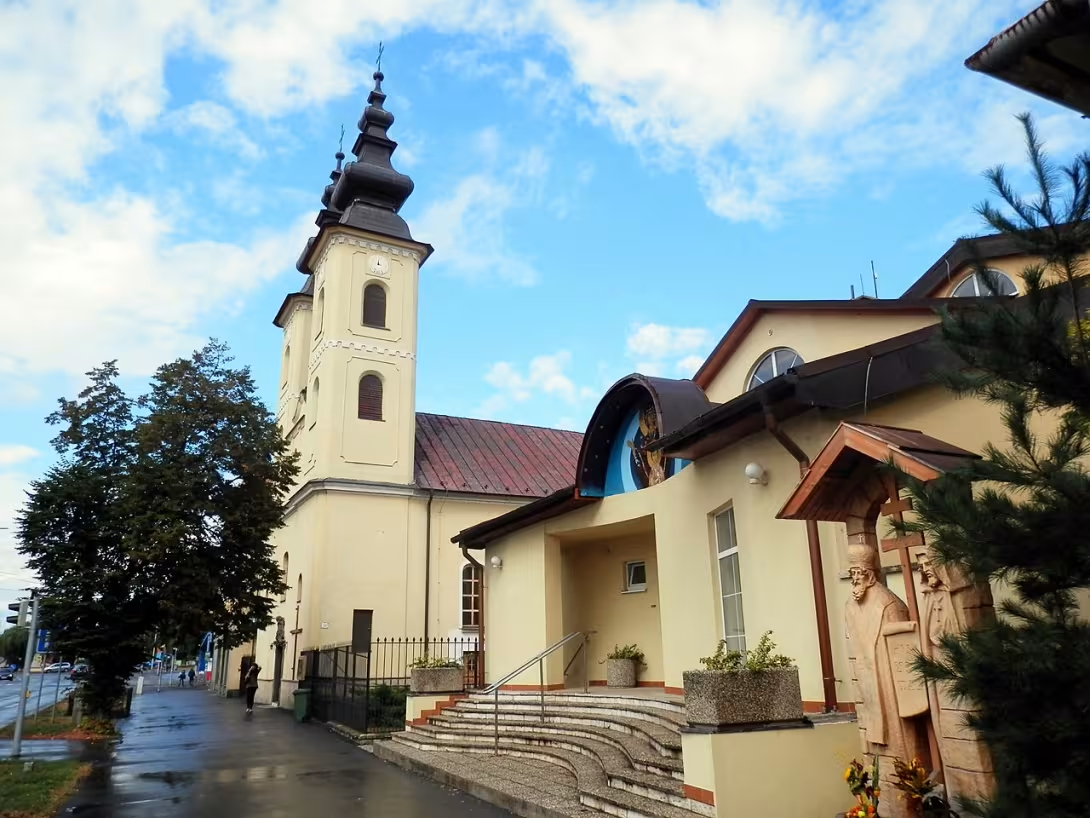
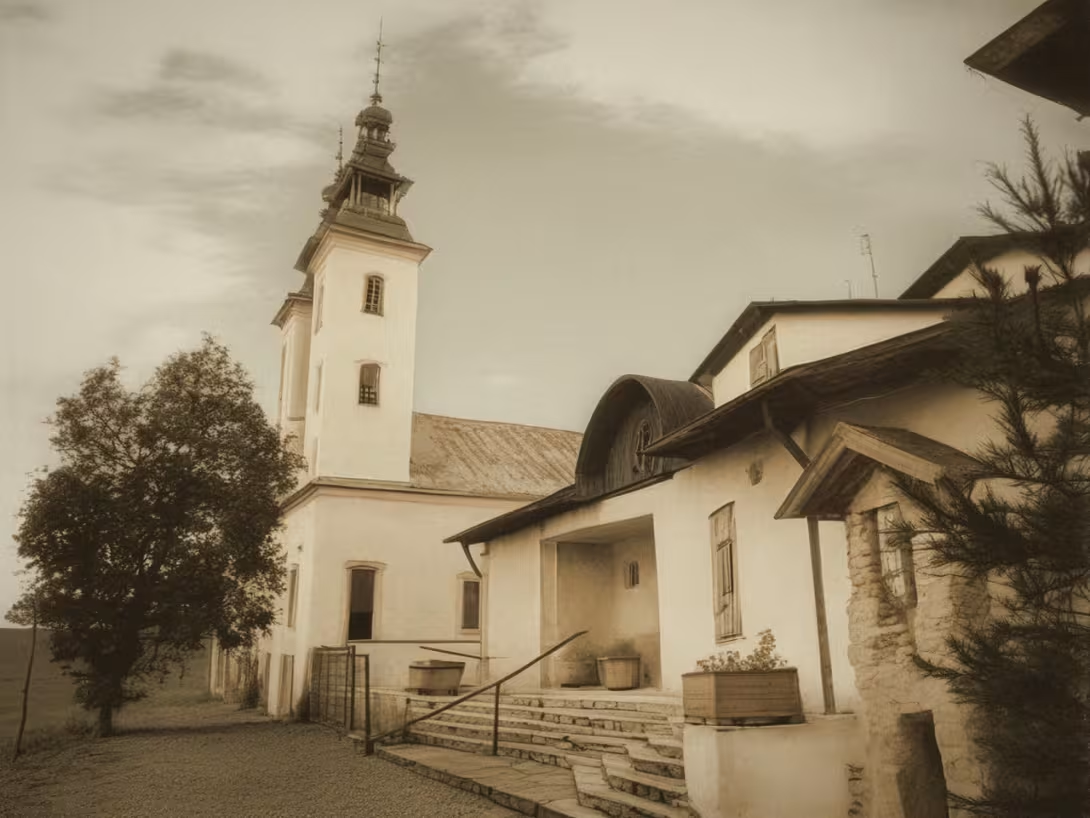
The historical view on the left is a visualisation generated by artificial intelligence and serves as inspiration.
Historical Milestones
- 1701
- the creation of the previous wooden church
- 1705
- the miracle of a tearing icon that began the tradition of pilgrimage
- 1750
- construction of the current stone temple
- 1792
- remembrance of the parish of Rafajovce in Schematism as a Parochian
- 1825
- the death of the first known priest Stephen Bačinsky
- 1931
- interior renovation, including painting and iconostasis
Interesting facts
- The temple is connected with the tradition of the miraculous icon, which in 1705 lamented. - This event became the basis for pilgrimages and forgiveness on the Festival of the Nativity of the Pure Virgin Mary. - Before the contemporary stone church from 1750 there was a wooden church from 1701. - In the village is maintained the tradition of a forgiving celebration at the Festival of the Sentification of the Holy Spirit, which is related to the existence of the Basilian monastery from 1695. - Rafajovce parish was mentioned as a Parochian with seven subsidiaries in 1792.
Guide
The guide was voiced by a synthetic voice created by artificial intelligence.
Show guide text
The text was prepared by artificial intelligence and has not been editorially reviewed. It may contain inaccuracies.
We welcome you to the village of Rafajovce, in the heart of Prešov region, where the temple of the Nativity of the Holy Mother of God is now standing before you. When you look at this object, you may first feel the peace and quiet atmosphere that helps to create a church cemetery. It is a place where the faith, history and memory of the local people unite. Look at the overall form of the building and perceive its majesty, which dominates the surroundings. You stand before a witness to a few centuries of the spiritual life of this community, which bears stories of miracles and devotion.
To understand why this temple is so important to the locals, we must rush back in time, deep into the early eighteenth century. The story of this place did not start with the stone walls you see today. In 1701 there was an original wooden church. In that period context, wooden buildings were common, but it was in this humble wooden temple that something happened that changed the fate of the entire village. In 1705 something extraordinary happened here, which the locals accepted as a divine mark. There was a tearing effect on the miraculous icon. This spiritual experience has created a powerful expansion and deep respect in people, resulting in the establishment of bonds and forgiveness. The Rafajs thus became the center of spiritual pilgrimage, where people from the neighborhood came to seek comfort and miracles.
It was this increased significance of the place and the increasing number of believers that made the original wooden church insufficient. The need for a larger and more permanent space led to the construction of the present temple in 1750. Now, when you notice his appearance, observe lines and details that are typical of joining Baroque and Classicist styles. Baroque brings dynamism and emotion to the architecture, while classicalism adds order and balance to the construction. Although we do not know exactly who the architects of this building were, their work with space and form created an object that still works harmoniously.
Now see the overall composition of the building. Look at the facade and see how the Baroque elements overlap with the simplicity of classicism. This transition of styles is characteristic of many buildings from the middle of the eighteenth century, when it slowly departed from the precise ornamentality of the baroque to the clean lines. If you look at the walls and the overall disposition, you will see the stability of the stone design, which was intended to protect shrines and believers for long generations.
I wonder if you have noticed how organically the temple is connected to the church cemetery. This space is not only a resting place for the dead, but is an integral part of the entire complex. In the line between the temple and the graves, earthly life is linked to eternity, which is all the stronger in connection with the icon of the Holy Mother of God.
Let us now stop at an interesting historical figure that visited this temple almost immediately after its completion. In 1752 the personalities of the church hierarchy, Bishop Michal Manuel Olšavský, came here for a visit. The bishop's visit was not merely a formality but was to confirm the state and quality of the temple. In his records of the time bishop Olšavsky described the object as large and in good condition. Perhaps the most interesting thing, however, the bishop explicitly highlighted the quality of the icons found in the temple. This suggests that already in the mid - eighteenth century, the artistic level of the high-level decoration in Rafajovec was evoked by the admiration of so high church officials.
If we now think about the interior and what lies within us, we must mention an important point in the chronology of this temple. Although the base building dates back to 1750, the temple was renovated in 1931. It was during this period that contemporary painting and iconostasis was born, which is a key element of each Orthodox or Greek Catholic temple. Iconostasis serves as a spiritual boundary between the earthly world of instigation and the heavenly world, which is the altar. When you perceive the atmosphere of the place, think that the current visual appearance of the interior is the result of work from the early twentieth century, but it carries a tradition from much older times.
It's fascinating to imagine this place changing. From a modest wooden church from 1701, to the miracle of a tearing icon that attracted thousands to the construction of a monumental stone temple. Imagine the crowds of believers who came here in the eighteenth century, led by faith in miracles, and perceive the silence that now reigns in this space. It is this contrast between the historical h normd and the present peace that makes the Temple of the Nativity of the Sacred Mother of God an extraordinary point on the map of the Prešov region.
However, the identity of the people who physically built the temple remains a mystery. Unknown names of architects or craftsmen who poured stone foundations and adorned the walls. Their names were not lost in time because of interest, but probably because the glory of God was more important at the time and the benefit to the community than the personal glory of the builder. However, their work has survived centuries, and today it is a witness to all of us.
Now we invite you to visit the entire facility in peace. Take a look at the church cemetery in detail, and give yourself a moment of meditation on the strength of faith and tradition that has kept this temple in this state for hundreds of years. Let yourself be guided by the atmosphere of this place and watch how history intersects with the present.
Thank you for sharing this short trip with us in the history of the village of Rafajovce. We hope that this view of the Temple of the Nativity of the Holy Mother of God has helped you to better understand its meaning and beauty. We wish you a pleasant further stay in this region and a peaceful journey.
Tips for visitors
We recommend a visit late in spring or autumn, when nature around the Temple of the Nativity of the Holy Mother of God creates a peaceful environment. You come to the village of Rafajovce by car or public transport; check the current links in the internet search engine.
When visiting we recommend shoes with fixed soles, suitable for moving around the church cemetery and surrounding the building. Don't forget the discreet clothes in holy space.
From the point of view of the photo are suitable moments shortly before the sunset arrest, when light highlights the details of the facade and cemetery. You can also capture the construction in a wider context with the surrounding landscape.
For families with children, visit is an opportunity for a short lesson on architecture and church cemeteries. It is important to heed silence and respect for the place.
Frequently asked questions
Can the monument be visited?
Religious buildings are usually open mainly during services; at other times a visit is normally arranged with the parish or the operator. We have not verified specific times.
Where is the monument?
Location: č. 2, Rafajovce, Prešovský kraj. The map on this page shows the exact spot.
Why is the monument protected?
It is listed in the Central List of the Monuments Fund of the Slovak Republic as a national cultural monument (ÚZPF no. 41D-11004).
For children
Close your eyes for a moment and imagine pressing the invisible button of time. Boom! You fly deep into the past, exactly 276 years back. Cars, asphalt roads and your phones will disappear around you. The air smells like fireplace smoke and fresh bread. You just landed in the village of Rafajovce, when the temple of the Nativity of the Holy Mother of God began to be built here.
Nearby
🏰 Historic sites (22)
- Múzeum Tokajíckej tragédie 7.2 km
- Tokajícka tragédia 7.3 km
- Milan Rastislav Štefánik 8.4 km
- Miesto Tokajickej tragédie 8.7 km
- Obete 8.7 km
- Sedembolestná Panna Mária 11.0 km
- sv. Ján Pavol II. 11.4 km
- Partizánskej jednotke Čapajev 11.6 km
- Riško 11.7 km
- Kúria 12.3 km
- Kaštieľ Vyšný Žipov 12.6 km web
- Praveké mohyly 13.5 km
- Tiborov pamätník 13.8 km
- Krížová cesta Podčičva 14.2 km
- sv. František z Assisi 14.3 km
- sv. Ján Nepomucký 14.3 km
- Čičva 14.3 km
- sv. Cyril a Metod 14.4 km
- sv. Jozef 14.6 km
- padlým v SNP 14.8 km
🍽️ Restaurants and dining (25)
- Pizza Ďapi 2.6 km +421 951 441 358 web
- Penzión Goral 2.7 km +421 915 250 442 web
- Pizzéria Palermo - Magic Bar 3.5 km +421 903 640 963 web
- Motorest Alpina 3.7 km
- Maják 4.3 km
- Bistro na pláži 4.5 km
- Dreveňák 5.4 km
- Plecháč 5.7 km
- Terasa u Sisi 5.7 km
- Cream Caffé 5.7 km
- Sofija 5.7 km
- Reštaurácia Dobrá 5.8 km +421 903 634 670
- Rumpeľ 6.2 km web
- MiniBar 6.2 km
- Daisy Bar 12.8 km
- Pizzeria Barca 13.4 km
- Krčma 13.6 km
- Motorest Breznica 14.4 km +421 944 706 639
- Dreveňák 14.4 km
- Dreveňák 14.4 km
🏨 Accommodation (16)
- Autocamping Krym 2.7 km Nová Kelč 72 +421 905 359 413
- Hotel Zátoka 3.0 km +421 908 808 654 web
- Monica Camp&Glamp 4.8 km +421 915 927 497 web
- Penzión Monika 4.9 km Domaša Monika - Poľany 523 web
- Garden Hotel Domaša 5.2 km +421 908 854 807 web
- SOFIA Yacht Club 5.2 km +421 907 242 745 web
- Zelená Lagúna 5.4 km Vranovská cesta 900/2
- Autokemp Domaša Tíšava 5.4 km +421 911 299 843 web
- Sofia 5.7 km
- Tatra 6.2 km
- Hotel Šport 6.2 km
- Jodo 6.3 km
- Valkov 6.3 km
- Janka 7.2 km
- Chata Kopany Skrabské 9.7 km
- PZ Čičva 13.5 km
🥾 Hiking and nature (148)
- Stykovica 1.5 km
- Ondalík 1.6 km
- Kruh 1.7 km
- Ďapalovský vrch 2.5 km
- Prameň v lese 2.9 km
- Kyselka I. 3.9 km
- Park rodákov 3.9 km
- Baňa 4.0 km
- Švabľovka v lese 4.2 km
- Kyprica 4.2 km
- Kamenec 4.8 km
- Grófňa 5.0 km
- Čopánka 5.0 km
- 'Srdce' - fotopoint 5.1 km
- Butová 5.3 km
- Košiare 5.7 km
- Banské 5.7 km
- Lazný vrch 5.7 km
- Uhlisko 5.7 km
- Biľová 5.9 km
Thematic route
As there are no other locations in the area of the area, I propose a thematic route in the area of the main objective:
1. The Temple of the Nativity of the Holy Mother of God 2. Church cemetery - historical part of the area with burial monuments. 3. The temple area - the surroundings of the temple.
Seasonal recommendations
In spring, the surroundings of the Temple of the Nativity of the Holy Mother of God in Rafajovce will awaken into life and the landscape will be covered with fresh green tones. Nature around the church and the church cemetery blooms. It is recommended to visit the site in the morning light. Due to wet soil it is advisable to wear waterproof shoes and choose layered clothes.
The summer season brings intense lighting, which highlights the details of architecture and construction in the country of Prešov region. The neighborhood is full of flowers. Early morning or late evening hours are a good time to visit. The sun requires a head covering and plenty of drinking water.
Autumn in Rafajovce changes the surroundings of the temple into golden and red shades, which gives the cemetery a peaceful character. The air is cleaner and the visibility of the details of the building is good. The shorter day and colder mornings should be taken into account when planning the visit, so it is advisable to wear a warmer sweater and come before sunset.
Zimą is the atmosphere around the sacral building quiet. Snow often covers the church cemetery and creates a contrast with the façade of the temple. Nature is in the heat and the landscape is freezing. The practical advice is to wear insulated and non-slip shoes to prevent slipping on the frozen surface, and to choose clothing suitable for freezing weather.
Visualisations and artistic views


The visualisations are generated by artificial intelligence and serve as inspiration.
Photographs from the area
Real photos taken near the monument

Source and licence are given for each image.
Visitor Tips
No tips yet. Be the first!
Log in and add your tip.
Location on Map
More monuments – Rafajovce
Show all in the town
Visitor photos
No photos yet. Be the first to add a photo from your visit!
Log in and add your photo or leave a rating.
You get more points for a visit verified in the app — we can tell from the GPS that you are there.
Reviews and comments