

12 apostles rotunda Church
Rotunda 12 apostles in the village of Bína in the Nitra region is a Romanesque church from the turn of the 12th and 13th centuries. It has a circular floor plan, interior with twelve nowhere and preserved Romanesque wall paintings.
The church was formed as part of the Premonstrate monastery, which was founded before 1217 by the Comes Omodej and his son Stephen of the Hunt-Poznanov family. The Zempanus of the Hont family invited the Premonstrates of Great Warsaw to Bino. The charter from 1391 mentions three churches in the village: a monastic church with two towers, a parish church without a tower, which is this rotunda, and one destroyed church. Dedication to the 12 apostles is evidenced for the first time in 1561, although it is believed to be an original dedication.
It is a brick building of circular floor plan with internal ellipse apsid. It is at the depth of the wall abandoned and outside marked with three Romanesque windows. The inside diameter of the rotunda is approximately 7 meters. The interior is divided into twelve semicircles nowhere symbolizing the twelve apostles. This system of distribution coincides with Saint Donat's Rotunda in Zadar from the beginning of the 9th century. Apsida has a maximum width of 360 cm and is highlighted by a rectangular triumphal arc. The foundations are built of quarry stones connected by lime mortar and clay with fragments of bricks, from which are built above ground walls. A building pattern can be likened to a rotunda in Jacob, Hungary, or the temple of God's grave in Jerusalem.
In 1683 the rotunda was destroyed and later lost more than 70 years. Baroque renewal took place after 1755. The original brick masonry was dismantled approximately to the level just above the Romanesque windows and the interior was baroquely closed. In 1944 a baroque plaster fell off during the bombing, which exposed the Romanesque core of the building. In 1945 a long extension was attached from the southern side before the entrance for the needs of the Holy Mass.
The complex monument reconstruction took place between 1954 and 1961. During this period, modern annexation was demolished, Baroque elements removed and Romanesque windows restored. When the Baroque mantle was removed in 1954, Romanesque wall paintings from the early 13th century, which were preserved in 1956, were uncovered. In addition to them, there are damaged paintings of saints from the years 1320 - 1350 and painted paintings on the Baroque dome of the ship.
The frescoes from the early 13th century illustrate a group of twelve apostles with figures about one metre high. Four characters are in the lining of three Romanesque windows of apsid and two to the right of the right window; the others are preserved only fragmentary. The colors range from pale-eyed and ash- grey in faces to sifted, golden-shaped, blue, and pink in drapes on a blue background. The drawing was led in brown-red colour. The paintings are attributed to the painter of Count Henry II of Eppora. They are similar to the frescoes in Udine and in the valley of Emze by Balzan. The votive image of the knight-crossing Madonna, which is clothed in a military coat in grey, blue and ochre.
Under the foundation of the rotunda were discovered graves from the time of Great Moravia with equestrian spurs. Since 1963 the building is declared a national cultural monument under the number ÚZPF 326/1. In 1963 Václav Mencl examined the original plaster on the above-ground masonry and in 2007 and 2011 architectonic-historical research of the facade took place.
Rotunda is located in the northeastern part of the village Bína. The building is characterized by its construction solution and by its byzantizing frescoes.
Tehdy a dnes
Drag the slider and compare how the monument might have looked when it was built with the view today.
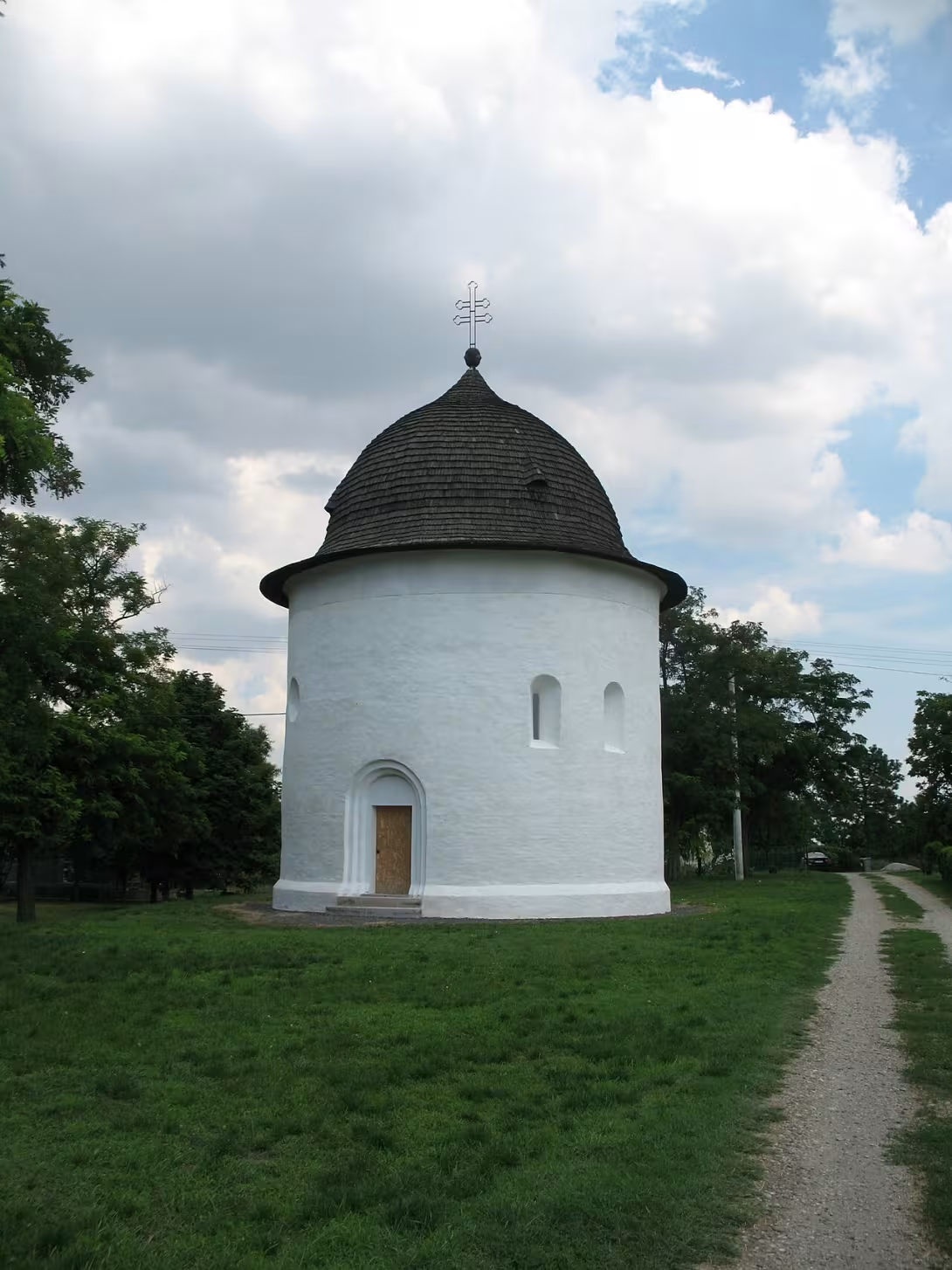
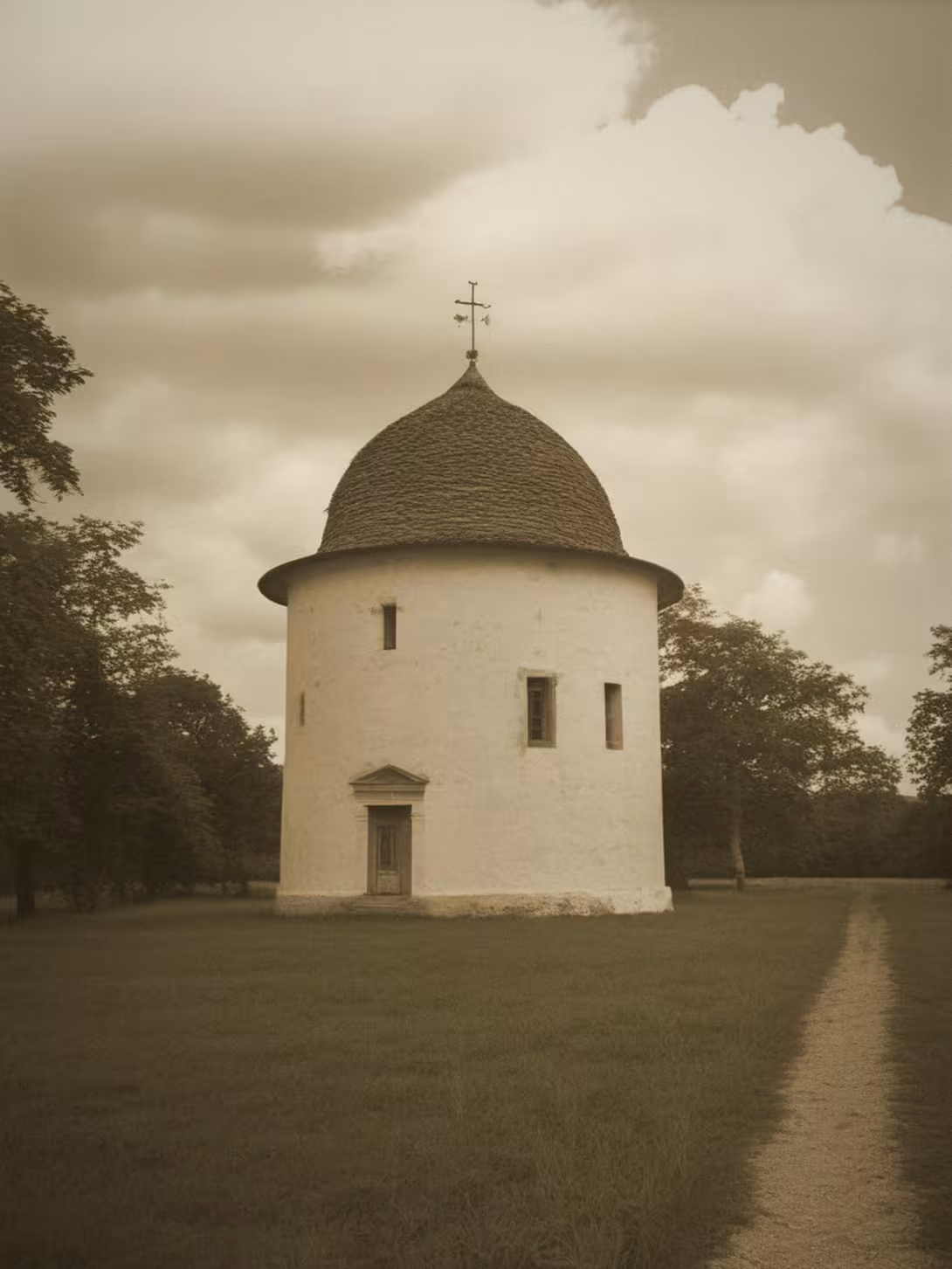
The historical view on the left is a visualisation generated by artificial intelligence and serves as inspiration.
Historical Milestones
- 1683
- the building was destroyed and subsequently lost more than 70 years
- 1755
- baroque renovation and modification of the building
- 1944
- the baroque plaster fell off during the bombing and the romanesque core was exposed
- 1954
- reconstruction of the building and uncovering roman paintings
- 1963
- declaration as a national cultural monument
Restoration history
| Years | Type | Extent | Condition after restoration |
|---|---|---|---|
| 2009 |
Reštaurovanie
rotunda 12 apoštolov |
Časť obnovená komplexne | dobrý |
Source: Monuments Board of the Slovak Republic — open data, licence CC BY 4.0
Interesting facts
- Rotunda from the turn of the 12th and 13th centuries has a circular floor plan and an interior with twelve nowhere, symbolizing twelve apostles. - The building was created as part of the Premonstrate monastery, which was founded before 1217 by the Comes Omodej and his son Stephen. - In the interior there are Romanesque wall paintings from the beginning of the 13th century, depicting a group of twelve apostles. - The Romanesque core of the building was bare in 1944, when the baroque plaster collapsed during the bombing. - Under the foundation of the rotunda were discovered graves from the
Guide
The guide was voiced by a synthetic voice created by artificial intelligence.
Show guide text
The text was prepared by artificial intelligence and has not been editorially reviewed. It may contain inaccuracies.
We welcome you to the village of Bína, in the heart of the Nitra region, where you are now facing a small but extremely significant piece of our common history. Look at this medieval structure we know as the rotunda of the twelve apostles. The first sight of this object may give rise to a feeling of peace and simplicity, but behind its walls there is a fascinating story of survival, extinction, and rebirth that has been going on for almost a thousand years. You are standing in front of a memorial that is a silent witness to the changes that our region has undergone and which hides layers of different ages. Now let's rush deep into the past to understand why this building ever arose. Rotunda comes from the turn of the 12th and 13th centuries, making it one of the oldest sacral buildings in the area. However, it was not built separately. Originally created as part of the Premonstrate monastery. This spiritual center was founded by Omodej and his son Stephen before 1217. At that time, monasteries were not only centers of faith but also centers of education and culture. So imagine this place almost eight hundred years ago, surrounded by monastic buildings, where monks prayed silently and where this rotunda served as a place of deep contemplation and prayer. Now when you look closer at the architecture of the building, note its characteristic circular plan. Rotundy is relatively rare in our country and this particular building has a very specific internal solution. If you look into the interior, you will see twelve no one who are strategically located in the space. These no one is just an architectural detail, but they have a profound symbolic meaning because they represent twelve apostles. It is a space designed to make the visitor feel the spiritual presence of the fundamental pillars of Christianity. However, the history of this building was not just a story of stability. If you notice the current appearance of the walls, you must know that the path to it was very dramatic. In 1683, in a period of great European unrest and war, the building was destroyed. Imagine the moment when this jewel of medieval construction collapses and remains a nearly forgotten ruin. Afterward, the rotunda fell into decline for more than seventy years, exposed to winds, rains and slow decay. Only by the Baroque restoration in 1755. At the time, the building was repaired and modified in the spirit of the time, which gave it a new look, but also covered its original Romance core under the layers of Baroque plaster. Now pay attention to one of the most interesting parts of this story, which is almost paradoxical. We often say that wars bring only destruction, but in the case of this rotunda, one of them has become an unintended tool of archaeology. In 1944, the baroque plaster collapsed during the bombing that hit the area. It was this tragic moment that revealed what was hidden centuries - the original Romanesque core of the building was exposed. It was as if history had decided to reveal its true face. This finding led to a thorough reconstruction of the rotunda in 1954. It was during this period that something truly rare was discovered: Romanesque wall paintings. Now that you look around in the interior, view these paintings as a direct connection to the people who lived and prayed almost a thousand years ago. They are traces of artistic expression from a time when the identity of our ancestors was formed in this region. In view of this immense value, the rotunda was declared a national cultural monument in 1963, thus ensuring its protection for future generations. It is fascinating to think about how many layers of time this small building carries. From the comet of Omodej and his son Stephen, through centuries of silence and demise, through Baroque renovation to dramatic revelations in World War II. Every stone and every fragment of color on the wall tells about endurance. The 12 apostles ' Rotunda is not just a building; it is a symbol that true values endure even the most difficult tests of time. We are slowly saying goodbye to this particular place, but we invite you to enjoy the atmosphere of this quiet corner in Binja. Go around the walls again, think about the symbolization of twelve, and see the peace that this space radiates. We hope that this short trip to the depth of the Middle Ages has helped you to better understand the meaning of this monument. We wish you a pleasant continuation in your discovery of the beauty of the Nitra region and thank you for sharing this moment of history with us.
Tips for visitors
Visit the rotunda in spring or summer, when the surroundings in the flower and the building stand out in natural light. You come to the village of Bín by car or public transport; check the current links in the internet search engine.
We recommend footwear with solid soles and discreet clothing suitable for the historic church.
For photography are suitable moments shortly before the sunset arrests, when light highlights the texture of the walls. Images from a straight angle capture the round shape of the building.
For families with children, a visit is an opportunity for a short trip connected with history and architecture. Since there are no other attractions in the immediate vicinity, we recommend focusing on the observation of the object itself.
Frequently asked questions
Can the monument be visited?
Religious buildings are usually open mainly during services; at other times a visit is normally arranged with the parish or the operator. We have not verified specific times.
Where is the monument?
Location: č. 110, Bíňa, Nitriansky kraj. The map on this page shows the exact spot.
Why is the monument protected?
It is listed in the Central List of the Monuments Fund of the Slovak Republic as a national cultural monument (ÚZPF no. 234-326).
For children
Imagine sitting on a hard stone floor and quiet around you. There's no music, no buzzing bee hive, no noise of the forest. Just quiet. Yet, you are now in a place where more than a thousand years ago people stood and prayed. No, it's not an old castle with hidden treasures. It is the rotation of 12 apostles in the village of Bína. This place has a story that began writing at the time when the first great cathedral was built in Europe. Imagine the year is 2000. Sounds close, right? But wait. This building is not new. Its roots date back to the beginning of the 12th century.
Nearby
🏰 Historic sites (36)
- Hradisko z neolitu 0.8 km web
- Hrádok Kamenín 3.1 km web
- Památník sovětské armádě 4.7 km web
- Vojenské historické múzeum 5.4 km web
- Hrádok Malé Kosihy 8.7 km
- Dr. Ormándy Miklós 9.3 km
- Zaniknutý hrádok 9.6 km
- Pieta 9.7 km
- Szent Vendel 9.9 km
- Letkési hősök emlékműve 10.7 km
- Kostol sv. Michala 10.8 km
- Obetiam bitky v roku 1849 11.4 km
- Kostol sv. Michala archanjela 11.8 km
- sv. Ján Nepomucký 11.8 km
- Štefan Gyurcsó 12.2 km
- Huszár-kastély 12.2 km
- Stampay János 12.6 km
- Kaštieľ Nána 12.8 km Madáchová 2526/28
- Obetiam 1. a 2. svetovej vojny 12.9 km
- 1944-12-22 airplane memorial 13.6 km
🍽️ Restaurants and dining (79)
- Vinum Fodor 7.0 km +421 905 947 755 web
- Kotra 7.7 km
- Hostinec 8.1 km
- Pohostinstvo Zalka 9.3 km
- Presso 10.5 km
- Baldacci 10.6 km +421 905 502 345 web
- Stop Söröző 10.7 km Dózsa utca 20
- Egy Falat Vendéglő 10.9 km Dózsa utca 48 web
- Café Granus 11.7 km
- Hronská perla 12.2 km
- Vörös Tölgy Étel-Ital Bár 12.3 km Árpád utca 1 +36 27 376 282 web
- Tűzkakas söröző 12.4 km Ipolysági út 3
- Ipoly söröző és Vendéglő 12.5 km Kossuth Lajos utca 1
- Barus 12.7 km +421 907 263 007 web
- U rebriňáka 12.7 km
- Horgász-tó vendégház és büfé 13.3 km
- Retro pub 13.6 km Petőfi utca 18
- Kabók PUB 13.6 km
- Filléres Kocsma 13.7 km
- Pohostinstvo Rida 13.8 km
🏨 Accommodation (41)
- Camping K2 Kamenín 5.2 km +421 948 458 181
- Poľovnícka chata 7.1 km
- Carpodrom 7.8 km web
- Vizi kemp 8.4 km +421 944 066 662 web
- Lodenica 9.0 km
- Hotel Château Šarkan 9.5 km Šarkan 304 +421 918 834 991 web
- Boglárka vendégház 10.6 km Rákóczi utca 35
- Hotel Château Bela 10.6 km +421 905 502 345 web
- Liliomtanya Vendégház 12.1 km
- Butella vendégház és borozó 13.3 km
- Margaréta vendégház 13.9 km Hunyadi tér 4
- Édes otthon vendégház és vendéglő 14.1 km web
- Hétszilvafás vendégház 14.2 km web
- Chata Ipeľ 14.2 km web
- Ilus vendégház 14.3 km
- Gubovics 14.3 km web
- Hubertus vendégház 14.3 km
- Vadas Thermal Resort 14.3 km +421 367 560 111;+421 367 560 101 web
- Schubert 14.4 km
- Ubytovanie Lelocký 14.4 km +421905292880 web
🚲 Rentals and sport (15)
- Prístavisko Salka 9.8 km
- Motocross Gbelce 11.5 km +421 905 400 276 web
- Železničná stanica Štúrovo 13.8 km web
- Lagúna 14.2 km
- Vonkajší sedací bazén 14.2 km
- Detský bazén 14.3 km
- Tobogány 14.3 km
- Hviezda 14.3 km
- Perličkový bazén 14.3 km
- Plavecký bazén 14.4 km
- Relax 14.4 km
- Fő utca 14.5 km web
- Mihálko - Predaj a servis bicyklov [mihalko.eu] 14.6 km Hasičská 3 +421 907 980 547 web
- Mihálko 14.6 km Hasičská 1644/3 +421 907 980 547 web
- Teraszok II 15.0 km web
🥾 Hiking and nature (58)
- Strážny kopec 3.0 km
- Bôbovec 5.5 km
- Strážna hora 6.2 km
- Drozdí vrch 6.2 km
- Kamence 7.0 km
- Fuzfa 8.6 km
- Pustá hora 9.1 km
- Horný vrch 9.7 km
- Modrý vrch 10.5 km
- Ploská hora 10.8 km
- Veľký vrch 10.8 km
- Zarastené jazero pri starej ťeheliarne 10.8 km
- Ság-oldal 11.0 km
- Orlí kopec 11.1 km
- Pustatina 11.2 km
- Dubník 11.4 km
- Čierna hora 11.5 km
- Bánya-hegy 11.8 km
- Rozhľadňa Parížske močiare 12.2 km
- Kaní vrch 12.2 km
Thematic route
I propose a thematic route focused on the main objective and its immediate area:
1. Rotunda 12 apostles - Roman church from the early Middle Ages. 2. Interior rotunda - Indoor space with preserved architecture. 3. Area around rotunda - Outdoor environment, which allows to perceive the geometric shape of the building within the village Bína.
Seasonal recommendations
In spring the surroundings of the Rotunda 12 apostles in the village of Bína will wake up to life and the landscape will cover green shades. The sun in this period provides fine lighting that highlights the details of historical walling. It is recommended to visit the pancreas in the morning. Due to variable spring weather, it is advisable to put on layers and put on waterproof footwear.
Summer months bring to the Nitra region intense light and rich colors of vegetation that create contrast with stone construction. The meadows around the monument are in full bloom. It is advisable to visit the site early in the morning or later in the evening to avoid the afternoon glow. It is recommended to take a hat and plenty of drinking water.
Autumn turns nature around rotunda into golden and red tones. Low autumn sun creates long shadows and highlights the texture of the object, which is suitable for photography. Due to the colder winds and humidity it is advisable to choose a warm sweater and comfortable shoes for nature.
Zimą acts rotunda 12 apostles in moderation, especially if it is covered by snow. The silence in the surroundings allows you to focus on the architecture of the building. When visiting this period it is necessary to choose quality warm clothes, thermo-layers and footwear with anti-slip sole.
Visualisations and artistic views


The visualisations are generated by artificial intelligence and serve as inspiration.
Photographs from the area
Real photos taken near the monument


Source and licence are given for each image.
Visitor Tips
No tips yet. Be the first!
Log in and add your tip.
Location on Map


Visitor photos
No photos yet. Be the first to add a photo from your visit!
Log in and add your photo or leave a rating.
You get more points for a visit verified in the app — we can tell from the GPS that you are there.
Reviews and comments