

chapel of the Seven Painful Virgin Mary Wayside chapel
The arrival chapel of the Seven Painful Virgin Mary in the village Podolie in Trenčín region is a Baroque brick building from the first half of the 18th century. The building is declared a national cultural monument (e.g. No. OJ L 298, 26.10.2012, p. 1.
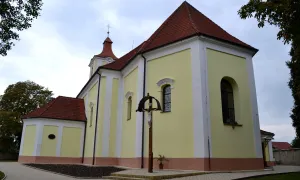
The building has a ground plan in the shape of a triangle. The facade is smoothly plastered in white-yellow painting, the corners are divided by pilasters with semi-circular selection. The chapel has two entrances with arches; the third side is without windows. Stone steps lead to the door. The doors are wooden, two parts and have four grilled windows. The building is covered by a pyramidal roof with tile covering and a metal cross.
The interior has a closed ceiling. On the altar is placed a wooden polychrome sculpture Piety, which depicts the Virgin Mary with the son after hanging from the cross. Piety is complemented by two angels crowning the Virgin Mary. There are also statuettes of St. Stephen and St. Elizabeth with two other angels in the space.
Chapel is located in the northern part of the village on the street Farská, approximately 100 meters northwest of the church of St. George. It stands at the branch from the Main Street (roads Krakovany - Čachtice) on Farska Street. In the vicinity of the building grow two limes, the age of which exceeds 200 years.
Historical Milestones
- 1770-1750
- creation of a brick baroque access chapel
- 1800-1850
- planting limes around the chapel
- unknown
- declaration of the object as a national cultural monument
Interesting facts
- It is a Baroque brick building from the first half of the 18th century, which is declared a national cultural monument. - The building has a ground plan in the shape of a triangle and its facade is in white-yellow painting. - On the altar is a wooden polychrome sculpture Piety, complemented by two crowning angels. - In the interior are located statuettes of St. Stephen and St. Elizabeth along with two other angels. - Two limes grow around the chapel, older than two hundred years old.
Guide
The guide was voiced by a synthetic voice created by artificial intelligence.
Show guide text
The text was prepared by artificial intelligence and has not been editorially reviewed. It may contain inaccuracies.
Welcome to the village Podolie, in the beautiful Trenčín region. Right now, you are facing a small but very significant witness to local history. Before you is the chapel of the Seven Painful Virgin Mary, also known as the arrival chapel. At first glance at this object you can feel the peace and harmony it brings into the country. Note how organically it fits into the surroundings and is dominant in this area. It is a place that has been accompanied by travellers, local residents and travelers for many years, providing them with a place to stop, meditate and pray briefly.
Let's take a look at when and how this building was created. The chapel dates from between 1700 and 1750. This means that we were transferred to the first half of the 18th century, when the Baroque peaked in our regions. This style defines the overall form of the building. At that time, the arrival chapels were a very important element of the country. They served not only as religious objects but often marked important roads, boundaries of possessions, or served as gratitude for the life saved or the pleas fulfilled. Although the exact names of architects who designed this project are not known today, it is evident that the building was meant to bring aesthetic value and spiritual background to Podolia.
Nyní pay attention to the architecture itself and the details you see right in front of you. If you look at the overall composition, you will notice something very interesting. The chapel is not a simple rectangle, but has a ground plan in the shape of a triangle. This geometric element adds dynamic and specific character to the construction, which is not entirely common in the access chapels. Look at the facade. Your eyes are likely attracted by white-yellow painting, which is typical of many Baroque buildings and adds a bright, friendly look to the chapel. This color contrast highlights the cleanliness of lines and simplicity, but also the elegantness of the whole object.
Let's move on to what's inside. If you look through the opening, you'll see the altar menza. It is there that is the most valuable artistic element of this chapel. It is a wooden polychrome sculpture of Piety, an illustration of Mary holding in her arms the dead body of her son Jesus. Polychromia means that the wood is not left in its natural state, but is painted with multiple colors, which adds depth and emotion to the outline. This whole dramatic scene is complemented by two crowning angels guarding this sacred image. It is a moment that invites to silence and insinuation over suffering and love.
Although in historical records we cannot accurately track down specific personalities that would work directly with the chapel, the building itself is now recognized at the highest level. Thanks to its historical and artistic value it was declared a national cultural monument. This means that the State has recognised its irreplaceability to Slovak cultural heritage. It is proof that even a small object in a small village can have a huge significance for the whole country.
In addition to the building itself, look around it. Notice the trees that surround the chapel. These are the leaves that were planted between 1800 and 1850. These trees are almost as old as the chapel itself. Imagine how these leaves grew along with the generations of the people of the Valley. They protected the travelers who stopped at the chapel with their shadows, creating a natural frame that protects the structure from the wind and the sun. Together with the brick building they form a harmonious whole, where architecture and nature are connected.
It is this combination of elements that is interesting. The Baroque brick building from the 18th century, complemented by the romantic planting of limes from the 19th century, creates an atmosphere that is seldom found today in such an authentic state. It's where time stopped. The secret of this chapel lies in its simplicity and at the same time in the precision of the details, such as the very triangle floor plan.
Before I say goodbye to you, I suggest you feel the atmosphere of this place a little while longer in silence. Look again at the white-yellow façade, remember the polychrome Pieta inside and inhale the smell of old limes. It is a place that teaches us humility and respect for the past.
I hope the visit to the Chapel of the Seven Painful Virgin Mary in Podolia enriched you and felt the peace that this place radiates. Now I invite you to continue your review of the beauties of the Trencin region and discover other gems of our history. Thank you for your attention and we wish you a pleasant day full of new experiences.
Tips for visitors
Since it is an access sacral structure, we recommend footwear suitable for the field. We recommend using morning or evening light to highlight the details of the facade and the country of the Trenčín region. For families with children, visiting the chapel is an opportunity for a short walk in nature.
Frequently asked questions
Can the monument be visited?
Religious buildings are usually open mainly during services; at other times a visit is normally arranged with the parish or the operator. We have not verified specific times.
Where is the monument?
Location: Podolie, Trenčiansky kraj. The map on this page shows the exact spot.
Why is the monument protected?
It is listed in the Central List of the Monuments Fund of the Slovak Republic as a national cultural monument (ÚZPF no. 224-12260).
For children
Keep your eyes open and imagine that you are passing through time. It's the first half of the 18th century. There are no cars, asphalt roads or mobile phones around you. There are only thick forests, the sound of a stream and a narrow dusty road, along which travelers travel with putty sticks in their hands. The air smells like fireplace smoke and fresh bread. It was at this time that a small but mysterious building was created, which stands here to this day.
Thematic route
As there are no other objects in the area of the area, I propose a thematic route focused on the main objective and its area:
1. Chapel of the Seven Painful Virgin Mary (architectonic object) - the exterior of the chapel. 2. Chapel area (outdoor area) - walk around the house in connection with the land of the village Podole. 3. Interior of the chapel (sacral spaces) - if possible, visit the interior area and its artistic design.
Seasonal recommendations
In spring the surroundings of the chapel in Podolí will wake up to life and the landscape of Trenčín region will warm up with green color. Nature blooms around this adjoining structure, creating contrast with architecture. The place is suitable to visit in the morning when the air is fresh and light natural. Due to variable spring weather, we recommend wearing layers and wearing non- leaky shoes. The summer season brings intense lighting and rich colors of vegetation that highlight the details of the sacral structure. The atmosphere is warm and peaceful. Visit the site in the early morning or late evening hours to avoid high temperatures. Do not forget enough water and protection from sunlight hat or cream. Autumn in Podolí Rozwietuje palette of gold, orange and red tones. Nature around the chapel changes and creates a background for photography. During this period, sunny days are appropriate, when the colors of the leaves are most prominent. Due to colder morning and evening temperatures we recommend taking a warmer sweater or light jacket. Winter season brings silence to the landscape and snow often covers the surroundings of the chapel with a white coat. Lighting is weaker and colder in this period. When visiting, it is crucial to wear very warm clothing and wear insulated footwear with anti-slip soles to prevent slipping on the frozen surface.
Visitor Tips
No tips yet. Be the first!
Log in and add your tip.
Visitor photos
No photos yet. Be the first to add a photo from your visit!
Log in and add your photo or leave a rating.
You get more points for a visit verified in the app — we can tell from the GPS that you are there.
Reviews and comments