

st. Juray's fortified church Church and fortification wall
The fortified church of St. George in the village Podolie in Trenčín region is a national cultural monument. Its foundations date back to the beginning of the 14th century. The building combines sacral object and Renaissance fortification from the 17th century.
The original Gothic church was rebuilt and expanded between 1748 and 1758. Between 1751 and 1758 a tower was added to the building. Renaissance fortification in the form of a stone wall with supporting pillars and key shooting rooms was built in the 17th century, probably after 1663. It was then restored in the 18th century and repaired in later times.
The church has a polygonal ending of the presbytery. Two chapels are attached to the ship: the northern part-time and the southern part-field. The tower has semi-circular windows. On August 15, 2000, a new entrance to the ship and the subway was opened. Two-winged door with bronze relief of St. George made Andrej Michalík.
The interior of the ship is decorated with Prussian vaults and painting decoration, probably the work of Eduardo Massányi. In the space there is a colored stained glass depicting Saint Peter and the Virgin Mary Immaculata. The main and side altars come from the first half of the 19th century (classicism), a wooden pulpit from the mid-19th century. The stone baptistery contains the sculpture of Christ's baptism by Saint John the Baptist. Under the floor there are crypts with the remains of the Očat family.
The tower contains three bells with electric drive. The middle bell bears the number 1403 written by Gothic Minuscule, the small bell with relief of St. George comes from 1904 and the large bell from 1923.
The area is registered by the Monument Office of the Slovak Republic under number ÚZPF 1300 and consists of a church (ÚZPF 1300/1) and a wall (ÚZPF 1300/2).
Tehdy a dnes
Drag the slider and compare how the monument might have looked when it was built with the view today.
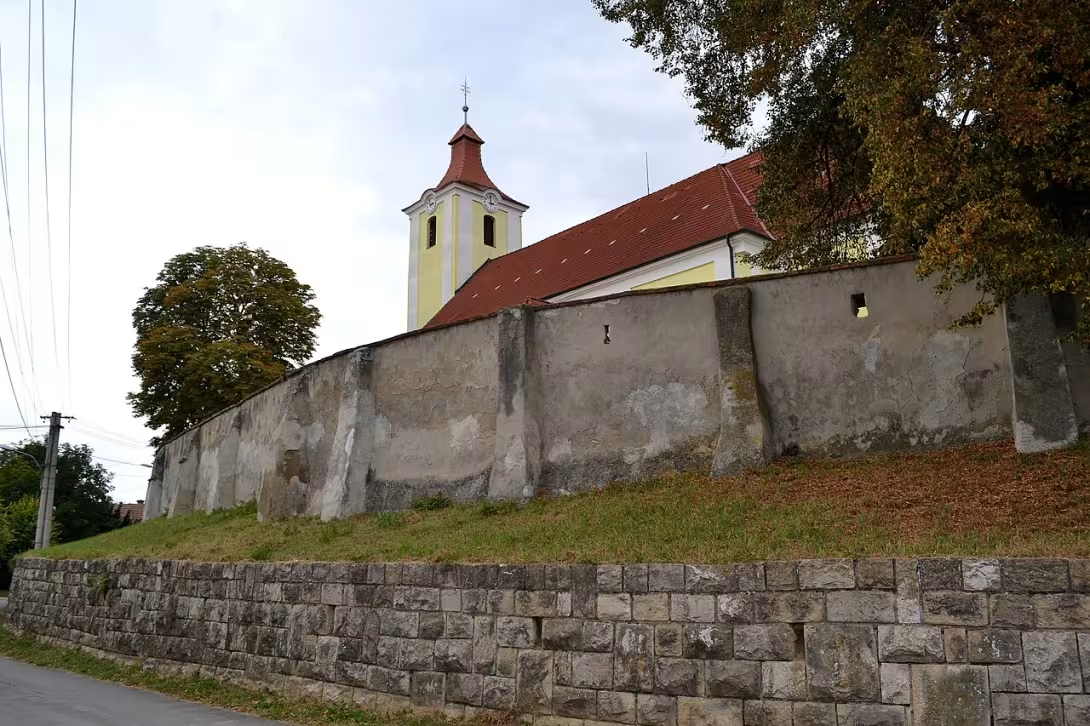
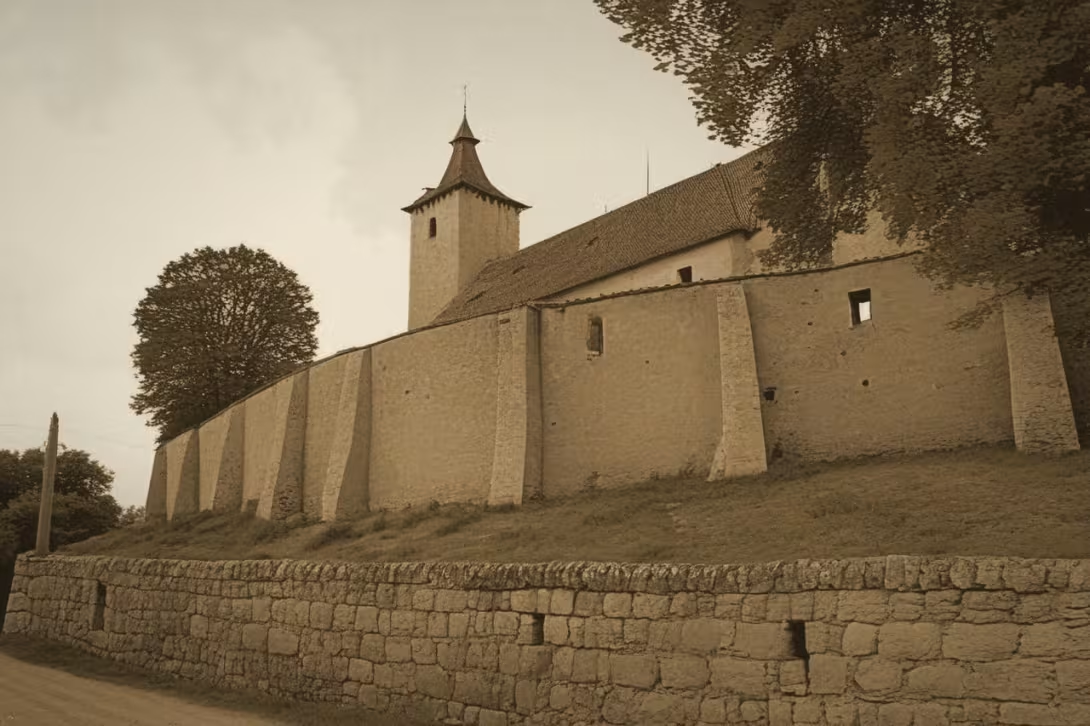
The historical view on the left is a visualisation generated by artificial intelligence and serves as inspiration.
Historical Milestones
- 1663
- likely time to build renaissance fortification
- 1748-1758
- reconstruction and extension of the original gothic church
- 1751-1758
- construction of a built-in tower
- 2000
- opening of a new entrance to the landing and ship (15 august)
Restoration history
| Years | Type | Extent | Condition after restoration |
|---|---|---|---|
| 2012–2015 |
Obnova
farský kostol sv.Juraja |
Časť obnovená komplexne | dobrý |
| 2012–2013 |
Obnova
farský kostol sv.Juraja |
Časť obnovená komplexne | dobrý |
Source: Monuments Board of the Slovak Republic — open data, licence CC BY 4.0
Artistic features
-
vitráž figurálna s dekorom — sv.Cyril,sv.Metod
sklo, vkladanie do siete · pseudohistorizmus · 1941-1950 -
vitráž figurálna s dekorom — sv.František z Assisi
sklo, vkladanie do siete · pseudohistorizmus · 1941-1950 -
vitráž figurálna s dekorom — Kristus poveruje sv.Petra
sklo, vkladanie do siete · pseudohistorizmus · 1941-1950 -
vitráž figurálna s dekorom — sv.Mária Goretti
sklo, vkladanie do siete · pseudohistorizmus · 1941-1950 -
vitráž s kresťanským symbolom — Kríž
sklo, vkladanie do siete · pseudohistorizmus · 1941-1950 -
vitráž figurálna s dekorom — Panna Mária Immaculata
sklo, vkladanie do siete · pseudohistorizmus · 1941-1950 -
vitráž figurálna s dekorom — sv.Jozef Pestún s dieťaťom
sklo, vkladanie do siete · pseudohistorizmus · 1941-1950 -
vitráž figurálna s dekorom — sv.Michal Archanjel
sklo, vkladanie do siete · pseudohistorizmus · 1941-1950 -
vitráž figurálna s dekorom — sv.Juraj
sklo, vkladanie do siete · pseudohistorizmus · 1941-1950 -
vitráž figurálna s dekorom — Božské srdce Ježišovo
sklo, vkladanie do siete · pseudohistorizmus · 1941-1950 -
vitráž s kresťanským symbolom — Kríž
sklo, vkladanie do siete · pseudohistorizmus · 1941-1950 -
vitráž figurálna s dekorom — sv.Notburga
sklo, vkladanie do siete · pseudohistorizmus · 1941-1950
Source: Monuments Board of the Slovak Republic — open data, licence CC BY 4.0
Interesting facts
- The foundations of the building come from the beginning of the 14th century and combines sacral building with Renaissance fortification from the 17th century. - Renaissance fortification consists of a stone wall with supporting pillars and key shootings, probably built after 1663. - The interior of the ship is decorated with Prussian vaults, painting decorations and colored stained stains depicting Saint Peter and Virgin Mary Immaculate. - Under the floor there are crypts with the remains of the Očat family. - The tower contains three bells, with the middle one carrying the 1403 summer wr
Guide
The guide was voiced by a synthetic voice created by artificial intelligence.
Show guide text
The text was prepared by artificial intelligence and has not been editorially reviewed. It may contain inaccuracies.
We welcome you to Podolie, in the heart of the Trenčín region, where you are now facing a fascinating monument that combines two completely different functions. Look at the building in front of you. At first glance, it can be assumed that it is a common sacral object, but you will notice something unusual in your closer investigation. You stand in front of St. George's fortified church. It is a place where the spirit realm meets the need for defence and security, creating a unique atmosphere that you can now perceive directly in front of you. To understand why this church looks just like this, we must storm deep into the past. Although the building you see today has undergone many changes, its roots go much further than it seems at first sight. The foundations of this building come from the beginning of the 14th century. Imagine, then, that there was a temple in the times of the medieval peak. It was originally a Gothic church, but with time it had to respond to the disturbing period in which the region was located. The key moment in the history of this place was a thousand and six hundred thousand and three. It was at this time that the Renaissance fortification was probably built, which made the church not only a place of prayer, but also a safe haven for the local inhabitants. It was not just about aesthetics, it was about survival. The Renaissance elements you see today indicate that during the 17th century, people had to be prepared for danger and sought protection in the walls of their temple. Now I ask you to pay full attention to the architecture and details surrounding you. Note in particular the Renaissance fortification. Look at the stone wall surrounding the structure. There are clearly visible support pillars that give it stability and strength. If you look out, you'll see the key guns. It was these openings that served to defend themselves and to protect their enemies, while the defenders themselves remained safe behind the thick walls. It is a fascinating contrast - on the one hand we have a peaceful church and on the other hand a military element in the form of a fortification. Let's go ahead chronologically now. When you look at the overall form of the building, you see the result of the great changes that took place in the eighth century. In the period from a thousand seven hundred forty to a thousand seven hundred fifty-eight the original Gothic building was significantly rebuilt and expanded. At this time, the church changed into a form we know today. Related to these works was also built a tower whose construction took place in the years one to one thousand seven hundred fifty and seven hundred fifty. This tower today dominates the silhouette of the entire object. Although in historical records we cannot identify exactly the specific architects who designed the project, nor do we know the specific personalities that would be closely connected to this place within the known legend, the building itself speaks for itself. It is the epitome of a community that cared for its spiritual need, but at the same time was aware of the reality of its period. If you have the opportunity to swallow inside, I recommend you focus your attention on the interior of the ship. Note the Prussian vaults that give space a specific rhythm and elegance. In addition, the interior is decorated with painting decoration that complements the overall impression of this sacral space. It is interesting to see how the inside of the church differs from its rough, fortified exterior. While the outer walls speak of defense and strength, the inner space with arches and paintings speaks of peace and spirituality. One of the most interesting things you should know is the real union of two worlds. This object is a rare example of a combination of sacral object with Renaissance fortification. It is not common to see a church that would thus significantly integrate defence elements from the seventeenth century directly into its structure. It's almost like a castle and a church in one. Another important milestone in the modern history of this monument is the 15th August of the year two thousand. It was on this very day that a new entrance to the underfloor and the ship opened up, allowing people easier access to this historical splendor and opened the door for new visitors like you. So you stand in front of a building that has survived centuries. From the Gothic foundations of the 14th century, through the Renaissance fortification from the thousand six hundred-thirty csiattri, to Baroque reconstructions from the eightteenth century and modern adjustments from the new millennium. Every stone in these walls tells of different times, other needs of people, and their dream of safety and faith. Now that you know the main points in the history and architecture of St. George's fortified church, I invite you to visit the place yourself once again. Feel the texture of the stone walls, think about how people must have felt in the shooting rooms hundreds of years ago, and feel the peace they have drawn from this historic building in Podolia. Thank you for your attention and we wish you a pleasant further survey of this beautiful region. Let yourself continue to be inspired by the atmosphere of this place.
Tips for visitors
The visit is recommended from May to October. You come to the village Podolia by car or public transport; check the current links in the internet search engine.
We recommend shoes with fixed soles. When entering the interior, take care of clothing corresponding to the sacral nature of the place.
Detailed pictures of the fortified elements of the church are suitable for photography. The best light for exterior images is during morning or late afternoon hours when shadows are softer and wall surfaces are better picked up.
Families with children can connect the visit with a short walk around. Children will thus know the details of the construction and function of churches as defence fortresses.
Frequently asked questions
Can the monument be visited?
Religious buildings are usually open mainly during services; at other times a visit is normally arranged with the parish or the operator. We have not verified specific times.
Where is the monument?
Location: Podolie, Trenčiansky kraj. The map on this page shows the exact spot.
Why is the monument protected?
It is listed in the Central List of the Monuments Fund of the Slovak Republic as a national cultural monument (ÚZPF no. 224-1300).
For children
Pull your shoelaces tight and close your eyes. Now we're gonna move back in time exactly 326 years. We're in 1700. There are no cars, no phones or asphalt roads around us. The air smells like smoke from fireplaces and in the surrounding area, only the sound of wind and the flashing of horses. We stand in the village of Podolenie and there is something strange rising before us. It's not just an ordinary building for prayer, it's a real stone fortress.
Nearby
🏰 Historic sites (206)
- Park miniatúr 0.3 km +421 32 743 75 05 web
- sv. Florián 0.4 km
- Kaštieľ Častkovce 1.2 km
- Trojičný stĺp 1.7 km
- sv. Vendelín 1.8 km
- Praveká kniežatská mohyla 2.3 km
- Trojičný stĺp 3.5 km
- sv. Florián 3.5 km
- Ján Hollý 3.7 km
- sv. Ján Nepomucký 3.8 km
- Kúria Drugetovcov 3.9 km Malinovského 806/31
- sv. Florián 3.9 km
- Kalvária 4.1 km
- Mariánsky stĺp 4.1 km
- Trenčianske múzeum - expozícia Čachtice 4.3 km
- Draškovičov kaštieľ 4.3 km Malinovského 245/4 web
- Drugetovská kúria 4.4 km Medzihorská 180/3
- Najsvätejšia Trojica 5.2 km
- Trojičný stĺp 5.3 km
- sv. Gorazd 5.3 km
🍽️ Restaurants and dining (345)
- Bufet pod Lipami 0.1 km
- Espresso & pizzeria Grande 3.9 km
- U Agnešy 3.9 km
- Tri elementy 3.9 km
- Kaviareň U Jara 4.0 km
- Pod hradom 4.2 km
- Pizzeria 4.2 km +421 903 813 260
- Čachtický Kebab 4.2 km
- Grófkin dvor 4.2 km
- Dami 5.3 km
- Krčmička na hrachu 5.3 km
- Reštaurácia Sedliacka stodola 5.4 km +421908097917 web
- Rio taverna 5.4 km
- Škulec 5.5 km
- Bufetík 5.6 km Hrachovište 236 236 +421908198186
- Stuart's Pub 5.6 km
- Pohostinstvo Martina 5.7 km
- Rybník Bašovce 5.7 km
- Chilli Caffe 5.7 km web
- Kotva 5.7 km
🏨 Accommodation (72)
- Penzión u predsedu 2.7 km web
- Škulec 5.5 km +421 905 853 325 web
- Penzión Čerenec 6.8 km +421 905 983 855 web
- Penzión Kulko 7.3 km
- Ubytovňa Milex 7.9 km Piešťanská 2676/31A +421902225522 web
- Ranč Colombia 8.3 km +421 948 908 398
- Red Dingo Homestead 8.4 km +421 944 775 670 web
- Agropenzión Adam 8.6 km +421327772111 web
- Abako 9.3 km
- Hotel Javorina 9.3 km +421 32 771 20 67 web
- Red House 9.4 km +421 905 600 788;+421 915 322 258 web
- Hotel Diana 9.6 km +421 32 771 22 15 web
- Magura 9.7 km Pod Párovcami 1317/58 web
- Kúria 9.7 km +421 904 838 789 web
- Penzión Fuete 9.9 km web
- Astra 10.1 km
- Športhotel 10.2 km
- Rekreačné zariadenie Javorinka 10.2 km +421 911 74 74 71 web
- Hotel Park 10.3 km +421 337 951 111 web
- Löwe 10.4 km
🚲 Rentals and sport (45)
- RDA Shop 8.1 km
- MTBiker centrum 8.2 km +421233056730 web
- Sportisimo 8.7 km web
- Ski Centrum 9.0 km
- Oprava bicyklov Peter Rebro 9.2 km
- Rybárstvo Rojko 9.3 km
- Plavecká škola 9.3 km A. Hlinku 113A web
- StrapoBikes 9.5 km Žilinská cesta 16A +421 908 953 478 web
- Rival bike sport 9.6 km +421 32 771 29 36; +421 915 867 427 web
- Tomino - Rybárske potreby 9.6 km
- Huma šport 9.6 km +421 903 752 297
- Extra sport 9.6 km
- Sportisimo 9.9 km web
- SCT GYM 9.9 km Piešťanská 555/12 web
- Topšport 10.0 km
- Motokárová dráha Trebatice 10.0 km
- Squash Center 10.1 km +421 905 526 740 web
- Diplomat aréna 10.1 km Kuzmányho 7820/19
- Extrem šport 10.1 km
- Atletický štadión Piešťany 10.2 km
🥾 Hiking and nature (112)
- Veľký Plešivec 3.9 km
- Kozinec 3.9 km
- Malý Plešivec 3.9 km
- Salášky 4.3 km
- Drieňovica 5.0 km
- Bakalár 5.2 km
- Kačiš 5.6 km
- Drapliak 6.2 km
- Zadné Dúbravy 6.5 km
- Sedielce 6.5 km
- Skalka 6.7 km
- Vršnice 7.1 km
- Čachtická jaskyňa 7.3 km
- Synagóga 7.3 km
- Vrbovská veža 7.3 km
- Snedanisko 7.6 km
- Tlstá hora 7.9 km
- Pávičie 8.4 km
- Matiáška 8.5 km
- Vaďovský vrch 8.7 km
Thematic route
As there are no other locations in the area, I propose a thematic route focused directly on the main monument area.
Route in the area of the fortified church of St. George
1. Fortified church of St. George - sacral building in the village Podolie with defence elements. In the past, she served as a refuge for prayer.
2. Defense wall and courtyard - Walk around the church and fortification system. There are remnants of walls that protected the temple and local inhabitants from attacks.
3. Indoor space and exposition - Interior of the church and its artistic equipment. The exposition approximates the history of the building and its importance to the Trenčín region.
4. Church Tower - The exit to the tower, which in the past served as a watchtower. From its peak is the view around the village Podolenie.
Seasonal recommendations
In spring, the surroundings of St. George's fortified church in Podolia will awaken into life. The first green grass and flowering trees contrast the stone walls. We recommend visiting the place in the morning when the light is fine and the air is clean. Due to variable weather we recommend layered clothing and solid shoes into the ground.
Summer season brings long days and strong sunlight, which highlights the details of the fortification of the building. The neighborhood is full of flowers. Visit the place early in the morning or later in the evening to avoid high temperatures. Don't forget the hat and enough drinking water.
In the autumn, nature around the church turns into golden and red tones. The low sun creates long shadows and contrasts on the facade. Choose days with clear sky. In Podolia it may be colder in October, so we recommend a jacket or light sweater.
Zimą is a fortified church of St. George's silence, especially if the building covers the snow. When visiting the advent time, wear warm clothing and nonslip shoes to move safely around the monument. The shortest days of the year are suitable for observing the winter landscape.
Visualisations and artistic views


The visualisations are generated by artificial intelligence and serve as inspiration.
Photographs from the area
Real photos taken near the monument

Source and licence are given for each image.
Visitor Tips
No tips yet. Be the first!
Log in and add your tip.
Location on Map
Visitor photos
No photos yet. Be the first to add a photo from your visit!
Log in and add your photo or leave a rating.
You get more points for a visit verified in the app — we can tell from the GPS that you are there.
Reviews and comments