

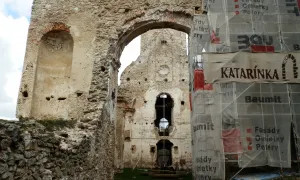
church with hussite walls destroyed Ruined church with grounds
This monument in the village Prierž in Trnava region consists of an extinct church with an area. According to the register, the building comes from the second half of the 16th century, namely 1591. Artwork corresponds to the Baroque style.
The area, registered by the Monument Office of the Slovak Republic under number ÚZPF 12247, consists of three objects. The first is a partially studied baroque church from the year 1591. The second is brick fortification from the Baroque period led after 1671. The third is a church cemetery from the middle of the 16th century, which has not been studied and shows no essays.
Object in the village The hernia is declared a national cultural monument. It is an example of the historical fortified area from the transition between the 16th and 17th centuries, which combines the extinct church and preserved brick fortification.
Historical Milestones
- 1591
- Church formation
- 1671
- Position of brick fortification
Interesting facts
- Church with extinct area in the village The hernia comes from 1591 and its artistic work corresponds to the Baroque style. - The complex consists of three objects: a baroque church, brick fortification and a church cemetery. The brick fortification from the Baroque period was brought out after 1671. - The church cemetery dates from the middle of the 16th century, has not been studied and shows no essays. - The monument is declared a national cultural monument and represents an example of the historical fortified area from the transition period between the 16th and 17th centuries.
Guide
Show guide text
The text was prepared by artificial intelligence and has not been editorially reviewed. It may contain inaccuracies.
Welcome to the Prieraz. You are standing in a place that is quiet and peaceful today, but if you imagine that under your feet and around you there are traces of ancient, turbulent history, you will feel something much deeper. In front of you there is an area that is no longer what used to be. It's not a place full of monumental buildings or tall towers that you could see from a mile away. It is rather a place of memory where architecture meets the void and where traces of the past are no longer buildings, but the shape of the landscape itself and the remains of the protective elements.
When you look around, you may miss something important at first sight. And that's where the hidden power of this place is. You're standing in front of an extinct church. Although the church itself is no longer visible, its spirit and meaning are still being pushed into this earth. Feel the atmosphere - a place that used to be the center of the community, a place of prayer, meetings, and refuge - today he is a silent witness to the time that goes on relentlessly.
Now pay attention to what is still material and what may really interest you. Look at the remains of the Hussite walls. These walls are not just a mere wall; they are a symbol of the restless era in which people moved, believed, and fought. The Hussite walls indicate that this place was not only a spiritual center but also a strategic point that had to be protected. At a time when religious and political passions spread in the European context, such walls provided security not only for believers but also for the entire environment. Although we can only throw, they are not accurate figures, looking at these remains of the walls means looking directly into the eyes of the restless century, when the boundaries between faith and power were constantly transformed.
Let's just go ahead and think about what you see here. When you look at the area itself, try to draw the outlines of what once stood there. It is not easy because the architect who designed this church and these walls remains in the shadow of oblivion. Not known his name, we don't even know the exact year the first stone was placed in this earth. However, this anonymity adds a special, even mystical dimension to the place. It is not a memorial to a particular king or great architect, it is a memorial of people - ordinary people who lived here, worked and sought refuge under the protection of these walls.
At this point, you may be asking why it's just like this. Why is this church missing? Historical records didn't give us a clear answer. Unknown chronology does not give us the opportunity to determine exactly whether its demise was the result of war, natural disasters, or whether simply time and human care slowly and undetected. It is this uncertainty, this void that you feel, that is the greatest story this place tells. It's a story about the revelation of everything that man builds.
Note how nature gradually tries to return this place to itself. Where the holy place once stood, the quiet and natural environment dominates today. It is a fascinating contrast between the human pursuit of permanence and the constant movement of nature. The Hussite walls are still stuck here as witnesses, as the last guards of something that no longer exists.
You might be asking if there were any big personalities. Paradoxically, the greatest personality of this place is mere ignorance. We don't have the names of heroes or the names of kings we could mention here. But it is this lack of specific characters that allows us to perceive this place in a wider, human context. It's not the place of one history, it's the place of many little lives that have been turning around, hiding behind walls and leaving in peace.
As you continue to walk through this area, do not just let what you see through your eyes but try to perceive what you feel. Take note of the weight of history that is present, even if it is invisible. Every stone, every trace of the wall you can reach here, is a small fragment of something great. It's a call to stop and think about what's going to happen when it's long gone.
The mystery of this place lies in its silence. What happened to the people who led their lives here? What led to this church becoming part of the country by being no longer clearly identifiable as a building? These questions will not have an immediate answer, but just finding them is what makes visiting this place in Prietraz exceptional.
Now we invite you to continue your next discovery. Go through this area slowly without seeking specific goals. Let this moment survive in peace. Look at the walls again, try to see in them something more than just stone remains. They may show you the strength that has survived centuries, or you may see only the sad beauty of what is no longer there.
Thank you for being with us on this short look to the past. We wish you a pleasant rest of your discovery of this beautiful country. We'll say goodbye, but keep this feeling of silence and secrecy in your heart that offered you this place.
Tips for visitors
It is best to visit a place in spring and autumn when lower vegetation allows for better visibility of the Hussite walls and the site of the extinct church. You can reach the village of Prietrž by car or public transport; check the current links in the internet.
In the area we recommend shoes to the ground and repellent, especially in summer. The photographers will use low light shortly before sunset to highlight the relief of walls and the remaining details.
The place is suitable for families with children for a walk about the Hussite period, during which they can look for traces of old vines. There are no other sights in the vicinity.
Frequently asked questions
Can the monument be visited?
According to the heritage register the structure no longer exists; there is nothing left to see on site.
Where is the monument?
Location: Prietrž, Trnavský kraj. The map on this page shows the exact spot.
Why is the monument protected?
It is listed in the Central List of the Monuments Fund of the Slovak Republic as a national cultural monument (ÚZPF no. 215-12247).
For children
Close your eyes and imagine shooting down a time machine. You set it exactly for 1591 and with loud boom! You'll be moving back to the past in 435 years. Cars will disappear around you, asphalt roads and cell phones. Instead, you'll see dense forests, the brilliant nature, and the people in a glowing floral dress and woolen coats. You just landed in Prietrez, at a time when something extraordinary was happening here.
Thematic route
As the list of surroundings is not completed, I propose a route within the main objective area:
1. The ruins of the church and the area - the main point of the route. 2. Husit walls - Defensive facilities surrounding the area. 3. Courtyard - Walk through the courtyard and tour the fragments of the building.
Seasonal recommendations
In spring, the surroundings of the extinct church in Priežnica will wake up to life and the country will bloom. The sun in this period provides fine lighting that highlights the details of the Hussite walls without too much shadow. It is recommended that shoes are suitable for wet grass and visit in the morning when the air is cleanest and nature is the most alive.
Summer months bring intense lighting and full colors of surrounding vegetation, which can partially mask the building itself. The atmosphere is warm, but because of the high temperatures, it is best to leave in the early morning or late evening hour to avoid the sun. Easy clothing, a hat, and plenty of drinking water are essential.
Autumn is a time when nature around the area turns into golden and red tones. The low autumn sun creates dramatic contrasts on old brick parts. Due to the colder weather and the possible humidity of the terrain it is advisable to wear layered clothes and waterproof shoes.
Winter brings a different atmosphere to Prietrž, especially if the area covers snow, which highlights the silhouette of the extinct church and its walls. The surrounding area is quiet and desolate at this time. When planning a trip, it is necessary to take into account a short day and wear warm, waterproof clothing and suitable winter shoes.
Visitor Tips
No tips yet. Be the first!
Log in and add your tip.

Visitor photos
No photos yet. Be the first to add a photo from your visit!
Log in and add your photo or leave a rating.
You get more points for a visit verified in the app — we can tell from the GPS that you are there.
Reviews and comments