








pavlin monastery Monastery
The monastic complex in the village Šaštín-Straže in the Trnava region is a protected collection of sacral buildings, whose core consists of the Basilica of the Seven Painful Virgin Mary and the building of the monastery of Pavlín. The complex is registered in the register of national cultural monuments under the number ÚZPF 752. It was created in the 18th century in connection with the pilgrimage tradition and worship of the graceful statue of the Virgin Mary.
The origins of the pilgrimage place date back to 1564, when Angelika Bakičová, the wife of Count Imrich Czobor, gave the statue of the Seven Painful Virgin Mary. During the Turkish wars of the statue in 1654 they moved to the chapel of St. Imrich in Czoborov castle. It returned to its original location in 1710. A key moment for the monastery was the canonical examination, after which Archbishop Imrich Esterházy of Esztergom declared the statue miraculous on November 10, 1732. In 1733 representatives of the Order of Pavlins came to Šastín, who began the construction of the temple and monastery. The foundation stone was sanctified on July 10, 1736.
The complex is built in late Baroque style. The Basilica of the Seven Painful Virgin Mary is 62 metres long, 23 metres wide, and 26 metres high. The main altar of red marble was designed by imperial builder František Anton Hildebrandt, who is the author and facade of the temple. The interior is decorated by the fresco of the court painter Jean Joseph Chamant from 1757 and paintings on the side altars by the painter J. L. Kracker. Part of the area is a chapel from the year 1654 with triangular floor plan, economic building in the shape of the letter C, a pillar with the sculptures of the Holy Trinity from 1821 and Šaštínska Pieta from 1883.
The administration of the complex has undergone several changes. After the abolition of the order of pavlins by Emperor Joseph II. in 1786, the temple passed to the local priest's administration. In 1924 the Salesians came to the monastery, who set up a priesthood. During the Communist regime, the order was expelled in 1950 and the premises served as warehouses. The Salesians returned to the monastery at the end of February 1990.
The history of the place includes the ceremonial consecration of the temple on August 15, 1764 in the presence of Maria Theresa and František Štefan Lotrinsky. In 1964, Pope Paul VI promoted the temple to Basilica minor, and in 1995, Pope John Paul II visited the Basilica. Since 1997 it has been part of the Mariological Museum complex.
The monastery complex is a national cultural monument consisting of ten protected objects, including historic greenery. The area serves as a pilgrimage site.
Tehdy a dnes
Drag the slider and compare how the monument might have looked when it was built with the view today.
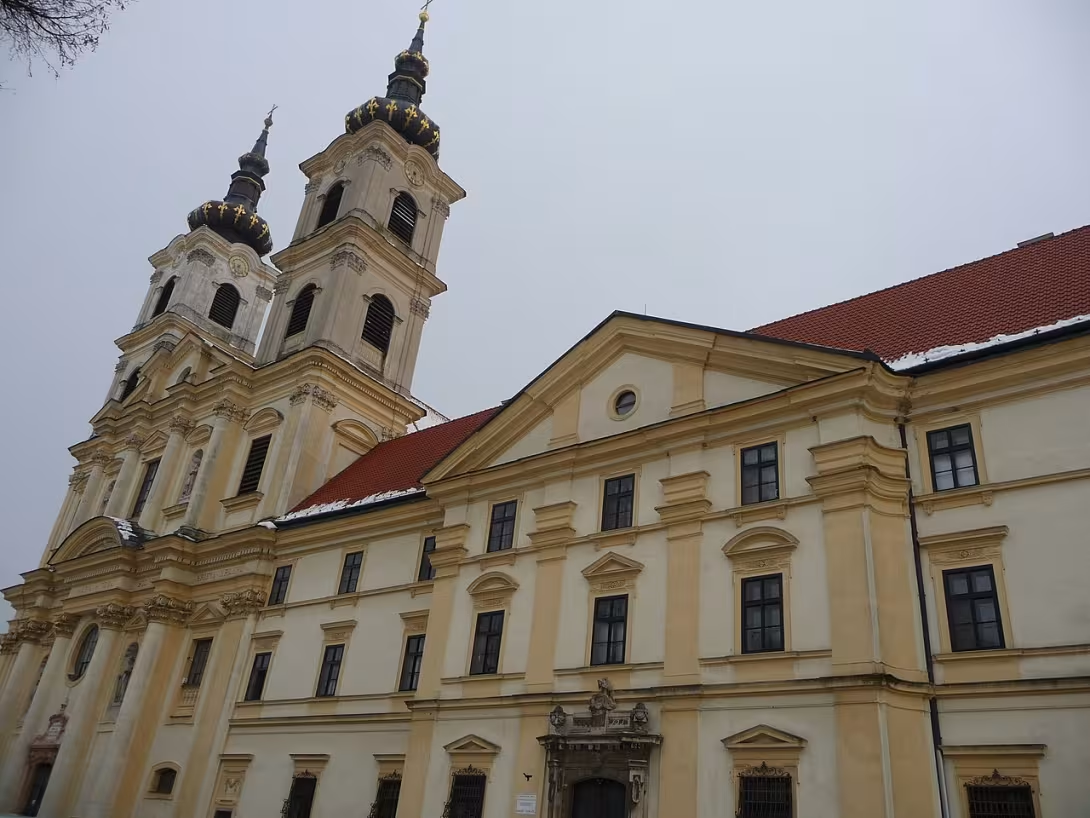

The historical view on the left is a visualisation generated by artificial intelligence and serves as inspiration.
Historical Milestones
- 1654: construction of the Chapel of the Seven Painful Virgin Mary
- 1732: proclamation of the statue of the Virgin Mary the Seven Painful
- 1736-1762: construction of the monastery complex
- 1764: festive eclipse of the temple in the presence of Maria Theresa
- 1964: temple promotion to Basilica minor
- 1991: proclamation as a national cultural monument
Restoration history
| Years | Type | Extent | Condition after restoration |
|---|---|---|---|
| 2022 |
Obnova
pavlínsky kláštor |
Časť obnovená komplexne | dobrý |
Source: Monuments Board of the Slovak Republic — open data, licence CC BY 4.0
Heritage surveys
-
2014/12 — Umelecko-hisotrický výskum, Architektonicky-historícký výskum
Doplnkový pamiatkový výskum -
2021 — Architektonicky-historícký výskum
Doplnkový pamiatkový výskum
Interesting facts
- The complex is registered in the register of national cultural monuments under number ÚZPF 752 and consists of ten protected objects, including historical greenery. - The statue of the Seven Painful Virgin Mary was made in 1564 by Angelika Bakičová, while Archbishop Imrich Esterházy of Esztergom declared it miraculous on November 10, 1732. - The Basilica of the Seven Painful Virgin Mary is built in late Baroque style, reaching 62 meters long, 23 meters wide and 26 meters high. - The ceremony of the temple was held on 15 August 1764 in the presence of Maria Theresa and František Štefan Lot
Guide
Show guide text
The text was prepared by artificial intelligence and has not been editorially reviewed. It may contain inaccuracies.
Welcome to the Shaštin-Strazes. You are now facing an important place that breathes history and spiritual peace. In front of you lies the area of the monastery of Pavlín, which is legally registered in the register of national cultural monuments. When you look ahead, see the integrity of this complex, which consists of ten protected objects. In addition to the buildings themselves, note the historical greenery that surrounds the area and gives it a special character. This place is not just a set of buildings, but a witness to the long centuries during which the faith and culture of our region was formed.
Pavlín Monastery in Šaštín is connected with deep respect to the Seven Painful Virgin Mary, who is patron saint of Slovakia. The history of this place goes deep into the past, one of the key moments being 1564. Just then, Angelika Bakič made a statue of the Seven Painful Virgin Mary, which became the focal point of spiritual life in this locality. This exceptional artifact later, on November 10, 1732, solemnly proclaimed the Archbishop of Esterházy of Esztergom. It was this event that finally confirmed the importance of Šaštín as an important pilgrimage site, where for centuries believers from all around the world came to seek comfort and hope.
Now come closer and pay attention to the details on the front of the buildings you have before your eyes. Although the architecture of the monastery complex developed over time, the overall impression that impresses you instead is extremely harmonious. Note how individual objects complement each other and how sensitive they are embedded in the surrounding space. Every part of this complex, which is now under state protection, bears the legacy of past generations. Try to perceive the game of light and shadow on the walls of buildings standing here as silent witnesses of history. It is this atmosphere of peace and continuity that makes Pavlin monastery a place where time stops.
As you walk around the area, realize that you are standing on land that has been shaped for generations by the presence of Pavlin monks. These monks, known for their ascetic and deep spirituality, left an indelible mark here. Their life was closely linked to the maintenance of the monastery and the care of pilgrims, who flowed here to the gracious statue. The story of Angelika Bakič and the subsequent recognition by Archbishop Esterházy are not only dry data in chronicles, but live proof of how strongly faith has influenced the shape and importance of this region.
The interesting thing that gives this place a punch mysterious is the fact that the complex consists of up to ten separate protected objects. At first glance, many visitors will not realize how extensive this area is. The combination of historical buildings with maintained greenery creates a unique whole, which is a real treasure in our cultural heritage. It is fascinating to imagine how this place has changed over the centuries, how the stormy times of history have weathered, and how, despite all changes, it has been able to maintain its dignity and mission.
We hope you are interested in this short walk in the history of the Pavlin monastery in Šaštín-Strazech. We invite you to walk around quietly, to see the atmosphere of this precious place, and to let his spiritual message affect one another. Take time to details that you may not have noticed at first sight, and try to imagine the life that took place centuries ago. Thank you for choosing our audio guide, and we wish you a pleasant time in this historical area. May your visit to Shaštín be an enrichment and inspiration. Goodbye.
Tips for visitors
Pavlín Monastery in Šaštín-Stráž is suitable to visit in the morning when the sun illuminates the main facade. When shooting exteriors and Baroque elements, it is advisable to use wide-angle lens. Visitors should choose clothing appropriate to the sacral nature of the place and comfortable footwear. The surroundings of the monastery allow walks in the area. We recommend to focus on exploring the exterior and architecture of the monastery complex.
Frequently asked questions
Can the monument be visited?
Religious buildings are usually open mainly during services; at other times a visit is normally arranged with the parish or the operator. We have not verified specific times.
Where is the monument?
Location: Kláštorné nám., Šaštín, Šaštín-Stráže, Trnavský kraj. The map on this page shows the exact spot.
Why is the monument protected?
It is listed in the Central List of the Monuments Fund of the Slovak Republic as a national cultural monument (ÚZPF no. 215-752).
For children
Imagine you're in a time machine right now. Can you feel it? The air smells like old parchment, wax candles and secrets. We just moved to 290 years ago. The year was 1736 and something spectacular began to happen in Šaštín-Straits. A Pavlín monastery grew up here, a place that looks like it's cut out of the most exciting adventure book.
Nearby
🏰 Historic sites (156)
- Pieta 0.1 km
- Trojičný stĺp 0.1 km
- Hrad Šaštín 0.2 km web
- sv. Róchus 0.5 km
- Pieta 0.5 km
- sv. Florián 0.9 km
- sv. Vendelín 0.9 km
- Immaculata 0.9 km
- Jubilejný les 0.9 km
- Padlým v 1. svetovej vojne 0.9 km
- Hrdinovia Slovenského národného povstania 0.9 km
- Tomáš Garrigue Masaryk 0.9 km
- sv. Florián 0.9 km
- Kalvária 1.1 km
- Pieta 1.3 km
- Kalvária 1.4 km
- Mariánsky stĺp 3.8 km
- Pomník padlých 3.8 km
- Kalvária 3.8 km
- Jozef Agnelli Baránek 3.9 km
🍽️ Restaurants and dining (73)
- Steip 0.3 km
- Noi Cafe 0.4 km
- Bagetka 0.7 km
- Lagúna bar 0.8 km
- U templa 0.9 km
- Demonio 0.9 km
- Pohoda 1.0 km M. R. Štefánika 95/116A +421915477914
- Peklo 1.0 km
- Shark bar 1.0 km
- U Habánú 1.0 km
- Záhrada u Vodníka 1.1 km
- Herňa u Andelú 1.1 km +421 34 6592353
- Pizzeria Tropic 1.1 km RO Gazárka 1484/22 +421 918 217 172 web
- Zrub na 5 1.2 km
- Bar Rúsek 3.9 km
- 7horses 4.7 km +421 919 038 140 web
- Dubník 4.7 km
- Hostinec Grajza 5.5 km
- Hostinec U Zemanov 5.5 km +421 902 303 143
- Reštaurácia Kamenica 6.1 km
🏨 Accommodation (23)
- Villa Anna 0.3 km +421 915 848 038
- Chata Gazárka II. 1.1 km +421346909576 web
- Penzión Gazarka 1.1 km Do Gazárky 1190/20 +421 905 505 754 web
- Chata Konvalinka 1.2 km web
- Rekreačná oblasť Gazárka 1.2 km +421 34 6592 348 web
- FWU 4.7 km +421 948 282 615 web
- Penzión U Zemanov 5.5 km +421 902 303 143
- Chata Lásek 6.0 km +421346909576 web
- Ubytovňa Frenat 7.5 km +421915764901 web
- Penzión u Tonky 8.2 km +421918614003 web
- Poľovnícka reštaurácia 9.0 km +421 34 662 13 47 web
- Turistická ubytovňa 9.3 km
- Ubytovanie u Šimkú 9.4 km +421 915 764 936
- Penzión Kollár 9.6 km +421 908 692 540 web
- Motorest u Janíčkov 10.4 km +421 905 555 500 web
- Alcatras+s 11.3 km +421 948 616 056 web
- Šenk u Štorových 11.4 km +421 905 429 444 web
- Per Tutti 12.0 km +421 902 488 537 web
- Dante 13.5 km +421 34 77 99 080 web
- Morava 14.8 km +421 34 695 9173 web
🚲 Rentals and sport (11)
- Elmar 0.7 km +421346580 291
- malina.bike 0.7 km +421907 997 176
- Army Shop 9.3 km
- VAPA 9.4 km +421 34 6597 830 web
- Tenisový klub Moravský Svätý Ján 12.3 km +421 908 565 950 web
- Požičovňa bicyklov 12.8 km +421 951 139 505
- Gbely 12.9 km web
- Gbely - Adamov 13.8 km web
- Dostihová dráha v Senici 13.9 km web
- Rekreační přístav Tvrdonice 14.4 km
- Senica Bajk 14.5 km +421 915 244 244 web
🥾 Hiking and nature (91)
- Jubilejný háj RČS 1918-1928, Šaštín-Stráže - Gazárka 0.9 km
- Novosady 2.2 km
- Vinohrádky 2.9 km
- Šibenica 2.9 km
- Záhradky 3.8 km
- Ságelská studnička 4.0 km
- Na háji 4.1 km
- Pod krovmi 4.2 km
- Kobyliarka 4.7 km
- Na Ivančine 4.9 km
- Otrčhora 5.0 km
- Slamený domček 5.5 km Peterská 1283/8
- Vinohrádky 5.5 km
- V šáší 5.6 km
- Studnička Pod Záhorovou dolinou 5.6 km
- Barbajky 5.6 km
- Pri zákľukách 5.8 km
- Dudovie vrch 5.9 km
- Prameň Lásek 6.0 km
- Vŕšky 6.6 km
Thematic route
The following route is aimed at exploring the area of the monastery of Pavlín in the village Šaštín-Straže.
1. The Basilica of the Seven Painful Virgin Mary Type: Sacral construction Baroque basilica is part of the monastic complex and pilgrimage place. The interior contains artistic decoration and a gracious statue of the Seven Painful Virgin Mary.
2. Monastic Courtyard Type: Historical area The courtyard area allows you to see the architecture of the monastery buildings. The Pavlín Council was active in these areas.
3. Monastery park Type: Public greenery The adjacent park is located in the immediate vicinity of the monastery walls and serves for walks.
Seasonal recommendations
Spring in Šaštín-Strazes brings a gradual awakening of nature around the monastic complex, when the surrounding greenery begins to color and the air is fresh. Soft spring light falling on the facade of historical construction creates ideal conditions for outdoor photography, while longer days allow you to enjoy the peaceful atmosphere of the place until the evening hours. For a visit I recommend choosing layered clothing, as the weather is variable and the morning temperatures can still be low, so it is appropriate to light jacket and sturdy shoes for walks in the adjacent area.
Summer is the time when the monastery is bathed in an intense sunny brightness, which highlights the architectural details and majesty of the object. During hot days, the surrounding area is a pleasant place to relax in the shade of growing trees that provide refuge from direct midday radiation. For a visit in this period is the most appropriate early morning time, when temperatures are still bearable, and I recommend choosing airwear from natural materials, not to forget the head cover and sufficient hydration during the stay outdoors.
Autumn brings melancholic and peaceful atmosphere to the monastery's space, underlined by falling leaves and subdued light of late afternoon. The golden shades of autumn combined with historical walls create a unique scenery that is very calming and suitable for meditation. During this period it is necessary to expect colder wind and occasional rain, so waterproof shoes and a warmer coat are essential, while the best light to observe architecture is caught during short but bright autumn days.
Winter adds a monastery in Šaštín-Strázích quiet, up to mystical times, especially if the landscape is covered with a layer of snow that suppresses the sounds of the surroundings. In Advent time and during the winter months, the atmosphere is very chambery, while the low sun creates long shadows and dramatic contrasts on the front of the building. When visiting, it is crucial not to underestimate the freezing weather, so it is necessary to choose quality winter clothes, gloves and warm shoes, while the best time to visit is around noon, when sunlight is most intense and the air temperature is most pleasant.
Visualisations and artistic views


The visualisations are generated by artificial intelligence and serve as inspiration.
Photographs from the area
Real photos taken near the monument


Source and licence are given for each image.
Visitor Tips
No tips yet. Be the first!
Log in and add your tip.
Zdroje a literatura
The factual basis for this text was the article na Wikipedii, whose authors are Wikipedia contributors. The article is available under the licence CC BY-SA 4.0.
Location on Map


Visitor photos
No photos yet. Be the first to add a photo from your visit!
Log in and add your photo or leave a rating.
You get more points for a visit verified in the app — we can tell from the GPS that you are there.
Reviews and comments