








františkánsky kláštor Katarínka Monastery ruin
The church and monastery of St. Catherine, also known as Catherine, represents the extinct buildings of the Franciscan monastery and preserved church walls and towers from the 17th century. The monument is located in the natural reserve Katarína in the mountains of Small Carpathians, approximately 3 km west of the village Dechtice in Trnava region.
The Franciscan Order monastery was founded in 1618. According to legend, St. Catherine Alexandria appeared to the young count and hermit John Apponyi. Before the monastery, in the first period of the 15th century under the rule of the Sigismund of Luxembourg, stood on the site of today's presbytery Gothic chapel.
The monastery complex is built in early Baroque style with elements of late gothic. Italian Pietro Spazzo was responsible for the construction.
The founding document for the monastery was issued on December 21, 1618 by the owner of the estate Count Krištof Erdődy. In 1646, his son Gabriel Erdődy, along with his wife Judita Amade, expanded the monastery after the object was pillaged by the troops of Juraj Rákoci I. The monastery was damaged several times by Turkish invasions and imperial armies. Following the Jozefian reforms, the monastery was abolished in July 1786. After the departure of the last archers in 1787 the building began to fade. Between 1788 and 1792 the monastery occupied seven military invalids from Trnava, later the object left and was dismantled into building material.
In 1663 the Turks invaded the monastery and later plundered by imperial troops. In 1683 the object was damaged by the troops of Imrich Tököli. In 1710 a religious writer, Benignus Smrtník, the author of the work "Kunšt," died well at the monastery of cholera. In 1782, Nakáčiansky priest Juraj Fándly complained that believers preferred to visit the church of St. Catherine rather than his parish church in Nahách.
Since 1995 he has been working to save the monuments of St. Catherine's Council. Archaeological, historical and geophysical research is under way. Within the preservation were secured walls of the monastery, church tower and presbytery. The baroque altar with statues of St. Catherine, St. Tekla and the torso of the angel was discovered under the rubble in the presbytery research. A crypt was discovered and covered in a church ship.
Access to the monument is possible on foot. A blue tourist sign leads from the village of Naháč, the road takes about 40 minutes. From Dechtice it is about 1 hour and 20 minutes and from Dobrá Voda it takes about 1 hour and 20 minutes. From the border of the Small Carpathians, access is possible only by foot.
The monument is devoted to historical research and rescue.
Tehdy a dnes
Drag the slider and compare how the monument might have looked when it was built with the view today.
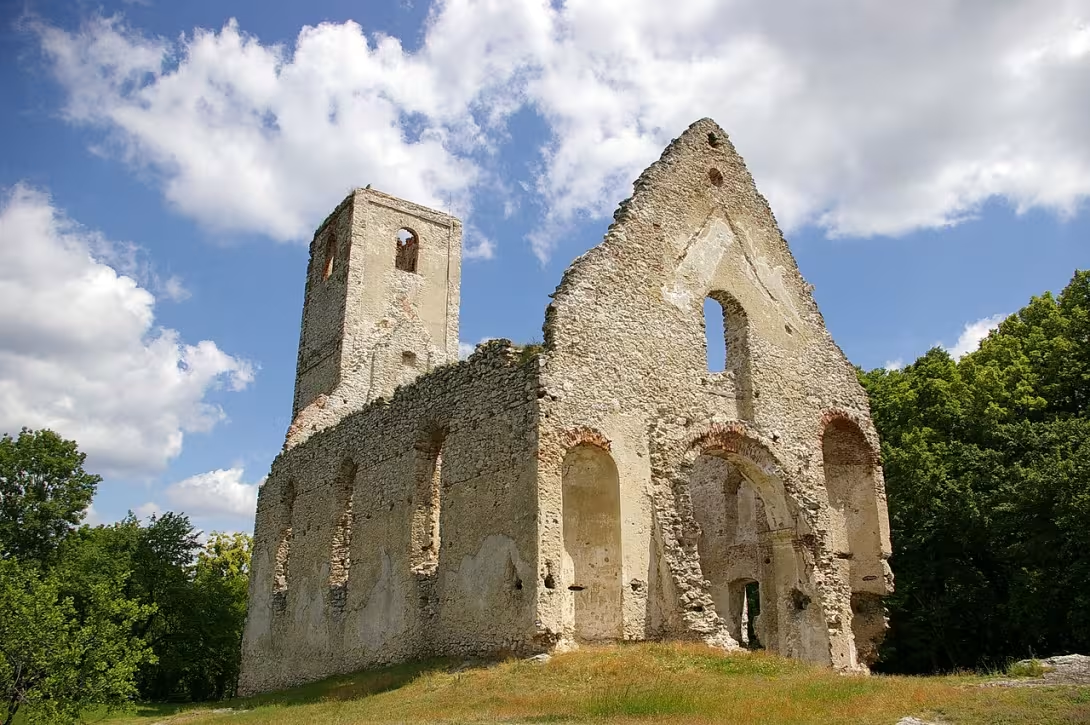

The historical view on the left is a visualisation generated by artificial intelligence and serves as inspiration.
Historical Milestones
- 1618 - Count Christopher Erdődy published the founding document for the Franciscan monastery
- 1646 - renewal and extension of the complex Gabriel Erdődym and Judou Amade
- 1663 - invasion and plundering of the Turks monastery and subsequent imperial armies
- 1701 - the church's restoration
- 1786 - Abolition of the monastery by Emperor Joseph II in the framework of Jozefian reforms
- 1995 - Establishment of St. Catherine's Order to Save Ruins
Heritage surveys
-
2015 — Umelecko-hisotrický výskum, Architektonicky-historícký výskum
Čiastkový pamiatkový výskum -
2013/12 — Umelecko-hisotrický výskum, Architektonicky-historícký výskum
Čiastkový pamiatkový výskum -
2017/12 — Umelecko-hisotrický výskum, Architektonicky-historícký výskum
Čiastkový pamiatkový výskum -
2021/12 — Umelecko-hisotrický výskum, Architektonicky-historícký výskum
Čiastkový pamiatkový výskum
Interesting facts
- The Franciscan Order monastery was founded in 1618 and was the responsibility of Italian Pietro Spazzo. - According to legend, St. Catherine Alexandria appeared to the young count and hermit John Apponyi. - Between 1788 and 1792 the monastery occupied seven military invalids from Trnava. - The baroque altar with statues of St. Catherine, St. Tekla and the torso of the angel was discovered under the rubble in the presbytery research. - A crypt was discovered and covered in a church ship.
Guide
Show guide text
The text was prepared by artificial intelligence and has not been editorially reviewed. It may contain inaccuracies.
Welcome to one of the most amazing and mysterious places you are in. You are standing in front of the Franciscan monastery Katarina, which in the silence of the Trnava region acts as a silent witness of ancient times. If you look at this historical structure that is highlighted in the middle of the surrounding nature, you may be immediately affected by its special atmosphere. It's not just a building; it's a place where a human whirlwind meets, historical destinies, and vague sine legends. See this moment, see the peace that reigns here, and let yourself be carried away by the stories hidden by these walls.
When we begin to see how this monastery originated, we must return deep into the 17th century. This whole history began in 1618, a time when many religious orders were built in our confederations. Behind the whole construction of the Franciscan monastery was a man with Italian blood and a visa, Pietro Spazzo. It was his hands and his knowledge that helped to create this complex, which would serve not only as a home for the Franciscans, but also as a spiritual pillar for the whole area of Dechtice and its surroundings. It is fascinating to think about how, over four hundred years ago, Italian artistic influences were linked to the local need to build a place for prayer and separation from the world.
Now, when you stand right in front of him, pay attention to the architecture itself and how the monastery fits into the surroundings. Although the details of its construction are changed in time, you can still perceive the original power and stability in it. Look at his face, at how his walls multiplied over time seem to be an essential part of this country. Consider the massiveness that the monastery exerts. It is not a building that would like to scream, rather it is a building that gives a feeling of duration and immobility. Notice how light and shadow work with its surface, how they change depending on where you stand. Although the architect whose hands have created every detail, the overall composition of the building tells you that they wanted to create a place that will resist centuries.
However, Catherine is not just about stone and mortar. Her true life begins where what we can see with our eyes ends and begins in the plains of legend. It was here, in this place, that events were taking place that gave this place its mystical touch. According to the old talks, St. Catherine Alexandria appeared here to a young count and hermit named John Apponyi. Imagine the isolation, the deep solitude that this man lived in, and then the moment that something supernatural came into his reality. This legend about the revelation of the Holy Catherine is what turned the monastery from a mere religious structure into a place that attracts spiritual seekers and people who believe that the world is much richer than it seems to us at first sight. This connection between the earthly count and the heavenly saint is the heart of this place.
The history of the monastery is not just about saints and miracles. It is also a story of human weakness, suffering, and the need for help. When we move to the end of the axis of the century, we will see a completely different picture of life in these walls. Between 1788 and 1792, the monastery also served as a place for seven military invalids. It is both a fascinating and sad contrast - a place that was created for prayer and spiritual ascension, it became a haven for men who did not suffer savaş wounds and needed peace and care. This short but important section of history reminds us that Catherine's monastery was always a place that could be adapted to the needs of people, whether it was a search for God or a search for refuge after difficult life trials.
Now that you decide how to continue your visit, remember that each part of this place has its own trail. Perhaps you will be impressed by the depth of the silence that rules here or by the feeling that you are in the space where time has stopped. There's something incomprehensible, something that can't just be described in words, but what you have to experience with your whole being. Whether you're more attracted to the spiritual legend of St. Catherine or fascinated by the historical transformation of the monastery into a place for the disabled, let yourself be guided by these stories.
Look around you again. Feel the atmosphere that's so unique. Catherine is not just a memory of the past; she is a living reminder of how the fates of individuals with the great history of nations and religions are lost. It is a place that invites you to stop, to unravel thoughts and to enjoy a moment of peace.
We lead you to discover this interesting place again. Walk around, see those quiet walls and let yourself feel that you have become right in the heart of history. Thank you for being with us during this short journey in time. Feel free to join us in this special monastery. We'll say goodbye, but leave a message in your heart that puts this place so strongly to every visitor.
Tips for visitors
Best time to visit and why: It is best to visit the Franciscan monastery Katarínka in summer, especially in July and August. For traveling to Dechtic, we recommend finding current connections via a search engine or mobile app.
What to take with you: When visiting the monastery we recommend having protective clothing, camera or mobile equipment for photography, drinking water and refreshments.
Photography - the best places and light: On the northern side of the monastery are visible ruined walls and windows. The ideal time for photography is morning or afternoon before the beginning of the evening when light is mild.
What to visit nearby (30 min from place): Near the monastery there are other historical monuments and picturesque landscapes suitable for short walks. Visit colorful rooms or enjoy peaceful time in natural landscapes.
Frequently asked questions
Can you visit the monument?
It's a ruin. Such places shall be freely accessible, but some shall be accompanied by a guide or closed for security reasons. We have not verified the current situation - move carefully and respect any prohibitions.
Where is the monument located?
Location: Dechtice, Trnava Region. The exact location shows the map on this page.
Why is the monument protected?
It is listed in the Central List of Monument Fund of the Slovak Republic as a national cultural monument (ÚZPF No 217-958).
For children
Imagine having the key to the time machine in your hand. You push the button, and the world around you starts to spin fast. The car, the phones and all modern gadgets disappear. Only deep silence remains, the smell of thick forest and the sound of horse hooves on a dusty road. This must have been exactly 408 years ago, when one very exceptional building - the Franciscan monastery of Catherine began to be built in Dechtice.
Nearby
🏰 Historic sites (260)
- Pamiatka na lesnú železnicu 1.5 km
- Planinka 1.7 km +421 905 269 181 web
- sv. Vendelín 2.0 km
- Juraj Fándly 2.1 km
- sv. Ján Nepomucký 2.1 km
- Pamätný dom Juraja Fándlyho 2.1 km
- Padlým obyvateľom obce v 2. svetovej vojne 2.2 km
- Padlým hrdinom v 1. svetovej vojne 2.2 km
- Trojičný stĺp 2.3 km
- sv. Florián 2.4 km
- Najsvätejšie Srdce Ježišovo 2.6 km
- Juraj Fándly 2.7 km
- Kráľovna pomoci 3.2 km web
- Mariánsky stĺp 3.3 km
- sv. Ján Nepomucký 3.6 km
- Archanděl Rafael 3.9 km web
- Padlým v 1. svetovej vojne 4.1 km
- Mariánsky stĺp 4.2 km
- Panna Mária s Ježiškom 4.3 km
- Trojičný stĺp 4.4 km
🍽️ Restaurants and dining (88)
- Pohostinstvo Naháč 2.2 km
- horný šenk 4.0 km
- Hostinec 4.3 km
- Hostinec u Procházku 4.5 km
- Pohostinstvo Šutiak 4.5 km
- Reštaurácia "Vo Dvore" 4.5 km
- Pizza Kanas Dechtice 4.6 km +421 908 655 771
- Hostinec Miriam 6.1 km
- U kmotra 6.2 km
- Kebab Trstín 6.2 km
- Bistro Koruna 6.2 km +421 915 424 961
- JOFFRE caffe 6.3 km
- Pizzeria Madunický 6.4 km Družstevná 654/15
- Pohostinstvo Kátlovce 6.5 km
- HVIEZDA Restaurant & Club 6.6 km Námestie 1. mája 397 web
- R&M Pub 6.6 km
- Krčma u Bociana 6.6 km Teplická 242/15
- LuMiReTi 6.7 km Námestie 1. mája 148/23 +421 911 723 456
- Pohostinstvo na rohu 6.7 km
- Pub Tribúna 6.8 km
🏨 Accommodation (20)
- Penzion Skalka 4.4 km web
- Chata Diana 5.5 km
- Kaštieľ Alfonz 6.1 km +421 910 826 072 web
- Garni Hotel 7.3 km
- Agropenzión 7 Divov 7.6 km +421 33 55 77 330 web
- Turistická ubytovňa 8.8 km Za bránou 323/1
- Penzión Villa Agnes 10.2 km +421 907 775 998 web
- Penzión Záhoran 10.3 km +421 34 658 31 44 web
- RZ Partizán 10.7 km +421 905 283 021
- Penzión Smolenice 10.7 km Obrancov mieru 210/43 +421 911 553 204 web
- Penzión Eden 10.9 km Obrancov mieru 118/56 +421907662771 web
- Chata SNP 11.0 km +421 904 870 940 web
- Kaštieľ Dezasse 11.3 km +421 948 196 796 web
- Ubytovanie Dolina 11.4 km
- Záruby resort 11.9 km web
- Koniareň 12.0 km web
- Rekreačné stredisko Jahodník-Škarbák 12.0 km
- Penzión Tvarožek 12.2 km web
- Šandorf 13.8 km +421 911 012 043 web
- Malvázia 14.1 km +421 903 90 42 78 web
🚲 Rentals and sport (6)
- Zelený Bicykel 7.0 km web
- Zelený bicykel 9.1 km +421 905 55 53 88 web
- Bike Service 9.4 km +421 903 402 782 web
- Zelený Bicykel 9.5 km web
- Danip-centrum 10.5 km +421 907 114 900 web
- Brezovské kúpalisko 10.7 km
🥾 Hiking and nature (174)
- Merakusove lázne 0.5 km
- Kátlovská hora 0.8 km
- Lípie 1.6 km
- Okrúhla 1.7 km
- Kráľova dráha 1.9 km
- Landríky 2.3 km
- Lažteky 2.3 km
- Rybníček 2.7 km
- Horné vinohrady 2.7 km
- Svätodušnica 3.2 km
- Handliarovská skala 3.3 km
- Kopec 3.4 km
- Hradište 3.5 km
- Šidlová 3.6 km
- Mihalinová 3.6 km
- Stoček 3.6 km
- Studnička Ľahký kameň 3.8 km
- Boričky 3.9 km
- Prameň Pod Dankech lúku 4.1 km
- Kresaná Skala 4.2 km
Thematic route
Thematic cruise route: Franciscan Monastery Catherine
1. Franciscan monastery Catherine
- Type: Religious monument
- Proč is worth a visit: Franciscan monastery in Dechtice is one of the oldest Franciscan towns in Slovakia. Its historical buildings, including a church with frescoes and architecture, offer a view of the past. In the monastery there is an exhibition focused on the history of the Franciscans. 2. The Courtyard of the Monastery
- Type: Architectural courtyard
- Proč is worth a visit: The courtyard of the monastery is a place to relax and view the surrounding architecture. You may seem to enjoy a peaceful moment that allows you to understand the context and meaning of the monastery in a rare landscape area. 3. Monastery Tower
- Type: Historical Tower
- Why it is worth a visit: The climb to the top of a significant monastery tower offers a panoramic view of the surroundings of Dechtic. 4. Church in the Monastery
- Type: Religion building
- Proč is worth a visit: The church of the monastery is home to frescoes and architecture. Its interior offers a view of art and culture that were part of the Franciscan community. 5. Park around the Monastery
- Type: Green zone
- Proč is worth a visit: Park offers the opportunity to walk in a natural and peaceful atmosphere. The ideal place for a short rest period after a tour of the historical monastery facilities. This route offers a view of the Franciscan monastery Katarina and its immediate surroundings, where you can discover the history and culture of Dechtic.
Seasonal recommendations
Jaro: Catherine Monastery is manifested in the spring by flowering of newly planted flowers and trees. Warm sunlight highlights the stone architecture of the ruin. The atmosphere is clean, ideal for relaxation between flowers. When visiting, we recommend wearing casual clothes with a handy coat and good footwear for irregular terrain. The best time to visit is morning or evening.
Léto: The Létos are illuminated by the Catherine monastery with long sunny days, which adds a dramatic effect to its ruin. At higher temperatures we recommend wearing soft and long clothing, sunscreen and plenty of drinking water. The best time to visit is morning or evening.
Under: In the podium, the monastery Katarínka turns into gray and green-orange spectrum for deciduous trees. Sunlight creates a breathtaking atmosphere between golden leaves, ideal for photography. When visiting we recommend wearing multi-layered clothes and good footwear for changing temperatures and possible humidity. The best time is morning or in time like that.
Winter: The Catherine monastery manifests itself in its most cloudy form when the earth covers dreams. Sunlight is weaker and longer evenings add melancholy cold. Prepare for winter temperatures by wearing multilayer clothing, including wind and cold protective elements. Good footwear with smooth soles are essential on the fried surface. The best time to visit is in the weather without dust storms, when the light is still long enough for photography.
Visualisations and artistic views


The visualisations are generated by artificial intelligence and serve as inspiration.
Photographs from the area
Real photos taken near the monument


Source and licence are given for each image.
Visitor Tips
No tips yet. Be the first!
Log in and add your tip.
Zdroje a literatura
The factual basis for this text was the article na Wikipedii, whose authors are Wikipedia contributors. The article is available under the licence CC BY-SA 4.0.
Location on Map

Visitor photos
No photos yet. Be the first to add a photo from your visit!
Log in and add your photo or leave a rating.
You get more points for a visit verified in the app — we can tell from the GPS that you are there.
Reviews and comments