

church of Our Lady Rosary Church
Roman Catholic parish church of Our Lady of Rosary in the village of Radom in the district of Svidník is a classicistic building from the years 1792 to 1797. The interior combines elements of rococo and classicism.
The church built the Religious Fund at the end of the 18th century, probably according to the construction project of the Chamber.
It is a single-ship area with segmented presbytery closure. The northern sacristy is added to the building and a tower is built into the western shield facade. The interior consists of an enveloping of Prussian vaults with interklenbých strips, which are mounted on wall pilasters. The exterior has been reinforced by supporting pillars since 1874. The western facade consists of a horizontal rustic rustic rizalit on a shield field with a round window and concave profiled wings. The rafters of the tower are divided above the shield by corner pilasters and a terraced roof ledge, covered with a baroque mine with lateral.
In the interior is the main altar from the period of passage rococo to classicalism with the painting of the Rosary Virgin Mary and rusticalized carving forms. The side altar of St. Anna from the end of the 18th century contains an image of a saint in a classicistic frame; carving details and side semifigures of Jesuit saints are rococoque. The Classicist pulpit is complemented by the Years and Festons from the church construction period. The stone baptistery with a tank from 1681 sells the church building; today it stands on a classicist balustrovite foot without a foot.
The church is listed in the Central List of Monument Fund of Slovakia under number 236/1. Renovated, located in good condition and standing in the middle of the village next to the cemetery.
Tehdy a dnes
Drag the slider and compare how the monument might have looked when it was built with the view today.
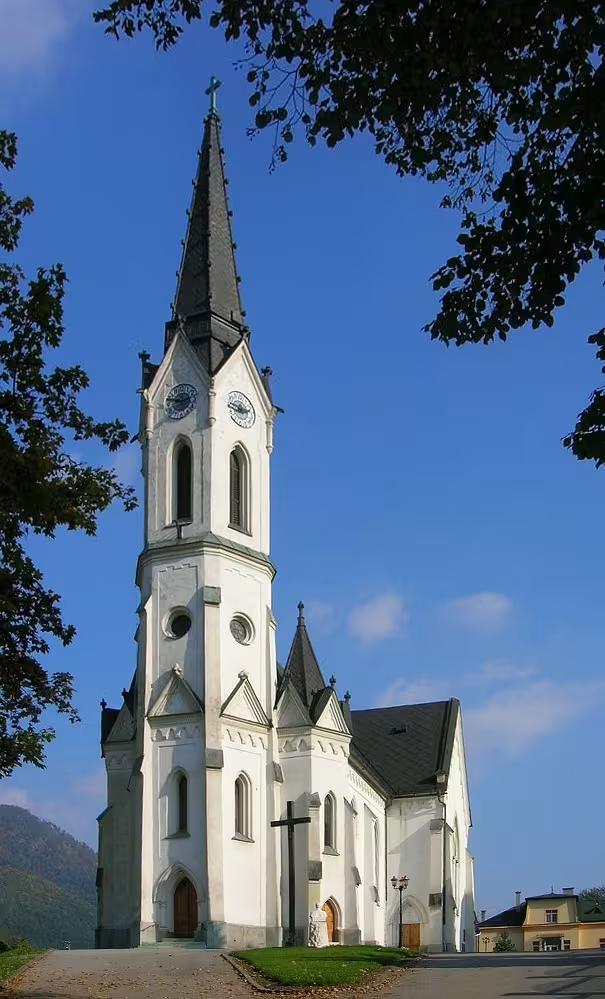

The historical view on the left is a visualisation generated by artificial intelligence and serves as inspiration.
Historical Milestones
- 1681
- Creation of a stone baptismal element
- The average labour costs of the sampled Union producers developed over the period considered as follows:
- Construction of the classical Roman Catholic Church
- end of the 18th century
- Building a church A Religious Fund
- 1874
- Strengthening the church exterior with supporting pillars
Interesting facts
- It is a classicistic structure from 1792 to 1797 built by the Religious Fund. - The interior combines elements of rococo and classicism and is encased by Prussian vaults. The exterior of the building has been reinforced by supporting pillars since 1874. - The main ambit altar comes from the period of passage of the rococo into classicalism and contains an image of the Rosary Virgin Mary. - The stone baptistery with a tank from 1681 sells the building of the church itself.
Guide
The guide was voiced by a synthetic voice created by artificial intelligence.
Show guide text
The text was prepared by artificial intelligence and has not been editorially reviewed. It may contain inaccuracies.
Welcome to Radoma, in the heart of Prešov region. Right now, you are facing an impressive building that dominates the local space and carries within itself the peace of several centuries. Before you lies the church of Our Lady Rosary, a place that is not only the spiritual center of the community, but also an important witness to regional history and architecture. When you look at the building, you may be impressed by its balanced form and peaceful expression typical of the period in which it originated. Listen carefully to the atmosphere of this place where faith meets the artistic expression of ancient times. Let's now look at how this building originated and in what context it was built. If we go back in time, we have to stop at the end of the eighth century. It was during this period, namely between 1792 and 1797, that the Roman Catholic building was built. It was not, however, the construction of one particular nobleman or local patron, but its creation was made possible by the Religious Fund. At that time it was an important mechanism that helped finance the construction and maintenance of church objects so that believers had a decent place to pray. It is fascinating to think that the construction process lasted for almost five years, which at the time required a huge effort of local inhabitants and craftsmen. Now that you see the church exterior, take note of its architectural style. This is classicism, which means that the building puts emphasis on harmony, simplicity and cleanliness of line. Classicism has tried to restore the ideals of antiquity, which is manifested in the absence of too octo-decorative elements and in the emphasis on symmetry. However, if you look closer at the walls of the building, you will notice something very interesting. Note the support pillars that strengthen the exterior. These elements were not part of the original project from the end of the eighteenth century. They were added later, namely in 1874. Their presence tells us that the building needed technical support over time to continue to stand up reliably and protect everything inside it. These pillars are silent witnesses of the church's care for generations of people in the 19th century. Now I invite you to move to the inside of the building, where a completely different world is opened. If you enter the interior, feel the space above your head. The church is encircled by Prussian vaults, giving space a specific rhythm and stability. What is truly fascinating is the artistic dialogue that takes place in the interior. Inside you will not find only one style, but a combination of two different periods. Note the elements of the rococo that bring lightness, playfulness and elegant curves into the space, and also the elements of classicism that return the interior to moderation and rationality. This contrast creates a unique atmosphere where rococo prestige meets the discipline of classicism. The main ambit altar is the key point to which you should pay the most attention in the interior. This altar is extremely interesting in terms of artistic development. It comes from the period of the rococo transition to classicalism. It's basically a stopped moment in art history. When you look at it, you can see how the older, more dynamic forms of the Rococo slowly give up new, stricter rules of classicalism. It's like watching the transition from one century to another encoded in wood and colors. Although the names of the architects who designed the church are now unknown, there are traces of the building that are older than the main building itself. This is a detail that can be overlooked at first sight but is historically extremely valuable. It is a stone baptismal element that dates back to 1681. Imagine that this one element precedes the construction of the current classicistic church by more than a hundred years. It is basically the only survivor fragment from a much older period that has been preserved and integrated into a newer area. This baptismal element is like a bridge that connects the present church with its predecessors and reminds us that the faith and tradition in Radom extend deep into the seventeenth century. It's fascinating to think about how many stories happened in these walls. From the moments of joy at baptisms that took place at that stone element to silent prayers in times of uncertainty. Although history does not mention the specific names of the personalities associated with this place, each pavement and every detail of the altar speak of thousands of nameless people who came here to seek peace and spiritual support. Before I say goodbye to this place, stop for a moment and consider this attraction. Church of the Virgin Maria Rosary is basically an architectural roadway. On the one hand, we have the stability of the support pillars from 1874, on the other hand, the fineness of the rococo in the interior and the old stone baptismal element from 1681 is at the heart of everything. It's a place where time doesn't run linearly, but it layers above one another. Now you can continue to explore the surroundings in peace. I recommend you once again bypass the building around and from different angles to watch as the pillars of 1874 complement the overall strength of the building. Feel the silence of this place and let yourself be guided by the atmosphere that generations have built before us. Thank you for your attention and we wish you a pleasant next stay in Radom.
Tips for visitors
We recommend a visit in spring and summer, when the surroundings of the church are in flower and the building is well lit by natural light. You come to Radom by car or public transport; check your current connections in the internet search engine.
When visiting we recommend footwear suitable for walks and clothing corresponding to the sacral nature of the place. For photography are suitable exteriors of the church, especially in the morning and evening light, which highlights the details of the facade.
There are no other specific attractions in the immediate vicinity, so it is recommended to focus on the architecture of this historic church. Families with children can use the visit for a short lesson about local architecture and a shared walk in nature.
Frequently asked questions
Can the monument be visited?
Religious buildings are usually open mainly during services; at other times a visit is normally arranged with the parish or the operator. We have not verified specific times.
Where is the monument?
Location: č. 40, Hradisko, Radoma, Prešovský kraj. The map on this page shows the exact spot.
Why is the monument protected?
It is listed in the Central List of the Monuments Fund of the Slovak Republic as a national cultural monument (ÚZPF no. 41C-236).
For children
Close your eyes now and imagine pressing the invisible button of time. Boom! You'll fly deep into the past, exactly 234 years back. The year is 1792. Cars, cell phones and asphalt roads will disappear around you. Instead, you see only green meadows, horse cars and people in strange hats and long dresses. Just at this time in the village of Radoma began to build something special.
Nearby
🏰 Historic sites (32)
- kpt. Adolf Weinhold 6.2 km
- Stropkovský hrad 6.4 km Zámocká 519/3
- Kaštiel Kurima 8.8 km Námestie sv. Michala 210/35 web
- Kaštieľ Marhaň 9.0 km web
- Hrad Svidník 9.5 km
- Adam Hlovík 9.8 km
- 100. výročie vzniku ČSR 9.9 km
- Kaštieľ Kalnište 9.9 km web
- Kaštieľ Giraltovce 10.2 km Dukelská 49/53
- Bánoovský kaštieľ 10.3 km Kukorelliho 335/17 web
- Dr. Jozef Goldberger 10.4 km
- Padlým ruským vojakom 11.2 km
- Múzeum ukrajinskej kultúry 11.8 km web
- Galéria Dezidera Millyho 11.8 km web
- Kaštieľ Svidník 11.8 km Partizánska 45/20 web
- Na pamiatku partizánskej skupiny "Čapajev" 11.9 km
- Múzeum ukrajinsko-rusínskej kultúry 12.0 km Centrálna 258/6
- 10. výročie vzniku ČSR 12.0 km
- Ludvík Svoboda 12.1 km
- Vojenské múzeum 12.2 km Bardejovská 414/25 +421 54 752 1398 web
🍽️ Restaurants and dining (52)
- Hostinec 1.7 km
- STEAK HOUSE u Mamy 5.8 km
- Letná krčma 5.8 km
- Pizzeria Marhaba Bar 6.2 km
- Victoria Bar 6.2 km
- Zámocká Pivnica 6.3 km
- Fresh Corner 6.7 km
- Motorest Breznica 8.0 km +421 944 706 639
- PePe Pub 8.0 km web
- Pizza Marhaň 9.1 km web
- Campari Club 9.1 km
- Motorest Polianka 9.3 km Stročín 120
- U Jara 9.4 km
- Majestic Burger 9.5 km +421 917 733 111 web
- Tony kebab 9.7 km
- Pizza Tony 9.7 km
- Zara caffe 9.7 km
- Bistro Bus 9.7 km
- Panoráma 9.7 km +421905444658
- Hostinec Miki 9.8 km
🏨 Accommodation (9)
- Horal 4.3 km
- Poľovníček 6.1 km
- chata na Kozej brade 9.2 km
- Hotel Alfa 9.8 km Dukelská 70/71
- Stara Posta 11.9 km web
- Hotel RUBÍN 11.9 km Centrálna 274/9
- Slávia 11.9 km Gen. Svobodu 706/37 web
- Jami 12.0 km
- Comenius Apartments - Apartmány na rohu 12.3 km Komenského 315/24
🚲 Rentals and sport (4)
- Kúpalisko Stropkov 5.9 km web
- Krytá plaváreň 6.4 km
- Peem Servis 11.7 km web
- AquaRelax 12.7 km
🥾 Hiking and nature (127)
- Prameň pod cestou 1.2 km
- Prameň v skruži 1.7 km
- Šťava 1.8 km
- Krúžky 2.1 km
- Rojov 2.2 km
- Stavenec 2.6 km
- Baňa 2.8 km
- Kochman 3.3 km
- Hrb 4.0 km
- Nižná Baňa 4.2 km
- Kamenná 4.2 km
- Chrasť 4.7 km
- Fircová 5.4 km
- Búčie 5.8 km
- Incova hora 5.8 km
- Ostrá hôrka 6.0 km
- Úboč 6.1 km
- Kobylovec 6.1 km
- Park Adolfa Weinholda 6.2 km
- Dúbrava 6.6 km
Thematic route
As the above background is empty, I propose a route that focuses exclusively on the monument itself and its immediate surroundings so that we comply with strict rules and do not use any fictional sites.
The church of Our Lady Rosary is the main point of this short but spiritually rich walk. This sacral building in Radoma represents an important cultural and religious footprint in Prešov region. Visitors can enjoy the quiet atmosphere surrounding this place and admire the architectural details that testify to the history and faith of local inhabitants.
Nádvorí church forms a natural framework for the first point of the route. The space before entering the temple offers an ideal place for a short break and reflection. Green surroundings and climates allow visitors to relax from the common rush and enter the space with other, quieter energy. It is a place where the link between the building and its surroundings can best be perceived.
The church tower is another important element worth noting. Although it is not always accessible from the inside, its silhouette dominates the horizon and serves as a landmark for the whole village. It symbolizes the direction towards the heavens and recalls the historical function of bells once called believers to prayers. Observation of this part of the building outside allows to appreciate its proportions and materials.
The interior of the church (if accessible to the public) represents the heart of this route. Here visitors can learn about liturgical equipment, altars and possible exposures that document the parish life. The atmosphere inside the temple is usually cooler and quieter, which promotes a spiritual experience. It is a place where history meets the present, and where the weight of traditions that are transmitted here from generation to generation can be felt.
The surroundings directly at the church include the immediate environment surrounding the building. Whether old trees, stone fences or small gardens, these elements give the whole authentic and historical character. A walk in this area allows visitors to understand the context in which the church exists and appreciate its place in the country. It is the conclusion of the route which connects individual points into one whole and leaves the visitor with a feeling of peace and harmony with the place.
This route is designed to be as faithful as possible to the information available and to focus on the quality of the experience from one particular monument, without the need to travel to remote locations.
Seasonal recommendations
At the spring visit of the Church of Our Lady of Rosary in the village of Radom you can observe the building in the surroundings of the waking nature of Prešov region. Spring sun and green vegetation create a pleasant environment without many tourists. The weather is variable during this period, so it is advisable to choose layered clothing and waterproof footwear. The best time to explore the exterior and surroundings is clear in the morning when temperatures are suitable for walking and light is good for photography.
In the summer season sunlight highlights the architectural details of the building. It is recommended to schedule the visit for early morning hours or later in the afternoon to avoid the afternoon heat. Since it is sacral space, it is important to care for suitable clothing with covered arms and knees despite warm weather.
In autumn the surrounding nature is colored in yellow and red shades. The low sun creates long shadows and the number of visitors is minimal. Since the days are shrinking and the weather is getting colder and windy, the best time to visit is early afternoon. It is advisable to wear a warm sweater or a windshield to stay outdoors.
Winter around the church of Our Lady Rosence is characterized by a quiet and often snow cover that highlights the silhouette of the building in the country. In Advent and Christmas season, winter black comes quickly. When visiting, you need to think about warm clothes, hat and quality shoes, as the interior of the church is not heated. The best time to arrive is around noon when it is the most daylight. It is also recommended to check the status of roads in the region in advance.
Visualisations and artistic views


The visualisations are generated by artificial intelligence and serve as inspiration.
Visitor Tips
No tips yet. Be the first!
Log in and add your tip.
Location on Map
More monuments – Radoma
Show all in the town


Visitor photos
No photos yet. Be the first to add a photo from your visit!
Log in and add your photo or leave a rating.
You get more points for a visit verified in the app — we can tell from the GPS that you are there.
Reviews and comments