








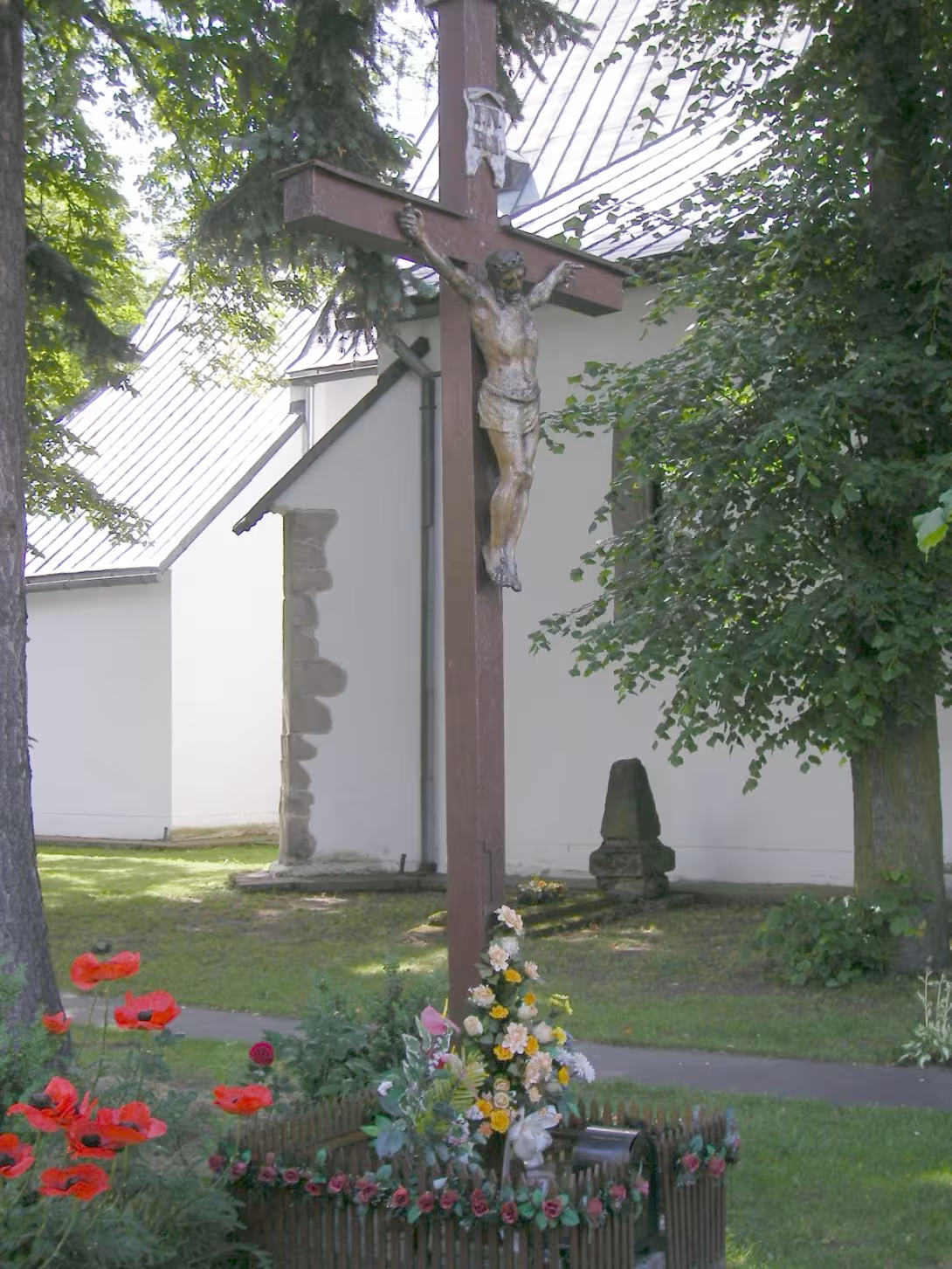
church r.k.sv.Martin Church with grounds
The church of St Martin's Roman Catholic parish in the centre of Martin in Žilina region is an early Gothic building from the second half of the 13th century. The area contains medieval frescoes and eloquent monuments of noble genders.
The building comes from about the 13th century, some authors mention specifically the 1970s. The church was built at the site of the burial place; it is believed that there was an older church or chapel. The monument office of the Slovak Republic in the area also records the remains of the Romanesque church from the 12th to the beginning of the 13th century and the medieval church cemetery from the 11th to 13th century.
The building is built in early-gothic style. The sanctuary has a square ground plan and a cross vault. Both the main entrance portal and the winning arch have a broken shape, with the winning arch showing a simple profile. The sacristy portal is simple. The area is also a brick baroque belfry from 1754 and a church garden from the second half of the 19th century.
Confessional church membership has changed several times in history. During the 16th - century Reformation, it was used by the Evangelical Church. After the recatholizing of the Revay patrons, he went back to the Catholic Church. During the professional uprisings ownership has changed repeatedly. After repressing the uprising of František II. Rákoczy in the early 18th century, he finally came into the administration of the Catholic Church.
Inside there are medieval frescoes from the first half of the 14th century, which were covered during the period of the evangelical report. They were rediscovered after the fire in 1871. The paintings were restored in 1908 and between 1951 and 1952 led by P. Mendel. In 1991 they were declared a national cultural monument. On the northern wall of the Presbytery are depicted Virgin Mary leading Christ as a child, apostles Peter and Paul with attributes and two other characters of saints. The South Wall contains a painting of three apostles without attributes with two married couples of donors and two damaged characters of the apostles. It is assumed that these are separate images, not continuous cycles.
The church served as a burial ground for noble families David, Korbély, Kossuth and Zaturecký. There are monuments of the genus Révay from Sklabina and Blatnica. On the south wall of the sanctuary is located Renaissance epitaph of red marble from the second half of the 16th century. It shows František Révaya in life-size with hands tied to prayer. The figure is in civilian clothing, which is unusual within the former Hungarian region, since similar tombstones are in armor or church ornament. On the chorus in the sideship is the death shield of Paul I. Révaya from 1635 with gender coats, war trophies and female characters representing the allegory of virtues.
Other facilities include 14 reliefs of the cross road, the statue of Piety by Fraň Štefunk and the altar painting of the Virgin Mary permanent help from Martin Benka.
Tehdy a dnes
Drag the slider and compare how the monument might have looked when it was built with the view today.

The historical view on the left is a visualisation generated by artificial intelligence and serves as inspiration.
Historical Milestones
- 16th century: church used the evangelical church during the reformation
- the beginning of the 18th century: finally passed into the hands of the Catholic Church after the suppression of the uprising of Francis II. Rákoczy
- 1871: medieval frescoes were discovered after the fire
- 1908: restoration of wall paintings
- 1951-1952: restoration of frescoes by P. Mendel
- 1991: medieval wall paintings declared a national cultural monument
Restoration history
| Years | Type | Extent | Condition after restoration |
|---|---|---|---|
| 2010 |
Obnova
kostol r.k.sv.Martina |
Čiastočná | dobrý |
Source: Monuments Board of the Slovak Republic — open data, licence CC BY 4.0
Artistic features
-
maľba figurálna — Infantia Christi
omietka, freska-secco · gotika · okolo pol.14.st. -
vitráž s abstraktnou kompozíciou — Abstraktná kompozícia-kríž
sklo, vkladanie do siete · moderna · 1961-1970 -
maľba figurálna — Súbor stredovekých malieb
omietka, freska-secco · gotika · okolo pol.14.st. -
maľba figurálna — Súbor malieb z 1.pol.20.st.
omietka, secco - maľba na suchú omietku · moderna · 1921-1930 -
maľba figurálna — Útek do Egypta
omietka, secco - maľba na suchú omietku · moderna · 1921-1930 -
maľba figurálna — Apoštoli
omietka, freska-secco · gotika · okolo pol.14.st. -
vitráž s abstraktnou kompozíciou — Abstraktná kompozícia
sklo, vkladanie do siete · moderna · 1961-1970 -
maľba figurálna — Svätci
omietka, freska-secco · gotika · okolo pol.14.st. -
vitráž s abstraktnou kompozíciou — Abstraktná kompozícia-hriech
sklo, vkladanie do siete · moderna · 1961-1970 -
maľba figurálna — Dobrý pastier
omietka, secco - maľba na suchú omietku · moderna · 1921-1930 -
maľba figurálna — Kristus uzdravuje chorých
omietka, secco - maľba na suchú omietku · moderna · 1921-1930 -
maľba figurálna — Apoštoli
omietka, freska-secco · gotika · okolo pol.14.st. -
vitráž s abstraktnou kompozíciou — Abstraktná kompozícia-krv Kristova
sklo, vkladanie do siete · moderna · 1961-1970 -
maľba figurálna — sv.Rodina v tesárskej dielni
omietka, secco - maľba na suchú omietku · moderna · 1921-1930 -
vitráž dekoratívna — Gloriola
sklo, vkladanie do siete · moderna · 1961-1970 -
vitráž s abstraktnou kompozíciou — Abstraktná kompozícia-modlitba
sklo, vkladanie do siete · moderna · 1961-1970 -
vitráž s abstraktnou kompozíciou — Abstraktná kompozícia-odpustenie
sklo, vkladanie do siete · moderna · 1961-1970 -
vitráž s abstraktnou kompozíciou — Abstraktná kompozícia
sklo, vkladanie do siete · moderna · 1961-1970 -
vitráž s abstraktnou kompozíciou — Abstraktná kompozícia
sklo, vkladanie do siete · moderna · 1961-1970 -
vitráž s abstraktnou kompozíciou — Abstraktná kompozícia-milosť
sklo, vkladanie do siete · moderna · 1961-1970 -
maľba s krajinou — Slnečné hodiny
omietka, secco - maľba na suchú omietku · ľudová práca · 19.st. -
vitráž s abstraktnou kompozíciou — Abstraktná kompozícia
sklo, vkladanie do siete · moderna · 1961-1970 -
maľba figurálna — sv.Peter,sv.Pavol
omietka, freska-secco · gotika · okolo pol.14.st.
Source: Monuments Board of the Slovak Republic — open data, licence CC BY 4.0
Interesting facts
- It is an early Gothic building from the second half of the 13th century, which was built on the site of the burial ground. - In the area there are remains of Romanesque church from the 12th to the beginning of the 13th century and medieval church cemetery. - The interior is decorated with medieval frescoes from the first half of the 14th century, which were rediscovered after the fire in 1871. - The Renaissance epitaph of František Révay is unusual by the fact that the figure is displayed in civilian clothing instead of armor or church ornate. - The church served as a burial ground for no
Guide
Show guide text
The text was prepared by artificial intelligence and has not been editorially reviewed. It may contain inaccuracies.
Welcome to the heart of Martin. Right now you are facing one of the most important monuments in this region, which bears the mark of many generations. In front of you is the church of St. Martin's church with the surrounding area. When you look at it, you may only feel the calm atmosphere of the present, but in reality you are in a place that is deeply linked to the early history of the region. Look carefully at the overall form of the building and see the silence surrounding this holy space.
Let's now look at when and how this church originated. Although the exact names of architects or builders have kept history a secret, we know that this is an early Gothic construction. Its origin dates back to the second half of the 13th century. It is fascinating to think that at the time this church began to rise, the world around us seemed quite different. An important detail, however, is the place where the church stands. The building was not built just by chance, but was built directly on the site of an older burial ground. This gives this place a special character and reminds us of the connection between the world of the living and the dead, which was perceived very naturally in the Middle Ages.
Now that you notice architecture and surroundings, not only the building itself, but also the entire area in which you move. This is where one of the most valuable layers of history lies. In the area there are remains of an older Romanesque church, which stood here in the 12th century until the beginning of the 13th century. This means that under your feet and around the current construction lie the foundations of the period that preceded Gothic. Note also the medieval church cemetery. These elements, together with the main building, form a whole that racjonalizes the development of Christianity and settlements in this city.
Although we do not have the names of specific personalities associated with this place by personal stories, the church itself witnesss the stories of thousands of people. Imagine all the prayers, ceremonies, and historical events that have taken place over the past seven centuries. Each stone of this building bears the memory of those who have sought comfort, peace, or spiritual support.
Now laugh at me, but let me bring you to one of the greatest attractions that are in the interior. If you have the opportunity to enter, I recommend you pay full attention to the walls. The interior is decorated with medieval frescoes from the first half of the 14th century. These paintings are medieval codes that at the time of their origin should have spoken to people who could not read. These are precious artistic testimony from the time that early Christian artist and symbolism developed in our parts. At the same time, see the fact that this whole complex is standing on an old burial ground, creating a strong contrast between the colorfulness of frescoes and the quiet eternal rest.
It's fascinating how the epochs layer. From the Romanesque foundations of the 12th century, to the early Gothic construction of the 13th century, to the artistic details of the 14th century. It's all here, in front of you, in one area.
I hope this short trip to the past has helped you to better appreciate the value of St. Martin's church. Now I'm going to let you go through the area in peace, think about its history, and perhaps you've quietly perceived the presence of all the centuries that shaped this place. We wish you a pleasant further stay in Martin and a pleasant discovery of other historical treasures of this city. Let your senses absorb the atmosphere of this medieval sanctuary. At the next point of your journey.
Tips for visitors
Visit the church of St. Martin in spring or autumn. Pleasant temperatures allow detailed bypass around the area and observation of architecture without summer crowds.
We recommend dressing appropriately due to the character of the sacral structure. During a longer tour of the city we recommend practical shoes for walking around the historical centre.
For photography are suitable moments shortly before sundown, when light highlights details of facade and tower. Suitable angles are around the area, where you will capture the construction in the context of the urban environment.
Families with children can follow the architecture and history of the city while walking around the area. We recommend to focus on the church area itself.
Frequently asked questions
Can the monument be visited?
Religious buildings are usually open mainly during services; at other times a visit is normally arranged with the parish or the operator. We have not verified specific times.
Where is the monument?
Location: Námestie SNP, Martin, Žilinský kraj. The map on this page shows the exact spot.
Why is the monument protected?
It is listed in the Central List of the Monuments Fund of the Slovak Republic as a national cultural monument (ÚZPF no. 316-568).
For children
Close your eyes and imagine pressing a secret button on a time machine. Click! You'll fly deep into the past. We're about 126 years from now, back to when there were no smartphones, internet or cars. We are in the city of Martin, where stands the proud church r.k.sv.Martin. But beware, this place hides a much bigger secret than it seems at first sight. It's like a detective where every stone tells its own story.
Nearby
🏰 Historic sites (130)
- Juraj Jánošík s družinou 0.1 km web
- Okno do histórie 0.2 km
- Múzeum Andreja Kmeťa 0.4 km +421 43 245 5113 web
- All for JAN 0.4 km
- Andrej KMEŤ 0.5 km
- Dom Jozefa Cígera Hronského 0.5 km +421 904 908 785
- Andrej Kmeť 0.5 km
- SNK - Literárne múzeum 0.6 km +421 43 245 1610 web
- Etnografické muzeum 0.6 km
- Prva budova Matice slovenskej 0.6 km
- Múzeum Martina Benku 0.6 km Kuzmányho 524/34 web
- Pamätník Memoranda národa slovenského 0.6 km
- sv. Cyril a Metod 0.7 km
- Pamätnik obetiam totalitného režimu 0.8 km
- Pavol Országh Hviezdoslav - verš 1.2 km
- Pamätný objekt SNP 1.6 km
- Slovenské národné povstanie 1.6 km
- Aeromúzeum Martin 1.8 km +421 905 802 314
- Pamatnik SNP 1.9 km
- Pamätník francúzskym partizánom 2.0 km
🍽️ Restaurants and dining (215)
- Hugo Dolce & Gelato 0.1 km
- Pizza z pece 0.1 km
- Julius Meinl 0.1 km
- Banyan 0.1 km
- Slovak express 0.1 km
- KFC 0.1 km Námestie SNP 2
- Café Gallery 0.1 km
- Pražiareň kávy 0.1 km
- Caffeine 0.1 km
- Poke 0.1 km
- Spot Coffee Co. 0.1 km Riadok 5515/1
- Česká hospoda 0.1 km web
- Flámmovňa 0.1 km web
- Burger & Schnitzel u Rena 0.1 km
- Pizzéria Venézia 0.2 km +421 948 22 07 08 web
- Basta Fidli 0.2 km +421 948 081 717 web
- Pán Palacinka 0.2 km
- Šport pub 0.2 km
- Kamala 0.2 km
- NhaBe 0.2 km +421910172869 web
🏨 Accommodation (58)
- Turiec 0.2 km A. Sokolíka 132/2 +421434012077 web
- Penzión Čierna pani 0.6 km +421 43 413 15 23 web
- martINN 0.7 km
- Penzión Ľadoveň 1.3 km web
- U Martina 2.3 km
- Victoria 2.5 km +421 434 304 836 web
- Penzión Pri Kaštieli 3.0 km web
- Hotel Bystrička 3.0 km web
- Eso 3.4 km web
- Apartmány Turiec 3.6 km +421 908 255 558 web
- Hotel Hrádok 4.1 km
- Zrub Virginia 4.1 km +421907858454 web
- Wellnes penzión Ferrata 4.7 km Ul. Gladiola, Martin 03601 +421 908 700 888 web
- Chata ToMi 4.7 km +421 948 623 148 web
- Chata Dolina 4.9 km
- Linda 5.6 km
- KoRAS 5.9 km
- Burra 5.9 km K. Kalocsaya 2
- Turistická ubytovňa Hôrka 6.3 km web
- Turistická ubytovňa 6.6 km +421 905 205 476
🚲 Rentals and sport (31)
- Max Šport 0.1 km web
- Novsport 0.1 km
- Sportisimo 0.1 km
- Adventura Sports 0.2 km
- Marki Sport 0.2 km
- unisport 0.3 km
- Sport 2000 0.3 km
- Segoland - lanový park 0.5 km +421 918 402 854 web
- Fit Club Strojár 0.8 km
- Motokáry Martin 1.0 km +421 940 548 131 web
- Všešportový areál 1.1 km
- Plaváreň 1.2 km
- Športová hala Podháj 1.4 km Československej armády 1698/10
- Intersport 2.3 km
- Decathlon 2.6 km
- Sportisimo 2.6 km
- Fatra Sport 3.0 km
- Šport park Pltníky 3.0 km +421 905 657 206 web
- Športové centrum Diaková 3.6 km
- Areál SIM 5.3 km web
🥾 Hiking and nature (268)
- Altánok 0.2 km
- Malá Hora 0.8 km
- Tank T-34 1.5 km
- Námestie protifašistických bojovníkov 1.9 km
- Hájsky medokýš 1.9 km
- Nábrežie Turca 2.1 km
- Park na Severe 2.2 km
- Kopanica 2.5 km
- Bôriček 3.0 km
- Bôry 3.1 km
- Jazierko a lokalita hrádok 3.3 km
- Mestská Borová - výhľad na Martinské hole 3.7 km
- Silava 3.8 km
- Krásna 3.8 km
- Stráž 3.9 km
- Kobyla 4.3 km
- Hrádok 4.4 km
- Rozhľadňa nad Bystričkou 4.7 km
- Húseň 4.9 km
- Radúchovo 4.9 km
Thematic route
As there are no other objects in the area of the area, I propose a thematic route in the area of the main objective:
1. Church of St. Martin - Visit the interior of this Roman Catholic temple.
2. Church area - Take a walk around the building and check the exterior of the church.
3. Courtyard and surrounding area - Explore the immediate area that completes the complex of monuments.
Seasonal recommendations
In spring, the area of St. Martin's church will be surrounded by waking nature. The sun in this period provides natural lighting that highlights the details of the facade. It is recommended to visit the site in the morning. Due to variable weather, it is advisable to coat with layers and wear comfortable shoes. Summer season brings intense light and high temperatures. This creates a contrast between the exterior and the colder environment of the building. The neighborhood is full of flowers. We recommend planning the visit early in the morning or late in the evening to avoid the glow. Use lightweight, breathable clothing and sun protection. Autumn in Žilina region Rozwietuje the area with golden and red tones of leaves. The low sun creates long shadows that are suitable for photography architecture. During this period we recommend woolen clothing that protects against colder winds. It is appropriate to plan the visit during working days when there are fewer people around. The winter season brings peace to the area. Snow often covers the details of the terrain and creates a white background for the church. In Advent time, the atmosphere is festive. Due to the low temperature and snow, cover yourself in warm layers, put on non-slip shoes and use a cap or gloves. We recommend coming in daylight, which quickly disappears in winter.
Visualisations and artistic views


The visualisations are generated by artificial intelligence and serve as inspiration.
Photographs from the area
Real photos taken near the monument

Source and licence are given for each image.
Visitor Tips
No tips yet. Be the first!
Log in and add your tip.
Zdroje a literatura
The factual basis for this text was the article na Wikipedii, whose authors are Wikipedia contributors. The article is available under the licence CC BY-SA 4.0.
Location on Map


Visitor photos
No photos yet. Be the first to add a photo from your visit!
Log in and add your photo or leave a rating.
You get more points for a visit verified in the app — we can tell from the GPS that you are there.
Reviews and comments