








tolerance evangelical church Church
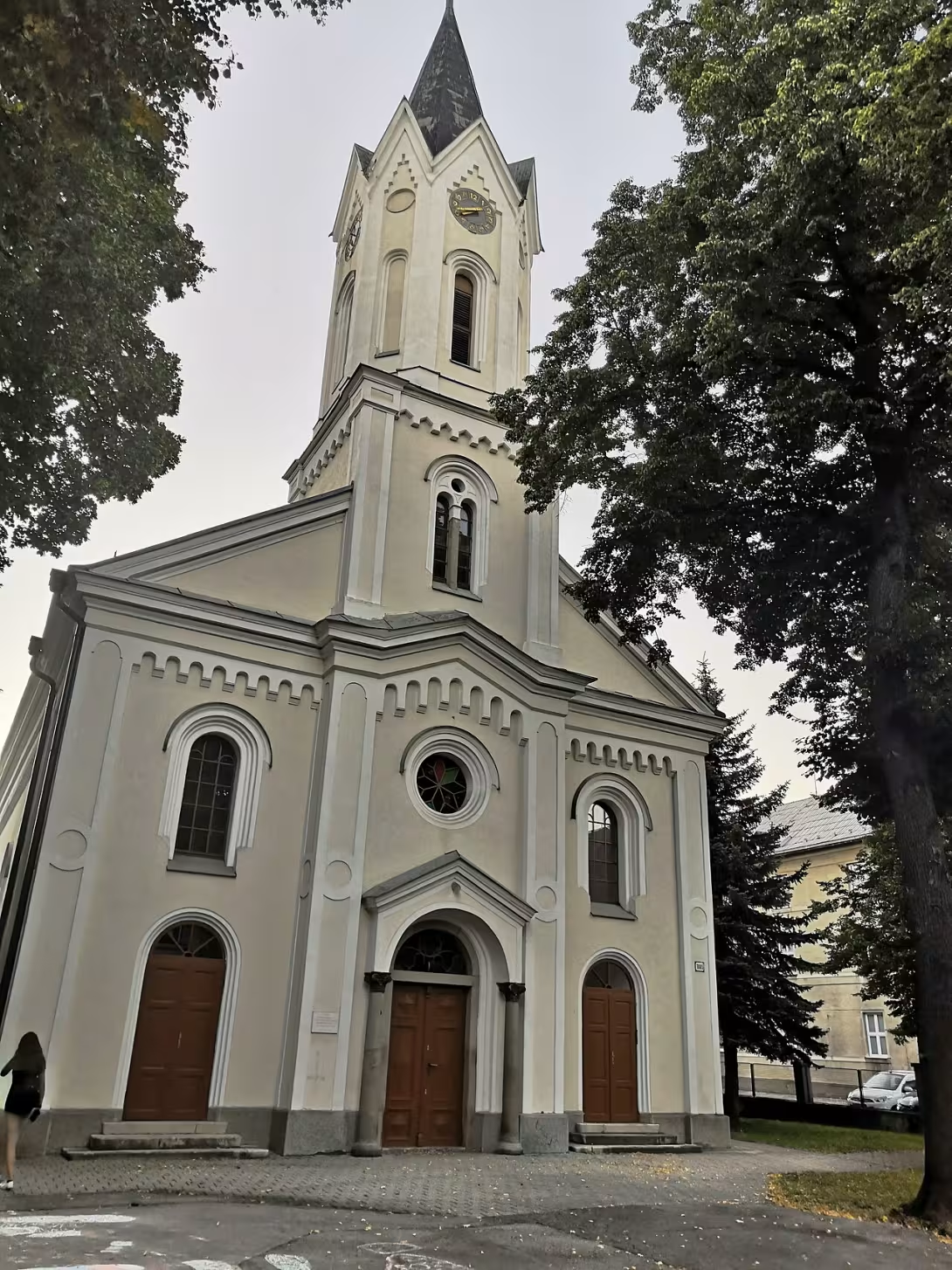
Evangelical church in Martin is a tolerance classicistic building from 1784 in the Žilina region. The building is declared a national cultural monument. At its gates in 1861, a Memorandum of the Slovak Nation was held.
Reformation in Turkey spread quickly with the support of the robe František Révaj. Already in 1536, Martin's parish priest Laurentius spoke in a reformist spirit. Between 1544 and 1545, the Evangelical Church was formed, using St. Martin's church at first. During the period of anti-reformist pressure, the local parish priest Michal Paulovich was dragged away on the gallery where he died in Nealola. A separate church was abolished in 1709 after the arrival of the imperial armies. Subsequently, the Gospels were persecuted, and church services were held in homes until the release of the Tolerance Patent.
The foundation stone of the new church was laid on 1 May 1784. Originally it was a modest building without a tower on the northern edge of the town. The wooden tower was built in 1789 after the amendment of the law. They built a school near the church. In 1885 the builder E. Erben a new brick tower. In 1895 Samuel Petrikovich, who built it, rebuilt the ships vigorously and added sacristy. At this stage, the ship acquired the current polygonal shape and facade modified in the Neo-Roman style.
Architecturally it is a hall single-ship building with a polygonal finished presbytery facing west. The east façade is triaxial with a slightly protruding rizalite, three portals and circular window. The entrance to the church leads from the east through the portikus to the space with a cross vault. The ship is encircled by a vaulted vault with lunet segments; behind the presbytery is the ground floor polygonal sacristy. The four-storey tower is oriented to the east and is part of the church mass. The interior consists of a three-armed empora carried by Tuscan columns. In 1903 a new newly-classicist altar, a pulpit, and a baptistery in white colored with plating was installed. Electrical lighting started in 1915.
Personalities of Slovak national revival and culture were active in the church, including Karol Kuzmány. During World War II, representatives of the local church congregation joined the resistance. Farar Joseph Bučko, the opponent of the authoritarian regime, died in a concentration camp. Ján Bakoš, the Martin Chaplain and the participant of the SNP met a similar fate.
Together with the parish and school, the church forms a closed urban unit of today's Memorandum Square. After the fall of the Communist regime, church life developed and in 1998 the object was restored.
Tehdy a dnes
Drag the slider and compare how the monument might have looked when it was built with the view today.

The historical view on the left is a visualisation generated by artificial intelligence and serves as inspiration.
Historical Milestones
- 1784
- laying the foundation stone of the church
- 1789
- construction of a wooden tower
- 1861
- implementation of the Memorandum of the Slovak Nation before the gates of the church
- 1885
- construction of a new brick tower by E.
Interesting facts
- It is a tolerance classicistic building from 1784, which is declared a national cultural monument. - At the gates of the church, a Memorandum of the Slovak Nation was held in 1861. - Originally the building was modest and without a tower, wooden tower was built only in 1789. - In 1903 a new newly-classicist altar, pulpit and baptismal in white colors were installed in the interior. - Personalities of Slovak national revival and culture, such as Karol Kuzmány, worked in the church.
Guide
Show guide text
The text was prepared by artificial intelligence and has not been editorially reviewed. It may contain inaccuracies.
Welcome to the heart of Martin. You stand in front of a building that is not only an architectural witness to the past but also a symbol of spiritual and national endurance. Before you lies a tolerance evangelical church, a building that carries layers of history from several centuries. Now that you are looking at it, you may perceive its peaceful atmosphere and the classicistic simplicity typical of buildings from a period of tolerance. It is a place where faith meets national awakening, which is why it is now declared a national cultural monument.
Now let's rush into the past together to understand why this church looks just like this. The foundations of this building were laid in 1784. To understand the context, we need to realise that the word tolerance in the name is not accidental. It refers to the Tolerance Patent issued by Emperor Joseph II, which allowed Protestants to build temples, albeit with certain limitations. That is why these original - focus structures were modest. At the time, nearly 300 years ago, the building was not as massive as it is today. Originally the building was modest and maybe more interesting, completely without a tower. Imagine this temple in its early years as a simple space for prayer and a community that was quietly enrolling in a city land.
Now if you look at the overall shape of the building, note its balance. The architecture of classicism avoided unnecessary ornaments and sought beauty in symmetry and clean lines. These are the elements you can see when looking at the facade. However, the building over time has undergone significant changes that reflected the growing needs of the community and the development of the city of Martin. The first significant addition was the wooden tower, which was already built in 1789, only five years after the foundation stone was laid. The wooden tower supplied the church with the necessary vertical accent and the sound of bells, which called the worshippers.
However, time went by and the need for modernisation was inevitable. If you raise your eyes to today's tower, you see no longer wood, but massive brick construction. This new brick tower was built in 1885 by a builder named E. Erben. It is a detail that changes the overall nature of the building and adds its stability and monumentality, which you still see today. But the changes didn't just end with the bell tower. In 1895 the remodeling of the church ship came. Samuel Petrikovich was responsible for this intervention. Thanks to it, it has gained its present size and shape, allowing more people to take on inside.
Now we should stop at one of the most important things associated with this place. Look at the space in front of the church gates. It may seem to you to be a mere square or an access road, but in 1861 one of the key moments of the Slovak national movement took place here. Just outside the gates of this church was a Memorandum of Slovak Nation. It was a period of strong pressure for Hungarianisation, and the Slovaks then expressed their demands for recognition of language and culture through this document. Imagine that crowd of people, the tension of air, and the sense of unity that surrounded that place. Thus, this church is not only a religious building but was the center of national confidence.
When we move inside in the spirit, although you are standing outside now, I can bring you closer to what is waiting for you in the interior. In 1903 the interior was modernized, which gave him the present time. At the time, new elements were installed in the interior, namely the newly classicistic altar and pulpit. These elements complement the overall aesthetic of the temple and create a harmonious whole that combines functionality with artistic expression of the period of the turn of the century.
You may now wonder if there is a mystery or a less well-known fact. Wonder how much the building has changed since its beginning. From a modest, towerless house for believers from 1784 to a monumental building with a brick tower and rebuilt boat. It's a fascinating story about growth and adaptation. Every change, whether it was a wooden tower from 1789, a brick tower from 1885 or a rebuilding of a ship from 1895 shows that Martin grew and the need for this spiritual centre grew with it.
Now take a moment of silence and the atmosphere of this place. You are facing a memory that has survived regime changes, political storms and national awakenings. It is a place where at one point the architecture of classicalism meets the dramatic history of the Slovak nation.
Let's finish our short tour outside the building. Now I invite you to go over the neighborhood in peace, to look at the details of the facade, and perhaps even to take a look inside to see with your own eyes the newly-classicist altar and pulpit from 1903. Let yourself be led by a sense of respect for the history that this place holds. Thank you for your attention and we wish you a pleasant next stay in Martin.
Tips for visitors
We recommend a visit in spring or autumn. Pleasant temperatures will make it easier to walk through the city center and natural light will highlight the architecture of the church.
When visiting the building we recommend discreet clothing according to the character of the building. Take comfortable shoes for a longer tour of the historic centre.
Details of the facade and surroundings of the building are suitable in terms of photos. The best light for exterior shots is during the -Golden clock-- shortly before sundown, when the walls of the church get warm shade.
Families with children can combine the visit with a short walk after Martin.
Frequently asked questions
Can the monument be visited?
Religious buildings are usually open mainly during services; at other times a visit is normally arranged with the parish or the operator. We have not verified specific times.
Where is the monument?
Location: Memorandové nám. 1005, Martin, Žilinský kraj. The map on this page shows the exact spot.
Why is the monument protected?
It is listed in the Central List of the Monuments Fund of the Slovak Republic as a national cultural monument (ÚZPF no. 316-569).
For children
Close your eyes and imagine you're moving in time. You're flying backwards in exactly 242 years. The ground under your feet is changing and you're landing in Martin. It's not the city you know from today's maps. The streets are dustier, quieter, and the air smells like smoke from fireplaces and fresh bread. You're in 1784. It was at this time that a building began to be built, which today looks like a silent witness to great history.
Nearby
🏰 Historic sites (124)
- Pamätník Memoranda národa slovenského 0.0 km
- sv. Cyril a Metod 0.1 km
- Prva budova Matice slovenskej 0.1 km
- SNK - Literárne múzeum 0.1 km +421 43 245 1610 web
- Andrej KMEŤ 0.2 km
- Pamätnik obetiam totalitného režimu 0.2 km
- All for JAN 0.2 km
- Múzeum Martina Benku 0.3 km Kuzmányho 524/34 web
- Múzeum Andreja Kmeťa 0.3 km +421 43 245 5113 web
- Dom Jozefa Cígera Hronského 0.3 km +421 904 908 785
- Andrej Kmeť 0.5 km
- Juraj Jánošík s družinou 0.5 km web
- Etnografické muzeum 0.6 km
- Okno do histórie 0.7 km
- Pavol Országh Hviezdoslav - verš 0.8 km
- Pamätný objekt SNP 1.0 km
- Slovenské národné povstanie 1.0 km
- Pamätník francúzskym partizánom 1.4 km
- Pamatnik SNP 1.7 km
- Aeromúzeum Martin 1.8 km +421 905 802 314
🍽️ Restaurants and dining (217)
- Sperto 0.1 km
- Pema 0.1 km
- Kocúr 0.1 km +421 949 799 966 web
- La Donuteria 0.1 km
- Insomnia 0.2 km
- martINN 0.2 km +421 917 941 500 web
- mini pizza/minit 0.2 km
- Pofel 0.2 km
- Pizza Maxim 0.2 km +421907468152 web
- Langoše 0.2 km
- P-Klub 0.2 km
- Mill€nium 0.3 km
- Pasáž 0.3 km web
- Kaviareň 0.3 km
- Reštaurácia Pasáž 0.3 km
- Melis Karaoke Bar 0.3 km
- Bubble store 0.3 km
- Kesta 0.4 km
- Havana Bar 0.4 km
- Mini Pizza 0.4 km
🏨 Accommodation (59)
- martINN 0.2 km
- Penzión Čierna pani 0.3 km +421(0)43/413 15 23 web
- Turiec 0.6 km A. Sokolíka 132/2 +421434012077 web
- Penzión Ľadoveň 1.9 km web
- Victoria 2.1 km +421 434 304 836 web
- Penzión Pri Kaštieli 2.4 km web
- U Martina 2.6 km
- Hotel Bystrička 3.4 km web
- Zrub Virginia 3.5 km +421907858454 web
- Eso 3.8 km web
- Apartmány Turiec 4.2 km +421 908 255 558 web
- Hotel Hrádok 4.3 km
- Chata ToMi 4.4 km +421 948 623 148 web
- Wellnes penzión Ferrata 4.5 km Ul. Gladiola, Martin 03601 +421 908 700 888 web
- Linda 5.0 km
- Chata Dolina 5.2 km
- Burra 5.2 km K. Kalocsaya 2
- KoRAS 5.2 km
- Turistická ubytovňa 6.2 km +421 905 205 476
- U Očenáša 6.2 km
🚲 Rentals and sport (33)
- Fit Club Strojár 0.2 km
- unisport 0.4 km
- Adventura Sports 0.5 km
- Všešportový areál 0.5 km
- Novsport 0.5 km
- Max Šport 0.6 km web
- Segoland - lanový park 0.6 km +421 918 402 854 web
- Sportisimo 0.7 km
- Plaváreň 0.7 km
- Marki Sport 0.8 km
- Športová hala Podháj 0.9 km Československej armády 1698/10
- Sport 2000 0.9 km
- Motokáry Martin 0.9 km +421 940 548 131 web
- Intersport 1.6 km
- Decathlon 1.9 km
- Sportisimo 2.0 km
- Fatra Sport 2.3 km
- Šport park Pltníky 2.4 km +421 905 657 206 web
- Športové centrum Diaková 3.8 km
- Areál SIM 4.6 km web
🥾 Hiking and nature (265)
- Malá Hora 0.5 km
- Altánok 0.6 km
- Tank T-34 0.8 km
- Námestie protifašistických bojovníkov 1.3 km
- Nábrežie Turca 1.5 km
- Park na Severe 1.6 km
- Hájsky medokýš 2.5 km
- Jazierko a lokalita hrádok 2.6 km
- Bôriček 3.0 km
- Kopanica 3.1 km
- Mestská Borová - výhľad na Martinské hole 3.4 km
- Bôry 3.5 km
- Krásna 3.8 km
- Silava 4.3 km
- Stráž 4.5 km
- Radúchovo 4.6 km
- Hrádok 4.7 km
- Kobyla 4.9 km
- banský mlyn 5.1 km
- Rozhľadňa nad Bystričkou 5.1 km
Thematic route
As the list of surroundings is not completed, I propose a thematic route in the area of the main objective:
1. Tolerance Evangelical Church - Visit the interior of the church from the period of religious tolerance. 2. Church area - Walk around the courtyard and look at the architecture of the building. 3. Exhibition within the church - Discover historical details and exhibits that document the history of the community.
Seasonal recommendations
In spring, the surroundings of the tolerance evangelical church in Martin are surrounded by fresh greenery. The sun in this period provides natural lighting that highlights the details of the facade. It is recommended to visit the place in the morning and wear layered clothes suitable for variable temperatures. Summer season brings intense light and rich colors of nature. The ideal time to visit is early morning or later noon to avoid the strongest glow. Practically easy, breathable clothing and sun protection. Autumn in Žilina region rozświetuje surroundings of the church with golden and red tones of leaves. The air is cooler and the atmosphere calmer. It is appropriate to wear a warmer sweater or jacket and choose days with a bright sky when the sun creates long shadows. The winter season changes the shape of Martin, especially if the construction covers the snow. In Advent time, the place takes on a spiritual dimension. Due to low temperatures and humidity, it is necessary to dress warmly, use waterproof shoes and layered clothing.
Visualisations and artistic views


The visualisations are generated by artificial intelligence and serve as inspiration.
Photographs from the area
Real photos taken near the monument


Source and licence are given for each image.
Visitor Tips
No tips yet. Be the first!
Log in and add your tip.
Zdroje a literatura
The factual basis for this text was the article na Wikipedii, whose authors are Wikipedia contributors. The article is available under the licence CC BY-SA 4.0.
Location on Map


Visitor photos
No photos yet. Be the first to add a photo from your visit!
Log in and add your photo or leave a rating.
You get more points for a visit verified in the app — we can tell from the GPS that you are there.
Reviews and comments