

church of the Sacred Mother of God Church
The Church of the Sacred Mother of God is a non-baroque Greek Catholic church from the second half of the 19th century in the eastern part of the village Horna in the Košice region. It has a four-seater wooden iconostasis and a historic icon of the Mother of God.
The building was built in 1890. It's a one-ship church with a semicircular presbytery. The shield facade is built-in tower between two baroque peak wings. The tower is divided into cordon ledges with corner lysenes and finished with baroque onion with lateral. The interior is encircled by Prussian vaults with arch bands, which set on the ledges of pilasters. The facade was originally horizontal rustic.
The main and side altars come from the beginning of the 20th century. They are believed to be work done by Rétay and Benedict from Budapest. From this workshop comes iconostasis from 1890. It is a quadruple polychrome wooden architecture in historical style. The first row of icons consists of St. Nicholas, the Mother of God, Christ and the Dance of the Virgin Mary; the middle part consists of the royal doors with the medallions of four evangelists. The second series contains icons of 12 great holidays and icon of the last dinner. The third row depicts the 12 apostles with the icon of the Pantocrat, and the fourth row consists of medallions of the Old Testament prophets. The iconostasis ends the calvary with the depiction of the crucified Christ, the Holy Mother of God, and the apostle John.
In the temple there is the icon of the Mother of God over 230 years old. According to the oral presentation, the icons flew into the woodpecker. Later, the restoration was cut and painted by the stops of St. Rosary, but in 1999 the icon was restored and sanctified in its original state. This monument and associated tradition are the basis of the coat of arms of the village Horna. In the interior there is also a picture of Madonna Byzantine type from the end of the 19th century and a picture of St. Trinity from 1891 by J. Brynzák. There are two bells from 1925 in the tower.
In 1944 the building suffered severe war damage. The first repairs took place in 1954 and the reconstruction was completed in 1970. Iconostas has undergone extensive reconstruction since 1997 and has been re-sanctified. The building is registered in the Central List of Monument Fund of SR under the number ÚZPF 10258/1.
Tehdy a dnes
Drag the slider and compare how the monument might have looked when it was built with the view today.
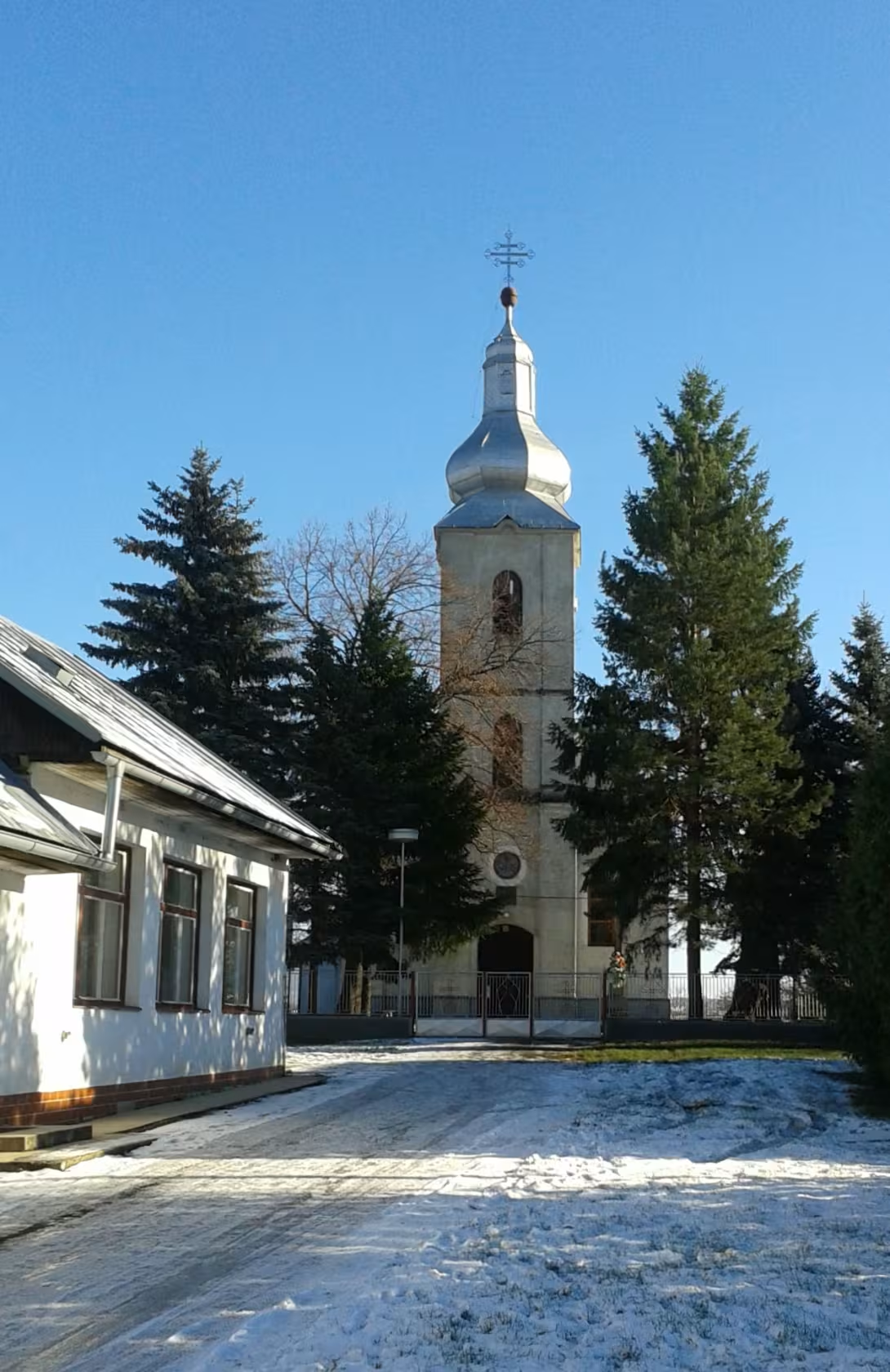
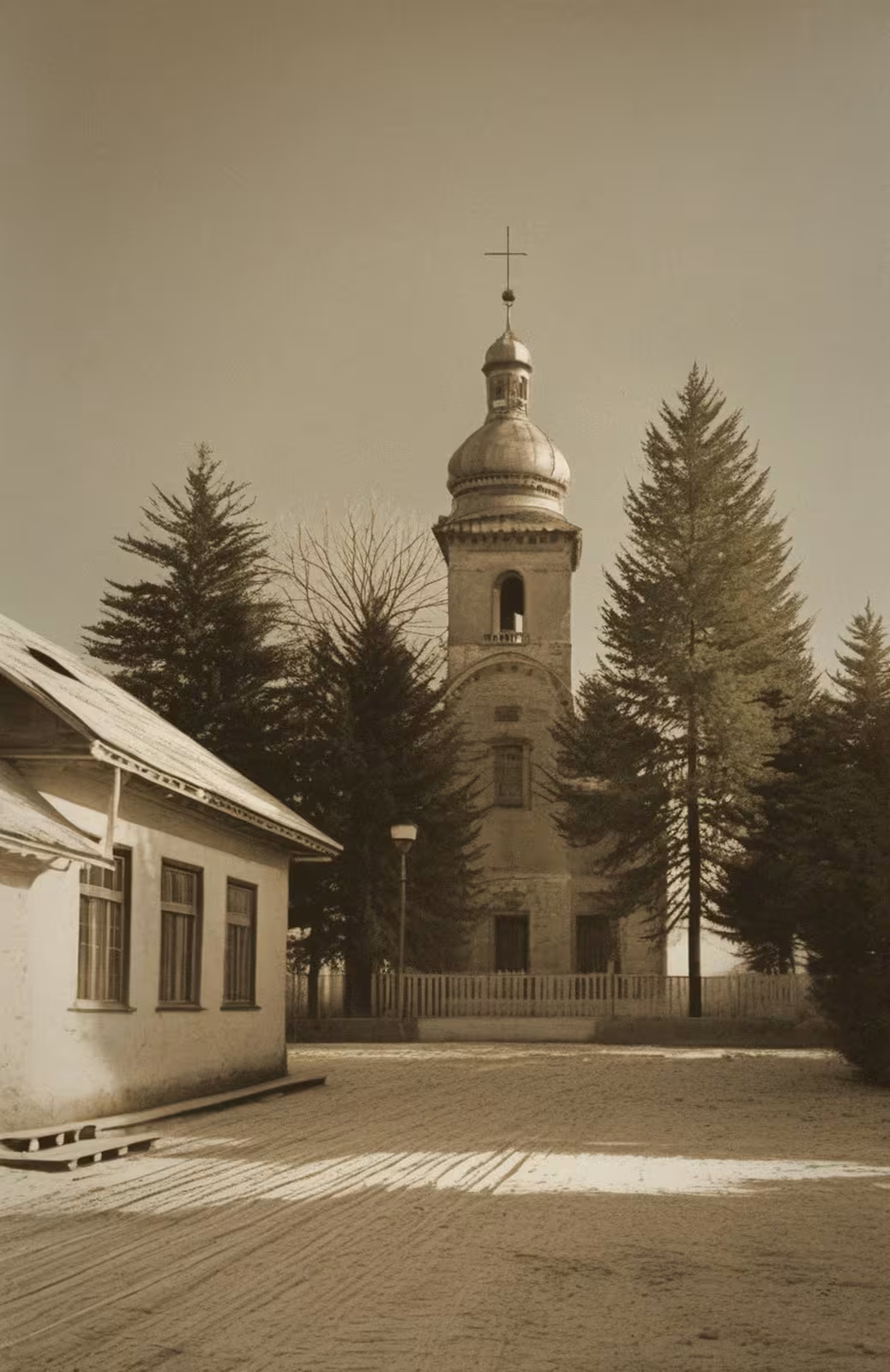
The historical view on the left is a visualisation generated by artificial intelligence and serves as inspiration.
Historical Milestones
- 1890
- construction of a non-barreel church
- 1925
- installation of two bells in the tower
- 1944
- heavy war damage to the temple
- 1954
- repair of the church after war damage
- 1970
- complete completion of reconstruction
- 1997
- the start of extensive reconstruction of the iconostasis
- 1999
- restoration and sanctification of the icon of the Mother of God
Interesting facts
- The church is a non-baroque Greek-Catholic church from 1890 with a tower finished with baroque onion and lateral. - It contains a four-seater polychrome wooden iconostasis from 1890, probably from the workshop of Rétay and Benedict from Budapest. - In the church is the icon of the Mother of God older than 230 years, which together with the associated tradition forms the basis of the coat of arms of the village Horna. - According to the oral presentation, the screen of the mentioned icon flew into the woodpecker. - The building suffered severe war damage in 1944 and the reconstruction was
Guide
Show guide text
The text was prepared by artificial intelligence and has not been editorially reviewed. It may contain inaccuracies.
Welcome to the village Horna, in the heart of the Košice region. Right now, you are standing before the Church of the Sacred Mother of God, which dominates the local country and reminds its presence of the spiritual heritage of the region. Looking at it, the first thing you are likely to be interested in is its balanced form and peaceful atmosphere, which you spiritually exude. It is a place where history, faith and artistic craft meet, and we are now inviting you to immerse yourself with us in the story of this neo-Beautiful temple. Let's first see when and how this church originated. The church was built in 1890. At that time, the construction of such an important building for the Horni community was a great milestone. Although the names of the specific architects who developed the project remained unknown at the time, the result of their work shows a high aesthetic sense and precision. The neobaroque style in which the building is built combines the elements of the classic Baroque with the more recent trends of the late 19th century, creating a harmonious whole that fits into the traditional architecture of the eastern Slovak country. Now we ask you to pay attention to the details you see right in front of you. Look up at the temple tower. Note the ending that is typical of this style. The tower is finished with baroque onion and above this element is lantern, which gives the entire building an elegant and take off look. It is this silhouette of the tower that is a characteristic of the Greek Catholic churches of this period and represents the symbol of the earth's connection with heaven. If we stop at the history of this place, we will find that the life of the temple has not always been peaceful. The building went through several key stages that left a mark in its history. In 1925 two bells were installed in the tower, which since then called the local inhabitants for worship and announcements important events in the village. Then came the tragic stage. In 1944, during the dramatic events of World War II, the temple suffered severe war damage. It was a period of great sadness and demise, when it seemed that the beautiful work of 1890 could disappear forever. However, the faith and determination of the local people were stronger than destruction. Already in 1954 repairs started after the war damage. However, the reconstruction was not quick or simple, as resources were limited at that time. The reconstruction work continued for many years until the reconstruction was completed in 1970. What you see today is thus the result of the endurance of the generations who have decided to preserve this temple for the future. Now we invite you to focus on what lies inside the temple, because that is where we will find one of the most precious treasures. The most prominent element is the four-seater polychrome wooden iconostasis, which dates from 1890, i.e. the time of the church itself. Iconostas is a masterpiece that divides the temple space with its rich colors and details. According to historical assumptions, it probably comes from the workshop of Rétay and Benedict from Budapest. These masters were recognized in their time, and their work in this temple testifies to the importance that builders attached to the artistic decorating of God's house. In addition to the iconostasis, a very valuable icon of the Mother of God, older than the building itself, is preserved in the temple. It is an object of deep respect and a symbol of continuity of faith that has survived centuries and continues to be in this unbiased space. The interesting thing that you may be interested in is also not to die the important process of recovery that takes place in newer times. In 1997 a large-scale reconstruction of the iconostasis was started. The restaurant of this complex wooden work requires extreme precision and knowledge of old techniques to preserve the original color and detail of each of its four stages. It is a constant battle against time and natural ageing of material so that we can today admire the beauty of polychromia in their full spldor. Now when you look at the temple as a whole, view it not only as a brick and wood building but as a living organism that survived wars, repairs, and renovations. From the neo-baroque onion tower to the detailed iconostasis, each part of this temple tells a story of endurance and devotion. We hope this short trip to history has helped you to better understand the meaning of the Church of the Sacred Mother of God in Horni. Now we leave you to admire the architecture in peace and see the peace of this place. You can keep looking around or slowly move on to other monuments of this beautiful region. Thank you for your attention and we wish you a pleasant day full of new discoveries.
Tips for visitors
Best time to visit and reason: - Spring and summer months (April to September): The surroundings of the temple and forests are flowering. In the morning and later in the afternoon are suitable conditions for photography and observing the details of architecture. - Autumn months (October): Time suitable to observe a change in the colour of the leaves.
It is recommended to navigate according to local information tables. Transport: You can use public transport that will take you to the vicinity of the temple. Check current connections and routes in mobile applications or on the official website of the transport company.
What to take with the seba: - A camera or smartphone with a good camera: The temple and surroundings are suitable for photography especially in the morning or evening, when light highlights details. - Comfortable shoes: The surroundings can be uneven, especially in forest or field areas. - Water and light snacks: There may not be enough stores around. - Map or GPS: It will help you navigate the field.
Photography - places and light: - Front entrance to the temple: Suitable light is in the morning or shortly before sunset, when it highlights the details of stone reliefs and the color of windows. - Surroundings of the temple (fields and forests): In summer they serve as a background for photos. Morning dew or evening fog complement the shots. - The church bell tower: The bell tower provides a view of the surroundings and is suitable for photography in the morning when the light is softer.
What to visit nearby (within 30 minutes of the place): - Horna village: Traditional houses and local sights. - Dams and watercourses nearby: Streams and water areas suitable for walks.
Tips for families with children: - Walk around the temple: Possibility to observe trees, flowers and animals around. - Games and storytelling: Space for games and inventing stories associated with the surrounding nature. - Visiting local cultural events: Local events or festivals, whose up-to-dateness you will verify on the information boards or with the residents.
Frequently asked questions
Can the monument be visited?
Religious buildings are usually open mainly during services; at other times a visit is normally arranged with the parish or the operator. We have not verified specific times.
Where is the monument?
Location: Horňa, Košický kraj. The map on this page shows the exact spot.
Why is the monument protected?
It is listed in the Central List of the Monuments Fund of the Slovak Republic as a national cultural monument (ÚZPF no. 429-10258).
For children
136 years ago, when fields and animals were still spreading in Horni, Košice region, the temple of the Sacred Mother of God began to be built. At that point, it was not yet known what secrets and stories would be hidden here later. Imagine under the sun and the noise of the wind the stones that turned into a tower with a baroque onion and shining lateral, as if they wanted to touch the sky.
Nearby
🏰 Historic sites (18)
- Panna Mária 2.1 km
- sv. Michal Archanjel 2.2 km
- Odvlečených židov 2.3 km
- Utečencov čo umreli na hraniciach 2.3 km
- Gitarové múzeum 2.4 km Gorkého 338/9 +421902370909 web
- Hrádok Choňkovce 6.4 km
- Vila 9.6 km
- Kaštielik 9.8 km
- Zotavovňa 9.8 km
- Tibava 10.2 km
- Archeologická lokalita. Praveké osídlenie 10.6 km
- Partizánom 11.1 km
- Stará píla 11.4 km
- Kúria 11.5 km
- Podstavec kríža 1903 12.2 km
- Pamätník Panne Márii na Brezovom mostíku 12.6 km
- Chrám Prenesenia ostatkov sv. Mikuláša 12.9 km web
- Pietne miesto utopeným 14.0 km
🍽️ Restaurants and dining (48)
- Reštaurácia Sobranecké Kúpele 1.2 km +421 907 146 785
- Cupika 2.0 km
- 11-ka Pub 2.1 km
- Bunker 2.1 km
- Pohostinstvo 2.1 km
- Maňa 2.2 km
- Reštaurácia Lucia 2.3 km +421 908 504 600
- Pizzeria Megyco 2.3 km
- Roulette club 2.3 km
- Pohostinstvo Marta 2.3 km
- Pizzeria Marianno 2.3 km
- Fresh Corner 2.4 km
- Očko Pub 2.5 km
- Pohoda 2.8 km
- Hostinec Motuz 3.8 km
- Penzión Valéria 7.3 km
- Motorest Rybnička 7.9 km web
- Hostinec Bystrina 8.1 km
- Motorest Marko 9.6 km
- Hostinec u Emila 9.8 km
🏨 Accommodation (21)
- PZ SRNEC Baškovce 5.4 km
- Ubytovanie 8.2 km
- Gazdovské lesy Vyšná Rybnica 9.4 km
- Penzión Ivana 9.8 km
- Starý Koňuš 10.2 km web
- Rusty Fox 11.2 km
- Levková chata 11.4 km
- Прага 13.6 km Верховинська вулиця 38 +380 312 64 0764 web
- Гостинний дім 13.6 km Верховинська вулиця 36 +380 312 64 4428;+380 312 61 4470 web
- Park Hotel Bristol 13.7 km вулиця Героїв України 29
- Europa 13.8 km Верховинська вулиця 3 +380 312 64 2518 web
- Sĺňava 13.8 km
- Хата 14.2 km
- Family 14.3 km
- Гуллівер 14.3 km
- Apartel Uzhhorod 14.3 km +380 67 005 5552 web
- Klokocovy 14.5 km
- Green Island 14.6 km
- Kamex 14.8 km
- PZ Poľana 14.8 km
🚲 Rentals and sport (2)
- Letné kúpalisko Sobrance 1.8 km
- Špica 2.4 km
🥾 Hiking and nature (114)
Thematic route
Route: Cultural and spiritual heart of Horna village
Since there are no specific other sights in the given area, I propose a central route which aims to further explore the main objective and its immediate area. This walk allows you to enjoy the atmosphere of the place without the need for long movements.
Church of the Sacred Mother of God This church is the architectural and spiritual centre of the village Horna. His facade and interior furnishings testify to local building tradition and religious life of believers in this part of the region of Košice. Visitors can enjoy the quiet atmosphere of sacral construction and admire details that often miss attention during quick shows.
The Hope and Entrance Zone of the Temple The space around the church serves as a natural place to relax and contemplate. From here the view of the surrounding village building is opened, which preserves typical character of the rural environment. It is the ideal place for a short break, where you can take photos or just sit and suck up the quiet environment of the village.
Interiors and exposures If the church is open, I recommend exploring its interior furnishings. There are often historical altar paintings, statues or other liturgical objects that document the development of local art. A careful view of the interior details reveals stories and symbols that give the construction depth and authenticity.
Church area surroundings The immediate surroundings of the temple, including any old trees or historical fences, form an important part of the overall experience. Natural elements close to sacral construction create a harmonious contrast between human work and nature. A short walk after this small area will illustrate the overall impression of the visit and allow you to better understand the place in the context of the whole village.
This compact route is ideal for visitors who want to devote time to one particular monument and its direct proximity, without having to travel to more distant locations.
Seasonal recommendations
Spring visit to this sacral building in Horná brings an extraordinary atmosphere of waking nature. The surroundings of the church are surrounded by fresh greenery and flowering trees add calm and relaxed character to the environment. The light this season is still soft and diffuse, creating pleasant conditions for observing architectural details without sharp shadows. Practical advice mainly relates to unpredictable weather, as spring can bring about rapid changes from sunny day to rainy. Clothing should be layered to adjust to temperature fluctuations. The best time to visit is noon when nature fully awakens and roads are dry, which facilitates access to the monument. Summer offers the longest days and the most intense light that reveals the colors and textures of the church facade in full shine. The surroundings are at that time the greenest and most lively, creating a contrast between ancient buildings and nature's vitality. The atmosphere is often noisier thanks to more tourists and local residents who use warm evenings. Practical advice includes care of hydration and sun protection, especially if you plan a longer stay outdoors. Clothing should be easy and breathable, suitable for higher temperatures. Morning or evening hours are ideal for visiting, as the sun is not so intense and temperatures are more acceptable, which increases the comfort of the overall experience. Podzim brings unique coloring of leaves to the surroundings of the Upper part, which creates a dramatic and photogenic background for the church. The light is lower and warmer this season, giving the architectural elements depth and mystical atmosphere. Nature is beginning to fall into sleep, which may provide some visitors with an opportunity for deeper contemplation and silence. Practical advice focuses on colder temperatures and the possibility of wet grass or fallen leaf on pavements. Clothing should be layered, with an emphasis on heat and waterproofness if the rain is predicted. The best time is noon when the sun still warms and the roads are driest, which ensures safe and pleasant access to the memory. Winter offers the quietest and most peaceful atmosphere, often highlighted by a snow cover that surrounds the church and its surroundings. Light is short and cold, which creates sharp contrasts and emphasizes hard lines of construction. Nature is in sleep, which allows you to focus exclusively on architectural and historical values of monuments without visual disturbing elements. Practical advice focuses on extreme cold and possible slippery travel. Clothing must be very warm, layered and with an emphasis on dry and non-slip shoes. The best time to visit is noon, when the sun is warmest and the sun is highest, which reduces the risk of hypothermia and facilitates movement in snowy terrain.
Visualisations and artistic views


The visualisations are generated by artificial intelligence and serve as inspiration.
Visitor Tips
No tips yet. Be the first!
Log in and add your tip.
Location on Map
Visitor photos
No photos yet. Be the first to add a photo from your visit!
Log in and add your photo or leave a rating.
You get more points for a visit verified in the app — we can tell from the GPS that you are there.
Reviews and comments