








church of St.Ladislava with area Church with grounds
The church of St. Ladislav with the area is an Art Nouveau sacral building from 1912 to 1913 in Hurbanovo. The architecture is inspired by the Gothic of Poemohrad and uses wooden construction.
The complex was established on the site of the Baroque church from 1718, which was restored after the earthquake in 1763. The original church and the parish building destroyed the fire in 1911. The new church, parish and belfry were created according to the design of architect István Medgyaszay; the implementation project was developed by Boldoghy Gyula and his colleague. In this construction Medgyaszay instead of reinforced concrete used the possibilities of wood.
The area is registered by the Monument Office of the Slovak Republic under the number ÚZPF 11547. It consists of a church, a corridor parish and a brick belfry. The floor plan of the church consists of an octagon with four arms in the shape of a cross. One arm is extended and determines the main entrance. From the northwest side there is a polygonal sacristy. The tower measures 48 meters at the ground plan 10 x 10 meters.
The interior is covered by a wooden dome whose dark tone contrasts with the white walls. The arms of the cross open with a compressed tudor arch, which also follows the vault of the side spaces. Choras separates wooden carved railings with folk motifs. The pulpit, which was replaced by a copy of the original, adorns these motives. Chores and beamed ceiling of side spaces rest on lean wooden pillars with volute heads inspired by Transylvanian art.
The dome is covered by a tent roof with a broken lantern on a polygonal floor plan. Side space is closed by hip or flat roof. Smooth walls are divided by a full arch window opening system. Decorative motifs are located on wooden structural elements, namely on the brackets supporting the roof. The capacity of the property is 1550 places: Ground floor holds 164 persons, kóry 240 persons and the remaining 1100 persons can stand in the premises.
Tehdy a dnes
Drag the slider and compare how the monument might have looked when it was built with the view today.
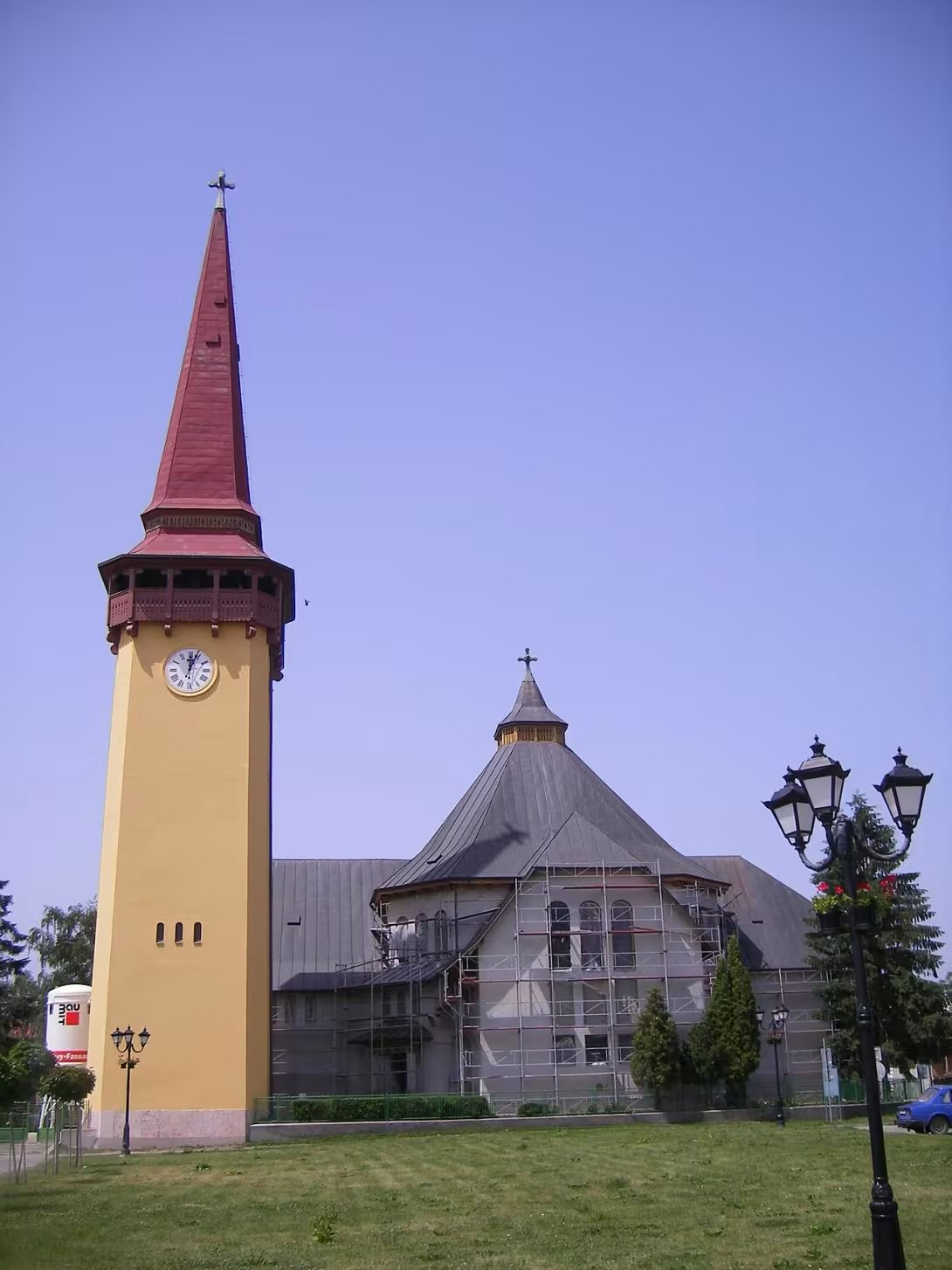

The historical view on the left is a visualisation generated by artificial intelligence and serves as inspiration.
Historical Milestones
- 1718
- creation of the original baroque church
- 1763
- baroque church restaurant after earthquake
- 1911
- burn-out of the old church and building parish due to a big fire
- 1912
- beginning of construction of a new church, parsonage and bell tower
Interesting facts
- It is an Art Nouveau sacral building from the years 1912 to 1913 whose architecture is inspired by the Gothic Gothic. - Architect István Medgyaszay used wood in construction instead of reinforced concrete. - The church was founded on the site of a baroque church from 1718, which in 1911 destroyed the fire. - The floor plan of the church consists of an octagon with four arms in the shape of a cross and its interior is covered by a wooden dome. - The capacity of the building is 1550 seats, while the premises can cost up to 1100 people.
Guide
Show guide text
The text was prepared by artificial intelligence and has not been editorially reviewed. It may contain inaccuracies.
Welcome to Hurbanovo. You have just stopped at one of the most prominent points of this place - the church of St. Ladislav and its complex. You are standing in a space that is not just a set of buildings but a living witness to the history that has been turning around for centuries. When you look around you, you may be reached by the strange harmony that this complex radiates. It is not just a mere sacral structure; it is a monument that bears the traces of the old world, tragedy and unbreakable restoration efforts. Look at the atmosphere of peace that exists here today, but at the same time imagine all the moments that have survived this place.
However, in order to fully understand what you see before your eyes today, we must go back to the past together with you in time. This locality has a fascinating chronology, which has not always been about building but also often about survival. The whole history of this place begins in 1718 when the original baroque church was established here. At the time, the baroque was a style that expressed grandeur and strength, and this church was the heart of the local community. This Baroque era took a long time, with the building surviving unexpected natural disasters. In 1763 it was caught in this area and the earthquake damaged the church, which required a large restaurant. Despite these trials, the church remained a fixed dot in the country until the year that changed everything appeared.
That fateful year was 1911. There was a huge fire in this area that was an absolute tragedy for the local people. The fire didn't just damage the church itself, but it also destroyed the parish building. At one point, part of the history that stood here for centuries disappeared. However, this moment was not only the end, but it also became the beginning of something completely new. Just a year after this fire, in 1912, the construction of a new church, parishes and bell towers began. What you admire today is thus the result of a quick reaction, a deep faith and artistic appearance of people who have decided to build something modern and respectful to tradition on the ruins of the old world.
Now please pay attention to the very architecture of this building. When you look at it, you will immediately realize that it is not a classic church that you may have known from other places. This sacral structure, which originated between 1912 and 1913, is a fascinating example of Art Nouveau style. At that time, the Secession represented a modern, organic and artistically rich approach to architecture, which sought to deviate from the strict rules of the past. However, what makes this church really special is its inspiration through the Gothic of Poemohrad. If you look at the overall composition and shapes of the building, you can capture those specific elements that resemble the Gothic architecture of Eastern Europe. This combination of Art Nouveau modernity and Gothic spirituality creates a unique visual language that is not common in this area. Feel the lines and shapes that try to link the new century to the deep roots of the past.
Looking at this construction, the question of who was behind this visionary idea cannot be avoided. The architect was Istvan Medgyaszay. It was a man who could bring something unconventional at a time of major technical change. At a time when construction began to spread massively throughout the world with reinforced concrete and modern industrial materials, Medgyaszay chose a different, perhaps even bold direction. Instead of letting the trend of reinforced concrete be chased, he used wood options. This decision was very interesting at the time. The use of wood to this extent and in such a context gives the building a specific character and shows the high level of craft skills and technical awareness of the architect. It is a fascinating contrast between the modern idea of Art Nouveau and the traditional, natural material that gives the entire building a measure of organic proximity to the surroundings.
It may seem to you now that this building is only the result of an artistic decision, but it is much more. It's a symbol of resistance. You are standing in front of a place once completely destroyed by fire, but instead of there being only an empty place and memories of a baroque church from 1718, a new visionary architecture was created here. This church is proof that even after a great loss, something that has its own strong identity can be built.
As you continue your tour, try to view this space not only as an object but as a story of transition between eras. From Baroque stability, to tragic fire, to Art Nouveau restoration. Look at the area around you and get carried away by this sense of continuity. Every detail you see here is the result of decisions taken over a century ago.
We hope that this short look at the history and architecture of St.Ladislav's church has helped you to better understand its meaning and uniqueness. Let yourself be inspired by this beauty and continue to discover Hurbanov and its surroundings. Thank you for spending time with us.
Tips for visitors
We recommend a visit in spring or summer, when the area of the church of St. Ladislav is in bloom and the building is well lit by natural light.
When walking through the area we recommend suitable footwear and at the entrance to the temple clothing corresponding to the sacral nature of the place. For photography are suitable exteriors of the church, especially before sunfall, when light highlights the details of the facade.
Families with children can relax and get to know local history. Since there are no other attractions in the immediate vicinity, we recommend to focus on the examination of the church and its area.
Frequently asked questions
Can the monument be visited?
Religious buildings are usually open mainly during services; at other times a visit is normally arranged with the parish or the operator. We have not verified specific times.
Where is the monument?
Location: Komárňanská 269/90, Hurbanovo, Nitriansky kraj. The map on this page shows the exact spot.
Why is the monument protected?
It is listed in the Central List of the Monuments Fund of the Slovak Republic as a national cultural monument (ÚZPF no. 231-11547).
Nearby
🏰 Historic sites (166)
- Sv. Ján Nepomucký 0.0 km
- Jókai Mór 0.1 km
- Kúria rodu Javor 0.1 km Komárňanská 51/103
- Trojičný stĺp 0.1 km
- Múzeum Mikuláša Thegeho Konkolyho 0.3 km +421 352 45 11 02 web
- Kaštieľ Steinerovcov 0.3 km Komárňanská 258/112
- Mikuláš Kopernik 0.4 km
- Mikuláš Konkoly-Thege 0.4 km
- Kaštieľ Fesztyovcov 0.4 km
- Večná sláva bojovníkom 0.4 km
- sv. Vendelín 0.6 km
- Schwarzov kaštieľ 0.6 km Komárňanská 81/163
- Pamätník oslobodenia 0.6 km
- Dom Hany Hegerovej 0.8 km +421 905 310 037 web
- Pamätník obetiam II. svetovej vojny 0.9 km
- Kúria Vollnerovcov 1.0 km Železničná 1375/36
- Kúria Ordódyovcov 1.6 km Novozámocká 226/14
- sv. Ján Nepomucký 1.9 km
- Kúria Ordódyovcov 2.5 km Novozámocká 183/100
- sv. Florián 4.9 km
🍽️ Restaurants and dining (232)
- Kaštieľ Steiner 0.3 km +421 35 760 22 19
- espresso esso sudán 0.3 km
- Aréna 0.5 km
- Kelt Internet Cafe 0.5 km
- Mixi 0.5 km
- Twins 0.5 km
- Kudy Kebab 0.6 km
- Bar Anička 1.0 km
- Pohostinstvo Mix II 1.8 km
- Starý orech 3.5 km
- Nová krčma 5.8 km
- J&J 6.1 km
- St. Petrus Vini 7.0 km +421 949 152 811 web
- Class Bistro Nesvady 7.6 km +421948069797
- Penzión Éder 7.9 km +421 905 604 707 web
- RISTORANTE 83’ 8.1 km +421902557017 web
- Kelt Garden 8.2 km
- Bástya Csárda 11.3 km web
- Schnaps 11.4 km
- Apáli 11.4 km
🏨 Accommodation (30)
- Agroturistická ubytovňa 6.2 km
- St. Petrus Vini 7.0 km +421 949 152 811 web
- Domčeky Nesvady 7.8 km +421 903 727 788 web
- Penzión Nesvady 7.8 km +421905607320 web
- Éder 7.9 km Bélu Bartóka 173/1 +421 905 604 707 web
- Divá Kačica - Reštauracia a Pensión 8.5 km +421907472434 web
- Ubytovňa Panonia 11.9 km
- Salur 12.5 km +421 35 650 6060 web
- Hotel Stardust 12.9 km +421 35 640 30 85
- Hotel Korzo 13.0 km
- Hubert Varga 13.2 km Jókaiho 28/19 web
- Európa 13.3 km web
- Penita Restaurant & Pension 13.3 km +421 905 311 714
- Hotel Grand 13.3 km
- Villa Centro 13.3 km Eötvösova 989/5 +421 905 66 00 11 web
- Banderium 13.4 km
- Szekeres penzión 13.5 km Svätojánska 3127/12 +421 905 431 665 web
- Lehár 13.5 km web
- A7 Apartments Komárno 13.5 km +421 915 512 007 web
- Olymp 13.5 km web
🚲 Rentals and sport (35)
- Športovo Relaxačné centrum, Bagota 1.6 km
- Športová hala Nesvady 8.1 km +421357692436
- Klub turistov Kormorán Komárno 11.2 km web
- Kajak & kanoe klub Komárno 11.4 km
- Gold Gym 12.5 km
- Veloprom 12.5 km web
- SPORT CENTER 12.7 km
- tokyobike 13.1 km
- Rock bike 13.1 km
- RC Comorra Off Road Track 13.1 km
- Plaváreň 13.2 km
- Krytá plaváreň 13.2 km Eötvösova 3155/41 web
- Bazén s termálnou vodou s masážnymi vírivkami 13.3 km
- Rekreačný neplavecký bazén 13.3 km
- Výukový bazén "Castiglione" 13.3 km
- Plavecký bazén "Castiglione" 13.3 km
- Detský bazén 13.3 km
- Bazén s termálnou vodou 13.3 km
- Arena sport 13.3 km
- City Sport 13.4 km
🥾 Hiking and nature (45)
- Hurbanovský park 0.4 km
- Bohatský park 1.6 km
- Abov 2.4 km
- Kaštieľsky park 2.5 km
- Martovská slobodná univerzita 4.8 km web
- Park Dulovce 5.8 km
- Holica 6.0 km
- Stará hora 7.5 km
- Postriežka 8.3 km
- Postriežka 9.4 km
- Marcelovský park 10.6 km
- Kostolec 12.5 km
- Chrbát 12.7 km
- Artézska studňa na Tajovského 12.7 km
- Park Slnečná 12.7 km
- Zelené údolie 12.8 km
- Námestie Kossutha 12.8 km
- Park pod kalváriou 12.8 km
- Artézska studňa na Gúgskej ceste 12.9 km
- Rác kert 13.0 km
Thematic route
1. Church of St. Ladislav - Temple with historical architecture and interior equipment. 2. Tower of church - Point overlooking the village Hurbanovo. 3. Church area - Outdoor space for walks. 4. Park near the church - Adjusted greenery around the church for rest.
Seasonal recommendations
In the spring in the area of the church of St. Ladislav will bloom greenery. The sun in this period provides lighting suitable for observing the details of the facade. It is recommended to visit the place in the morning and wear layered clothes.
Summer months bring intense light and rich colors of nature that contrast with architecture. Due to high temperatures it is advisable to arrive early in the morning or late in the evening. Practical is light, breathable clothing and sunscreen protection.
Autumn changes the colors of the area to golden and brown. The low sun creates long shadows that highlight the sculpture of the structure. When visiting, it is advisable to choose comfortable shoes and to take an unsightly jacket or sweater.
Zimą is the church of St. Ladislav moderate, especially if the area covers snow. It's quiet in Advent time. Due to low temperatures and wind, warm and waterproof clothing is essential. Short visits at the time of the strongest daylight are recommended.
Visualisations and artistic views


The visualisations are generated by artificial intelligence and serve as inspiration.
Photographs from the area
Real photos taken near the monument


Source and licence are given for each image.
Visitor Tips
No tips yet. Be the first!
Log in and add your tip.
Zdroje a literatura
The factual basis for this text was the article na Wikipedii, whose authors are Wikipedia contributors. The article is available under the licence CC BY-SA 4.0.
Location on Map
More monuments – Hurbanovo
Show all in the town


Visitor photos
No photos yet. Be the first to add a photo from your visit!
Log in and add your photo or leave a rating.
You get more points for a visit verified in the app — we can tell from the GPS that you are there.
Reviews and comments