

the church of St.Tomas the Apostle, chapel at the vineyard Church
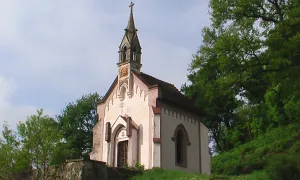
The former church of St. Thomas the Apostle, known as the chapel on the vineyard, is a Gothic sacral building from the 14th century in the village of Hontianske Nemce. It is a national cultural monument (ÚZPF 12328).
The chapel probably served as a subordinate building to St. Martin's parish church. In the 16th and 17th centuries the building was probably not maintained due to the threat of Osmans, religious clashes and economic problems of the inhabitants.
It is a simple Gothic structure with a plan of longitudinal single-ship. The shrine is polygonally finished with small narrow windows with semi-circular ending. Access to the building was solved through the portal on the south side. The ship likely had a flat wooden ceiling and a western empora, while the shrine was covered with a vault that was later destroyed. In the interior there were three brick gothic oltäre.
Baroque renewal took place at the turn of the 17th and 18th centuries. The initiator was the priest and Esztergom canonic Tomáš Petróci, who probably realized it after 1689 of gratitude for the release from Ottoman captivity. The chapel thus acquired the patronage of St. Thomas with the conpatricinium of St. Urban and St. Donat. St. Thomas's Patricinium died during the 19th century.
Historical Milestones
- 1300-1399
- creation of gothic sacral construction
- 1500-1699
- the period of neglect because of the ottoman threat and religious clashes
- to 1689
- baroque restoration led by Tomáš Petróci
- 1800-1899
- st. Thomas's patronage shall cease
Interesting facts
- It is a Gothic sacral building from the 14th century in the village of Hontianske Nemce, which is declared a national cultural monument. - In the interior there were three brick gothic oltäre. In the 16th and 17th centuries the building was probably not maintained due to religious clashes, economic problems of the inhabitants and the threat of the Ottomans. - The Baroque restoration after 1689 was probably realized by priest Thomas Petróci from gratitude for the release from Ottoman captivity. The chapel had St. Thomas's patrocinium with the conpatricinium of St.
Guide
The guide was voiced by a synthetic voice created by artificial intelligence.
Show guide text
The text was prepared by artificial intelligence and has not been editorially reviewed. It may contain inaccuracies.
Welcome to the village of Hontianske Nemce. Right now, you are facing an outstanding witness to history, which is the former church of St. Thomas the Apostle, also known as the chapel of the vineyard. When you look at this building, you may see in it the first moment only a quiet monument that is now peacefully fitting into the country, but in fact there is a building in front of you with a rich and dramatic story that reaches deep into the Middle Ages. Look at the overall silhouette of the building and see the atmosphere of this place, which has been accompanying local residents in their daily lives and prayers for hundreds of years.
To understand what we have in front of us, we have to crash back in a few centuries. This sacral building was created in the fourteenth century, namely between 1300 and 1399. At that time, Europe was dominated by a gothic style that was marked by an effort to lead the spirit and mind toward heaven. It was in this spirit that this building was built to serve as a place of refuge, meditation, and spiritual support. It originated at a time when communities formed in the region and faith was at the heart of social life. Gothic in Hontianske The Germans have thus left a mark that persists until today and is proof of how important this place was within the spiritual map of time.
Now, when you discuss the monument more closely, take note of its overall disposition. Although time and events changed the appearance of many buildings, this building preserved its identity as Gothic sacral architecture. Look at the lines of the building and perceive its moderation. Although you may not see all the details in the original Lesko today, it is important to realise that it is a national cultural monument, which undermines its immense value for Slovak cultural heritage. Inside the building there were in the past three brick gothic oltäre, which shows that the space was designed so that several rituals and prayers could take place simultaneously, which was typical for the more significant sacral objects of the time.
However, the history of this place is not only a story of rise and beauty, but also a story of survival and rebirth. After a period of its initial glory, the era of darkness came. During the sixteenth and seventeenth centuries, the building became neglected. Imagine the tension that prevailed in this area at the time. The threat of the Ottoman invasion, which intimidated the whole of Central Slovakia, along with the religious clashes and economic problems of the population, made it impossible to pay sufficient attention to the maintenance of the church. The building probably suffered for a long time from a lack of care, while people fought for their survival in an unstable political and social environment.
The break came at the end of the 17th century. After 1689 there was a new beginning. During this period came Baroque restoration, which in many ways changed the character of the building and restored its functionality. The key character of this restoration was Tomáš Petróci, who, with his initiative and guidance, ensured that the memory would awaken again from his sleep. Baroque brought dynamism and emotion to the architecture, and although the foundation remained Gothic, the influence of Petrócie's restoration helped the construction to survive another decade. It is fascinating to think of how one person can change the fate of a building and save it for future generations.
However, the centuries that followed brought about further changes. In the nineteenth century, namely between 1800 and 1899, there was a gradual disappearance of St. Patrocinium is basically a spiritual protection and dedication of the church to a specific saint, and its demise meant a new type of transformation for the construction. What you see today is the result of these layers of time - from Gothic filling, to Baroque rebuilding, to a quiet period of later act.
One of the most interesting things you can imagine in this monument is the contrast between its present silence and what has happened here in the past. Imagine the three brick oltäre that stood in the interior. The brick oltäre are a symbol of stability and durability in Gothic. The fact that there were up to three of them suggests that the chapel on the vineyards was not just a small addition, but had hidden potential for a deep liturgical life. The exact identity of the architects who designed this construction in the 14th century remains a mystery. Their names were not preserved, but their work survived for centuries of wars, famines, and religious changes so that you could see it.
So you stand outside a building that's like an open book. Each stone and every part of the facade tells about how people in the Hontianske Nemce got out of crises and how they tried to maintain their faith and culture even in the most difficult times. It is a place where medieval Gothic meets with Baroque energy and where the silence of the present overlaps the echoes of ancient prayers.
Before you go further in your travels, we recommend you stay close to this monument for a while. Look around you, see the surroundings of the vineyards and think how many generations of people have gone the way you go. This chapel is a silent witness to the time that teaches us patience and endurance. Thank you for sharing this short trip with us in the depths of the history of the Hontianske Nemce. We wish you a pleasant sequel to discovering the beauty and secrets of this region.
Tips for visitors
We recommend a visit in the spring and summer months, when the surroundings of the chapel on the vineyards in the flower. To the Hontians Germans can come by car or public transport; check the current links in the internet search engine.
To move in the field around the building we recommend shoes with fixed soles. In summer, we recommend using insect repellent.
Photography is suitable from surrounding vineyards. For outdoor images, it is appropriate to light during the -Golden Clock-- shortly before sunfall, when architecture gets warm tone.
Families with children can connect the visit with a walk around and explore the Banská Bystrica region.
Frequently asked questions
Can the monument be visited?
Religious buildings are usually open mainly during services; at other times a visit is normally arranged with the parish or the operator. We have not verified specific times.
Where is the monument?
Location: Hontianske Nemce, Banskobystrický kraj. The map on this page shows the exact spot.
Why is the monument protected?
It is listed in the Central List of the Monuments Fund of the Slovak Republic as a national cultural monument (ÚZPF no. 325-12328).
For children
Close your eyes and imagine you're passing through time. It's the fourteenth century. There are no cars, asphalt roads or mobile phones around you. There are only dense forests, the field is a wave of meadows and the air smells like fireplace smoke. You stand in the village of Hontianske Nemce and there is something fascinating growing in front of you. It's a building that looks like a fairy tale of knights and secrets. Welcome to the former church of St. Thomas the Apostle, which the locals simply call the Chapel on the vineyard.
Thematic route
As there are no other sites in the area of the area of the main objective, I propose a thematic route:
1. The former Church of St. Thomas the Apostle - The main monument. Visit this historical structure. 2. Interior of the church - Indoor space. Look at the preserved features of the equipment. 3. Chapel area on the vineyards - Surroundings of sights. Walk around the chapel in the context of local country and wine tradition.
Seasonal recommendations
In the spring, the former church of St. Thomas the Apostle and the chapel of the vineyard will wake up to life. The first green food and flowering trees complement the historical character of buildings. The place is suitable to visit in the morning when the light is pleasant to photograph. Due to variable weather, layer clothing and waterproof footwear are recommended.
Summer brings intense sunlight and rich colors of the landscape. The surrounding vineyards are in full growth. The visit is suitable in the early morning hours or late evening to avoid glowing. It is necessary to take plenty of water and a sun hat.
Autumn in the Hontianske Germans are characterized by golden tones of leaves. The sacral architecture contrasts with the colorful natural background during this period. For a walk it is appropriate October, when temperatures are mild. It is recommended to wear a lightweight sweater or jacket.
Zimą will turn the landscape around the chapel into a quiet space that can be coated with snow. Shorter day and early dusk should be taken into account when visiting advent time. It is essential to wear warm clothing, thermoregulatory layers and solid winter shoes with anti-slip sole.
Visitor Tips
No tips yet. Be the first!
Log in and add your tip.
More monuments – Hontianske Nemce
Show all in the town

Visitor photos
No photos yet. Be the first to add a photo from your visit!
Log in and add your photo or leave a rating.
You get more points for a visit verified in the app — we can tell from the GPS that you are there.
Reviews and comments