








city walls Town fortifications
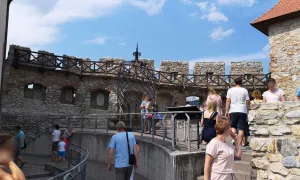
The town fortification in the village Pukanec in the Nitra region comes from the second half of the 16th century. This Renaissance building was created in 1578.
The area is registered by the Monument Office of the Slovak Republic under number ÚZPF 1628 and consists of six parts. These include the northern, eastern and southern basthion, which were built in Renaissance style between 1578 and 1595. It also includes the northern and eastern courts of the same period. It is complemented by a trench in the middle, built between 1578 and 1595.
The building is declared as a national cultural monument.
Tehdy a dnes
Drag the slider and compare how the monument might have looked when it was built with the view today.
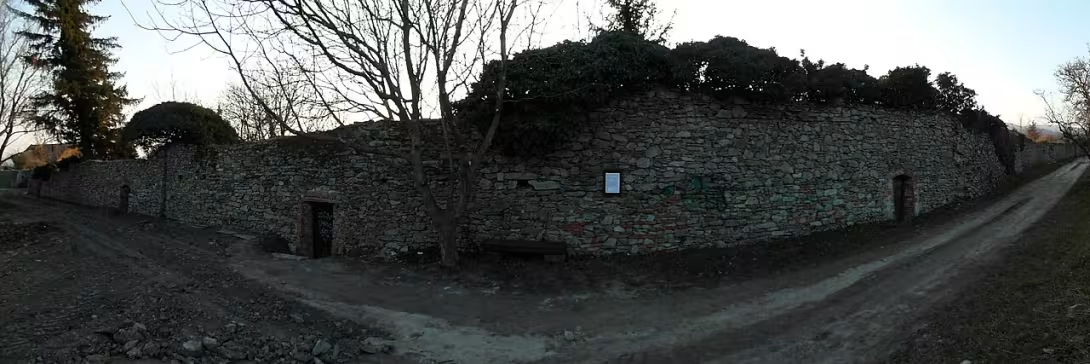
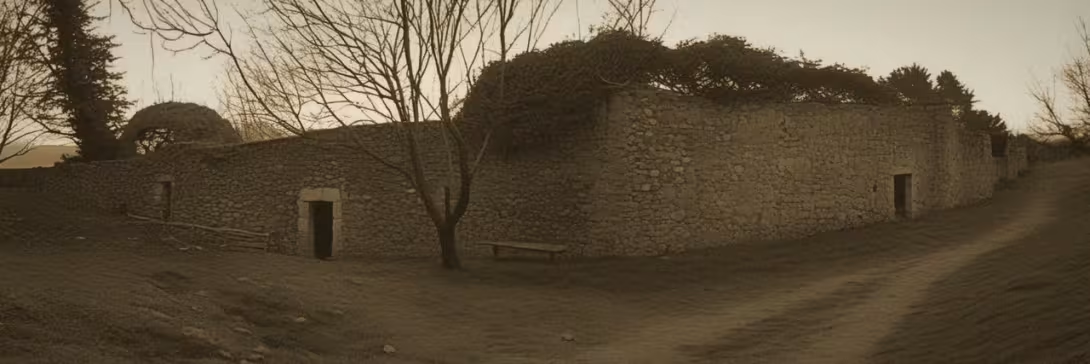
The historical view on the left is a visualisation generated by artificial intelligence and serves as inspiration.
Interesting facts
- The town fortification in the village Pukanec comes from the second half of the 16th century and was founded in 1578. - This Renaissance object is declared a national cultural monument. - The area consists of six parts, which include northern, eastern and southern basthion. It also includes the northern and eastern courts. - In the suburbs there is a trench built between 1578 and 1595.
Guide
Show guide text
The text was prepared by artificial intelligence and has not been editorially reviewed. It may contain inaccuracies.
We welcome you to Pukanec, a city with a rich history where time seems to be stopped for a while. You are standing right in front of city walls that once formed the protective perimeter of this city. Now that you look around, you perceive the traces of ancient times that show how important it was for the people to ensure their safety and to clearly define the boundaries of their home. Although these fortifications no longer serve to defend themselves from enemies, they still carry the atmosphere of the ancient centuries and tell the story of a city that has firmly guarded its place in the history of the region of Nitra.
Let us now consider why these walls were built at all. Although accurate chronology of their origin is not precisely documented today, the perception of city fortifications transmits us to the time when the city was a separate organism with its own rights and responsibilities. In the Middle Ages and early modern times, walls were not just a military element. The fortification defined the status of the city. Anyone who crossed the gates of the walls entered a space where laws differed from those of the surrounding countryside. Castles protected trade and craft, which were at the heart of the Pukanca economy, and gave residents a sense of stability in uncertain times.
Nyni pay attention to the architecture itself and to what you see before you. When you look at these historical fragments, note how they are written into today's city picture. Look at the way the preserved parts of the fortification are connected to the surrounding terrain. Although we do not know exactly who the architects of these buildings were, it can be seen that they were designed with regard to strategic location. Feel the texture of the surface and the overall strength of these elements. It is in these details that the genius of ancient builders, who had to work with the available materials and knowledge of their time, lies behind in order to create a barrier that was intended to reflect a potential threat.
If we stop by on the question of specific personalities connected with this place, we find something interesting. The history of the walls in Pukanec is not associated in the records with one particular famous name or ruler, whom we could appoint as the main builder. That is where the power of this place lies. These walls are not a memorial to one person, but are the result of a joint effort of the entire city. They have witnessed thousands of ordinary residents, craftsmen, and guards who lived, worked, and protected their families. Each stone in these walls bears a trace of anonymity, but it is very strong in itself because it represents the collective identity of Pukanco.
You may now wonder if there are any great mysteries or legends associated with the walls. It is in unknown data and the absence of specific names that the greatest interest is born. The castles of Pukanec are like an open book, from which some sides faded, but that is what forces us, visitors, to imagination. It's fascinating to think about how many secrets these walls have kept. Who has been going through them, what conversations have taken place here, and what events have taken place in the shadow of these fortifications, which we are no longer aware of from written sources. It is this measure of the unknown that gives the place extraordinary charm and makes it a place where history meets legend.
We will slowly draw closer to the end of our short tour of this particular point. The city walls in Pukanec are silent witnesses of time, reminding us of the importance of protection and community. We recommend you now in peace to pass around, to perceive silence and to try to imagine what this place looked like hundreds of years ago, when the walls were fully functional and the city sought refuge in them.
Thank you for your attention and for discovering this historic place with us. Now we invite you to continue to explore the beauty of Pukanec and its surroundings. May you please in this city and let its history continue to inspire you. We wish you a pleasant journey and a pleasant day.
Tips for visitors
Spring and autumn months are the best time to visit. The pleasant temperatures and colors of the landscape highlight the details of historical fortifications and facilitate walks around the city.
We recommend shoes with fixed soles, suitable for moving around the city streets and surrounding walls.
For photos, look for the golden hour shortly before sunset. The sun then produces soft light that highlights the texture of the stone and the architecture of Pukanec.
For families with children the visit is an opportunity for a short historical lesson in the field. Children can look for remnants of fortifications and learn how cities have been protected in the past.
Frequently asked questions
Can the monument be visited?
This is a structure in a public space that can usually be seen from outside free of charge. We have not verified that this particular one is freely accessible.
Where is the monument?
Location: Pukanec, Nitriansky kraj. The map on this page shows the exact spot.
Why is the monument protected?
It is listed in the Central List of the Monuments Fund of the Slovak Republic as a national cultural monument (ÚZPF no. 232-1628).
For children
Imagine a time when kings and air smelled black dust. Something big was created in 1578 in the foothills. Some 448 years ago in Pukanec, they began building a powerful stone wall to protect all the valuables. At the time, there were no mobile phones or the Internet, just a bang of hammers, a sweat of builders, and a fear of danger coming afar off.
Thematic route
Thematic cruise route: Pukanec and its city walls
1. Urban fortification Pukanec The preserved part of the 16th century historical fortification that protected the city from raids. It shows the defensive architecture of the medieval settlement. It is a suitable starting point for a walk around the old town.
2. St. Nicholas Church Renaissance sacral building from 1586 in the center of Pukance. Interior fittings and frescoes testify to Baroque-Renaissance tradition. The visit is associated with a walk around the historic square.
3. Pukanec Mansion Originally Renaissance, later Baroque-treated residence, which today serves as a cultural house. Interesting exhibition dedicated to local history and folk crafts. The building is located near the city walls.
4. The parish office and parish church 18th century complex with classicistic church and parish house. The visit is suitable for those interested in sacral architecture.
5. Square SNP Centrum Pukance, surrounded by historical houses and monuments. Nearby is a town hall with Renaissance elements.
*The route passes near the main destination and uses the listed locations. *
Seasonal recommendations
Spring In March and April, the city walls of Pukanec are dressed in green and brown color when trees and grass wake up after winter sleep. The morning sun adds a golden shade to the stone walls, while the evening milk creates a mysterious atmosphere. In the surrounding fields, the first shepherds appear, and in the forests below the city there is the singing of sparrows. The recommended time to visit is 10 o'clock or in the afternoon when the temperature is pleasant. Clothes in thin layers are recommended because spring days are unstable and the evening can cool off.
Summer In June and July, the city walls in Pukanec are part of the sunny landscape, when the Nitra region flows through yellow-green tones. The sun below creates sharp shadows and dramatic contrast on stone blocks. Summer evenings bring scent from fields and vineyards, while in the distance there is a ringing of sheep. Recommended time to visit is early in the morning or after sixteen o'clock, when the temperature drops below 30 degrees. Light clothing, hat and sunglasses are recommended. During the summer season avoid the following hours when the stones overheat.
Fall In September and October, the leaves on the surrounding trees turn into red, orange, and brown tones. Morning dew and evening milk add melancholy shade to the stone walls, while the sun produces fine golden reflections. The surroundings are quieter, the fields are emptying and dry leaves roaring in the woods. Recommended time to visit are morning hours with clean air or afternoon when the temperature is about 15 degrees. It is recommended to warmer clothes because autumn days are cool and the evening temperature is falling rapidly. The view from the hills shows the contrast between stone walls and autumn nature.
Winter In December and January, the city walls in Pukanec are surrounded by snow, and the Nitra region spills silvery and dark tones. The snow on the stone walls gives the memorial an argument look, while the morning sun produces fine blue reflections. The surroundings are quiet, the fields are under snow, and in the woods there is a crackling of frost. Recommended time to visit are afternoon hours when the sun is above the horizon, or bright winter days with good visibility. It is recommended to warm and comfortable clothing, because in advent times temperatures are around zero and the wind can be sharp. During the winter months avoid the following hours when light is weak and the temperature is lower.
Visualisations and artistic views

The visualisations are generated by artificial intelligence and serve as inspiration.
Visitor Tips
No tips yet. Be the first!
Log in and add your tip.


Visitor photos
No photos yet. Be the first to add a photo from your visit!
Log in and add your photo or leave a rating.
You get more points for a visit verified in the app — we can tell from the GPS that you are there.
Reviews and comments