








evangelical church Church
Evangelical church in Ochtiná in Košice region is a medieval sacral monument. It was built at the turn of the 13th and 14th centuries as a Romanesque-Gothic single-ship with a quadraticly finished sanctuary, dedicated to St. Nicholas. In 1963 it was declared a national cultural monument of the Slovak Republic.
The formation of the church is closely connected with the stit branch Bebekovci, which they consider as initiators of construction. This family had a considerable influence in Ochtin and its surroundings and probably supported building construction. The first mention of the church comes from the papal tithes from 1332 to 1337.
The architecture of the church combines Romanesque, Gothic and Baroque elements. One-ship structure with a polygonal presbytery corresponds to the medieval style. The Presbytery is encircled by the cross rib vault, which was determined dendrochronologically after 1377. On the north side is a side boat with a star arch. Western oriented tower has combined Romanesque windows, which were probably planted secondary. In the 17th century, they replaced the flat wooden ceiling with a Prussian vault, and in the 18th century they added an empor and a tower with an onion helmet.
The church has been evangelical since 1545.
The interior contains medieval frescoes from the middle of the 14th century, covering the entire surface of the presbytery and part of the attic space. They are the work of Master Ochtin Presbytery, who also formed in the church in Kocelovce. The fresco cycle shows christological events from the Preaching to the Resurrection of Christ, including the Pasha part.
Between 1976 and 1977, restoration research was carried out on frescoes. Professor Milan Togner and Academy had. Jiří Josefík introduced the term Master of ochtinsky Presbytery for the author of these paintings.
The Evangelical Church in Ochtiná is open to visitors today.
Tehdy a dnes
Drag the slider and compare how the monument might have looked when it was built with the view today.
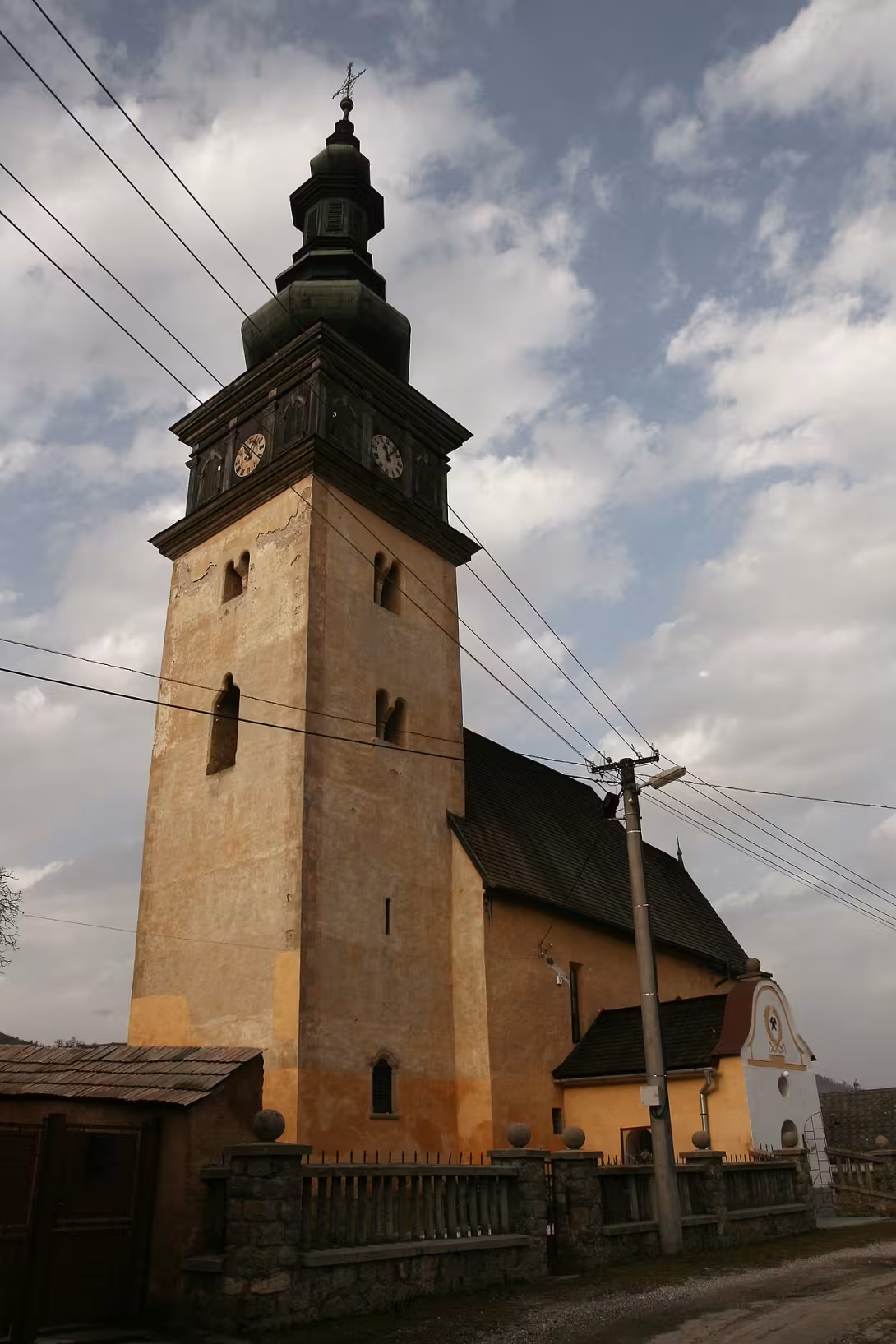

The historical view on the left is a visualisation generated by artificial intelligence and serves as inspiration.
Historical Milestones
- 1332 - 1337: first mention in the list of papal tithes
- 1340 - 1380: significant construction and implementation of fresco painting
- the second half of the 15th century: building a side ship, sacristy and towers
- 1545: the church is evangelical
- 17th century: replacing wooden ceiling with a spring vault
- 18th century: supplementing the empor and tower with an onion helmet
- 1897: fresco exposure
- 1901 - 1907: restoration of frescoes
- 1958 - 1959: church restoration
- 6 may 1963: declaration of the national cultural monument
Interesting facts
- The Evangelical Church in Ochtiná was built at the turn of the 13th and 14th centuries as a Roman-Gothic single-ship with a quadratic shrine, dedicated to St.
Guide
Show guide text
The text was prepared by artificial intelligence and has not been editorially reviewed. It may contain inaccuracies.
Welcome to Ochta's. They have just stopped at one of the most important historical points in this region, which bears the unprecedented power of the past centuries. You are standing in front of an evangelical church, a building that is not just a mere building made of stone and mortar, but a living witness of ancient times, long ago lost in the darkness of history. When you look at it, you may be immediately affected by the strange, quiet grandeur that it emits. It is a sense of stability and longevity that comes only from objects that have survived hundreds of years of adverse conceptions, changes in political powers and changes in human way of life. Feel the atmosphere of peace that exists at this moment, and let yourself be carried away by the thoughts of the people who stood before you many centuries ago.
However, in order to understand the real meaning of this place, we must, together with you, return to the past in our thoughts. This church is not the result of chance, but a consistent act of society at that time. Its history begins at the turn of the thirteenth and fourteenth centuries. It is a time that has been crucial for our country, a time for the formation of new power structures and deep religious traditions. At that time, the world began to be built in this area, which should be durable and firm, just like this building. The creation of this church is not just a question of religious cult, but it is closely linked to the power races that then dominated these countries and determined the direction of the entire region.
Now, when you look at the building itself, pay attention to its architectural expression. The church represents a fascinating transition between two great eras in the history of architecture. It testifies to us about the time when the Roman style gradually began to connect with the new, rising Gothic style. It is a period of transformation when massive, heavy shapes began to open in the direction of light and height. Feel this harmony. It is a single-ship structure, which means that its inner space is uniform, coherent and creates a sense of intimacy and unity for all those coming. Look at how balanced the whole composition is. A significant element is the sanctuary, which is completed in the shape of a square. This geometric cleanness and precision are typical of the then effort to express divine firmness and order through geometry. The entire building is dedicated to St. Nicholas, which gives this place a specific spiritual identity and deep meaning for the local community throughout the centuries.
If we look for the reasons why this church ever stood up, we must look at the people who then had power and influence. The Bebeks are considered the initiators of this construction, namely their stit branch. At the time, the Bebekov family was one of the most important and powerful noble families whose work left enormous traces throughout the region. Their decision to build this church was not only a matter of personal piety but also a symbol of their status and ability to control the environment in which they lived. By becoming patrons of this building, they left behind a legacy that continues to this day. Although ruling rulers and political boundaries are changing, this church remains a firm anchor that links the present with the era of great noble families.
At this point, you may be wondering a question that makes us all feel fascinated and humble in front of the unknown. Although we know who was the likely initiator of construction and at what time the church was built, the names of the architects themselves and the masters who laid each stone remain in the shadow of history. Not known. It's one of the great mysteries history sometimes offers us. Who were these people? What skills did they have to build that resisted time? What were their motivations, and what thoughts did they have in their heads while working in that country? This anonymity of the builders only increases the rareness of this place. Every detail, every line of this Romano-Gothic building is the result of their quiet mastery that we managed to preserve, although no one knows their names anymore. It is this unknownness that gives the church a mystical and timeless dimension.
Let's just stop for a moment and just see the overall atmosphere of this place. There is no need to look for complicated explanations or to look for every little detail. Just remember that you are standing before an object that survived the transition from the Middle Ages to a new era that survived both the rise and the fall of powerful generations and which is still standing here to remind us of our own place in time. This church in Ochtiná is a silent friend of history that invites us to reflect on what remains of us.
We believe that this short journey in time has brought you peace of mind and new views on this historic heritage. Let yourself be inspired by what you have seen and heard. Continue your discovery, walk around the landscape and see the beauty of this history that is all around you. Thank you for your journey together and we wish you a wonderful rest of the day to discover the beauty of our country. We'll say goodbye, but let this atmosphere stay in your heart even longer.
Tips for visitors
The Evangelical Church is located around Ochtiná and it is advisable to visit it in the autumn or spring months when the light is soft. This time highlights the architecture of the church. When visiting, take comfortable shoes and layered clothing in case of colder weather.
When taking pictures, focus on the facade of the church in the morning or afternoons when the side light supports depth and detail. The Ochtiná area offers a quiet area ideal for a short walk and admiration of the countryside.
This local sights are also suitable for easy trips with children, where they can explore historical architecture in a safe and quiet environment.
Frequently asked questions
Can the monument be visited?
Religious buildings are usually open mainly during services; at other times a visit is normally arranged with the parish or the operator. We have not verified specific times.
Where is the monument?
Location: č. 151, Ochtiná, Košický kraj. The map on this page shows the exact spot.
Why is the monument protected?
It is listed in the Central List of the Monuments Fund of the Slovak Republic as a national cultural monument (ÚZPF no. 428-533).
For children
Imagine having a time machine. He's not just gonna plant you in the past, he's gonna put you in the darkest dreams ever. You'd move exactly 726 years into reverse! It's 1300 and the world around you looks completely different. No cars, no computers, no internet. Just thick forests, muddy roads and the sound of locust hoofs on the ground. The air smells like smoke from fires and fresh wood that was then used for everything.
Nearby
🏰 Historic sites (61)
- Dom meštiansky 3.8 km
- Sebőkova kúria 3.9 km Ochtinská 33/2
- Morový stĺp 3.9 km
- S.N.P 4.0 km
- Pamätná izba Pavla Dobšinského 4.5 km web
- Pavol Dobšinský 4.5 km
- Pavol Dobšinský 4.8 km
- SNP 5.6 km
- Kerekes Gabi 7.4 km
- Pamätný dom P. J. Šafárika 7.6 km +421 587951243
- Ján Kožár 7.7 km
- Pališov 8.1 km
- Mestské múzeum Jelšava 8.8 km
- sv. Florián 8.9 km
- Huta Etelka 9.1 km web
- Pamätník Vojtechovi Róthovi 9.3 km
- Oslobodenie obce 25.1.1945 9.3 km
- SNP 9.4 km
- Pamätná izba Sama Tomášika 9.4 km
- Ľubošovi Lestákovi 10.1 km
🍽️ Restaurants and dining (31)
- Espresso Marka 1.9 km
- Pohostinstvo 3.1 km
- U Barbory 3.5 km
- Aragonit 3.8 km
- Penzión HOSTINEC U VINTNERA 3.9 km
- PizzaCaffe za kostolom 3.9 km +421 949 657 654 web
- Maja 5.6 km
- Sultán 6.8 km
- Bar Vanesska 8.0 km Námestie SNP 89/3
- Bella Piazza 8.7 km +421 907 804 854
- Cent-Rum 9.1 km
- Hostinec Kolkáreň 9.3 km
- Gôšovská keršma 10.8 km
- Hostinec Psota 11.3 km web
- Flipper 11.5 km
- Street food 11.8 km
- Lepšie ako doma 12.1 km
- Route 68 12.4 km
- Penzión TKM 12.9 km Polomská cesta 553/41 +421 905 439 667 web
- Pohostinstvo v Mokrej Lúke 13.0 km
🏨 Accommodation (33)
- Hotel Hrádok 3.5 km +421584860220 web
- Chata na Petermanskom vrchu 5.4 km
- Repisko 6.1 km
- Chata Poliačky 6.2 km web
- Penzión Poľovný dom 9.0 km Kúpelná 196/7
- poľovnícka chata Rusnák a Maďari 9.1 km
- Chata Zeme 9.2 km web
- Slánska 9.3 km
- Viliama 10.8 km
- chata Ondrejka 11.3 km
- Flipper 11.5 km +421 907 114 004 web
- Vila Andrássy 11.9 km +421 911 122 199 web
- Rekreačné stredisko Július 12.0 km +421 903 324 947 web
- Turistická ubytovňa Rejdová 12.2 km +421 58 788 3240
- Turistická ubytovňa požiarna zbrojnica 12.2 km +421 58 788 3240
- Penzión u Tomku 12.3 km +421 58 734 7314
- Trostie 12.7 km
- Rarmen 13.1 km
- Barónka Bed & Breakfast 13.4 km +421 910 405 569
- Galleria Betliar 13.5 km +421 944 550 858 web
🚲 Rentals and sport (3)
- Július 11.1 km +421 903 324 947 web
- Konský dvor 13.7 km +421 58 73 21 620 web
- Letné kúpalisko Revúca 15.0 km
🥾 Hiking and nature (244)
- Ortáš 1.9 km
- Ochtinská aragonitová jaskyňa 2.5 km +421 58 488 1051 web
- Bredač 2.6 km
- Dúbrava 2.8 km
- Hrádok 2.8 km
- Trojštít 2.9 km
- Glac 3.4 km
- Kameň 3.4 km
- Štôlňa Barbora 3.5 km
- Vŕšok 3.6 km
- Magura 3.6 km
- Klen 4.0 km
- Evanjelický a. v. kostol 4.0 km Teplická 207/1 web
- Vysoká hora 4.3 km
- Veľká Šteť 4.4 km
- Roveň 4.6 km
- Slavošovský tunel 4.7 km web
- Kar 4.9 km
- Šebeková 4.9 km
- Slavošovský tunel 5.1 km
Thematic route
1. Evangelical church area - Type: Outdoor space. The entrance part, which allows first contact with the architecture and atmosphere of this place. 2. Interior of the Evangelical Church - Type: Sacral space. The main boat of the church, where you can admire interior furnishings and feel the peace of the spiritual environment. 3. Church Tower - Type: Architectural element. The dominant element of the building, which is an important part of the historical identity of the building. 4. Church Park - Type: Recreational area. Adjusted greenery in the immediate vicinity, suitable for quiet reflection and short rest.
Seasonal recommendations
In spring you can experience in the Ochtiny region waking nature and fresh greenery, which complements the historical character of the Evangelical church. Light is soft and less sharp, creating a peaceful atmosphere. It is recommended to prepare for variable weather by layering clothes.
Summer months bring thick green and intense sunny days around the church. Since the sun is very strong, it is appropriate to have light, breathable clothing and sunscreen protection. The best time to visit is late afternoon.
Autumn visit offers melancholy beauty with colorful leaves and morning fog that create a magical environment. The light is low and golden, which highlights the texture of historical materials. Humidity and coldness require firm shoes and layered clothing.
In winter the surrounding area is quiet and often covered with white cover, which gives the church grandeur. The light is sharp and bright, but the days are freezing. It is necessary to come in full winter gear, including warm jackets, caps and gloves.
Visualisations and artistic views


The visualisations are generated by artificial intelligence and serve as inspiration.
Photographs from the area
Real photos taken near the monument

Source and licence are given for each image.
Visitor Tips
No tips yet. Be the first!
Log in and add your tip.
Zdroje a literatura
The factual basis for this text was the article na Wikipedii, whose authors are Wikipedia contributors. The article is available under the licence CC BY-SA 4.0.
Location on Map
More monuments – Ochtiná
Show all in the town
Visitor photos
No photos yet. Be the first to add a photo from your visit!
Log in and add your photo or leave a rating.
You get more points for a visit verified in the app — we can tell from the GPS that you are there.
Reviews and comments