

evangelical church Church
Evangelic church in the village of Brdárka in the Košice region is originally a Renaissance-Baroque sacral building built in 1696 on the site of an older wooden building. It is listed in the Central List of the Slovak Monument Fund under number 477/0. This church contains preserved Baroque organ positive from 1762, late baroque decoration of the empora with seven paintings, including the depiction of Emperor Joseph II and the historical cartoon referring to Father Paul Joseph Šafárik.
The church was founded in 1696 when it replaced the original wooden sacral building. Church City Brdárka originally belonged to Kobeliarov, where he worked as a priest father of Paul Joseph Šafárik. The building has undergone several construction modifications. In 1749 the church was adapted and betting on carved columns. Another reconstruction took place in 1786, when the building was almost completely rebuilt. A separate tower was completed in 1850. Later on, the church replaced the roof from the Ministry of Culture of the Slovak Republic. The civic association Gothic Route participated in the co-financing of the reconstruction of the altar in cooperation with the Central European Foundation and the spiritual, cultural and material side of the church is taken care of by the Association for the Saving of the Church in Brdárka.
It is a longitudinal hall space with a polygonal closure of the presbytery and the tower. The Presbytery is encircled by horse and lunett, the ship has Prussian vaults with stucco patterns. Facades were originally divided by a lysene frame and today they are complemented by semi-circle windows. The tower, once divided by double pilasters, is covered with an onion baroque mine with a lateral bells from 1921. The interior of the temple has a floor of quarry stone. There is a wooden pillar altar from 1754, which was restored in 1806, complemented by spiral columns, a mighty ledge with small angels, a extension and gold-plated plastic ornaments. Contentally it is connected with Easter, contains the image of the Last Supper, the Crucified Christ and in the extension picture of the Resurrection. The late baroque pulpit from the mid - 18th century, renovated in 1806, has a podkasat parapet with carved gold-plated semi-reliefs of the Savior and four evangelizers and voludous baldachyns ending with the sculpture of an angel. Baroque-Classicist Baptist of the Half The 19th century rests on the volute leg and contains folk sculptures Baptism of Christ. The inventory of monuments in Slovakia from 1967 also mentions the late Baroque patronage bench from the middle of the 18th century with sliding grate and plant painting on the parapet. The whole church, including the tower, passed through the classicistic modifications.
In the interior there is a baroque organ positive from 1762 with neo-baroque ornament from organist Daniel Wallachy from Spišská Sobota, which passed the monument reconstruction completed in 2017. Another element is the Baroque Protestant Empora from the mid-18th century, restored in 1826, with a rustic painting on the parapet. On the lower benches sat women, on elevated chores supported by columns men or youth. Empora in Brdárka is decorated with plant ornaments and seven images: the scene in the middle depicts Emperor Joseph II and six other pictures captures Bible motifs, including the Garden of Eden, the creation of Adam, the prophet Elijah, and King David. On the east side of the empora there is a historical cartoon with the Slovak inscription: God restored the chorus this one for the princesses of the two-honorable Mr. Paul Šafáry, under the richtarství slovak man Martin Novák, vice-president Jan Smerek Kohút. 1826 in the days of May
The church stands on a hill in the central part of the village of Brdárka. The current state of the building is not good, but the area is registered under number ÚZPF 477.
Tehdy a dnes
Drag the slider and compare how the monument might have looked when it was built with the view today.
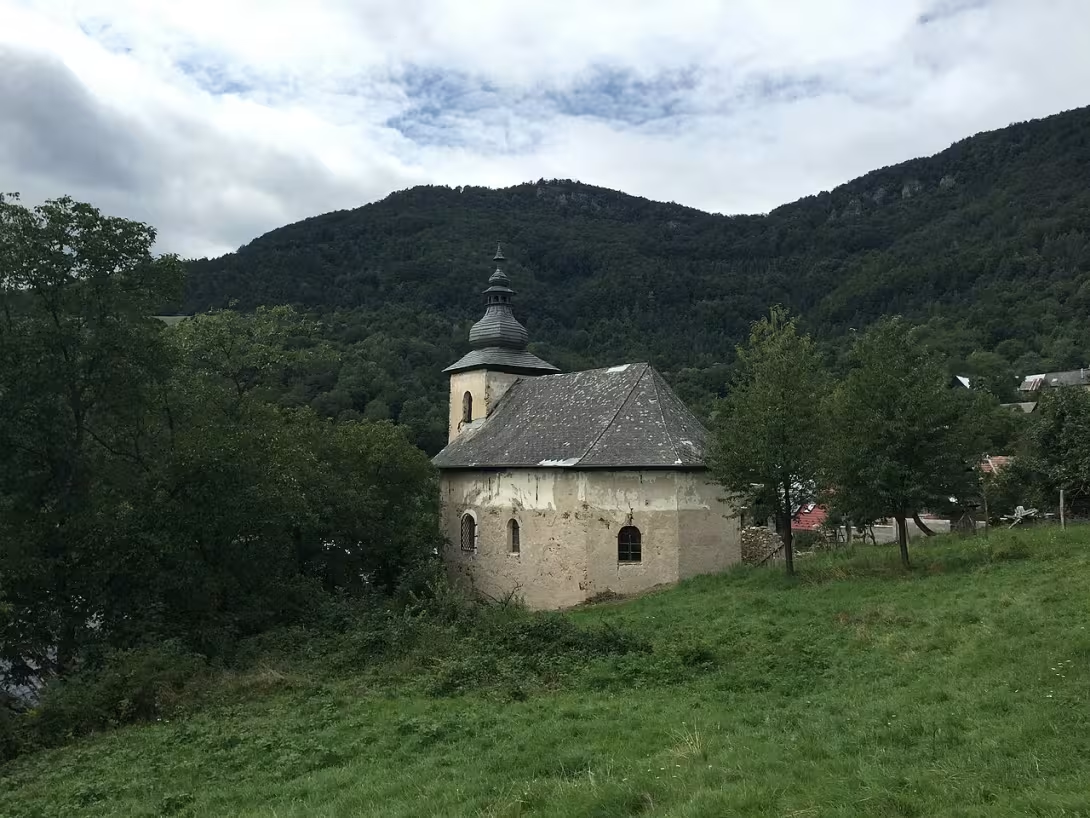
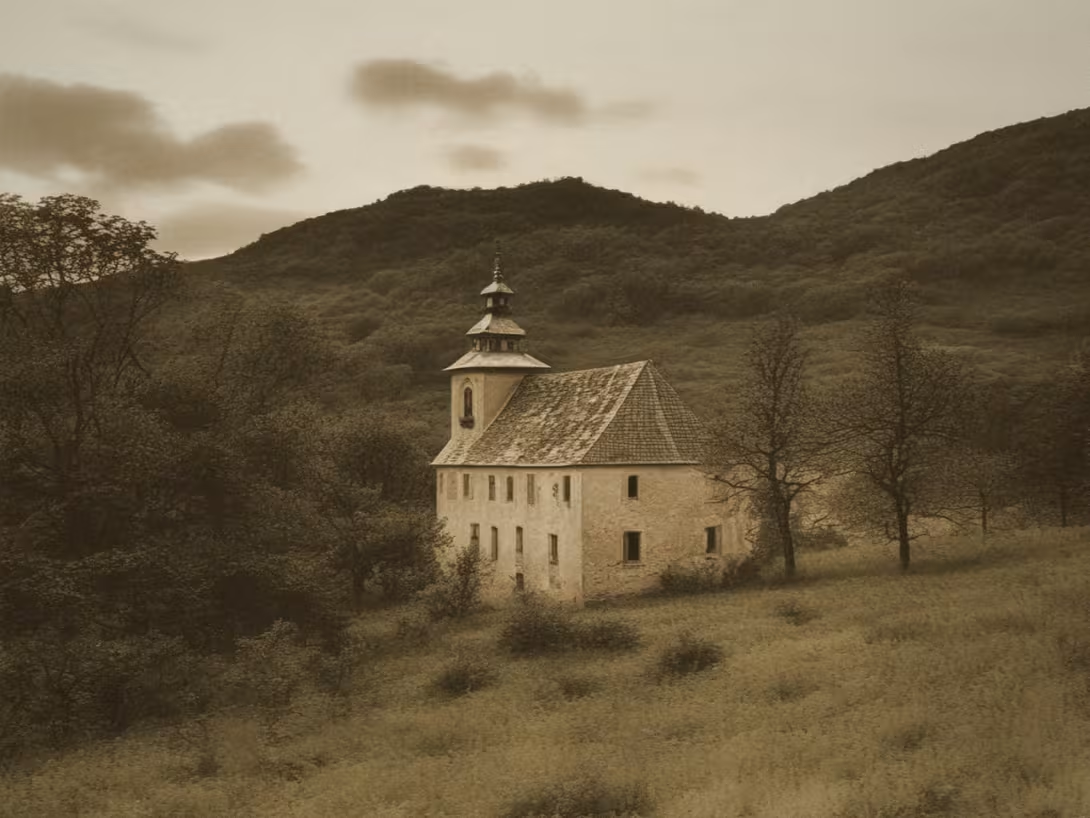
The historical view on the left is a visualisation generated by artificial intelligence and serves as inspiration.
Historical Milestones
- 1696: Originally built Renaissance-Baroque church on the site of an older wooden building.
- 1749: Building modifications of the church, installation of wooden empor.
- 1786: Almost total reconstruction of the church.
- 1850: Construction of the tower in a classicistic style.
- 1826: The restoration of the emporium, with which a memorial card dedicated to the priest Paul Shafary.
- 2017: Completed overall monument restoration of historical organ positive by Daniel Wallachy.
Interesting facts
- Evangelic church in Brdárka is originally a Renaissance-Baroque sacral building built in 1696 on the site of an older wooden building. - There is a preserved Baroque organ positive from 1762 with neo-baroque ornament from organist Daniel Wallachy. - Part of the interior is the late baroque empora decoration with seven paintings, including the depiction of Emperor Joseph II.
Guide
Show guide text
The text was prepared by artificial intelligence and has not been editorially reviewed. It may contain inaccuracies.
Welcome to the picturesque village of Brdárka here in the Košice region. You stand before a precious historical monument, in front of an evangelical church that quietly and dignifiedly completes the atmosphere of this magical corner of Slovak nature. Now that you look at it, the story of centuries unfolds in front of your eyes, translated into this unique sacral structure. Feel the peaceful atmosphere around you, the smell of the surrounding forests and meadows that seem to protect this quiet place from the bustle of the modern world. Look in front of you at the facade, let your eyes run along its outlines and try to feel the spiritual depth that this place has been radiating since time immemorial. Let us go down to history together and see how this temple was formed. The Evangelical Church in Brdárka is originally a Renaissance-Baroque sacral object whose roots go deep into the past. It was built in 1696 and the interesting thing is that it grew up on the site of an even older wooden building, which until then served the local community. Imagine over three centuries ago when people in this remote area, with great effort and faith, built their tabernacle. Although accurate architects or specific historical personalities associated with the very birth of the building remain shrouded in mystery, the work itself speaks for everything. It speaks of the determination, loyalty to traditions, and deep devotion of the ancestors who lived here, worked and passed on faith from generation to generation. Nyní pay attention to the architecture itself and the details that define this object. Although we do not know the exact author's manuscripts of architects, the building bears unmistakable signs of its time, in which Renaissance and Baroque influences are mingled. When you stand in front of the entrance, see the overall proportionality and purity of the lines that testify to the mastery of the then builders. It is this combination of Renaissance and Baroque elements that gives the church its unique visual character. We do not have to go into the invented details, for the true beauty of this temple lies in its authenticity and faithfulness in its original form, in which the stormy historical transformations have passed. Every stone and every corner of this object bears the memory of the generations that came here to seek comfort, peace, and spiritual strength. When you come in and look around the interior, your eyes will surely rest on the real jewels that hide this place. In the temple there is an extremely valuable and preserved Baroque organ positive from 1762. This musical instrument is decorated with a beautiful neo-baroque ornamentic, whose authors are the hands of the clever organist Daniel Wallachy. Imagine the sounds that spread from this organ to the temple centuries ago, accompanying the singing of believers during Sunday's service. In addition to this magnificent organ, a late baro is also part of the interior... stop for a while and feel the silence that reigns here, interrupted only by your own breath. This space breathes the history and art of old masters who put their talents in every carved ornament and every detail of the interior equipment. Interesting and somewhat mysterious about this place is the very atmosphere of permanence. In a region where empires, religious backgrounds, and social institutions changed, the church stood and still stands as an unbreakable witness to faith. The year 1696, when it was built on older foundations, represents a turning point when locals had to cope with difficult conditions at the foot of the mountains. The fact that the organ positive from 1762 with the beautiful ornament from Daniel Wallachy has been preserved today is a bit of a miracle. These items survived wars, fires, regime changes, and weather aversion so that they can tell their story to you today. They are silent witnesses of the past who need our attention and respect so that their message does not extinguish. At the end of our tour today, I want to invite you to another discovery. Stay in front of this precious church for a while, let the peaceful energy of Brdárka and enjoy the present moment in the womb of the beautiful nature of the Košice region. Look again at the architecture that survived centuries, and think of all those people who brought their joys and concerns before us. I hope this history walk has brought you new knowledge and enriched your day. Thank you for your attention, I wish you many more wonderful experiences in getting to know other monuments and goodbye to the next trip.
Tips for visitors
It is worth visiting the beard in spring when the orchards bloom, or in autumn when the surrounding nature plays with warm colors. Morning light and morning create suitable conditions for photographing the evangelical church in the mountain environment, while the architectural details of the building stand out. You can reach the village by car because it lies in a more remote part of the region; we recommend to check the transport connection in advance. Take strong shoes, drinking water, and a camera for walks in meadows and hills. For families with children, this location is suitable for relaxation away from the city rush. Children are particularly interested in meadows and character of the village.
Frequently asked questions
Can the monument be visited?
Religious buildings are usually open mainly during services; at other times a visit is normally arranged with the parish or the operator. We have not verified specific times.
Where is the monument?
Location: č. 7, Brdárka, Košický kraj. The map on this page shows the exact spot.
Why is the monument protected?
It is listed in the Central List of the Monuments Fund of the Slovak Republic as a national cultural monument (ÚZPF no. 428-477).
For children
Imagine you're in a time of some 300 years or so. The year is a thousand six hundred ninety-six, and something grand is happening in the quiet village of Brdárka. In those days, people didn't need cell phones or TVs to create something amazing. The locals decided to build a new, solid church on the site of an old wooden building. It was like building a huge secret fortress that would resist age and protect all who would enter it.
Nearby
🏰 Historic sites (53)
- Oslobodenie obce 25.1.1945 0.1 km
- Kúria - pohostinstvo 2.7 km
- Pamätný dom P. J. Šafárika 3.4 km +421 587951243
- Pamätník SNP 4.7 km
- Múzeum tradičnej ľudovej kultúry 4.8 km web
- Grófska ľadovňa 5.2 km web
- Kaštieľ Andrášiovcov 5.4 km SNP 234/16 web
- Múzeum Vlachovo 5.4 km web
- Akademik Jur Hronec 5.8 km
- Gočovskí učitelia 5.8 km
- Rodný dom Jura Hronca 5.8 km
- Obetiam 2. svetovej vojny 6.3 km
- Pamätná tabula založenia sídliska Rozkvet 6.4 km
- Múzeum Mobilov Dobšiná 6.4 km +421 902 110 097 web
- Huta Etelka 6.4 km web
- Pamätník SNP 6.5 km
- Pamätná izba Pavla Dobšinského 7.2 km web
- Pavol Dobšinský 7.2 km
- Pavol Dobšinský 7.3 km
- SNP 7.3 km
🍽️ Restaurants and dining (59)
- Gôšovská keršma 5.8 km
- Calisto 6.2 km
- Lila Bar 6.2 km SNP 505/6
- La Dolce Vita 6.2 km +421 948 395 399 web
- Denný bar pod Čuntavou 6.3 km
- Hostinec Bujak 6.3 km
- Pizzeria 6.3 km
- Hostinec Kolkáreň 6.3 km
- Pizzeria u Eda 6.3 km
- Pohostinstvo 6.3 km
- Banik - Reduta 6.4 km
- Marvin 6.5 km SNP 613/243
- Šoltés 6.5 km SNP 630/279
- Tri ruže 6.5 km SNP 1170/277
- Bar Vanesska 7.3 km Námestie SNP 89/3
- Maja 7.4 km
- Sultán 7.9 km
- Espresso Marka 8.3 km
- Hotel Raj 10.5 km web
- Horáreň 10.6 km web
🏨 Accommodation (57)
- Slánska 0.1 km
- Rekreačné stredisko Július 2.8 km +421 903 324 947 web
- Turistická ubytovňa požiarna zbrojnica 4.7 km +421 58 788 3240
- Turistická ubytovňa Rejdová 4.8 km +421 58 788 3240
- Penzión u Tomku 5.1 km +421 58 734 7314
- Vila Andrássy 5.6 km +421 911 122 199 web
- Penzión Dobšinka 6.0 km Rybárska 12/7 web
- Penzión Dobšinka 6.0 km Rybárska 17/15 web
- Chata na Petermanskom vrchu 6.3 km
- Chata Poliačky 6.3 km web
- Trostie 8.2 km
- chata svätého Huberta pod Suchým vrchom 8.7 km
- Chata Mláka 8.9 km web
- chata Rakovec 9.1 km
- chata Gápel 9.2 km
- Repisko 9.8 km
- Zámoček Podsúľová 10.3 km +421 587 322 750;+421 587 322 751 web
- Salamander 10.3 km web
- Domček u Ferka 10.4 km +421908382828 web
- Rita 10.5 km web
🚲 Rentals and sport (3)
- Július 1.9 km +421 903 324 947 web
- Požičovňa športových potrieb a informačná kancelária 10.6 km +421 905 356 540 web
- E-biky Telgárt 13.6 km +421 907 499 743 web
🥾 Hiking and nature (186)
- Brdárske čerešnové sady 0.4 km
- Brdárske čerešnové sady 0.5 km
- Brdárske čerešnové sady 0.6 km
- Brdárske čerešnové sady 0.6 km
- Brdárske čerešnové sady 0.8 km
- Veľký Radzim 1.2 km
- Spúšťadlo 1.3 km
- Malý Radzim 1.4 km
- Vŕšok 1.6 km
- Ježovec 1.6 km
- Cipová 2.1 km
- Bučina 3.1 km
- Šibenica 3.2 km
- Kilhov 4.0 km
- Fridvald 4.2 km
- Ždiar 4.3 km
- Halen 4.4 km
- Krásna hôrka 4.5 km
- Biela skala 4.5 km
- Hriadky 4.7 km
Thematic route
Evangelic church in Brdárka - type: historical sacral building - why: 19th century building with preserved Gothic elements and interior paintings.
Church yard - type: outdoor space - why: stone fence near the building.
Tower with view - type: architectural element - why: from the top there is a view of the surrounding country of Košice region and village.
Inner chapel of St. Martin - type: chapel - why: space with Baroque altar and wall frescoes.
Exposition of local church history - type: exhibition section - why: panels and artifacts illustrating the evolution of the evangelical community in Brdárka.
Seasonal recommendations
Spring brings nature awakening in the surroundings of the Slovak Rudohorie, where the surrounding meadows and sides blossom with wild flowers and fruit trees. Light during sunny spring days creates conditions for photographing the exterior of the Evangelical church against the background of the sometimes snowy mountains. Since this is a quiet village, you will not meet the crowds of tourists here at this time. Due to variable weather and colder mountain winds, put yourself in layers and remember solid waterproof shoes, because the grassy terrain in the area is soaked after winter and spring rains. Summer will envelop the village in greenery and crowns of trees, with the morning sun rays penetrating over the ridges of the mountains and forming shadows on the walls of the building. The atmosphere is calm, sometimes interrupted by the sounds of nature. In the main summer season, it is worth going to a place early in the morning, until the sun is too violent, or in the evening, when the rays pick up a warm yellowish touch suitable for shots. Wear light breathable clothing, remember to cover the head against the sun, a sufficient supply of drinking water, and insect repellent. Autumn turns the surrounding landscape into a palette of shades from yellow to orange to deep red. The low sun creates a side light during the autumn afternoon, highlighting the details of the exterior and texture of the Evangelical church masonry. In the colder autumn period there is peace without tourism. Arm yourself with a warm wind, a cap, and gloves on the roams of the foothill terrain because the dry weather and the stronger wind can surprise you at this altitude. Winter transforms Brdárka into a quiet environment, where the village and surrounding nature lie under a layer of snow. The atmosphere is chambery, often amplified by the sunlight reflected from the snow cover, which creates a contrast for photos. During the winter months you will meet the minimum people here, so the surrounding landscape you will have almost for yourself. High quality winter clothing, including high insulated shoes with non-slip soles, is essential because access roads and paths can be covered with ice and deep snow.
Visualisations and artistic views


The visualisations are generated by artificial intelligence and serve as inspiration.
Photographs from the area
Real photos taken near the monument


Source and licence are given for each image.
Visitor Tips
No tips yet. Be the first!
Log in and add your tip.
Location on Map
More monuments – Brdárka
Show all in the town
Visitor photos
No photos yet. Be the first to add a photo from your visit!
Log in and add your photo or leave a rating.
You get more points for a visit verified in the app — we can tell from the GPS that you are there.
Reviews and comments