

evangelical church Church
Evangelical church in Nandraž (Banskobystrický kraj) is a classicistic building with Baroque elements from 1787. The interior has Prussian vaults and Baroque artistic equipment.
The foundation stone of the church in the center of the village was laid on 9 April 1787. The building was sanctified on 21 September 1788.
The church is a hall with a semicircular cap and a tower. Interior consists of Prussian vaults, in the space below the tower there is a ridge vault. Facades are smooth, the tower is divided into pilasters and finished with baroque onion with lateral. In 1911 the building was renovated.
The Baroque altar from the first half of the 18th century was renovated at the end of the century. It has a column architecture with spinning columns and a extension; in the center is the statue of the Crucified and on the sides of the statue of the apostles John the evangelizer and Paul. The wooden polychrome pulpit also comes from the first half of the 18th century and was restored in 1789. On its parapet are among the spiral pillars of the statue of Christ and the evangelizers, on the canopy is the statue of St. Michael the Archangel from 1789.
The baptismal from the end of the 18th century is wooden, classicistic, with carved volute feet and sculptures of Christ baptism on the top. From the second half of the 18th century comes the classicistic patronage bench.
The church, altar, pulpit and baptismal are listed in the list of cultural monuments. The complex is registered in the Central List of Monument Fund of the Slovak Republic under number ÚZPF 531/1.
The church is located in the center of Nandraž.
Tehdy a dnes
Drag the slider and compare how the monument might have looked when it was built with the view today.
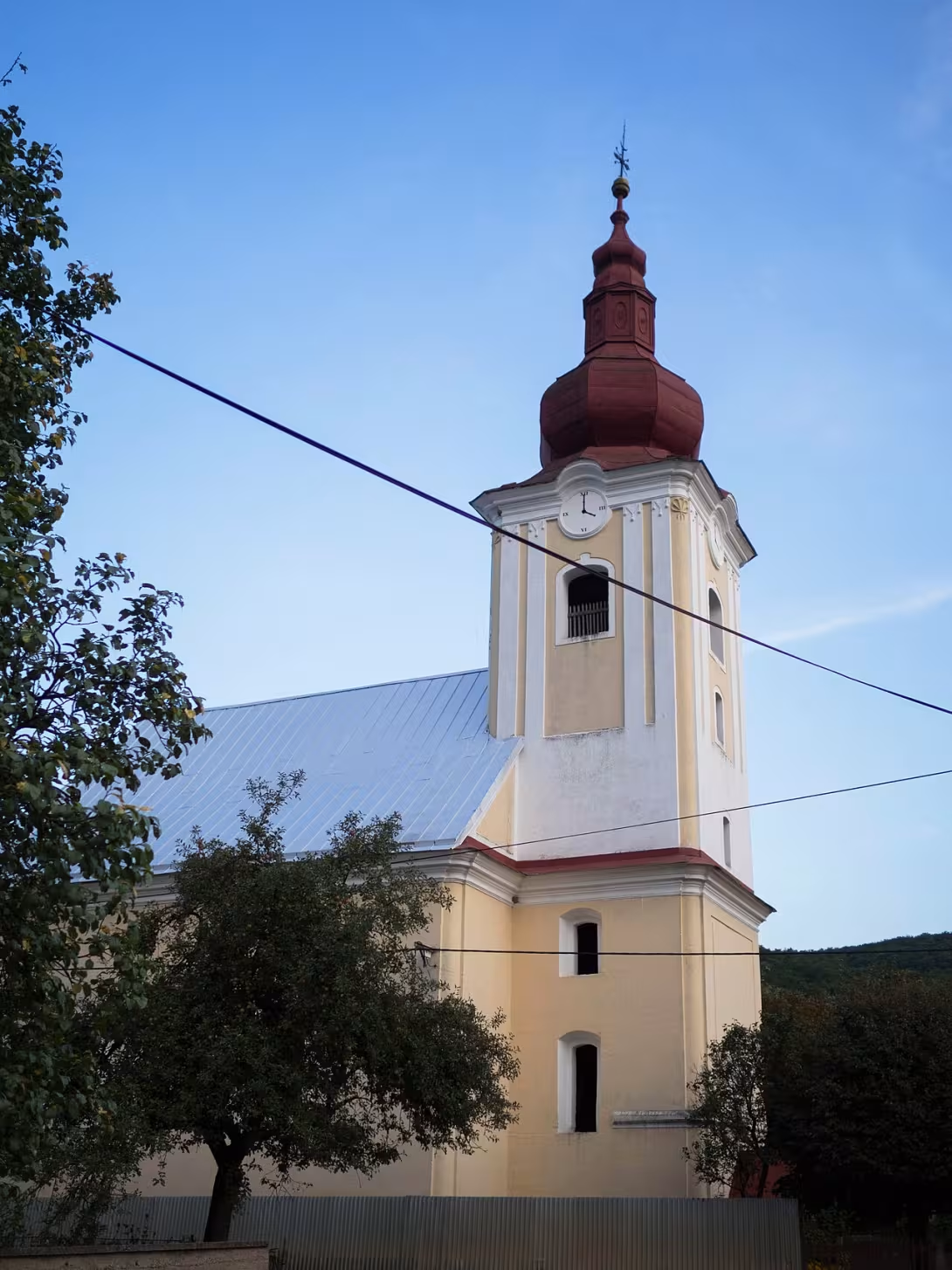
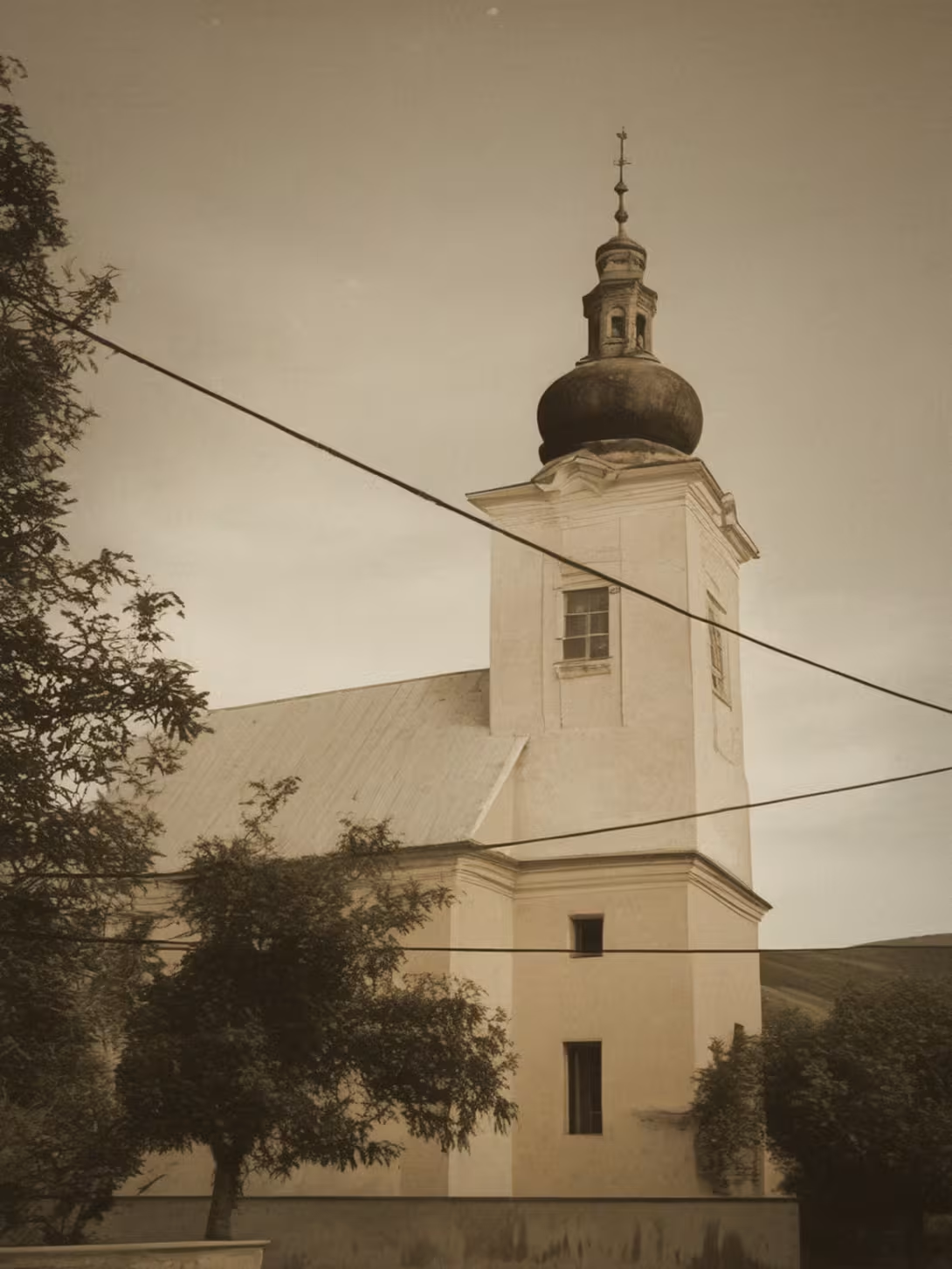
The historical view on the left is a visualisation generated by artificial intelligence and serves as inspiration.
Historical Milestones
- 9. 4.1787 - underlying stone laid
- 21. 9. 1788 - sanctification of the church
- 1911 - renovation
Interesting facts
- It is a classicistic building with Baroque elements from 1787. - The interior has Prussian vaults and there is a ridge vault in the space below the tower. - The Baroque altar has a column architecture with spinning columns and the statue of the Crucified is in the center. - The wooden polychrome pulpit comes from the first half of the 18th century and was restored in 1789. - The church, altar, pulpit and baptismal are listed in the list of cultural monuments.
Guide
Show guide text
The text was prepared by artificial intelligence and has not been editorially reviewed. It may contain inaccuracies.
You will find yourself in Nandraž, a picturesque village in Banská Bystrica region, proud of its rich history and unusual architectural monument. You are just standing in front of an evangelical church, a building that at first glance looks calm and dignified, but reveals many secrets and artistic details. Look at the facade of this building, which welcomes you with its classicistic glare, but also surprises you with the presence of Baroque elements. It is an unusual combination that shows that this building is not only a simple sacral object, but rather a living witness to the transformation that the Slovak architecture went through in the second half of the eighteenth century. The atmosphere around the church is quiet and worshipful, which is the ideal setting for you to stop for a while, put your headphones on, and let them drift into the world of history that took place centuries ago.
This evangelical church in Nandraž was founded in 1787, which places it in the period when classicalism began to manifest itself in our parts, but the baroque still resonated strongly in the minds of builders and works of art. Unfortunately, the exact origin and details of who was behind its construction were not preserved in the form of specific names of architects or patrons, which adds a certain mystery to this construction. At that time Nandraž was an important center of the evangelical community, and the church served not only as a place of prayer but also as a symbol of the identity and unification of local believers. Construction in 1787 indicates that the municipality had sufficient financial resources and organisational power to implement such a project, which was a challenge for smaller municipalities at that time. Although we do not know exactly who drew the plans, we can imagine that they were local masters who had experience in transition from Baroque to Classicism and who were trying to create an area that would meet new aesthetic requirements, while respecting traditional values.
Now that you've already seen the outside impression, let's look at what's hidden inside, if you have the opportunity to visit it, or imagine it on the basis of a description. At the entrance to the church you will immediately be attracted to the architecture of the space that is characteristic of this building. Note the ceiling structure where Prussian vaults meet. These arches are not only a functional element, but they create a unique acoustics and a visual game of light and shadow that gives space depth and dynamics. Prussian vaults are typical for certain periods of construction and their presence here shows the emphasis on the technical and aesthetic solution of the space. If you look at the space below the tower, you will see an even more interesting detail - a ridge vault. This type of vault is more complex and requires a higher degree of artistic expression, indicating that the builders were not just about covering the space, but about creating a monumental and formidable whole. The vault under the tower is like an architectural signature, which distinguishes this part of the church from other premises and attracts the attention of visitors.
The biggest artistic dominant of the interior is the Baroque altar, which awaits you in its place. Looking at the altar, you will have to pause over its pillar architecture. It is a complex structure, where spinning columns become the main supporting and decorative element. These columns are not only static supports, but their spinning and shaping create a sense of movement and grandeur, which is typical of Baroque art. In the center of the altar is the statue of the Crucified, which is the spiritual and visual core of the whole work. This statue, likely made of wood or other material that was common at the time, expresses the suffering and sacrifices that are key to evangelical theology. The contrast between the classicistic framework of the church and the Baroque altar is very significant and creates an interesting tension that is worth exploring.
Besides the altar, do not miss the pulpit, which is another important element of the evangelical church. This wooden pulpit is polychromed, meaning it is painted in several colors, and comes from the first half of the eighteenth century. It is older than the church building itself, which suggests that it was probably transferred from the previous church or other sacral building in the area. The wooden structure of the pulpit with its polychrome adds a warmer and more intimate atmosphere compared to a stone or plastered architecture. Polychromia, or wood painting, was a common technique that allowed the illusion of more expensive materials, such as marble, and at the same time allowed expressive visual expression. The pulpit is a place where the words of discipline are echoed, and its location and design are designed to be visible and audible to all believers in the church.
The history of this church is unfortunately associated with unknown personalities, which may be disappointing for some visitors, but at the same time opens up room for imagination and conceit. Who were the ones behind the construction in 1787? Who painted the pulpit in the first half of the eighteenth century? These questions remain unanswered, adding a mystery to the memory. We can only imagine that these were local masters who had experience with Baroque art and who tried to create a work that would be lasting and beautiful. Their work has been preserved to this day, testifying to their skills and devotion. Although we do not know their names, their message is visible in every detail of the church, from Prussian vaults to the spiral pillars of the altar.
The very combination of classicistic and Baroque styles is an interesting thing worth exploring. At a time when classicalism began to promote itself as a new style that was supposed to be simpler and more rational, they decided to compromise in Nandraž. The classicistic facade with its silverery and symmetry is complemented by Baroque elements that bring emotion and decorativeness. This combination is not common and shows that builders were not only blind followers of the new fashion, but had their own opinion on what the church should look like. The Baroque altar and pulpit from the first half of the eighteenth century were probably preserved and integrated into the new building, creating a unique mix of epochs. This mix is now appreciated by art historians
Tips for visitors
Visit time: Spring or autumn months are recommended. Pleasant surroundings and soft light make it easier to observe architecture.
Transport: The place is available by car and public transport. Check your current connections in the search engine.
What to take with you: Water and comfortable shoes are recommended. When shooting, use a technique suitable for capturing the details of the building.
Photography: For outdoor images we recommend natural daylight. Morning or late afternoon hours help avoid sharp shadows on the facade.
Family with children: Children can observe the historical shapes and details of the church in a quiet environment.
Frequently asked questions
Can the monument be visited?
Religious buildings are usually open mainly during services; at other times a visit is normally arranged with the parish or the operator. We have not verified specific times.
Where is the monument?
Location: č. 52, Nandraž, Banskobystrický kraj. The map on this page shows the exact spot.
Why is the monument protected?
It is listed in the Central List of the Monuments Fund of the Slovak Republic as a national cultural monument (ÚZPF no. 328-531).
Nearby
🏰 Historic sites (55)
- Starý Jelšavský hrad 2.6 km web
- Rákoš 3.2 km
- SNP 3.5 km
- Banícka expozícia Rákošská Baňa 4.2 km +421 950 738 100 web
- sv. Florián 4.3 km
- Mestské múzeum Jelšava 4.3 km web
- Slovenské národné povstanie 4.6 km
- Železničné múzeum Lubeník 5.0 km +421905435895
- Kövi malom 5.2 km
- Tančiareň 5.4 km web
- Šivetický hrad 5.7 km
- Vysoká pec v Sirku 5.8 km
- Pamätná izba Sama Tomášika 6.3 km
- SNP 6.4 km
- Stredoveký kostol 6.5 km
- Ľudovít Grünfeld 7.0 km
- Pamätník obetiam 1. svetovej vojny 7.1 km
- Hrdinom SNP 7.8 km
- Kaštieľ Hucín 9.8 km
- Gustáv Frák 9.8 km web
🍽️ Restaurants and dining (28)
- Pohostinstvo u rusa 3.5 km
- Bella Piazza 4.6 km +421 907 804 854
- Flipper 6.5 km
- Hostinec Psota 6.5 km web
- Pohostinstvo v Mokrej Lúke 7.8 km
- Hostinec na križovatke 9.3 km
- Rozkvet 9.5 km
- Maják 9.6 km Okružná
- Nižná 9.7 km
- Mamut Pub 9.8 km +421 940 999 111 web
- U Barbory 9.8 km
- Ponorka 9.8 km
- Aladin 9.9 km
- Sklenár 9.9 km Remeselnícka
- Cíti café 10.0 km Námestie Slobody
- Kura 10.1 km
- U Jána 10.1 km
- Pizza & Restaurant Gusto 10.1 km
- Harmónia 10.2 km
- Balaton pizzeria 10.3 km
🏨 Accommodation (10)
🚲 Rentals and sport (4)
- Letné kúpalisko Revúca 8.8 km
- ProBike 9.5 km
- Hotel Hrádok 9.8 km web
- Free Style Sport 10.2 km
🥾 Hiking and nature (172)
- Stráne 0.9 km
- Lipový briežok 1.0 km
- Bradlo 1.9 km
- Veletínka 2.6 km
- Ostrá skala 2.7 km
- Tri peniažky 2.8 km
- Pri javore 2.9 km
- Drieňová 3.4 km
- Skalka 3.6 km
- Štyri chotáre 3.6 km
- Skalka 3.9 km
- Antalka 4.0 km
- Lipina 4.1 km
- Mrškovka 4.1 km
- Kráľov dvor 4.2 km
- Skalka 4.4 km
- Železník 4.4 km
- Hradovisko 4.6 km
- Osek 4.9 km
- Prihradzianska Hradná 4.9 km
Visualisations and artistic views


The visualisations are generated by artificial intelligence and serve as inspiration.
Photographs from the area
Real photos taken near the monument


Source and licence are given for each image.
Visitor Tips
No tips yet. Be the first!
Log in and add your tip.
Location on Map
More monuments – Nandraž
Show all in the town

Visitor photos
No photos yet. Be the first to add a photo from your visit!
Log in and add your photo or leave a rating.
You get more points for a visit verified in the app — we can tell from the GPS that you are there.
Reviews and comments